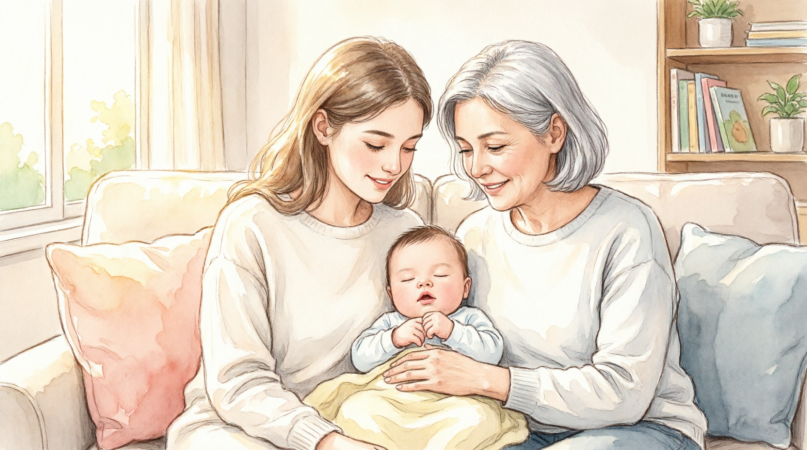
At 2:13 in the morning, with my son asleep against my chest and Mark’s unanswered messages glowing on my phone, I typed a sentence I had spent three months being too frightened to write.
My name is Emily Parker. I think your husband is the father of my baby.
I read it until the words stopped looking like English.
Matthew shifted beneath my chin. His cheek was warm against the hollow of my throat, and one tiny fist had worked free of his blanket. I lowered the phone and pressed my lips to his hair. He smelled faintly of milk and the lavender detergent I had bought because the pediatrician said his skin might be sensitive.
The apartment was silent except for the refrigerator humming in the kitchen and Matthew’s uneven newborn breathing. Outside, tires hissed over wet pavement. Somewhere upstairs, plumbing knocked inside a wall.
I had imagined sending that message dozens of times. In every version, Mark’s wife called me a liar, threatened me, or posted my name online. Sometimes she simply forwarded the message to Mark, and he arrived furious that I had broken the only rule he still seemed capable of enforcing: stay quiet.
But I was tired of being quiet.
Matthew had been born six weeks earlier with Down syndrome.
Those words had frightened me once. Not because I loved him less, but because during pregnancy I had known almost nothing about what his diagnosis might mean. Every doctor seemed to have another list of possibilities. Heart problems. Feeding difficulties. Developmental delays. Therapies. Specialists. Tests.
I had gone home from appointments carrying folders thick enough to make my future feel like paperwork.
Mark had carried nothing.
He had stopped answering.
When I first told him I was pregnant, he stared at me across a restaurant table for so long that the waiter came twice to ask whether we wanted dessert.
“We’ll figure it out,” he had finally said.
I believed him.
That was before I knew about Sarah.
Mark had told me his marriage was effectively finished. Separate bedrooms. Separate lives. A relationship preserved on paper because of their daughter, Ava, and because divorces became complicated when property and family businesses were involved.
I knew he was technically married. That fact already sat heavily enough on my conscience. But he had made the marriage sound like an administrative inconvenience rather than a living relationship.
There were always reasons I could not visit his house.
There were always explanations for weekends he disappeared.
There were always promises about later.
Then my pregnancy became real enough to appear on an ultrasound screen, and “later” began retreating faster than I could reach it.
At twenty weeks, a specialist confirmed that our baby had Down syndrome.
Mark sat beside me during the appointment.
I remember that clearly because of what happened afterward.
He asked more questions than I did.
Not emotional questions. Precise ones.
How reliable were the results? Had the diagnosis been documented in the hospital system? Who had access to the records? Was genetic information confidential? Could an employer ever obtain it?
The doctor finally looked at him strangely.
“This is your child’s medical information,” she said. “Why are you asking about employers?”
Mark laughed as though embarrassed by his own nervousness.
“Work has made me paranoid about privacy.”
In the parking garage, he held me for almost a minute.
Then he disappeared for four days.
When he came back, he brought flowers and an envelope containing money.
I should have understood.
Instead, I cried against his shoulder because I was relieved he had returned.
That was the version of me I found hardest to forgive—the woman who accepted scraps because she was terrified of facing pregnancy alone.
By the seventh month, Mark rarely visited. When he did, he seemed distracted. Once I caught him photographing a medical appointment card lying on my counter.
“What are you doing?”
He lowered his phone immediately.
“Nothing.”
“You just took a picture.”
“I’m trying to remember your appointment.”
“You could ask me.”
His expression changed then. Only for a second.
I saw irritation before tenderness covered it.
“You’re exhausted, Em. I’m trying to help.”
He kissed my forehead.
I apologized.
That memory had bothered me ever since.
After Matthew was born, Mark came to the hospital once.
He stood several feet from the bassinet.
Matthew was two days old, wrapped tightly in a striped hospital blanket, his dark hair flattened against his head. I had spent the previous night learning how to feed him while a nurse patiently repositioned my hands.
I wanted Mark to touch him.
Instead, he stared.
“Does Sarah know?” I asked.
His face hardened.
“Not now.”
“When?”
“I said not now.”
“He’s your son.”
“Keep your voice down.”
I remember looking at Matthew and realizing that the man beside me was more worried about being overheard than about the child lying three feet away.
Mark left twenty minutes later.
He did not return.
For weeks I called him anyway.
Some days I hated myself for it.
Other days I told myself I was calling for Matthew, not me.
Then, three nights before I finally messaged Sarah, Mark sent me something different.
It was not an apology.
It was not a question about his son.
It was one sentence.
You need to stop making this bigger than it has to be.
I stared at those words until Matthew began crying.
Something in me changed.
I had spent months assuming Mark was afraid.
Now I wondered whether he had been planning.
That was why, at 2:13 that morning, I searched for Sarah’s profile, opened a blank message, and introduced myself.
I told her Mark and I had been involved.
I told her Matthew was six weeks old.
I told her Mark was his father.
Then I wrote the sentence that made my hands shake hardest.
Matthew was born with Down syndrome, and Mark has almost completely disappeared since the diagnosis.
I did not ask Sarah to forgive me.
I did not tell her Mark had said their marriage was over. It sounded pathetic now, even though it had once sounded convincing.
I simply finished:
You deserve to know. I am sorry this is coming from me.
Then I pressed send.
For fourteen minutes nothing happened.
I fed Matthew.
Changed him.
Walked the length of the living room until his eyelids grew heavy again.
At 2:31, my phone vibrated.
Sarah had read the message.
Three dots appeared.
Vanished.
Returned.
My stomach tightened so hard I thought I might be sick.
Then her answer arrived.
I know who you are.
I stopped breathing.
A second message appeared.
Please don’t contact Mark tonight.
Then:
And do not delete anything he has sent you.
I sat completely still.
That was not anger.
It was worse.
It sounded like a warning.
I typed, Why?
Sarah answered almost immediately.
Because I think my husband has been lying to both of us about more than the affair.
My fingers went cold.
What do you mean?
There was a long pause.
Then she wrote:
Is Matthew with you?
Yes.
Are your doors locked?
I looked toward the deadbolt.
The question frightened me enough that I stood and checked it.
Yes.
Sarah replied:
Good. I’m coming tomorrow morning. I have something you need to see.
I called her before I could reconsider.
She answered on the second ring.
Neither of us spoke.
Finally I said, “Sarah?”
Her breathing sounded controlled, but only barely.
“Yes.”
“I’m sorry.”
“I know.”
The answer was so quiet that it hurt more than shouting would have.
“I didn’t know everything,” I said. “Mark told me—”
“Emily.”
I stopped.
“I’m not ready to talk about what he told you.”
There was no cruelty in her voice. That made it harder.
“All right.”
“But I need you to listen carefully. Has anyone been following you?”
I looked toward the dark window.
“What?”
“Think before you answer.”
A memory surfaced.
A gray sedan outside my obstetrician’s office.
Another one near the pharmacy.
A man holding his phone too high when I left the hospital with Matthew.
At the time, none of it had seemed connected.
“I don’t know.”
“Has anyone photographed you?”
My pulse climbed.
“Why are you asking me this?”
Sarah exhaled.
“Because I found photographs.”
The room suddenly felt colder.
“Of what?”
“You.”
Matthew made a small sound against my shoulder.
I tightened my arm around him.
Sarah continued.
“Some were taken while you were pregnant.”
My knees weakened.
I sat down.
“How did you get them?”
“I found a folder in Mark’s home office.”
“Our home office,” she corrected herself after a moment, and the pain beneath those three words made me close my eyes.
“What kind of pictures?”
“You leaving medical appointments. Getting into your car. Going into your building.”
I could hear paper moving on her end.
“And there are dates.”
“What dates?”
“Appointments. Places. Times.”
I stared at the curtains covering my living-room window.
“Sarah, why would Mark have these?”
“I don’t know yet.”
She paused.
“But I intend to find out.”
The anger in her voice was no longer aimed only at me.
I asked the question that had been growing heavier with every second.
“Did he take them?”
“No.”
“How do you know?”
“Because he’s in two of them.”
I stood again without realizing I had moved.
Matthew startled.
I whispered an apology to him and rocked gently.
Sarah said, “There are payments too.”
“To who?”
“I haven’t identified the person.”
“Police?”
“Not yet.”
“Why not?”
“Because if I’m wrong about what this means, I don’t want to destroy evidence by frightening him.”
The word evidence landed differently from photographs.
This was no longer simply an affair being uncovered.
Someone had documented my pregnancy.
My appointments.
My movements.
“Why are you helping me?” I asked.
Sarah was silent.
When she finally answered, her voice sounded exhausted.
“I haven’t decided whether I’m helping you.”
Fair enough.
“But Matthew didn’t lie to me,” she continued. “He didn’t betray me. He didn’t make promises to either of us. Whatever Mark has done, that baby isn’t responsible.”
I looked down at my son.
His eyes were closed.
His mouth made the faint sucking motion he sometimes made in his sleep.
Tears blurred my vision.
Sarah spoke again.
“And there’s something else in the folder.”
“What?”
“I’m not discussing it over the phone.”
“Sarah—”
“Tomorrow. Ten o’clock.”
Then, after a hesitation:
“Emily, did Mark ever give you money?”
“Yes.”
“When?”
“Several times.”
“Cash?”
“Mostly transfers.”
“Did you ask him for it?”
“Sometimes for medical bills.”
“And the others?”
I thought about an unexpected deposit made shortly before Matthew’s birth.
“No.”
“How much?”
I told her.
Sarah became silent again.
“Why?”
“I found a transfer for the same amount.”
“That’s probably mine.”
“It has your name beside it.”
I almost laughed from confusion.
“Then it is mine.”
“No,” Sarah said. “That’s the problem.”
My fingers tightened around the phone.
“The transfer I found wasn’t sent to you.”
The refrigerator clicked off.
In the sudden silence, I could hear rain ticking against the window.
“Who received it?”
“I don’t know. The account number is partially hidden.”
She lowered her voice.
“But the note beside your name says ‘contingency.’”
I had no idea what that meant.
Apparently Sarah did not either.
Before hanging up, she repeated one instruction.
“Don’t tell Mark we spoke.”
I promised.
For the rest of the night, I did not sleep.
At dawn, I stood beside the window without opening the curtain and watched a thin line of sunlight appear around its edge.
At 7:40, my phone vibrated.
Mark.
For one hopeful, humiliating second, I wondered whether he was finally asking about Matthew.
His message contained only five words.
Did you contact my wife?
I stared at the screen.
Before I could decide whether to answer, another message arrived.
Emily, this is important. Answer me.
Then a third.
Whatever Sarah tells you, do not believe her.
I had never told him Sarah was coming.
And according to Sarah, she had not told him either.
I looked at Matthew sleeping in his bassinet.
Then at the locked front door.
For the first time, the question was no longer why Mark had abandoned us.
It was how he already knew.
Click here to continue reading: PART 2: Sarah Arrived Carrying Proof of My Affair, but the Photograph Beneath It Showed Someone Had Been Watching Long Before Matthew Was Born
The Message I Sent His Wife at Two in the Morning Was Supposed to End Everything, but Her Answer Changed the Danger
Part 1 of 28