The hospital smelled exactly like the place where Caleb had died.
Disinfectant.
Coffee.
Plastic.
Cool recycled air.
By the time Rachel and I reached the transplant floor, every instinct in me was screaming to turn around.
I had walked out of a hospital after losing my son only days earlier. Returning felt like deliberately placing my hand against a hot stove.
Rachel stopped outside room 417.
“You don’t have to do this today.”
“Yes, I do.”
“She knows you may be angry.”
“I don’t know what I am.”
That was the truth.
Rachel opened the door.
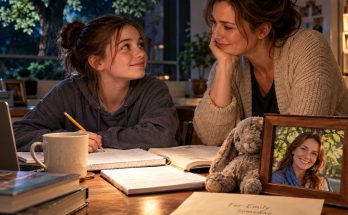
Emily sat near the window with a blanket around her shoulders.
She looked younger than I expected.
Eighteen.
Perhaps nineteen if I had not known better.
Her face was pale, and there were shadows beneath her eyes, but she was sitting upright.
Alive.
The sight of her chest rising and falling nearly knocked the breath from me.
Somewhere beneath hospital fabric and fresh surgical scars, my son’s heart was working.
Emily looked at me.
Her eyes filled immediately.
“I’m sorry.”
Those were the first words she said.
I remained near the door.
“For what?”
Her hand moved instinctively toward her sternum.
“For having his heart.”
The answer hurt so sharply that anger became impossible.
I crossed the room.
“You didn’t steal it.”
She lowered her eyes.
“No.”
“He gave permission.”
“Yes.”
“So don’t apologize for being alive.”
Emily bit her lip.
“He told me you might say something like that.”
I stopped.
“You talked about me?”
“A lot.”
The idea was oddly intimate.
Caleb, discussing me with a stranger.
Complaining, probably.
Protecting me, certainly.
“What did he say?”
Emily’s mouth trembled into a faint smile.
“That you worried as a competitive sport.”
Despite myself, I almost laughed.
“That sounds like him.”
“He said you loved him more than anything.”
My throat tightened.
“He was right.”
Emily looked down.
“He also thought you’d be angry once you learned what he had been doing.”
“I am angry.”
She raised her eyes quickly.
“Not about the transplant,” I said. “About the secrets.”
She nodded.
“He expected that too.”
“Then help me understand them.”
Rachel quietly stepped outside and closed the door.
For a moment, Emily and I were alone.
She reached beneath her pillow and removed an old envelope.
The paper was yellowed and soft at the folds.
“I’ve kept this for years.”
“What is it?”
“A letter from my father.”
“Thomas?”
She nodded.
“He wrote it before he died.”
My pulse quickened.
“What does it say?”
Instead of answering, she handed it to me.
The message inside was short.
Thomas told Emily that if anything happened to him, she should know that the man who had helped her at the lake was not responsible for the tragedy there.
He named that man.
David.
My husband.
Thomas wrote that David had tried to protect them.
He also admitted that he himself had been too frightened to tell the entire truth.
I read the letter twice.
Then a third time.
“When did you find this?”
“After my father died.”
“You were seven.”
“My mother kept it until I was older.”
“Does Rachel know what it says?”
“Yes.”
“And none of you came to me?”
Emily flinched.
I regretted the harshness immediately but did not take the question back.
“My mother didn’t know how to find you at first,” Emily said. “Later, she was afraid reopening everything would hurt you.”
“People keep deciding what will hurt me.”
Emily lowered her head.
“I know.”
I sat beside the window.
“Tell me about the lake.”
Her fingers tightened around the blanket.
“I remember pieces.”
“Tell me the pieces.”
She closed her eyes.
“I was six. My heart was already bad.”
“What do you mean?”
“I had been born with a serious defect. By then I was getting worse. There were surgeries, specialists, bills. I didn’t understand most of it.”
“But David knew?”
“Yes.”
“How?”
“My father met him through somebody at the hospital.”
That detail surprised me.
“David wasn’t a doctor.”
“No. But he knew people through the company he worked for. One of their charitable funds sometimes helped families with medical costs.”
I remembered David mentioning donations through his employer, though never individual cases.
“Did he give your family money?”
“Some.”
“How much?”
“I don’t know.”
“What happened after that?”
“My father borrowed more money elsewhere.”
Emily looked embarrassed despite having been a child when it happened.
“He got desperate.”
“From whom?”
“I never knew their names.”
“Loan sharks?”
“Something like that.”
A familiar chill moved through me.
Rachel had said David discovered something.
“Why was your father at Lake Weston?”
“He was supposed to meet someone.”
“Who?”
“I don’t know.”
“Was David meeting him too?”
“Yes.”
“Why?”
Emily stared toward the window.
“Because Dad had told him we were being threatened.”
The room suddenly felt smaller.
“My husband knew your family was in danger?”
“Yes.”
“And he went there anyway?”
“He wanted to get us away.”
“Us?”
“My father and me.”
“Where was your mother?”
“At work.”
I rubbed my forehead.
None of this matched the police report I had believed for ten years.
David had not been coming home.
He had been going toward a frightened man and his sick six-year-old daughter.
“What happened when David arrived?”
“I remember his car lights.”
Emily spoke slowly now, drawing each memory from someplace painful.
“I remember rain. A lot of it. Dad was arguing with somebody before David came.”
“Somebody in another car?”
“Yes.”
“How many people?”
“I only remember one man clearly. There may have been another.”
“What were they arguing about?”
“Money.”
I waited.
“Then David got out.”
The name sounded different in her voice.
Not my husband.
A figure from her childhood memory.
A man who had entered a storm.
“He told my father to put me in his car,” Emily continued. “Dad said no.”
“Why?”
“He was afraid the men would follow us.”
“What did David say?”
“I don’t remember exactly.”
“Try.”
Emily pressed both palms against the blanket.
“He said staying there was worse.”
That sounded like David.
He had always been practical when everyone else was emotional.
I could almost see him in the rain, coat soaked, jaw tight.
“What happened next?”
“One of the men started shouting.”
“At David?”
“At my father.”
“Did David fight him?”
“No. Not at first.”
“At first?”
Emily swallowed.
“The man grabbed Dad.”
I leaned forward.
“Then?”
“David pulled him away.”
Her breathing had become shallower.
I noticed her hand drift toward her chest.
“We can stop.”
“No.”
“Emily.”
“I need to finish.”
She drew a careful breath.
“There was another vehicle near the road. Dad ran toward our car. David yelled at me to stay down.”
“What happened?”
“Headlights.”
Her voice weakened.
“Very bright.”
I waited.
“Then a crash.”
My palms went cold.
The official report said another driver lost control on the wet road and struck David’s vehicle.
But Emily had placed multiple people there before the collision.
“Was it accidental?”
“I don’t know.”
That answer frightened me more than certainty would have.
“What do you remember after the crash?”
“Glass.”
Emily closed her eyes.
“Metal bending. My father yelling.”
She touched the side of her head as though the memory lived there physically.
“I was trapped for a minute. David got to me.”
“He was alive?”
“Yes.”
My heartbeat seemed to stop.
“What did he do?”
“He pulled me through a door.”
“Were you hurt?”
“My arm. Maybe my head.”
“And your father?”
“Still near the other car.”
I stared at her.
“The police told me David died instantly.”
Emily opened her eyes.
“He didn’t.”
The words struck like a blow.
“How do you know?”
“Because he carried me.”
I couldn’t speak.
“He carried me away from the road,” Emily said. “He put me behind a barrier.”
I covered my mouth.
My final image of David had always been invented from the police report: alone in a wrecked car, death immediate.
But he had climbed from the wreckage.
He had found a frightened child.
He had carried her to safety.
“What happened then?”
“He heard Dad shouting.”
Emily’s voice broke.
“David told me not to move.”
“No.”
The word escaped before she continued.
“He went back.”
I already knew what came next.
My body seemed to know before my mind accepted it.
“He went back for your father.”
“Yes.”
“And that’s when he died.”
Tears slipped down Emily’s face.
“Yes.”
I turned toward the window because I could not let her see what the answer did to me.
For ten years, I had grieved a man killed by bad luck.
Now I was grieving him again as someone who had survived long enough to make a choice.
He had escaped.
He could have stayed away.
Instead, David returned to danger for another person.
“What about your father?”
Emily was silent.
I turned back.
“What happened to Thomas?”
“He survived that night.”
I stared at her.
“Rachel told me he died from injuries later.”
“He did.”
“But you said he disappeared.”
Her expression changed.
“How do you know that?”
I realized Rachel must not have intended to tell me so much at the cemetery.
“She said enough.”
Emily looked uneasy.
“My father disappeared for months.”
“Why?”
“He believed the men would kill him.”
“And then?”
“He came back secretly.”
“Your mother knew?”
“Eventually.”
“Police?”
“No.”
“Why not?”
Emily shook her head.
“Dad was terrified.”
My anger returned.
“So while I was burying David, your father was hiding?”
Emily’s face crumpled.
“Yes.”
I stood and walked several steps away.
It was unfair to direct fury at a woman who had been six years old.
I knew that.
Knowing did not make it easier.
“He let everyone believe my husband died in a random accident.”
“Yes.”
“He knew what really happened.”
“Some of it.”
“And he said nothing.”
Emily looked down.
“Yes.”
I pressed my palms against my eyes.
For years I had wondered whether David had suffered.
Whether he had been frightened.
Whether he had thought of Caleb.
Of me.
Now the questions multiplied rather than disappearing.
“What exactly was your father afraid to reveal?”
Emily’s voice became very quiet.
“That the crash may not have been an accident.”
I lowered my hands.
“What?”
“He believed somebody caused it.”
“Who?”
“I don’t know.”
“Did he?”
“He never wrote the name.”
“Did he tell you?”
“No.”
“Your mother?”
“She says he never told her.”
I paced toward the door, then stopped.
Something did not fit.
“If nobody knew the man’s name, how did Caleb investigate any of this?”
Emily’s gaze moved to the old letter.
“He had more than that.”
“What?”
“Records from his grandmother’s house.”
“I know about those.”
“And something from your husband.”
My breath caught.
“What?”
Emily hesitated.
“A notebook.”
I stared at her.
“David kept a notebook?”
“Caleb found it behind a drawer in an old desk.”
I had never seen it.
“What was inside?”
“Names. Dates. Payments. Notes about my father.”
“And where is it now?”
Emily looked toward the bedside cabinet.
“Caleb gave it to me.”
Anger surged through me.
“He took something belonging to David and gave it to you?”
“He was afraid it might disappear.”
“Disappear how?”
Emily met my eyes.
“Because somebody had already searched his room.”
The words stopped me.
“What are you talking about?”
“About two months before Caleb went back into the hospital, he came home and found things moved.”
“He never told me.”
“He thought you would panic.”
“He was right.”
Emily opened the cabinet.
Inside was a small black notebook sealed in a clear plastic bag.
I recognized it instantly.
David used to carry notebooks exactly like that in his jacket pocket.
Emily placed it in my hands.
The cover was worn.
One corner had been softened by years of use.
I opened to the first page.
David’s handwriting.
Dates.
Initials.
Dollar amounts.
Telephone numbers.
Then I found the final entries.
Thomas Hart.
Lake Weston.
Threats increasing.
Move them tonight.
Below those words, David had written another line.
If T. is right, this is not about the debt anymore.
I turned the page.
The next sheet had been torn out.
Not recently.
Years earlier.
“What was on the missing page?”
Emily shook her head.
“Caleb never knew.”
I looked at the torn edge.
“Then why was he so convinced this mattered?”
“Because of what he found tucked inside the back cover.”
Emily reached into the cabinet again.
She handed me a photocopy of a receipt.
A motel receipt.
Dated the morning after David died.
The guest signature at the bottom belonged to Thomas Hart.
Emily’s father.
A man the police report had never mentioned.
A man who survived the lake.
A man who vanished immediately afterward.
I turned the paper over.
There was handwriting on the back.
Not David’s.
Thomas’s.
Three words.
He saw everything.
I looked at Emily.
“Who did?”
She gave me the answer that had apparently haunted Caleb during the final months of his life.
“We don’t know.”
Click here to continue reading: PART 4: Caleb Had Hidden One Final Recording, and the Voice Inside It Changed What I Believed About His Last Months
Three Days Before My Son Died, He Asked Me a Question I Was Too Frightened to Answer
Part 3 of 35