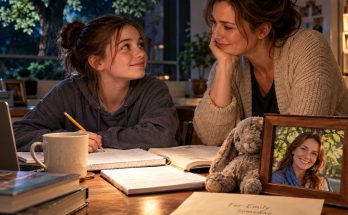
The envelope appeared because a pipe leaked.
Not fate.
Not a secret compartment opening at midnight.
Plumbing.
The resource house had been operating long enough for the building to develop the ordinary complaints of age. One Monday morning, water stained the ceiling of the room that had once been my bedroom and, much later, Julian’s office.
A contractor opened part of the wall.
Behind a built-in shelf, he found a narrow metal document box.
Grace called me.
“I think you should come.”
Those words still had the power to rearrange my heartbeat.
“What happened?”
“Nothing bad.”
“That is not reassuring.”
“There’s a box.”
I closed my eyes.
Our family had found enough boxes.
“Whose?”
“I don’t know.”
“Don’t open it.”
She laughed.
“You’ve said that before.”
“And you ignored me before.”
“I’m forty-three now.”
“Congratulations.”
Grace had become executive director of the resource house three years earlier.
Not through inheritance.
The board conducted an outside search.
She applied.
She interviewed.
Two other finalists were considered.
The board chose her without Khloe, me, or Harrison participating.
Mom would have approved of the paperwork.
Baby Martha was no longer a baby.
She was twelve and already furious that adults had given her a name with history attached.
Grace said that was hereditary.
When I arrived, the metal box sat on a conference table.
The contractor had not opened it.
Grace had not either.
Progress.
The box was old enough to belong to Dad.
I recognized his block handwriting on a faded strip of masking tape.
HOUSE PAPERS.
Grace saw my expression.
“Grandpa?”
“Yes.”
We called Elise.
Harrison had died two years after Mom.
Peacefully.
His funeral contained fewer jokes about legal documents than he deserved.
Elise arrived with the same practical manner her father had carried into every crisis.
She inspected the box.
“No lock.”
“Can we open it?”
“It’s in a building owned by the nonprofit, discovered during construction, and appears connected to prior ownership. We’ll document first.”
Grace smiled.
“Grandma would like you.”
“She did.”
We photographed the box.
Logged where it was found.
Then Elise lifted the lid.
Property surveys.
Original appliance warranties.
Old insurance policies.
Receipts from renovations Dad supervised.
Nothing dramatic.
Then Grace found an envelope.
Not sealed.
Inside were several pages in Dad’s handwriting.
At the top:
NOTES FOR MARTHA / HOUSE STRUCTURE.
My throat tightened.
Not another sentimental letter.
Planning notes.
More like Dad.
He had written them before the house purchase was finalized.
Questions.
Concerns.
Ideas crossed out.
Should title be Martha?
No—pressure risk / later care costs / inheritance complications.
Natalie?
Stable income / understands contracts / absent geographically.
Khloe?
Too young / not financially settled.
Trust?
Possible but administration heavier.
Independent review on sale/mortgage.
Martha lifetime occupancy.
No spouse control.
No creditor path.
Grace read over my shoulder.
“He really thought through everything.”
“Yes.”
Then she found a separate page.
One paragraph.
No heading.
Dad had written:
The point is not to make Natalie the owner. The point is to make it difficult for any one person—including Natalie—to become the owner of Martha’s choices.
I sat down.
Grace reread it.
“Did you know he wrote that?”
“No.”
We had understood the principle eventually.
But Dad had written it plainly.
Including me.
He had not structured the house because he trusted me without limit.
He structured it because he trusted nobody with unlimited power.
Not even the daughter whose name appeared on the deed.
Grace looked at me.
“Does that bother you?”
“It would have when I was thirty.”
“And now?”
“No.”
That was true.
Dad’s lack of absolute trust no longer felt like insult.
It felt mature.
Maybe loving.
He knew I was capable.
He also knew capability could become authority too easily.
He protected Mom from my good intentions as carefully as from someone else’s bad ones.
The next page made me laugh.
A handwritten list:
Things Natalie will hate:
1. Independent review.
2. Needing second approval.
3. Being told no.
4. This list.
Grace laughed so hard she had to sit.
“He knew you.”
“Yes.”
There was another list.
Things Khloe will hate:
1. Rules that feel unfair.
2. Being asked to read documents.
3. Consequences that cannot be charmed away.
4. Natalie knowing any of this.
Grace immediately photographed it.
“Do not send that to your mother.”
She already had.
Khloe called within thirty seconds.
“I hate all of you.”
Grace put her on speaker.
“Grandpa predicted that.”
“I especially hate him.”
“You’ve had decades to prepare.”
“Why was this hidden?”
That question mattered.
We looked through the remaining papers.
No explanation.
The box had likely been placed behind the built-in during renovation, perhaps accidentally sealed when shelving was added.
No grand mystery.
No deliberate final test.
Just papers lost inside a wall.
That almost made them better.
Dad had not arranged for us to discover them at the perfect emotional moment.
Life had simply returned them late.
Elise found one more sheet.
Draft language for a letter to Mom.
Most of it matched what Dad later wrote in the sealed envelope she had kept.
One paragraph did not.
Martha, if the girls fight over who is protecting you better, send both of them home.
I laughed.
Then cried.
Grace put a hand on my shoulder.
No fixing.
Just contact.
We decided the documents belonged in the Brooks family archive maintained by the nonprofit, with private family sections restricted.
Not everything needed public display.
Grace agreed.
The resource house told enough of Mom’s story to explain its mission.
It did not own every private sentence Dad wrote.
That boundary mattered even after everyone named on the paper was gone.
Khloe came that evening.
Older.
Slower.
Still working part-time because retirement bored her.
She read Dad’s notes.
When she reached her list, she said, “He was rude.”
“He was accurate.”
“Natalie.”
Grace smiled.
Khloe reached the paragraph about preventing any one person from owning Mom’s choices.
Her expression changed.
“He understood.”
“Yes.”
“Before Julian.”
“Yes.”
That was important.
Dad had not predicted Julian.
He predicted human pressure.
Dependency.
Fear.
Grief.
Money.
Family.
He built safeguards for ordinary weaknesses.
Julian later exploited those weaknesses more deliberately than Dad could have known.
But the structure had been designed for a principle larger than one villain.
Khloe sat with that.
“I spent years thinking Dad didn’t trust Julian.”
“He didn’t know him when he made some of these plans.”
“I know.”
She touched the paper.
“He didn’t trust us.”
“Not completely.”
Khloe smiled faintly.
“Mom would say good.”
Yes.
Good to true.
Grace found another receipt beneath the notes.
A small hardware-store purchase.
Three replacement locks.
Dated years before Julian moved into the house.
Khloe stared.
“What was Dad locking?”
“No idea.”
We searched the old renovation records.
Nothing.
Grace laughed.
“Finally, a mystery.”
I pointed at her.
“No.”
“What?”
“We are not turning three locks into a family conspiracy.”
“You’ve become boring.”
“Hard-earned.”
The locks probably belonged to storage cabinets.
Or gates.
Or Dad’s workshop.
We never learned.
That was allowed.
Not every clue deserved an answer.
That itself felt like progress.
The next board meeting approved preservation of the newly found materials.
Grace proposed displaying one sentence publicly.
Not Dad’s jokes about us.
The other one.
The point is to make it difficult for any one person to become the owner of another person’s choices.
She wanted it paraphrased rather than quoted as family doctrine.
The board discussed it.
Lawyers discussed it more.
Eventually a shorter line appeared in the main consultation room:
HELP SHOULD NOT REQUIRE SURRENDERING CHOICE.
Mom’s phrase.
Dad’s principle.
Our family’s lesson.
No attribution.
It belonged to the work now.
Months later, a woman named Teresa came to the resource house.
Seventy-six.
Widowed.
Her adult son had begun managing her accounts after surgery.
Nothing obviously criminal.
He paid bills.
Bought groceries.
Handled insurance.
Then he started questioning her purchases.
Then moving money “for safety.”
Then refusing to show balances because numbers made her anxious.
Teresa sat across from Grace and said:
“He means well.”
Grace did not answer with suspicion.
She asked:
“Do you still know where your money is?”
Teresa said no.
“Can you see the accounts?”
No.
“Can you change the arrangement if you want?”
Teresa hesitated.
“I think he’d be upset.”
Grace told me about her later.
Not details that violated confidentiality.
Just the pattern.
“You know what scared me?”
“What?”
“He might actually mean well.”
“Yes.”
“That almost makes it harder.”
Exactly.
Julian’s story had been dramatic enough to teach the obvious version.
Fraud.
Forgery.
Theft.
Isolation.
But control did not require criminal intent.
Sometimes it grew from convenience.
Fear.
Efficiency.
Love.
A capable child saying, “I’ll handle it.”
An aging parent saying yes once.
Then nobody revisiting the arrangement.
Dad had understood that before we did.
Maybe because he knew me.
Maybe because he knew Khloe.
Maybe because he knew himself.
Teresa’s situation resolved without police.
Her son attended a meeting.
He was defensive.
Then embarrassed.
Then willing.
Accounts were restructured.
View access separated from withdrawal authority.
Bills automated transparently.
Teresa regained her own card.
Her son still helped.
That outcome pleased Grace more than any prosecution could have.
“He wasn’t Julian.”
“No.”
“And she didn’t have to wait until he became one.”
“No.”
Prevention.
That was what the resource house had become.
Not a monument to what happened to Mom.
A place where people could interrupt smaller patterns earlier.
The house had finally moved beyond our family story.
That was healthy.
Grace eventually stopped introducing herself to clients as Martha Brooks’s granddaughter.
Not because she hid it.
Because it was no longer necessary.
She was Grace.
Executive director.
Mother.
Wife.
Daughter.
Granddaughter only when relevant.
Baby Martha—who insisted everyone call her Marty—volunteered during school breaks.
At thirteen, she asked why the organization carried her great-grandmother’s surname instead of ours.
Grace said:
“Because that’s the name on the building.”
Marty stared.
“That’s a terrible answer.”
“Ask your Aunt Natalie.”
I corrected her.
“Great-aunt.”
“Old-aunt,” Marty said.
I threatened to remove her from the will.
She asked whether I had an independent trustee.
The child had been raised badly.
Or perfectly.
One afternoon Marty found Dad’s public planning note in a display about the house’s legal structure.
She read the summary.
Then asked:
“Why didn’t Great-Grandpa just tell everybody what to do?”
I smiled.
“Because he was dead.”
“That’s not what I mean.”
“I know.”
She waited.
I thought about Dad’s papers.
His fear.
His safeguards.
His mistakes.
“He tried to create rules that still allowed people to choose.”
“Did it work?”
“Sometimes.”
“That sounds bad.”
“It’s the best rules can do.”
She considered.
Then pointed at the sentence on the wall.
“Help should not require surrendering choice.”
“Yes.”
“What if somebody chooses something stupid?”
There it was.
The eternal problem.
I laughed.
“Then sometimes they get to choose something stupid.”
“That’s terrible.”
“Wait until you have children.”
She made a face.
“I’m thirteen.”
“Exactly.”
That night, I called Khloe.
Not because anything was wrong.
We talked about Marty.
Grace.
The resource house.
Dad’s box.
Then Khloe said:
“Do you ever think about the day you came home?”
“Yes.”
“Would you do anything differently?”
A dangerous question.
“Yes.”
“What?”
“I would come sooner.”
Khloe was quiet.
“You didn’t know.”
“I know.”
“Then how?”
“I’d call more.”
“That’s hindsight.”
“Yes.”
“Anything else?”
I thought.
“I would ask Mom direct questions.”
“Like?”
“Are you controlling your money? Are you sleeping in your room? Do you feel safe? Are you choosing who lives there?”
Khloe exhaled.
“I wish you had.”
There was no accusation in it.
That made it harder.
“So do I.”
Then she said:
“I wish I’d answered honestly if you had.”
Two regrets.
Neither cancelling the other.
We sat on the phone with them.
No rescue.
No correction.
Eventually Khloe said, “Mom would tell us to stop.”
“Probably.”
“She hated self-pity.”
“She was excellent at everyone else’s.”
Khloe laughed.
Before hanging up, she said:
“I’m glad Dad didn’t trust us completely.”
I understood.
“So am I.”
The newly discovered papers had not changed the legal history.
They did not reveal a hidden inheritance.
No missing fortune.
No secret villain.
They changed something subtler.
For years, we told the story as if Dad had protected Mom by choosing the right person to hold power.
Me.
That was not what he had done.
He had protected her by dividing power.
By making ownership incomplete.
By requiring review.
By preserving occupancy.
By limiting spouses.
By expecting even love to need boundaries.
That was the final gift inside the wall.
Not trust.
Structure.
Because good people can become controlling.
Weak people can become complicit.
Frightened people can stay silent.
Charming people can become dangerous.
And none of us should have to depend entirely on another person remaining good forever.
Click here to continue reading: PART 34: Khloe’s Last Conversation With Julian Forced Her to Separate the Man She Once Loved From the Consequences She Had Spent a Lifetime Repairing
I Came Home Without Warning and Found a Stranger Living Like a King in the House I Had Built for Mom
Part 33 of 35