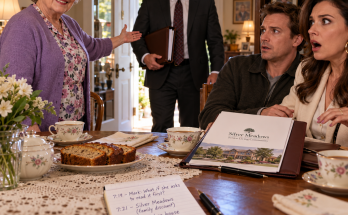
Six months after the cards were canceled, I stood inside the same Aurelia Ridge sales gallery where Lydia’s decline had first exposed Gavin’s financial performance.
The payment terminal had been moved.
The scale model remained.
Daniel recognized me immediately.
“You have unusual timing with this place.”
“That seems fair.”
I was not there to buy a house.
Meridian Crest’s real-estate subsidiary was completing its exit from the development.
The meeting was ordinary.
Budget reconciliation.
Capital return.
Final signatures.
I appreciated ordinary.
After months of dead men, hidden trusts, forged credentials, and billion-dollar tracing problems, ordinary paperwork felt almost luxurious.
When the meeting ended, Daniel mentioned the house Gavin and Celia had once considered.
“Still available?”
“No. Sold.”
“Good.”
He smiled.
“Do you want to know who bought it?”
“No.”
I meant it.
That surprised him.
It did not surprise me.
Some information did not improve a life simply because it was available.
That lesson had cost our families twenty-seven years.
Outside, I found Lydia waiting near the courtyard.
She had asked counsel whether she could speak with me.
I agreed.
Public place.
No secrecy.
She looked different.
Less expensive perhaps, though that might have been imagination.
She carried an ordinary leather handbag.
No black card.
The thought came and went without satisfaction.
“I wanted to thank you.”
“For what?”
“Not treating Gavin as responsible for everything Julian did.”
“He was responsible for enough on his own.”
“Yes.”
She almost smiled.
“That too.”
We sat on a bench.
Lydia had sold one of her properties to cover legal expenses and potential restitution obligations.
Northstar remained frozen.
Her personal spending had changed dramatically.
She did not mention hardship.
Good.
Relative inconvenience was not tragedy.
Then she said, “I owe you money.”
“Counsel is handling it.”
“Not that.”
I looked at her.
“The cards.”
She had calculated years of discretionary charges.
Not family travel we had jointly agreed to.
Not legitimate expenses.
The things she treated as entitlement.
Spa weekends.
Designer goods.
Hotels.
Dining.
She wanted to reimburse part immediately and sign a payment agreement for the rest.
“You don’t have to impoverish yourself.”
“I won’t.”
“Then send it through counsel.”
A familiar phrase now.
She nodded.
Then she looked toward the sales gallery.
“I was horrible to you that day.”
“You said Gavin supported me.”
“I believed he did.”
“Because he told you?”
“Because I wanted to believe it.”
That was different.
Gavin had allowed the impression.
But Lydia had participated because the story suited her image of her son.
“I should have asked.”
“Yes.”
“I should have noticed who paid.”
“Yes.”
“I should have stopped using the card after the separation.”
“Yes.”
She laughed softly.
“You’re not making this comfortable.”
“That isn’t what the conversation is for.”
“No.”
She accepted that.
Then she said something I had not expected.
“Canceling it was the kindest thing you could have done.”
I looked at her.
“No.”
She waited.
“It was a boundary. It does not need to become kindness.”
Lydia considered that.
Then nodded.
“Fair.”
That distinction mattered to me.
I did not want every justified act converted into virtue.
I canceled cards that belonged to me after my divorce became final.
That was not revenge.
Not generosity.
Not a lesson.
Administration.
Only other people’s assumptions turned it into a revelation.
Lydia stood to leave.
Before she did, she asked one question.
“Will you ever forgive Gavin?”
I looked at her.
“That’s between me and Gavin.”
She nodded.
Another boundary.
This time she respected it.
That was change too.
At Meridian Crest, the internal investigation into Samuel’s access concluded several months later.
Jonathan Reed’s interference with my overseas opportunity was formally documented.
Eleanor’s failure to report Samuel promptly resulted in discipline.
She retained her job but stepped down as my deputy.
Her decision.
Mine too.
Trust had been damaged.
Not destroyed entirely.
But roles mattered.
She transferred to a governance-reform group where her experience might actually be useful.
We had one final conversation.
“I thought gathering proof before telling you was protecting you from a false accusation,” she said.
“I understand.”
“That doesn’t make it right.”
“No.”
“I’m sorry.”
“I know.”
She looked relieved that I did not say more.
No absolution required.
Accountability could coexist with continued professional respect.
Jonathan’s case hurt differently.
His interference in my career could not be undone.
The overseas position had gone to someone else years ago.
That path disappeared.
I spent days wondering who I might have become if I had taken it.
Then stopped.
Counterfactual lives can become another kind of prison.
I had earned what followed despite that hidden intervention.
Samuel had not authored my career.
Jonathan had not.
Thomas had not.
I did.
One stolen opportunity did not convert every later achievement into manipulation.
That distinction became important enough that I said it aloud at the independent Meridian review.
“My career should not be described as engineered because someone interfered with one decision.”
The committee agreed.
Records were corrected.
Jonathan’s intervention was documented.
My record remained mine.
LatticeForge stabilized faster than expected.
Project Haven capital covered short-term needs.
New independent financing replaced Northstar-linked obligations.
Customers stayed.
Most employees stayed.
The board commissioned a full historical capital report.
Gavin’s disputed shares remained escrowed.
The final traced portion was smaller than eighteen percent.
Roughly nine percent of his stake had sufficiently direct connection to legacy capital to require adjudication.
The rest returned to him.
He did not celebrate publicly.
Wise.
Some of the disputed shares were eventually transferred into the interim trust.
Some value went toward restitution.
Some claims remained contested.
No dramatic confiscation.
Just numbers.
Gavin’s advisory work with the company became narrower over time.
He started something new eventually.
Not another startup.
A small product-development studio.
Funded with clearly documented personal capital.
He sent me the incorporation papers once.
Not for approval.
To show me.
“Every dollar accounted for,” his message read.
I smiled despite myself.
Then deleted the message after answering:
Good.
Celia took distribution of part of EH.
Not all.
She kept most invested under independent management.
She voluntarily committed ten million dollars to the foundation after legal ownership was confirmed.
Her choice.
No moral pressure.
No hidden obligation.
She also funded an archive project preserving Elena’s letters and the history of concealed beneficiary rights.
Not our whole family story.
Her mother’s.
She wanted Elena remembered as a person who made decisions.
Not simply the source of disputed money.
That felt right.
Vivian remained in Switzerland under legal supervision during ongoing proceedings.
She cooperated extensively.
Her early role in the diversion and later unauthorized actions created liability.
Her evidence also helped reconstruct truth.
Both could be true.
Nadine entered a plea process connected to Raymond’s death.
Celia did not attend every hearing.
She said she no longer wanted grief to become employment.
I understood.
Peter’s case proceeded separately.
His confession about poisoning my father carried enormous weight.
Dr. Crane faced consequences for concealment.
The law did what families could not.
Separated acts.
Assigned responsibility.
Imperfectly.
But openly.
Samuel’s prosecution became the most technically complex.
Unauthorized access.
Identity fraud.
Financial transfers.
Surveillance.
Forgery.
He continued insisting his goal had been to complete Thomas’s unwind.
The evidence showed otherwise in the only way that mattered.
Thomas’s own words.
Shared governance.
No private controller.
Samuel had chosen to ignore the instruction because he preferred his design.
His motives might affect sentencing.
They did not convert unauthorized control into consent.
Julian faced civil settlements and criminal exposure for historical conduct that prosecutors could still reach.
Age complicated proceedings.
So did statutes.
But the public record no longer protected his reputation through omission.
He voluntarily relinquished nearly all disputed control before final judgment.
Some called that cooperation.
Some called it strategy.
I did not need to decide which.
Acts could be useful without being pure.
The interim trust became functional.
The foundation launched under a temporary name rather than Thomas’s.
We called it the Clear Ledger Initiative.
Celia chose the name.
Gavin said it sounded boring.
“That’s why I like it,” I told him.
No family mythology.
No heroic dead men.
No implication that one person had saved anyone.
The public charter included four principles drawn from our history.
Assets cannot be treated as available merely because using them would solve a larger problem.
Consent cannot be bypassed for efficiency.
Conflicts require simultaneous disclosure.
No individual may hold unilateral emergency control over disputed funds.
Samuel’s lawyers called the final principle reactionary.
Good.
I joined the first board only long enough to establish governance.
One year.
No automatic renewal.
Celia did the same.
Gavin declined to serve directly.
Instead he nominated an independent technology-governance expert.
That was perhaps the clearest evidence he had learned something.
Julian nominated no one.
He was not entitled to.
One afternoon, months after the launch, I received a package from him.
Through counsel.
Inside was Elena’s last unanswered letter to Julian.
He had apparently found it among personal papers while preparing records for Celia.
It did not concern me.
So I sent it unopened to Celia.
That decision felt simple.
Years earlier, I might have read it because I could justify needing context.
Now I understood that access did not create entitlement.
Celia later thanked me.
She did not tell me what the letter said.
I did not ask.
That was perhaps the healthiest secret in the entire story.
Not concealment.
Privacy.
There was a difference.
Then came the final resolution of my fraudulent insurance policy.
Because the policy had been canceled before any claim and because premiums came from mixed funds, the insurer refunded a portion into court-controlled escrow.
No one received a windfall.
No symbolic victory.
Just reversal.
My name was removed from related structures.
All forged authorizations were legally voided.
The process took months.
I attended the final signing.
When it ended, Mara closed the file.
“This might be the first time I’ve seen you look bored.”
“I’ve never been happier to be bored.”
She laughed.
We walked outside.
“Do you remember the day you called me?”
“Yes.”
“You told me not to move money, cancel accounts, threaten anyone, or do anything unusual.”
“And then?”
“I waited eleven months.”
Mara smiled.
“And canceled two cards.”
That was all.
Two supplementary cards.
Gavin Mercer.
Lydia Mercer.
The simplest action in the entire sequence.
Yet it worked like pulling a loose thread.
Not because canceling cards uncovered fraud directly.
Because it removed a financial illusion everyone had become comfortable maintaining.
Lydia learned the money was not Gavin’s.
Celia learned the lifestyle was not what Gavin described.
Gavin learned divorce did not include continuing access to my resources.
I learned how much of my marriage depended on everyone avoiding precise ownership.
Who paid?
Who knew?
Who chose?
Who benefited?
Who had the right to say no?
Those questions eventually traveled backward twenty-seven years.
To Elena.
Remove my eleven million.
Do not reinvest it.
A boundary ignored.
That was the first true clue.
Not the transfer.
Not Northstar.
Not Julian.
A woman said no.
Everyone around her decided the system needed something else.
I thought about that often.
Then one Friday evening, Gavin asked to meet.
No lawyers required this time.
The legal matters between us were settled.
I chose a café.
Public.
Neutral.
He arrived before me.
Another habit he had learned.
There was no romantic tension.
That surprised me less than how peaceful that felt.
We spoke about practical things.
His studio.
LatticeForge.
The foundation.
Celia’s archive project.
Then he said, “I finally understand why you didn’t yell when you caught me.”
“I did not catch you.”
“You saw us.”
“Yes.”
“I thought your calm meant you didn’t care.”
“It meant I needed facts.”
He nodded.
“Of course.”
Then he looked down at his coffee.
“I’m sorry I made your money part of who I pretended to be.”
That apology mattered differently from the affair apology.
The affair broke trust.
The financial performance distorted reality.
Both damaged the marriage.
“I should have stopped it sooner,” I said.
Gavin looked up.
“What?”
“The pretending.”
“You didn’t cause it.”
“No. But I saw parts of it.”
“You let me use the cards.”
“Yes.”
“That isn’t the same as lying.”
“No.”
“But?”
“I liked that money could remove conflict.”
He understood.
I had paid because paying was easier than discussing what each of us could afford.
I let Lydia charge because confronting her seemed tedious.
I allowed Gavin’s business expenses on my account because reimbursement systems annoyed him.
Small conveniences accumulated into an architecture no one examined.
Not criminal.
Not comparable to Julian.
But structurally familiar.
Silence buying short-term ease.
“I’m not blaming myself for your choices,” I said.
“Good.”
“I’m identifying mine.”
He nodded.
We sat quietly.
Then Gavin asked whether I was happy.
I considered the question.
“More honest.”
“That sounds like you.”
“It’s enough.”
For now, it was.
We left separately.
No hug.
No final kiss.
No suggestion that divorce had secretly been a detour back toward each other.
That was not our story.
What we had was real.
What ended was real too.
Both could remain true.
At home, I opened the drawer where I once kept premium account materials.
The replacement card sat there.
Same account.
New number.
One cardholder.
Me.
For months, I had thought about closing the account entirely.
Too much history.
Too many absurd associations.
Then I decided not to.
The account had done nothing wrong.
Ownership had simply been unclear to everyone except the bank.
I laughed at that.
Then I took the card out and placed it in my wallet.
Not as a symbol.
Just because it was mine.