The report did not say I would remain sharp forever.
It did not say I could never fall.
It did not say living alone carried no risk.
It said something narrower and more useful.
At that time, the evaluation did not support the claim that I lacked the ability to manage my ordinary decisions and affairs.
I read the language twice before putting the pages into my bag.
The doctor had also recommended exactly what sensible aging required.
Continue routine medical care.
Review medications periodically.
Stay socially engaged.
Exercise within safe limits.
Address hearing or vision problems.
Return for reassessment if meaningful changes appeared.
Practical recommendations.
Not victory.
I called Henry.
He was pleased but immediately warned me against treating the report like a permanent certificate.
"Capacity can be specific and can change."
"I understand."
"Good."
"I want Mark to understand too."
We met at my house.
Mark came alone.
I gave him a copy of the relevant summary.
He read quietly.
His shoulders dropped.
"I'm glad."
I studied him.
"Are you?"
His eyes lifted.
"Yes."
"Because I'm okay, or because you don't have to worry?"
He thought before answering.
"Both."
Fair enough.
I sat opposite him.
"This doesn't mean you were wrong to notice that I'm seventy-three."
"I know."
"It means age wasn't evidence that I couldn't decide."
"I know."
"And if I do start having trouble someday, you tell me what you're seeing. Specifically."
He nodded.
"No secret calls."
"Right."
"No paperwork."
"Right."
"No stories about me becoming confused because they make somebody cooperate."
His face tightened.
"I told Alicia that."
"How did that go?"
He gave a tired laugh.
"Badly."
Alicia believed the evaluation proved nothing because, according to her, intelligent people could perform well during appointments while declining at home.
In the abstract, that was possible.
In our situation, however, she still could not name concrete examples.
No unpaid utilities.
No dangerous driving episode.
No medication errors.
No wandering.
No repeated financial losses.
No stove left burning.
Only age, a garden fall, an anniversary I had forgotten, and my refusal to accept her plan.
Resistance itself had become evidence.
That logic frightened me.
Mark admitted their arguments had worsened.
"I told her we crossed a line."
"What did she say?"
"That I was panicking because we got caught."
I waited.
"Was she wrong?"
He looked away.
"No."
That answer mattered.
The following week, Henry and I completed the new planning structure.
Mark was no longer my financial agent.
A professional fiduciary would handle that role if the necessary conditions arose.
Healthcare authority went elsewhere, with a backup.
The documents included clearer instructions.
My reasoning was recorded.
Copies were controlled.
The house remained mine.
My estate plan remained private.
When everything was signed, I expected relief.
Instead I cried in Henry's office.
Not loudly.
Just enough that he slid the tissue box toward me without comment.
"I hate this," I said.
"The paperwork?"
"My son not being the person I can name."
Henry waited.
I wiped my eyes.
"It feels like punishment."
"Is that why you changed it?"
"No."
"Then don't confuse consequence with punishment."
I looked at him.
He continued.
"If Mark becomes trustworthy again, that can improve your relationship. It does not automatically mean he should regain financial authority."
That distinction became one of the most important of my life.
Forgiveness was not reinstatement.
Love was not access.
Reconciliation was not a password.
A week later, Alicia finally came to my house.
Mark had asked whether she could.
I agreed on one condition.
No papers.
She arrived without a folder.
That alone almost made me smile.
Almost.
She sat at my kitchen table but refused coffee.
For several minutes we spoke about nothing.
Weather.
The twins.
Road construction.
Then she said, "Mark showed me your evaluation."
"I gave him permission."
"He shouldn't have needed it."
There it was immediately.
"Why?"
"Because he's your son."
"Being my son doesn't eliminate medical privacy."
She exhaled through her nose.
"Everything with you is boundaries now."
"Because everything with you became access."
Her face hardened.
"You think I wanted your house."
"I heard you discuss what could happen with its proceeds."
"We were talking."
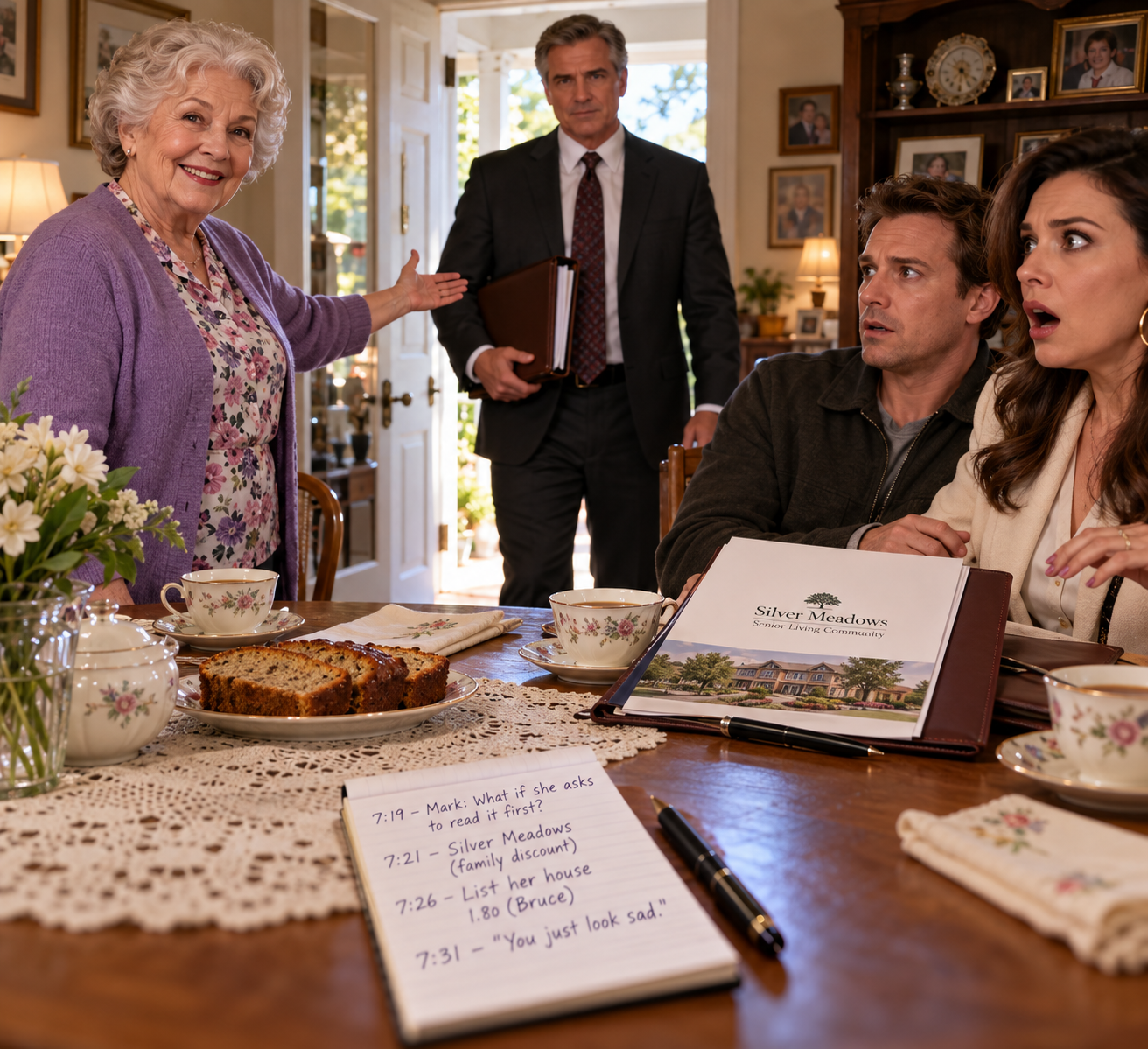
"You contacted a realtor."
"Preliminary."
"You contacted Silver Meadows."
"Research."
"You prepared legal forms."
"Drafts."
"You discussed taking my glasses."
She looked away.
That one had no useful synonym.
Finally she said, "I was frustrated."
"With what?"
"You."
"Be specific."
She laughed without humor.
"Mark has spent years running over here every time something happens."
"I didn't ask him to come every time."
"He comes because he feels guilty if he doesn't."
"Then that is something Mark needs to address."
"We have kids."
"So did I."
"We have debt."
"So have many people."
"We have a life."
"So do I."
She stared at me.
That was the argument.
Not stairs.
Not memory.
Not assisted living.
My continued independence interfered with a story Alicia had built about when responsibility would end and inheritance would begin.
I asked her directly.
"Did you expect my house to solve your financial problems?"
She did not answer.
"Did Mark?"
"He fantasized about it."
"And you?"
She looked at the table.
"Yes."
There was the first clean answer she had given me.
I felt strangely calmer.
"Thank you."
She looked up, surprised.
"For what?"
"For finally saying the real thing."
Her eyes filled, but she blinked the tears away.
"We're drowning, Dorothy."
I said nothing.
"Credit cards. College. The house. Everything costs more. Mark keeps saying it'll work out."
"And my house became part of how you imagined it working out."
She nodded.
That admission explained much.
It excused nothing.
"I helped you with forty thousand dollars."
"I know."
"Did that feel like nothing?"
"No."
"Then why did helping me become a debt I owed you?"
Her mouth trembled.
"I don't know."
For the first time, I believed her.
Entitlement rarely announces the exact moment it becomes entitlement.
She had begun with real frustration.
Mark had spent time helping me.
They were financially stressed.
My property had substantial value.
Mark expected eventually to inherit.
One thought leaned against another until taking control early began to feel like efficient family planning.
"You could have asked me for help," I said.
"We already did."
"Then I might have said no."
She gave me a bitter look.
"Exactly."
There it was again.
No.
The word they had been designing around.
"You are allowed to dislike my no."
She folded her arms.
"Easy for you to say."
"No, Alicia. It isn't. I love Mark. I love the twins. Saying no when family wants something is painful."
"Then why do it?"
"Because otherwise yes means nothing."
She looked at me for a long time.
The conversation did not end with an embrace.
No apology erased the kitchen folder.
No inspirational sentence repaired trust.
But Alicia admitted she had helped create a narrative about my decline because it made their preferred solution easier to justify.
She admitted the boat conversation was real.
She admitted the sale proceeds had become fantasy money in their marriage.
And I admitted something too.
I did not want to die in that house simply to prove nobody could move me.
Her expression changed.
"I thought you said you'd never leave."
"I said I'm not leaving because you maneuvered me into it."
"That's different?"
"Completely."
I explained that the stairs might genuinely become a problem.
The yard already irritated me.
Maintenance was expensive.
At some point I might choose a smaller home.
I might even choose a senior community.
The issue had never been whether change was forbidden.
The issue was who decided.
Alicia stared at her hands.
"I didn't understand that."
"You didn't want to."
She accepted the correction.
Before leaving, she asked one question.
"Do you hate me?"
"No."
She seemed surprised.
"I don't trust you."
That hurt her more.
"I don't know how to fix that."
"Don't try to fix it quickly."
"What am I supposed to do?"
"Respect my decisions when there's nothing in it for you."
She stood.
At the door she paused.
"I am sorry about the glasses."
I believed that she regretted saying it.
I did not yet know whether she understood why it mattered.
"Thank you."
She left.
Months passed.
Mark called less often.
At first I assumed he was punishing me.
Then I realized he was doing exactly what I had asked.
He called before coming.
He stopped treating every loose hinge as an emergency requiring his intervention.
When I asked for help, he helped.
When I did not, he stayed home.
Sometimes that felt lonely.
Autonomy, I discovered, had inconveniences.
If I wanted control, I also had to accept responsibility for arranging what I could not do alone.
I hired someone for gutters.
Paid for yard work.
Created a home-maintenance schedule.
Installed better lighting near the stairs.
Added a handrail where I had resisted one before.
Those choices did not weaken my argument.
They strengthened it.
Independence was not pretending I had no vulnerabilities.
It was choosing how to address them.
Alicia remained distant.
That was fine.
Trust did not need a deadline.
Then winter came.
One February morning I stepped onto the back porch carrying a bag of recycling.
The temperature had dropped overnight.
A thin layer of ice covered the top step.
My right foot slid.
The bag flew from my hand.
I grabbed the railing, missed, and went down hard.
Pain shot through my hip.
For several seconds I could not move.
The first thought that entered my mind was absurdly simple.
Alicia warned me about falling.
The second was worse.
What if she had been right?
I reached for my phone.
It had landed several feet away.
I stretched.
Pain stopped me.
The backyard was silent.
Then I heard Eleanor's voice from beyond the fence.
"Dorothy?"
I shouted.
Within minutes she was beside me.
An ambulance followed.
At the hospital, after imaging and examination, I learned I had escaped the fracture I feared.
Bad bruising.
A sprain.
Painful.
Manageable.
But the incident changed the facts.
This time there was a real safety event.
Mark arrived at the hospital looking terrified.
Alicia came behind him.
I watched them enter and braced myself for the sentence I expected.
We told you so.
It never came.
Mark sat beside the bed.
"What do you want us to do?"
I stared at him.
Not what are you going to do.
Not what have you decided.
What do you want us to do?
Alicia remained near the door.
She said nothing.
I asked Mark to bring clothes from home.
I asked Alicia to call Eleanor.
I asked both of them not to contact Silver Meadows.
Alicia gave the smallest nod.
"Okay."
The next morning, a discharge planner discussed temporary support, fall prevention, and home safety.
Mark listened.
When she asked whether family would be helping, he looked at me before answering.
"My mother decides that."
Something in my chest loosened.
Not everything.
Not yet.
But something.
Two days later I returned home with a walker I despised, instructions I intended to follow, and a son who carried my bag without once trying to carry my authority with it.
As we reached the kitchen, I noticed the drawer where the old folder had once rested.
Mark noticed me looking.
"I'm sorry," he said quietly.
I believed him more than I had in the coffee shop.
Not because his apology had improved.
Because this time, when genuine vulnerability finally gave him a reason to take control, he chose not to.
And for the first time since the pocket dial, I wondered whether trust might someday return in a form neither of us had to pretend was the same as before.
Click here to continue reading: PART 5: My fall gave Mark the chance to prove whether he had changed, and the first real test came before I could climb the stairs
When Mark arrived carrying papers about my future, he did not know I had already invited someone who understood every page
Part 4 of 43