
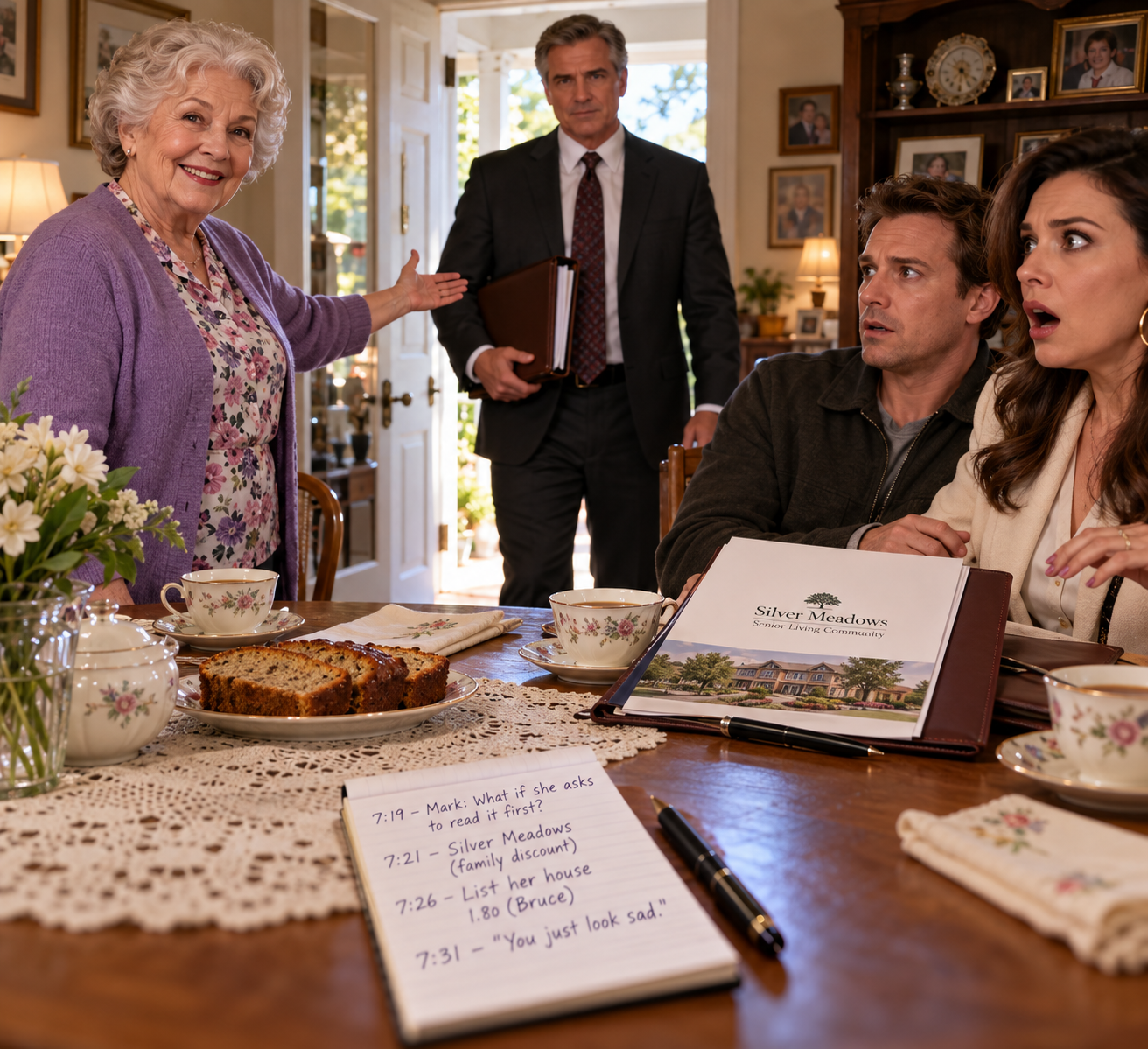
Mark arrived with Alicia.
I had invited both.
That surprised them.
Lena joined by video.
My healthcare agent came in person.
Professional fiduciary representative on another screen.
It looked like a corporate merger.
I hated it.
That was probably healthy.
I began.
"I am not surrendering decision-making."
Everyone nodded.
"Don't nod too enthusiastically."
Mark almost smiled.
I continued.
"I had a navigation problem."
They knew.
"I have mild cognitive impairment."
They knew.
"I want more structure before I need more control."
That distinction became the meeting.
Structure.
Not takeover.
We reviewed transportation.
I would stop driving entirely for now.
That hurt.
More than I expected.
My car had already been rarely used.
Still, surrendering keys felt symbolic.
I made the decision before anyone asked.
Maple Court transportation covered most needs.
Mark could help sometimes.
Alicia too.
Rideshare when appropriate.
No one became designated chauffeur.
Then medication.
Already organized.
We added pharmacy packaging.
Good.
Finances.
Professional review threshold lowered.
Routine spending mine.
Larger transfers reviewed.
Estate documents locked against casual family access but readily available to authorized professionals.
Good.
Appointments.
I wanted Mark allowed to attend when invited.
No standing right.
Good.
Emergency contact.
Same.
Capacity monitoring.
Scheduled reassessment.
No family declaration.
Professional evaluation.
Good.
Residence.
This mattered.
I intended to stay in independent living at Maple Court.
For now.
The director had already discussed support options that could be added without moving.
Meal reminders if needed.
Medication support.
Check-ins.
Transportation.
Housekeeping.
I did not currently need most of them.
But I wanted the menu known.
Mark said, "What about assisted living here?"
I stiffened.
The phrase.
Years of history packed into three words.
He saw my face.
"I mean later."
"I know."
"If the doctor says—"
"No."
Everyone became quiet.
Mark stopped.
I looked at him.
"No what?"
"No making the doctor the only decision-maker about where I live."
His face tightened.
"I didn't mean—"
"I know what you meant. But residence is not purely medical."
Lena intervened gently.
"Good point."
We discussed criteria.
Safety.
Function.
Support needs.
My preferences.
Available services.
Cost.
Medical recommendations.
No automatic move based on diagnosis alone.
Exactly.
Mark absorbed it.
"Okay."
This was his test.
Not agreeing with me on everything.
Respecting correction without withdrawing legitimate concern.
He did.
Then he said, "I still think if you start wandering, staying here might not work."
My irritation rose.
Then I stopped.
Specific.
Real.
"What do you mean by wandering?"
"Leaving and not being able to return."
"Repeatedly?"
"Yes."
"Or one navigation mistake?"
"No."
Good.
"Then say that."
He nodded.
"If you repeatedly leave and cannot return safely, I think we need to consider a higher-support setting."
I did not like hearing it.
He was not wrong.
"I agree to consider it."
Not agree to move.
Consider.
Specific threshold.
Everyone wrote it down.
That mattered.
Alicia said almost nothing.
Then she raised her hand.
I stared.
"Are we in school?"
"Feels like it."
"Go ahead."
"What about food?"
"What about it?"
"You're eating?"
"Yes."
"I know. I mean if meals start getting missed."
Another specific factor.
Good.
"Track if it becomes real."
She nodded.
No assumption.
No narrative.
Emma joined for the last fifteen minutes.
I had invited her because younger family should not receive crisis information secondhand if avoidable.
She looked frightened.
I hated that.
Then remembered fear was not harm.
Secrets could be.
I told her the facts.
Not every test score.
Enough.
She cried.
Then apologized.
"Stop apologizing for crying."
Family rule.
She laughed.
Lily was too young to understand.
Good.
No need to involve a child in adult anxiety.
By the end, we had a plan.
Written.
Clear.
Flexible.
No one had more authority than before.
We simply reduced ambiguity.
That meeting exhausted me more than legal battles had.
After everyone left, I slept for two hours.
Then woke angry.
At age.
At biology.
At the possibility of losing abilities I had fought so hard to protect from false claims.
It felt unfair.
Then another thought came.
The earlier fight had never been about proving I would remain capable forever.
It had been about refusing to have incapacity invented before it existed.
That still mattered.
The fact that change eventually arrived did not retroactively make Mark and Alicia right.
They had acted without evidence.
Now I was acting because of evidence.
Timing matters.
Process matters.
Consent matters.
I called Mark that evening.
"I need you to understand something."
"I'm listening."
"This diagnosis does not make what you did years ago correct."
Silence.
"I know."
"I need you to say it."
"What we did was wrong."
"Why?"
"Because you were capable, we didn't have evidence you couldn't decide, and we tried to get around your no."
Good.
"And now?"
"Now you're still capable, but there are real changes, and you're choosing support."
My chest loosened.
"Yes."
He added, "And if later you aren't able to choose everything, that still doesn't make the old plan right."
Exactly.
"Thank you."
"For what?"
"Understanding the difference."
He cried.
Quietly.
So did I.
The next few months went well.
No getting lost.
No medication problems.
No missed bills.
I sold the car.
That hurt.
Mark offered to handle the sale.
I said no.
Then realized forms tired me.
I asked him to assist.
Not own the process.
Assist.
We selected a buyer together.
I signed.
Money went to my account.
No emotional significance beyond what I chose.
When Mark handed over the keys, he looked sad.
"For me?"
"For you."
"Why?"
"Mom, that car smelled like peppermint and old receipts."
"True."
We laughed.
Transportation became easier than expected.
Maple Court van.
Friends.
Family.
Less parking stress.
One loss became one relief.
That happened more often than people admit.
Then I began forgetting names more frequently.
Not family.
Acquaintances.
The advisory board became frustrating.
I stepped down entirely.
No one forced me.
I hated that too.
But the meetings left me exhausted and embarrassed when I lost the thread.
The director thanked me.
I said, "Do not give me a plaque."
She laughed.
No plaque.
Good.
Writing class continued longer.
I loved it.
Then one afternoon, I could not follow a complicated discussion.
I went home angry.
Next week, I returned.
Not every bad day deserves surrender.
Balance.
At reassessment, the specialist said decline remained mild but clearer.
Daily function still largely intact.
No major incapacity.
We adjusted expectations.
No catastrophic language.
Then came a disagreement with Mark.
A real one.
I wanted to take a short trip to visit Claire.
Alone.
Flying.
Mark objected.
"That's not safe."
My anger ignited.
"Why?"
"You got lost before."
"Once."
"You're forgetting things."
"Names."
"Mom."
"Specific facts."
He paced.
"You can get overwhelmed in airports."
"I have never been lost in an airport."
"You haven't flown since diagnosis."
"That is not evidence."
He looked frustrated.
I was too.
Alicia stayed silent.
Good.
Then Mark said, "I think this is a bad idea."
There it was.
Opinion.
Allowed.
"I heard you."
"You're still going?"
"Possibly."
He stared.
"I don't know how to do this."
"What?"
"Respect your decision when I genuinely think it's unsafe."
That was honest.
I softened.
"Then we gather more facts."
I called the doctor.
Not to ask permission.
To discuss relevant risks.
The specialist said flying itself was not medically prohibited.
Navigation and complexity were reasonable concerns.
Suggested supports.
Direct flight.
Airport assistance.
Claire meeting at arrival.
Written itinerary.
Phone tracking if I consented.
No tight connections.
Daytime travel.
Good.
I called Claire.
She could meet me at the gate area permitted.
The airline offered assistance.
I accepted.
Then I called Mark.
"I am going."
Silence.
"I have supports."
I explained.
He still sounded unhappy.
"Okay."
That was the test.
Not agreement.
Respect.
Then he said, "Can I drive you to the airport?"
"Yes."
We did not argue in the car.
At check-in, he hovered.
I glared.
He stopped.
Airport assistance took over.
I turned.
"I'll call from Oregon."
He hugged me.
"Have fun."
Fear visible.
Control withheld.
That may have been the bravest thing he had done.
The trip went well.
Not perfectly.
I became confused finding a restroom after security.
Asked staff.
Problem solved.
I forgot where I put my boarding pass.
It was in my bag.
No crisis.
Claire met me.
We spent five days together.
I returned safely.
Mark was at arrivals.
He looked as though he had personally survived a war.
"See?"
I said.
He huggedged me.
"I still think it was risky."
"Maybe."
"But you handled it."
"With help."
"Yes."
That was the point.
Independence with support.
Not proving I needed nobody.
We drove home.
Then Mark surprised me.
"I'm glad you went."
I looked at him.
"Why?"
"Because if I'd talked you out of it just to calm myself, I think I'd regret that more."
That was the deepest change.
He could see his fear as his responsibility.
Not automatically mine.
I squeezed his hand.
"Good."
Several months later, something happened that changed the balance more substantially.
I left the stove burner on.
Not for hours.
Ten minutes.
A pot boiled dry.
Smoke alarm triggered.
Staff came.
No fire.
No injury.
But real risk.
No explanation.
No multitasking excuse.
I had forgotten.
I sat at the table afterward staring at the blackened pot.
This was not a forgotten name.
Not wrong hallway direction.
A safety event.
I called Mark.
He arrived.
Looked at the pot.
Then at me.
He said nothing.
Good.
I spoke first.
"This changes things."
His eyes filled.
"Yes."
Maple Court evaluated.
We added kitchen safeguards.
Automatic shutoff.
Meal support available.
I stopped cooking on the stovetop alone.
That hurt terribly.
I loved cooking.
Could still prepare cold meals.
Microwave.
Supervised cooking.
But open flame now carried evidence.
I made the choice.
Again.
Then came the more painful question.
Was independent living still appropriate?
Staff believed yes with added supports.
Doctor agreed.
For now.
Mark agreed but looked unsure.
I asked.
"Say it."
"I'm worried."
"Specific."
"The stove. The getting lost. The bank transfer memory."
Fair.
"Do you think I need assisted living now?"
He hesitated.
"Maybe."
Old word.
I almost laughed.
"Do you want me to move?"
"I want you safe."
"Not an answer."
He closed his eyes.
"Yes. I think I'd feel better if you had more supervision."
There.
Honest.
Potentially controlling if disguised.
Not when stated as his need.
"I hear you."
He waited.
"I am not moving yet."
Pain crossed his face.
Then he nodded.
"Okay."
No pressure.
No campaign.
No Alicia.
No facility calls.
He disagreed.
He respected.
That mattered more than agreement ever could.
I promised reassessment in three months or sooner after another significant safety event.
Written.
Specific.
Mark accepted.
Then he asked, "Can I hate this?"
"Absolutely."
"So do I."
We laughed sadly.
That night, I looked at the red-handled screwdriver box.
MARK — THIS ONE I PROMISED YOU.
Then Raymond's wall message.
This house is hers if I go first.
The house was gone.
Calvin was gone.
My abilities were changing.
But the central truth remained.
My life was mine even when my choices required more help.
And because Mark finally understood that, I was no longer afraid that needing him would erase me.
Click here to continue reading: PART 43: When I finally needed more care, Mark honored the promise he once broke by letting the decision remain mine until it truly could not
When Mark arrived carrying papers about my future, he did not know I had already invited someone who understood every page
Part 42 of 43

One Comment on “PART 42 – I chose more help before anyone could impose it, but Mark’s greatest test came when I disagreed with him and he had to let me”