The recording arrived through Charles Whitcomb's attorney under a formal agreement preserving its authenticity for examination.
Laura arranged for the audio specialist who had reviewed the earlier Northbridge recordings to inspect it before Daniel and I listened.
The specialist confirmed that the file appeared consistent with the recording system Charles had used at the time, though the original device and complete recording history would still matter.
Laura explained that we should treat the recording as evidence of what the speakers said, not automatic proof that every statement was true.
I nodded.
By then, I understood the difference.
We had spent months learning how easily confident voices could conceal falsehoods.
Daniel sat beside me in Laura's office.
His cane rested against the table.
He looked pale.
"Are you ready?" Laura asked.
He nodded.
I reached for his hand.
The recording began with the sound of a door closing.
Charles's voice was recognizable.
He asked Daniel's father whether he understood the consequences of telling Daniel that Sarah and the baby had died.
Daniel's father answered sharply.
He said Daniel was recovering from a catastrophic accident and could not withstand further emotional upheaval.
Charles reminded him that the child was alive.
Daniel's father said he knew.
Then Charles asked the question that had haunted us for months.
"Why keep them apart?"
There was a long pause.
Daniel's father answered that Daniel had always been too willing to abandon the family's expectations for Sarah.
He feared Daniel would leave the family business, reject his financial support, and build a life outside his control.
I looked at Daniel.
He stared at the table.
The recording continued.
Charles said that Daniel was an adult and had the right to know about his son.
Daniel's father dismissed the argument.
He said Daniel was injured, dependent, and emotionally unstable.
Then he spoke about Leo.
He described the baby as a permanent connection to Sarah and her family, a connection he believed would pull Daniel away from the future he had planned.
My stomach tightened.
He had not been trying to protect Leo.
He had been trying to protect his own control.
Charles warned that the deception could eventually be exposed.
Daniel's father said he would manage the risk.
He mentioned the proposed placement arrangements, the financial reserve, and the possibility of influencing my guardianship if necessary.
Charles objected to the idea of using the child as leverage.
But the recording also showed that he continued discussing how the plan might be carried out.
I listened carefully.
Charles was not an innocent observer.
He had recognized the danger and still helped create the machinery that kept us apart.
Daniel's father then said something that made Daniel close his eyes.
He admitted that he knew Daniel loved Sarah.
He said that was precisely why the truth had to be hidden.
"If he knows the boy survived," he said, "he'll spend the rest of his life trying to reach him."
Daniel's hand tightened around mine.
I looked at him.
His face had gone rigid.
The recording continued.
Charles asked whether Daniel's father intended to tell him eventually.
Daniel's father said he might reconsider once Daniel was fully recovered and financially secure.
But he offered no date.
No conditions that could be measured.
No promise.
Only the possibility that he might someday permit a father to know his child.
I felt sick.
For ten years, Daniel had lived with the belief that Sarah and Leo were dead.
His father had known the truth.
He had chosen the lie because he feared losing control of his son.
The recording ended with Charles warning that the arrangement could not remain hidden forever.
Daniel's father answered that by the time the truth emerged, the family would have enough resources to contain the consequences.
The final words were spoken calmly.
That made them worse.
Laura stopped the recording.
No one spoke.
Daniel sat motionless.
I waited.
After a long time, he said, "He knew."
Laura nodded.
"He knew you would want to find Leo."
Daniel looked at me.
"He knew I loved Sarah."
"Yes."
He lowered his head.
I placed my arm around him.
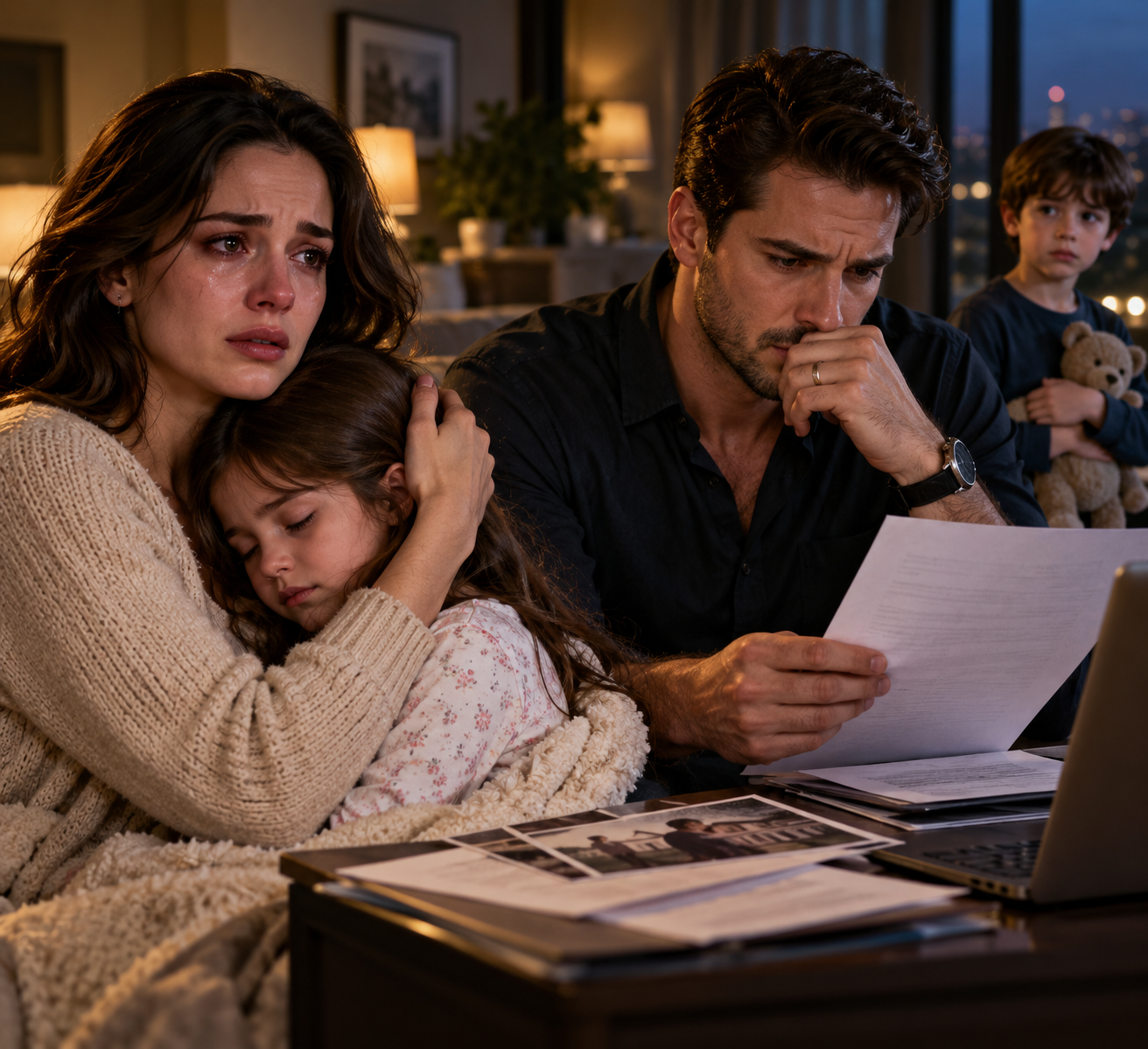
For several minutes, we sat together while the truth settled around us.
Then Daniel began to cry.
He had cried before, quietly and briefly, when Leo first called him Dad.
This was different.
He cried for the years he had lost, for the woman he had loved, and for the child he had been taught to mourn.
I held him.
There was nothing useful to say.
When he finally looked up, he wiped his face with a tissue.
"I spent years trying to understand why he lied."
I nodded.
"Now you know."
He shook his head.
"I know what he said. I still don't understand how he could do it."
I looked toward the window.
"Maybe we never will."
Laura gave us time before discussing the recording's legal significance.
She explained that it supported the evidence of deliberate concealment and could be relevant to the estate disputes, the forged letter, and Charles's conduct.
It did not resolve every question.
The financial records still required accounting.
The hospital's independent review was ongoing.
And Charles's own responsibility remained substantial.
Daniel listened carefully.
Then he said, "I don't want my father's money used to make this disappear."
Laura nodded.
"That has been your position throughout."
"I want Leo protected. But I don't want silence."
I looked at him.
"Neither do I."
That evening, we drove home together.
Leo was waiting with Mrs. Alvarez.
He ran toward Daniel.
"Dad!"
Daniel knelt carefully despite his injured leg.
Leo threw his arms around him.
Daniel held him for a long moment.
I watched from the porch.
For ten years, Daniel had believed this embrace was impossible.
Now it was part of our ordinary life.
Leo leaned back.
"Are you okay?"
Daniel smiled through tears.
"Yes."
"You look sad."
"I heard something difficult today."
Leo considered that.
"About Grandpa?"
Daniel nodded.
"Yes."
Leo looked thoughtful.
"Did he do something bad?"
Daniel took a breath.
"He made choices that hurt people."
Leo looked at me.
I nodded.
Daniel continued.
"But none of those choices were your fault."
Leo seemed relieved.
Then he asked whether they could finish the model airplane shelf.
Daniel laughed softly.
"Absolutely."
They went inside together.
I followed, carrying Daniel's bag.
The next few days passed quietly.
Daniel spent time with Leo, worked on his new house, and attended the appointments required for the legal recognition of his parentage.
I continued my own counseling sessions.
We both needed room to understand what the investigation had revealed.
One afternoon, I visited Sarah's grave alone.
I brought fresh flowers and a photograph of Leo standing beside Daniel in front of the new house.
I placed the picture against the stone.
"He's here," I whispered.
The wind moved through the trees.
"Daniel found him."
I sat on the grass for a long time.
I told Sarah about the recording, the hospital's acknowledgment, and the people who had finally begun telling the truth.
Then I told her about Leo's baseball games, his model airplanes, and his habit of asking questions no adult could answer easily.
I smiled.
"He has your stubbornness."
The cemetery was quiet.
I looked at her name.
"I wish you could see him."
For ten years, I had carried that wish alone.
Now Daniel carried it too.
When I returned home, Laura had left a message.
The hospital's independent historical reviewers had completed their preliminary findings.
They confirmed that the original concerns about Sarah's care had been improperly handled and that the family notification process had failed.
They also identified significant weaknesses in the way the hospital preserved and revised incident records.
Laura said the findings were consistent with much of the evidence we had already gathered.
The final report would require further review before release.
I felt relief, but not triumph.
Sarah was still gone.
No report could change that.
Later that week, Laura called again.
The hospital had submitted what it described as its final settlement proposal.
The terms included a written acknowledgment, financial compensation, and commitments to preserve records and cooperate with professional oversight.
The confidentiality provisions had been narrowed to protect legitimate private information without preventing us from discussing our family's experience.
Laura believed the proposal deserved serious consideration.
But she wanted Daniel and me to review it carefully before deciding.
I agreed.
That evening, Daniel came over.
We sat at the kitchen table with the proposal between us.
Leo was upstairs reading.
The house was quiet except for the wind chime outside.
Daniel looked at the papers.
"Do you think Sarah would want us to accept?"
I considered the question.
"I think she'd want us to make sure the truth stays known."
He nodded.
"And Leo?"
"I think she'd want us to protect his future."
Daniel looked toward the stairs.
"Then we have to decide what justice looks like when nothing can bring her back."
I stared at Sarah's photograph.
For months, I had believed the investigation would end when someone finally admitted what happened.
Now I understood that truth was only part of the answer.
We still had to decide what to do with it.
The following morning, Laura called with one final development.
The estate specialist had completed a preliminary accounting of the special reserve.
Most of the money remained intact, but the records suggested that some payments had been made without adequate documentation.
Laura said the accounting could support further legal action concerning Charles Whitcomb's management of the funds.
Daniel listened beside me.
Then he asked the question that mattered most.
"Can we protect whatever belongs to Leo without turning his life into another fight?"
Laura paused.
"Yes," she said. "But it will require careful decisions."
I looked toward the kitchen window.
Outside, Leo was practicing baseball with Daniel's old glove.
He was laughing.
I watched him for a moment.
Then I told Laura we were ready to discuss the next steps.
Not because the pain was gone.
Not because the people responsible had been forgiven.
But because Leo deserved a future that belonged to him.
And Sarah deserved a truth that no one could bury again.