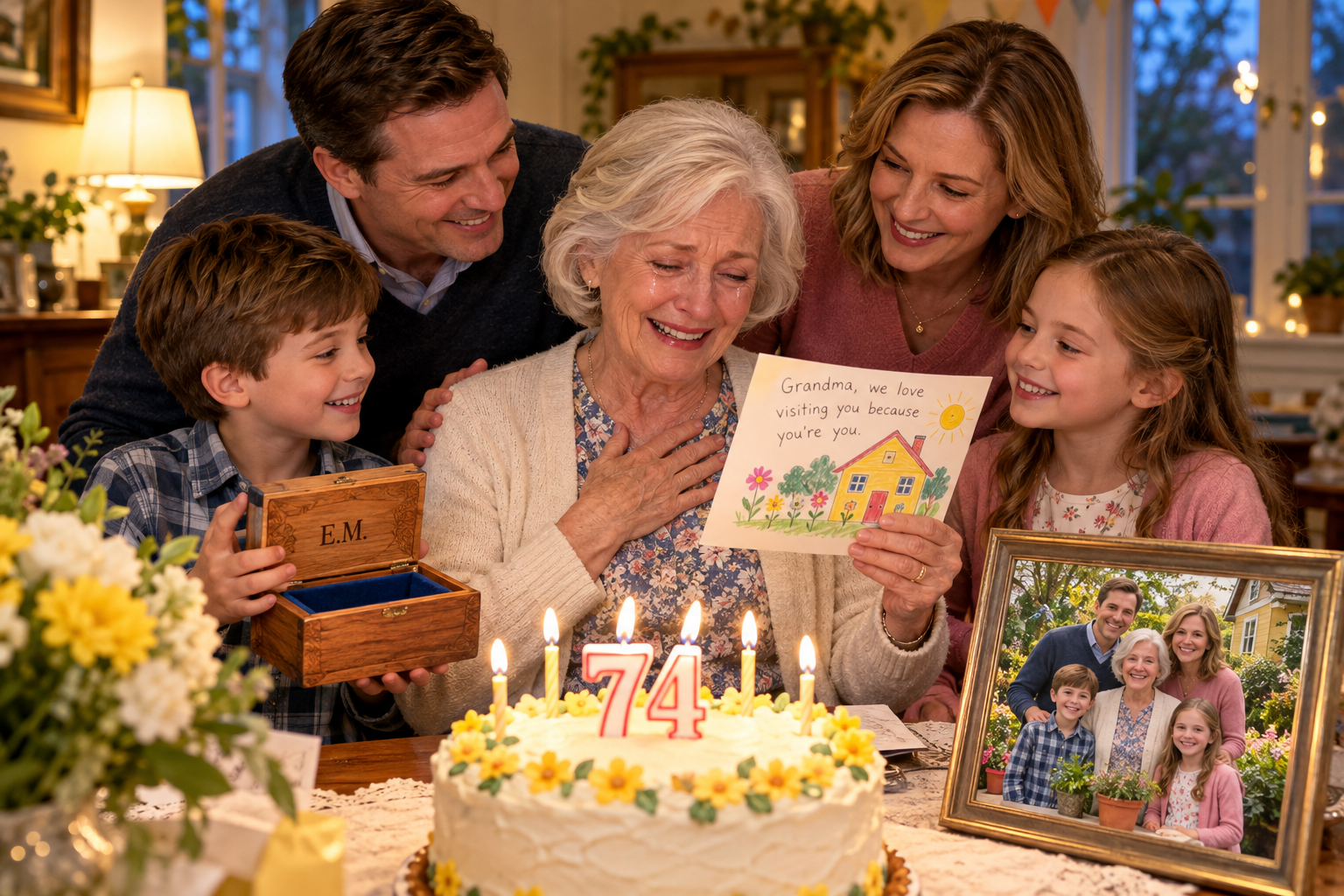
My seventy-fifth birthday arrived quietly.
There was no surprise party.
I had forbidden one.
Graham ignored me.
So did Anna.
Ruth claimed she knew nothing.
That was how I knew she was involved.
When I walked into the garden that morning, everyone shouted.
I nearly dropped my coffee.
“You promised.”
Graham laughed.
“We promised nothing.”
Anna hugged me.
“Happy birthday, Mom.”
The word still had the power to stop me.
I hugged her back.
“Thank you.”
The garden was decorated with simple lights.
There were tables.
Food.
Music.
Children running everywhere.
The foundation staff had come.
Some scholarship students were there.
Paige came too.
She looked nervous.
I hugged her.
“You're family.”
She looked surprised.
“Are you sure?”
“Yes.”
She cried.
I understood.
Family didn't mean forgetting what happened.
It meant deciding what happened next.
Ruth gave me a small box.
Inside was a photograph.
All of us.
Taken the previous Christmas.
I laughed.
“I look terrible.”
“You look happy,” Ruth said.
“That too.”
Daniel gave me something else.
A key.
I stared at it.
“What is this?”
“The key to the foundation's education center.”
“I thought I was retired.”
“You are.”
“Then why give me a key?”
“So you can visit whenever you want.”
I smiled.
That was the right kind of key.
No obligation.
No control.
Just access.
Graham came over.
“I have something.”
“Oh no.”
He handed me a folder.
I opened it.
It was the final report from his company.
The business was profitable.
Debt was low.
Employees had ownership options.
He had refused the major investor.
Instead, he had expanded carefully.
“You did this.”
He smiled.
“I did.”
I closed the folder.
“I am proud of you.”
He hugged me.
Then Anna appeared.
“I have something too.”
“Should I be worried?”
“Probably.”
She handed me a letter.
It was from one of the scholarship students.
The young woman from the first class had graduated.
She had become a teacher.
At the bottom, she had written:
I want to give someone else the choice you gave me.
I read it twice.
Then I cried.
Anna hugged me.
“Happy birthday.”
I looked around the garden.
All these people.
All these lives.
All these choices.
And somehow, all of them had begun with something that cost two dollars.
Graham raised a glass.
“To Mom.”
Everyone lifted theirs.
He continued.
“She taught me that money doesn't make you strong.”
Anna added:
“She taught me that knowing the truth doesn't make you free.”
Ruth smiled.
“And she taught me that seventy-four-year-old women can still make terrible decisions.”
Everyone laughed.
I pointed at her.
“Traitor.”
She laughed harder.
Then Anna became serious.
“She taught us that freedom means choosing what you do next.”
I looked at my children.
My children.
The phrase still amazed me.
Both of them.
Two lives that had once existed separately.
Now standing together.
I raised my glass.
“To choice.”
Everyone repeated it.
“To choice.”
The evening continued.
Later, when the garden became quiet, I sat with Anna.
“Are you happy?”
She asked.
“Yes.”
“Do you ever wish things had happened differently?”
I thought for a long time.
“Yes.”
She nodded.
“So do I.”
“But I don't wish you away.”
She smiled.
“Neither do I.”
We sat quietly.
Then she asked:
“Would you do it again?”
“The lottery?”
“Yes.”
I laughed.
“I'd rather not.”
“Why?”
“Because eleven million dollars was exhausting.”
She laughed.
Then I became serious.
“I wouldn't choose the pain.”
“What about the freedom?”
“I'd choose that.”
She leaned against my shoulder.
“I think I would too.”
That night, after everyone left, I walked into the kitchen.
The old scratch ticket was still framed.
The new worthless ticket sat beside it.
Thomas's photograph remained between them.
I touched the frame.
“Seventy-five,” I whispered.
It seemed impossible.
A year and a half earlier, I had been seventy-three and convinced my life was narrowing.
Now it felt wide open.
I had no idea how many years remained.
Maybe twenty.
Maybe ten.
Maybe fewer.
But for the first time, the number didn't frighten me.
I had stopped measuring life by what was left.
I measured it by what I could still choose.
I made tea.
Sat at the table.
Opened the blue notebook.
I turned to the last page.
When Evelyn is finally free, let her decide what the rest of her story looks like.
I smiled.
Then I added one sentence beneath it.
I did.
I closed the notebook.
The house was silent.
But it wasn't lonely.
There was a difference.
The rooms held memories.
The garden held laughter.
The walls held photographs.
The kitchen held the story of a two-dollar ticket.
And my heart held the people I had once feared losing.
I turned off the light.
Before leaving, I looked at Thomas's photograph.
“I don't need anything else from you.”
It was the most peaceful thing I had ever said.
Then I walked down the hallway.
Outside, the porch light remained on.
Not because someone might come.
Because someone always could.
That was the life I had chosen.
A life with an open door.
A life without secrets controlling the future.
A life where love did not mean possession.
A life where money was a tool instead of a master.
A life where the past could remain the past.
And where tomorrow did not need to be guaranteed.
It only needed to be mine.