
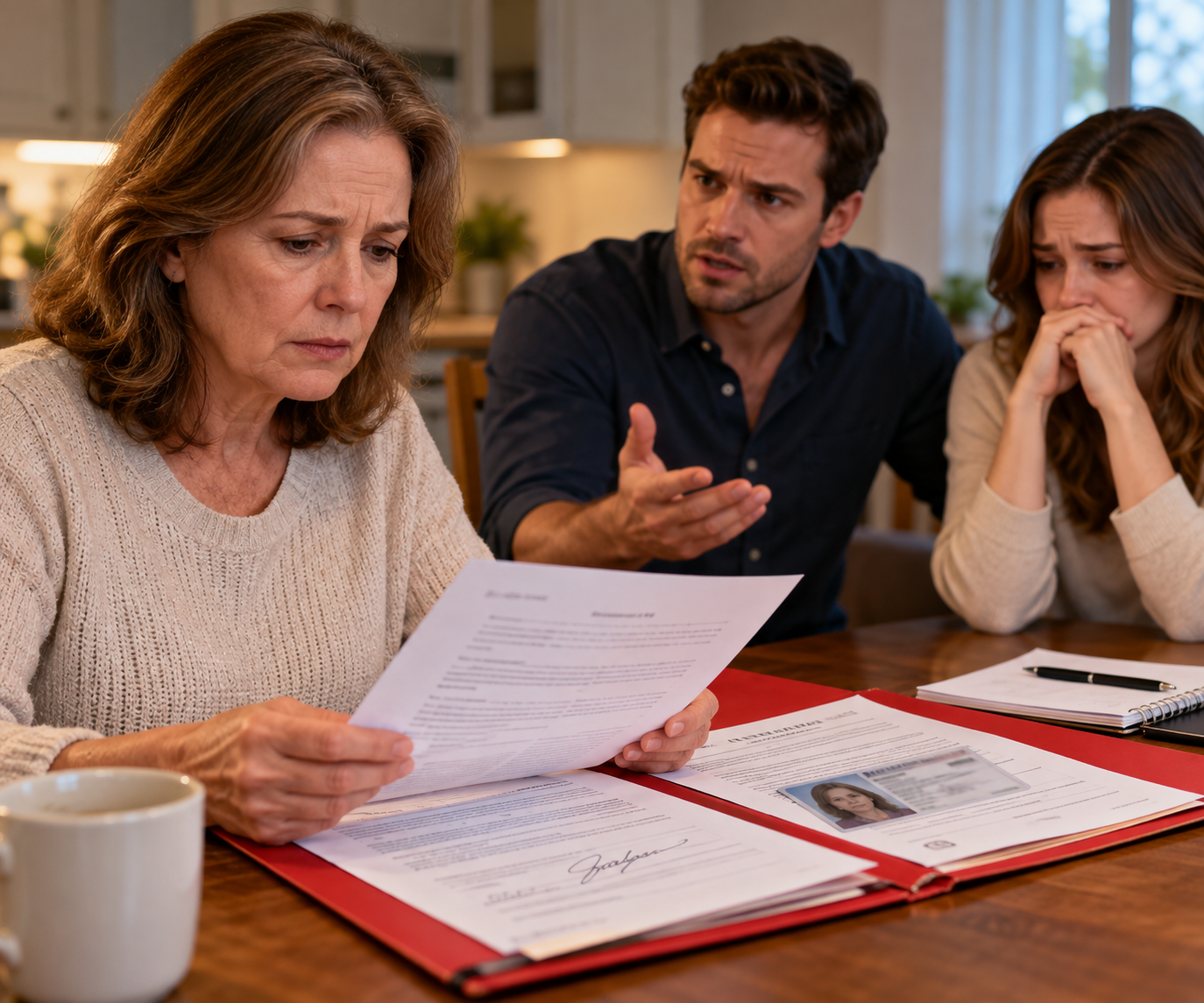
After the discussion, I sat quietly beside my attorney.
The red folder lay open.
The lease renewal was visible.
So was the photocopy of my driver's license.
I didn't want to look at either one.
But I didn't put them away.
My attorney reviewed the notes she'd made.
I watched her turn a page.
"How are you feeling?" she asked.
I considered giving her the answer I usually gave.
Fine.
I was fine.
Everything would work out.
Instead, I said, "Disappointed."
She nodded.
"Because they didn't answer?"
"Partly."
I looked toward my phone.
"Because Valerie asked me why I couldn't trust her."
My attorney didn't rush to respond.
I appreciated that.
"She sounded like she really didn't understand," I said.
"Have you told her what concerns you?"
"I've tried."
"About the documents?"
"Yes."
"And about the relationship?"
I didn't answer immediately.
That was a different question.
I had spent so much time separating the wedding from the lease renewal that I hadn't allowed myself to think about what the wedding had done to our relationship.
It hadn't caused the paperwork.
I knew that.
But it had changed how easily I believed I understood Valerie.
Before the wedding, I had assumed there were certain things my daughter would never do.
Not because she was perfect.
Because I thought we knew each other.
I thought she understood what being present in her life meant to me.
Then she married Brandon without inviting me.
And suddenly I wasn't as certain about my place in her life as I'd believed.
"I don't think I've ever told her how much it hurt," I said.
"Why not?"
"Because whenever I start, someone tells me I'm making her wedding about myself."
My attorney closed her notebook.
"You can acknowledge that hurt without making it the basis for decisions about the document."
I looked at her.
That was exactly what I needed to hear.
I'd become so afraid of sounding like a wounded mother that I'd stopped allowing myself to admit I was one.
The exclusion had hurt.
Deeply.
And it was possible to acknowledge that without using it as evidence against anyone.
I looked down at my hands.
"I raised her alone."
My attorney listened.
"I know that doesn't mean she owes me a wedding invitation. I understand she's an adult."
I swallowed.
"But I thought she'd want me there."
For a moment, I couldn't say anything else.
That was the simplest version of the truth.
I had wanted my daughter to want me beside her.
Not because she'd been pressured.
Not because I'd paid for things.
Not because I'd sacrificed years of my life.
Because I was her mother.
Because I loved her.
And because I thought she loved me in a way that would make my presence matter.
My attorney let the silence remain.
I was grateful.
I didn't need anyone to tell me that Valerie had been wrong.
I didn't need a speech about mothers deserving respect.
I just needed to admit that something important had changed.
After the meeting, Valerie contacted me.
I looked at her name on the phone.
For a few seconds, I considered leaving it unanswered.
Then I remembered what I'd promised myself.
I would listen.
I would not punish her for the wedding.
I would not treat her as guilty of something I couldn't prove.
I answered.
"Mom?"
"I'm here."
There was a pause.
"Are you angry with me?"
I looked at the red folder.
"I'm concerned about the paperwork."
"I know."
"Then you know why I need answers."
She sighed.
"I just feel like you don't trust me anymore."
I closed my eyes.
I had heard those words before.
Not from Valerie in exactly that form.
But I recognized the feeling they created.
The urge to reassure.
To apologize.
To say the thing that would make the other person comfortable.
I didn't answer immediately.
"Mom?"
"I'm thinking."
She went quiet.
I took a breath.
"Valerie, I want to trust you."
"You make it sound like you don't."
"I don't know who signed that document."
"I already told you—"
I interrupted gently.
"Let me finish."
She stopped.
It was a small thing.
Two words.
But I rarely asked my daughter to stop speaking so I could complete a thought.
I was used to listening first.
Explaining later.
Sometimes never explaining at all.
"I don't know who signed the lease renewal," I said. "I don't know who supplied my license. Until I know, I can't pretend there's no problem."
She said she understood.
Then she asked why I had brought an attorney.
"Because I needed someone who could help me understand the document without making it about whether I'm a good mother."
That was followed by a long silence.
I wondered whether I'd said too much.
My old instinct returned.
I wanted to soften the sentence.
Tell her I hadn't meant it as criticism.
Explain that I knew she'd been under pressure.
Instead, I waited.
Valerie finally spoke.
"Nobody said you're a bad mother."
I looked at the wall.
"Not in those words."
"Mom."
"Valerie, yesterday I asked about a signature. People told me I was making trouble because I was upset about your wedding."
She didn't respond.
"I was upset about your wedding."
My voice tightened.
I let it.
"I wanted to be there."
"I know."
"Do you?"
Another pause.
I didn't raise my voice.
I wasn't trying to make her cry.
I was trying to tell her something I'd hidden because I was afraid she'd reject me again.
"I spent thirty years being your mother," I said. "I wasn't expecting to control your wedding. I wanted to see you get married."
She breathed out.
"It was complicated."
"I believe it was complicated."
"Then why—"
"Because complicated doesn't mean it didn't hurt."
She stopped.
I looked toward the window.
I could feel the pressure beneath my ribs.
The same feeling I'd had when I first learned I wasn't invited.
I hadn't wanted to call it humiliation.
But that was part of it.
Other people had been included.
I hadn't.
And I hadn't known how to explain that to myself.
Valerie said she hadn't intended to hurt me.
I wanted to believe her.
I couldn't know exactly what she'd intended.
But I could tell her what had happened.
"You didn't invite me, Valerie."
"I know."
"And when I was hurt, I felt like I wasn't allowed to say so."
Her voice grew quieter.
"I didn't realize you felt that way."
I looked at the folder.
I wondered how she could have missed it.
Then I remembered all the times I'd smiled when I wasn't happy.
All the times I'd said I understood.
All the times I'd tried to keep the peace.
Maybe I'd helped create that misunderstanding.
That didn't erase the hurt.
But I could acknowledge it.
"I didn't explain it well," I said.
"No, you didn't."
For once, her response didn't make me defensive.
It sounded almost honest.
I wasn't used to hearing us speak that way.
Without someone trying to win.
Without a quick apology that ended the discussion before anything was understood.
I let the moment remain.
Then Valerie said, "I don't want us to keep fighting."
"Neither do I."
"Can we move past it?"
I looked at the paperwork.
There it was again.
The invitation to move forward before the difficult part had been addressed.
I knew she might mean the wedding.
I knew she might mean the documents.
I didn't want to guess.
"What do you want us to move past?"
She hesitated.
"All of it."
I rubbed my forehead.
"I can't move past the signature until I know what happened."
"I understand."
"And I can't pretend the wedding didn't hurt."
Her voice was small.
"I know."
I waited.
This time, I didn't offer a solution.
Valerie said she was sorry I had felt excluded.
I listened.
I wanted a clearer acknowledgment, but I wasn't going to dictate exactly how she should apologize.
I told her I appreciated her saying it.
I also told her that the paperwork still needed to be resolved.
Those were separate things.
She didn't argue.
I couldn't tell whether she agreed or was simply tired.
For the moment, I accepted that she had heard me.
We spoke a little longer.
Not about the lease details.
Not about Brandon's explanations.
We talked about how difficult the last few days had become.
I told her I didn't want every conversation between us to end with one of us feeling ashamed.
She said she didn't want that either.
I believed she meant it.
But I also knew wanting a better relationship wasn't the same as changing how we treated one another.
When the call ended, I remained seated.
The house was quiet.
I could hear the faint sound of traffic outside.
My attorney had already left.
The red folder was still on the table.
I placed my phone beside it.
I hadn't forgiven everything.
I hadn't resolved anything about the documents.
But I'd told Valerie something true.
Something I should have said sooner.
I had been hurt.
I was still hurt.
And I didn't have to hide that simply because I wanted my daughter to be happy.
I looked at the two pages carrying my identity.
I would continue asking about them.
But I wouldn't use the paperwork to settle the pain of the wedding.
And I wouldn't allow the wedding to become an excuse for the paperwork.
For the first time, the difference felt clear enough that I could explain it without apologizing.
Click here to continue reading: PART 12: I Stopped Asking My Daughter to Make Me Feel Better and Started Asking for the Records That Could Explain My Signature
They Said I Was Only Angry About the Wedding, but Nobody Could Explain Why My Signature Was on Their Paperwork
Part 11 of 20

One Comment on “PART 11 – Valerie Asked Why I Couldn’t Trust Her, and I Finally Told Her What the Wedding Had Really Changed Between Us”