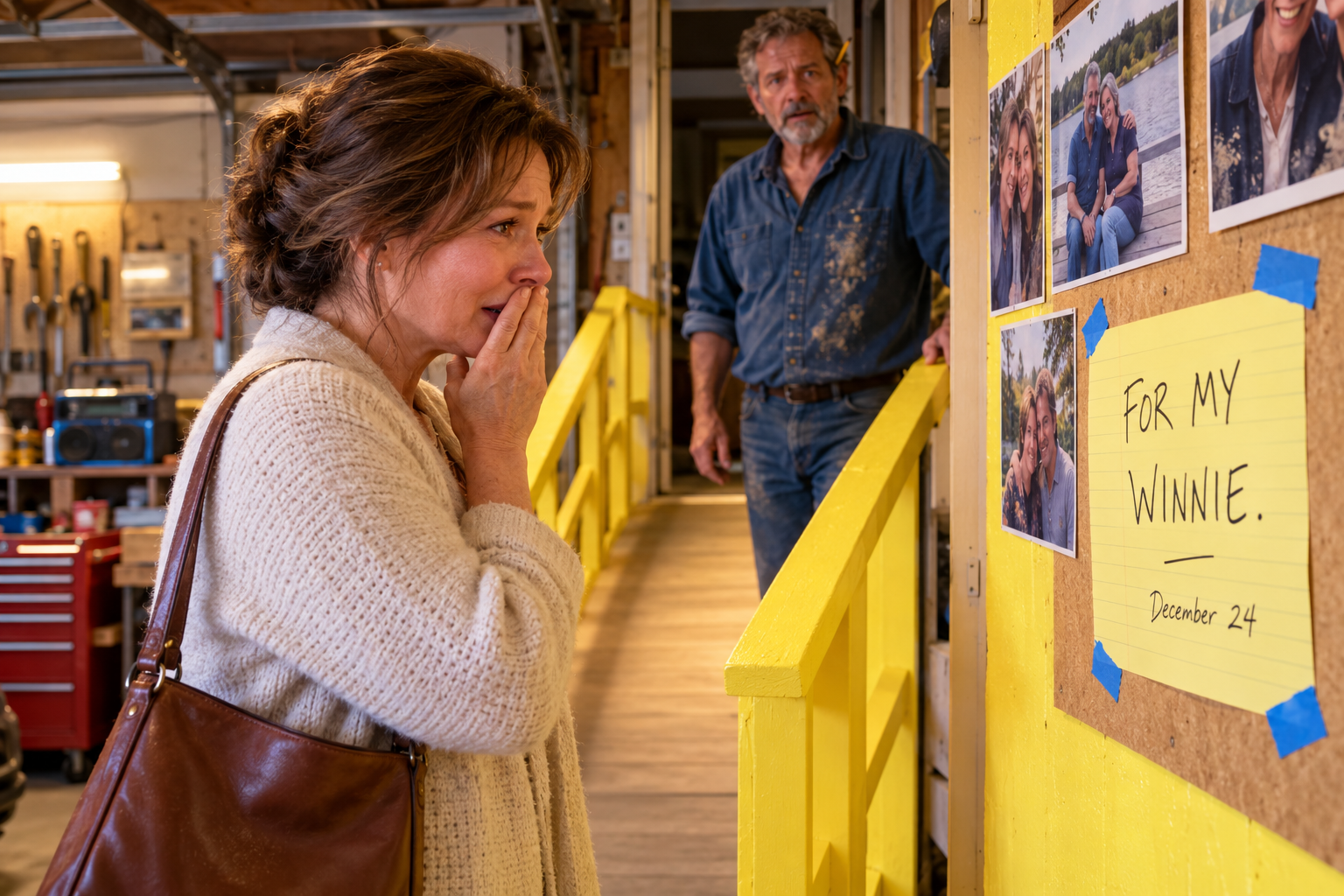
As Christmas drew closer, I found myself thinking about the date written beneath the yellow paper.
December 24.
It was an ordinary date to anyone who didn't know the reason behind it.
For me, it had become a question I carried from one day to the next.
I wondered whether Wendell had chosen it because of something that had happened in his life.
I wondered whether it was connected to the photographs.
I wondered whether it had anything to do with the paint or the ramp.
I could make guesses all day and still know nothing.
So I tried to put the questions aside when there was something else in front of me.
I had errands to run.
There were things to clean and things to put away.
I had small decisions to make about the holiday.
I did those things because they were part of my life, not because they could distract me forever.
I had learned that keeping busy could help for a while.
It could not answer a question that needed another person's voice.
Sometimes I caught myself rehearsing what I would say to Wendell.
I would tell him I didn't need everything explained at once.
I would tell him that I understood people had private matters.
I would tell him that I cared about him.
Then I would tell him that caring did not mean I could live comfortably with a door that never opened.
The words sounded reasonable in my mind.
Out loud, I worried they might sound like an accusation.
I didn't want to accuse him of anything.
I wanted him to understand how the silence felt from my side.
There was a difference.
I knew what it was like to be afraid of losing someone.
After Dwight died, I had carried that fear into places where it didn't belong.
I had worried about small changes.
I had read too much into ordinary silences.
I had sometimes prepared myself for bad news when nothing bad was happening.
Grief had made uncertainty feel dangerous.
It had also taught me that I could survive things I once believed would break me.
I was still here.
I could love someone and still ask a difficult question.
I could hear an answer I didn't expect and decide what to do next.
I didn't need to protect myself by pretending not to care.
That realization brought me a little peace.
It didn't make the questions disappear.
But it made them feel less like something I had to solve before I could breathe.
When I saw Wendell again, I tried to meet him where he was.
I didn't begin by asking about the photographs.
I didn't mention the yellow paper as soon as we started talking.
We spoke about ordinary things first.
I listened to him.
He listened to me.
There was a comfort in that familiar exchange, and I let myself enjoy it without demanding that it answer every question.
Still, I noticed how carefully I chose my words.
I wondered whether he was doing the same.
There were moments when I thought he wanted to tell me something.
Then the moment passed.
I could not know whether I was reading him correctly.
I only knew that both of us seemed aware of the conversation waiting between us.
I had spent much of my life learning when to speak and when to wait.
Marriage had taught me that silence could sometimes be gentle.
It could give two people room to calm down.
It could prevent a small disagreement from becoming a lasting wound.
But silence could also become a habit.
And once a habit settled in, it could be hard to recognize the moment when it stopped helping.
That was what I feared most about the space between Wendell and me.
I didn't want us to become two people who cared for each other but avoided the one subject that mattered.
I didn't want to be grateful for every kind thing he did while quietly accepting that one part of his life would always remain closed to me.
I had done enough of that kind of quiet bargaining with myself.
I had told myself not to ask too much.
I had told myself to be patient.
I had told myself that the questions would answer themselves eventually.
Maybe some questions did.
This one needed a conversation.
I thought about the way Wendell had looked at the paper.
His face had changed before he spoke.
He had looked at the photographs, then at the yellow paint, then at me.
I remembered the softness in his voice when he said, “Oh, honey.”
There had been no anger in those words.
There had been something else, something I couldn't name with confidence.
I had seen embarrassment in people before.
I had seen surprise.
I had seen the fear that came when a carefully planned moment arrived too early.
His expression could have meant any of those things.
I refused to choose one simply because it suited the story I was telling myself.
I wanted the truth, not a guess that felt comforting.
That evening, I thought about what the words “For my Winnie” had done to me.
They had made me feel included.
They had also reminded me that I was still waiting to understand how I fit into Wendell's life.
The words were tender.
The unanswered questions were real.
Both could exist at once.
I didn't need to reject the tenderness just because I needed an explanation.
And I didn't need to ignore the questions just because the tenderness felt good.
For a long time, I had treated hope as if it were something fragile that I had to guard from every possible disappointment.
I was beginning to understand that hope could be more practical than that.
It could mean giving someone a chance to tell the truth.
It could mean listening without deciding the ending in advance.
It could also mean knowing what I needed and saying it plainly.
I wanted to be part of Wendell's life.
Not just the part he found easy to share.
Not just the conversations that took place when there was nothing difficult to discuss.
I wanted to know him as he was.
That included the things he was proud of.
It included the things he found hard to explain.
And it included whatever had made him write my name on that yellow sheet of paper.
I didn't know what he had prepared for December 24.
I didn't know whether the date was meant to be a beginning, a promise, or something I had not imagined.
I could only wait for him to tell me.
But waiting no longer meant pretending I had no questions.
I had them.
I was allowed to have them.
And when the time came, I would ask.
I hoped Wendell would understand that the question wasn't a demand for perfection.
I wasn't asking him to make every part of his life beautiful before he let me see it.
I was asking him to trust me enough to let me stand beside him.
That was a much smaller request than the one I had feared making.
It was also more important.
I thought about the ramp in the garage and the buttercup-yellow paint.
The color was bright enough to stay in my memory.
I had noticed it because it seemed out of place among the tools and sawdust.
Now I wondered whether I had been so busy looking for a hidden meaning that I had failed to notice the simple fact that Wendell had been working on something.
I couldn't know what the work meant.
But I could acknowledge that it was there.
The same was true of the photographs.
They had been visible.
The paper had been visible.
Whatever Wendell had intended, those things had existed before I walked into the garage.
I didn't have to turn them into proof of anything.
I only had to let them remind me that there was more to learn.
When I thought of Christmas Eve, I tried to picture the kind of day I wanted.
Not an elaborate celebration.
Not a room filled with decorations or a surprise designed to make me forget every concern I had carried.
I wanted an honest day.
A day when I could ask a question and receive an answer.
A day when I didn't have to pretend the locked door in our relationship was something I had never noticed.
I wanted to feel welcome.
That was all.
And perhaps it was enough to begin with.
Click here to continue reading: PART 15: I Was Finally Learning That Giving Someone Time Did Not Mean I Had to Leave My Own Feelings Waiting Outside the Door
I Thought the Hardest Thing About Losing My Husband Was Learning to Sleep Alone Until Another Man Made Me Question Everything
Part 14 of 20