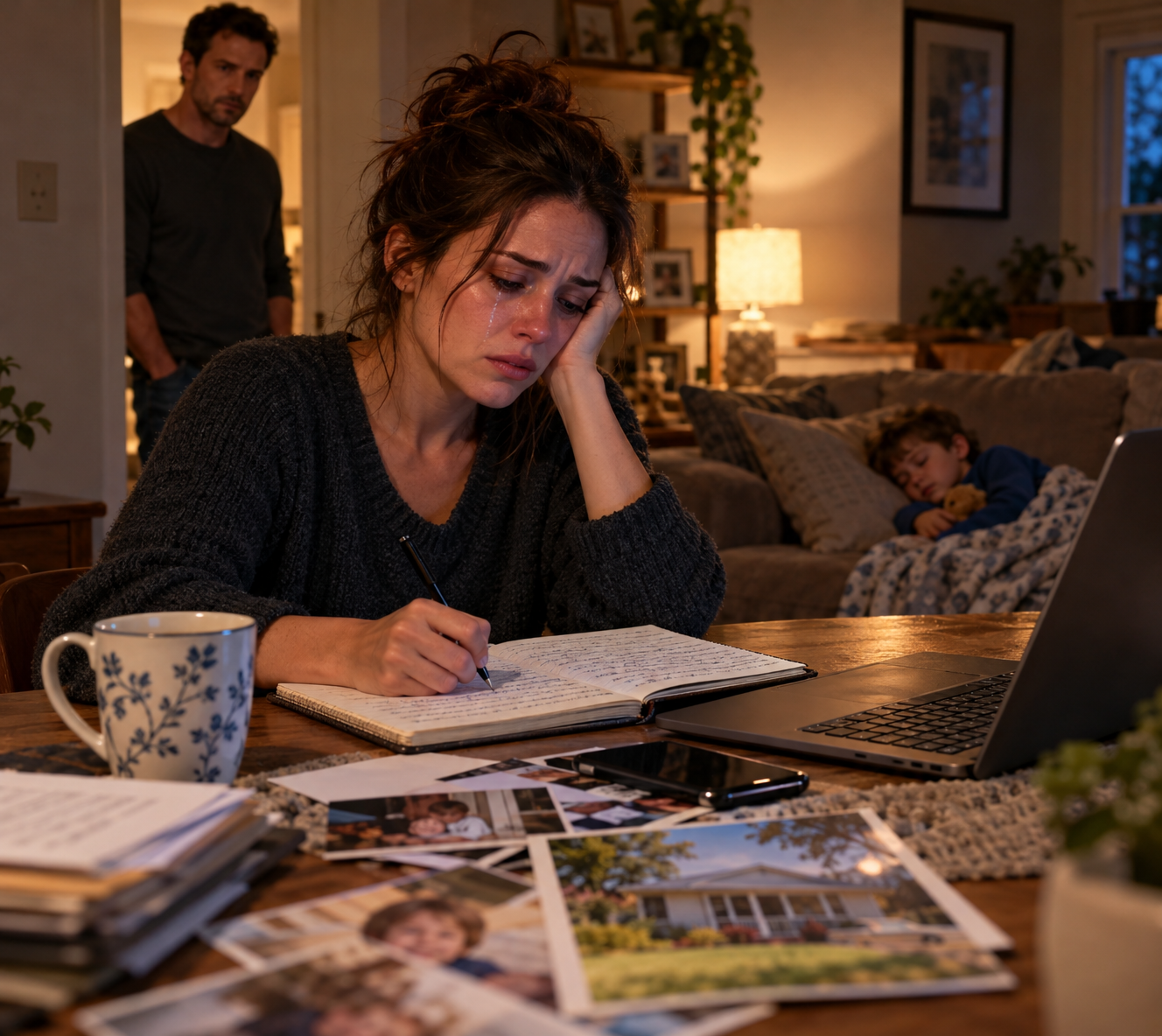
I had put the envelope down.
But I hadn't stopped thinking about what was inside it.
There was something I hadn't admitted to Mike.
Part of me wanted to know more.
Not because I wanted gossip.
Not because I thought Emily owed me another explanation.
I wanted to know whether she was going to be all right.
That was the part I couldn't settle.
I'd read her letter.
I'd seen the photograph.
I'd learned that Robert Whitmore was her father.
And I'd learned about Daniel.
But none of those things answered the question that mattered most to me.
Did Emily have enough for her babies now?
I looked at Mike.
He was still sitting across from me.
"Can I ask you something?"
He nodded.
"Of course."
"Do you think she has enough help?"
He considered it.
"I don't know, Rachel."
I looked down.
There it was again.
The same answer.
And the only honest one.
We didn't know.
Emily had told us about counting formula.
She had written about worrying over diapers.
She had explained how frightened she felt when her card stopped the transaction.
But she hadn't given us a full account of her circumstances.
She hadn't said what happened with every bill.
She hadn't explained every source of income.
And she hadn't asked either of us to investigate.
I knew all that.
Still, I wanted to know she was safe.
I rubbed the edge of the envelope with my thumb.
"That must sound strange."
"What?"
"Being this worried about someone I barely know."
Mike shook his head.
"Not really."
I looked at him.
"Yesterday, she was just a customer."
He waited.
"Now I keep thinking about her children."
He nodded.
I glanced at the photograph.
There was Robert Whitmore.
A man I'd recognized immediately.
A man whose businesses had become landmarks around town.
And beside him stood his daughter.
I'd looked at that picture so many times that I could remember it without holding it.
But I kept seeing another image too.
Emily at my register.
Her card between her fingers.
Her shoulders drawn inward.
The diapers on the counter.
Those two versions of her seemed so different.
Yet they belonged to the same woman.
I had to stop treating that difference as something that needed a dramatic explanation.
People's circumstances change.
Families fall apart.
Money becomes complicated.
And sometimes a person connected to wealth doesn't have the resources a stranger assumes they should.
I knew that now.
At least, I knew enough not to make the assumption again.
Mike moved slightly in his chair.
"You've been carrying this pretty heavily."
I nodded.
"I suppose I have."
"She didn't ask you to fix anything."
"I know."
I said it quickly.
Then I wished I hadn't.
Because it sounded as though I was defending myself.
Mike hadn't accused me of anything.
He had simply said what was true.
Emily had not asked me to solve her problems.
She had asked me to understand one moment.
That was different.
I looked down at the letter.
I'd already read it several times.
I knew where the handwriting changed.
I knew which lines had made me stop.
And I knew that the end of the passage left me with more questions than answers.
But reading it again wouldn't change those things.
It wouldn't produce the missing parts of her life.
It wouldn't tell me whether Robert and Emily had reconciled before his death.
It wouldn't tell me when Daniel died.
And it wouldn't tell me what financial arrangements Emily had.
The paper could only tell me what she'd written.
I thought about how often people do this.
Someone trusts us with a painful experience.
And instead of simply hearing them, we start searching for explanations.
We want causes.
We want someone to blame.
We want a solution.
Sometimes that comes from compassion.
Sometimes it comes from discomfort.
It's difficult to sit with another person's suffering when you can't do much about it.
I was learning that.
And I didn't particularly enjoy the lesson.
I preferred problems I could solve.
A price entered incorrectly.
A barcode that wouldn't scan.
A payment that needed another attempt.
Those had steps.
I knew what to do.
Emily's life wasn't a checkout problem.
There was no button I could press to make it right.
I looked at Mike.
"I don't want her to think I'm pitying her."
He nodded.
"I understand."
"I respect her."
"I know."
I paused.
"I don't know whether she knows that."
Mike looked at the envelope.
"You asked me to tell her."
I nodded.
That was true.
I'd already given him the message.
She wasn't failing her children.
She didn't owe me anything.
And I was glad I'd been able to help.
I had said everything necessary.
But worry can make a person repeat themselves.
I was doing exactly that.
I thought about how Emily had behaved at the store.
She had been embarrassed.
She'd tried to finish the purchase without drawing attention.
She had not asked the people behind her to listen to her problems.
She hadn't introduced herself as Robert Whitmore's daughter.
She hadn't asked me to make an exception because of her family name.
She'd simply tried to pay.
When the card failed, she had looked frightened.
I didn't know what she expected me to do.
But her letter told me what my response had meant.
I had treated her with respect.
That was what she'd remembered.
I realized how easily I could undo the spirit of that kindness if I became careless now.
I could tell other people about her.
I could repeat the details of her family argument.
I could turn Robert Whitmore's photograph into an interesting story.
I could make the encounter sound more dramatic than it had been.
People might listen.
They might be surprised.
They might ask questions.
And before long, Emily's private pain would belong to strangers.
I didn't want that.
I didn't want to become another person making her feel exposed.
I looked at Mike.
"I'm not going to tell people about her family."
He nodded.
"That's your choice."
"I mean the details."
"I understand."
"She trusted me."
He looked directly at me.
"Then keep her trust."
It was such a simple sentence.
I nearly smiled.
Mike had a way of saying things without decorating them.
I needed that.
Because I had been making everything more complicated than it had to be.
Keep her trust.
That was something I could do.
I couldn't make promises about her future.
I couldn't repair her relationship with a man who had died.
I couldn't bring back her husband.
But I could avoid adding to her worries.
I could keep the letter private.
I could leave her unanswered questions alone.
And I could treat her like a person rather than a family mystery.
I looked at the photograph again.
For a moment, I remembered the first time I recognized Robert.
The surprise had been immediate.
I had thought about all the property associated with him.
Commercial buildings.
A construction company.
The shopping center outside town.
I had wondered how his daughter could possibly need eight dollars.
Now I felt embarrassed by how quickly I'd connected those things.
Not because the question itself was unreasonable.
The contrast was real.
But because I'd allowed it to become more important than Emily's grief.
Robert Whitmore's money had attracted my attention.
Emily's words should have held it.
Eventually, they had.
I thought about Daniel.
He had been accused of wanting access to the family business.
He denied it.
He refused Robert's money.
He refused to apologize.
Emily chose him.
Those were the facts.
I didn't need to turn Daniel into a hero.
I didn't need to turn Robert into a villain.
Neither conclusion was supported by what Emily had written.
They were men I hadn't known.
Their argument belonged to a relationship I hadn't witnessed.
But the consequences reached the woman I'd met.
That was enough for me to understand why the letter mattered.
I lowered the photograph.
There was a particular kind of sadness in realizing you might never know the complete story.
I had expected answers when I opened the envelope.
Instead, I'd received a glimpse of someone else's life.
A glimpse wasn't the same as the whole thing.
I looked at Mike.
"Did she seem worried about giving me the letter?"
He considered the question.
"She wanted me to give it to you personally."
"That's all?"
"That's all I can tell you."
I nodded.
I wasn't going to press him further.
He had already been careful.
I needed to be careful too.
I touched the envelope.
I thought about the six years I'd spent at the grocery store.
Six years of meeting people for only a few minutes at a time.
Sometimes customers told me things.
They mentioned a sick relative.
A difficult week.
A problem at home.
Usually, I listened politely and continued working.
I didn't always know whether they wanted advice.
Most of the time, they didn't.
They wanted someone to hear them.
I realized that listening could be a form of respect.
Not every story needed my opinion.
Not every painful confession required a solution.
Sometimes the best thing I could do was accept what someone had chosen to share.
Without making demands.
Without asking for more.
Without trying to become important in their life.
That was what Emily's letter required from me.
I looked down.
"I think I understand now."
Mike smiled faintly.
"What?"
"Why she sent this."
He waited.
"She wanted me to know what yesterday was like for her."
I paused.
"Not to make me responsible for everything that happened before it."
Mike nodded.
"That sounds right."
I felt some of the tension leave my shoulders.
For the first time, I didn't feel as though I had to keep asking questions.
I could care about Emily without knowing everything.
I could worry about the twins without pretending I was their rescuer.
And I could be grateful for her letter without asking her to write another.
I folded the photograph into the letter.
Then I returned both to the envelope.
I was careful with the corners.
The paper made a soft sound.
I remembered the receipt printer at the store.
A much harsher sound.
A little strip of paper showing the amount someone had paid.
Emily had given me something different.
A letter showing what that payment meant.
I thought about those two pieces of paper.
One would have shown the transaction.
The other showed the person.
I knew which one mattered more.
I looked at Mike.
"Please give her the message when you can."
He nodded.
"I will."
I didn't ask him to promise a reply.
I didn't ask him to tell me what she said afterward.
I didn't ask for her telephone number.
I had no right to expect any of those things.
I had helped Emily because she needed help.
That was still the truth.
And I didn't want my curiosity to change it.
I held the envelope for another moment.
Then I put it away.
That was the first time I understood that respecting someone's privacy could be part of helping them.
Emily had already been forced to feel exposed at my register.
I wasn't going to expose her again.
Click here to continue reading: PART 18: The Eight Dollars and Forty-Two Cents Had Once Seemed Like a Small Purchase, but Emily Made Me See What Was Really at Stake
I Thought I Was Helping a Mother Buy Diapers, but the Photograph Mike Gave Me Made Everything Harder to Understand
Part 17 of 20