
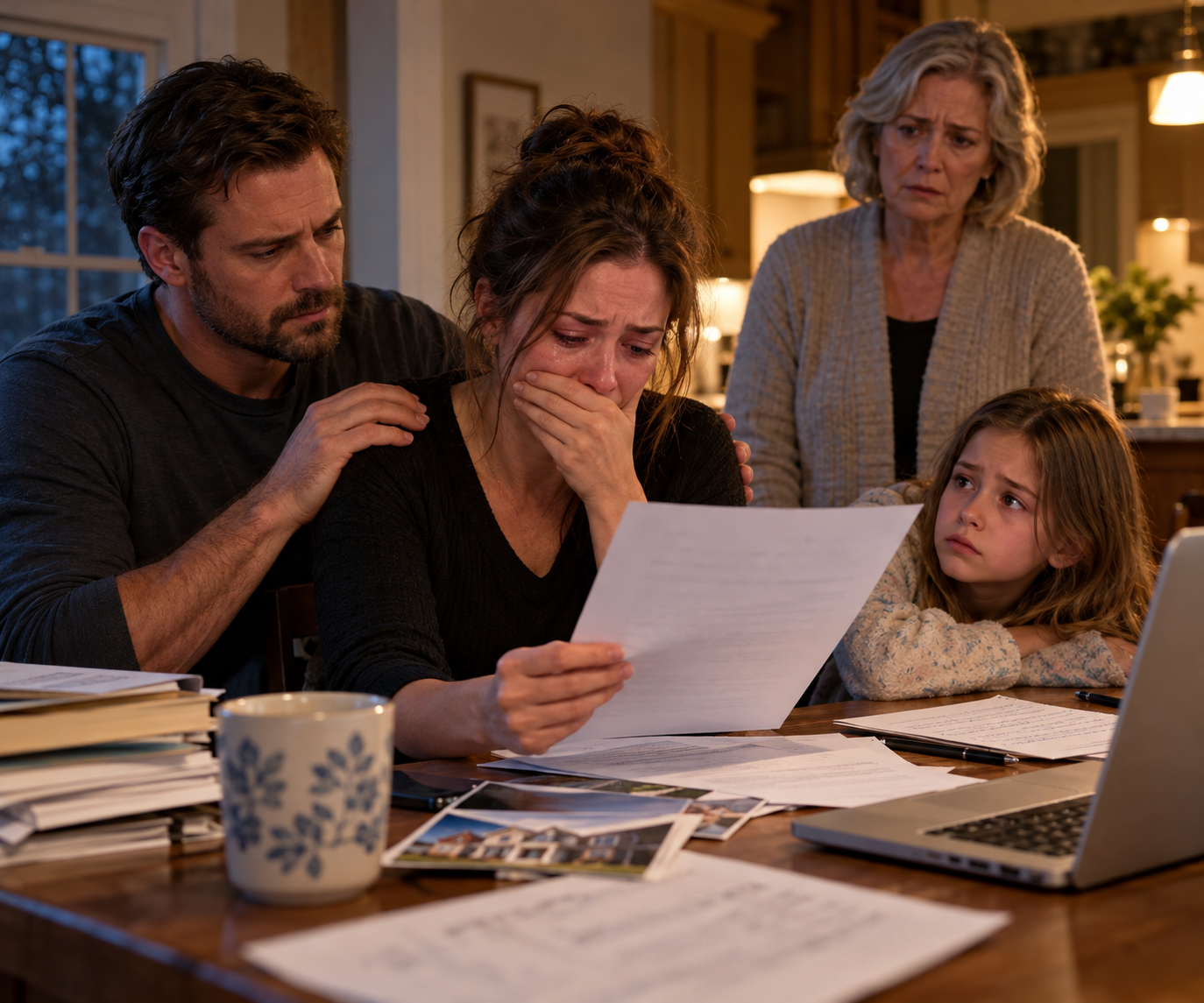
I couldn't settle.
Even when Ethan became quiet, my thoughts kept moving.
I went over the conversation at the barber's shop.
Then I went over the conversation in the car.
Then I returned to the moment the police knocked at our door.
Every time I reached the end, I started again.
I thought that if I remembered enough details, I might discover something I had missed.
But the memories remained the same.
The barber had noticed the area behind Ethan's ear.
He had been concerned.
I had been unable to explain it.
The officers had arrived and begun asking questions.
Nothing in that sequence told me why.
Ethan shifted beside me.
I stopped staring at the wall and looked at him.
"Are you comfortable?"
He nodded.
I pulled a cushion closer so he could rest his head.
He accepted it without speaking.
I wanted to ask what he was thinking.
I wanted to know whether he was frightened by the officers, worried about the mark, or simply exhausted by the long afternoon.
Instead, I let him sit quietly.
He deserved a little space.
I had begun to understand that my need for answers could easily become another burden for him.
Detective Alvarez returned after speaking with one of the other officers.
She asked whether I had a moment to talk.
I stood and followed her a short distance away, where Ethan could still see me.
She explained that they were continuing to gather information and that she wanted to make sure I understood the importance of keeping my own recollections separate from anything I might later hear from other people.
I listened carefully.
She wasn't accusing me of being unreliable.
She was explaining why it mattered to record what I had actually seen and heard.
I understood.
If I later remembered something clearly, I could share it.
If I only suspected something, I needed to identify it as a suspicion.
I agreed.
Then I asked whether I should write down everything I remembered from the barber's shop.
She said keeping an accurate account of the events could be useful.
I returned to the table and picked up my paper.
I wrote the date.
Then I wrote the approximate sequence of events as I remembered them.
The words came slowly.
I stopped whenever I realized I was about to add an explanation I couldn't support.
I wrote that Ethan had seemed reluctant to go.
I wrote that I hadn't asked him why.
I wrote that the barber had stopped cutting and examined the area behind Ethan's ear.
I wrote that he had asked whether anyone had looked at it before.
Then I wrote that I hadn't known what to say.
I read the notes again.
They looked almost painfully simple.
I had wanted to discover something important.
Instead, I had written down the things I knew.
Maybe that was the beginning of understanding.
I set the pen down.
Ethan had been watching me from the couch.
"What is it?"
"Just writing down what happened today."
"Why?"
"So I don't accidentally change the details in my memory."
He looked at the paper.
"Can I see?"
I brought it over.
He read a few lines.
His finger stopped beside the sentence about the barber.
"Is he in trouble?"
I sat beside him.
"I don't know."
Ethan's face tightened.
I explained that the police were trying to understand what had happened and that noticing something concerning didn't automatically mean a person had done anything wrong.
He listened.
I could see him trying to fit the explanation into what he had already experienced.
"Then why did the police come?"
"Because they need to understand the concern."
He looked at the paper again.
I wished I had a better answer.
But I wasn't going to invent one simply because he needed reassurance.
I took the paper back and placed it on the table.
"You haven't done anything wrong by not knowing," I told him.
He nodded.
I hoped the words would stay with him.
The detective returned to ask a few more questions about the timing of our trip to the shop.
I referred to my notes where I could.
When I wasn't sure of an exact time, I said so.
I didn't want to turn an estimate into a fact.
She asked whether I remembered the drive home clearly.
I described the questions I had asked Ethan and the way he had responded.
She asked whether he had seemed frightened.
I told her he had appeared worried, but I couldn't tell what he was worried about.
The detective accepted the answer.
After she left, I realized I was beginning to speak more carefully.
Earlier, I had tried to explain every feeling as if it were evidence.
Now I was learning to separate what I observed from what I feared.
The distinction did not make the afternoon easier.
It made it more honest.
Ethan asked whether he could go to his room for a little while.
I looked toward Detective Alvarez, who confirmed that we could discuss the arrangement with the officers.
After the necessary check, Ethan was allowed to take a short break.
I walked with him to his room.
His bed was unmade.
A book lay open near the pillow.
His sweatshirt was folded over the back of a chair, where he had left it earlier in the week.
I stood in the doorway while he climbed onto the bed.
He pulled the blanket over his legs.
I sat beside him.
For a while, he said nothing.
Then he asked whether we would still be able to do our usual things the next day.
The question hurt more than I expected.
He was trying to understand whether the police visit had changed everything.
I told him that I couldn't predict every part of the next day, but I would explain what I knew when I knew it.
He considered that.
"Can I still go to school?"
I told him we would follow the guidance we received and make the necessary arrangements.
He nodded slowly.
I could see that he wanted a simpler answer.
So did I.
I touched his shoulder.
"Whatever happens, you won't have to work it out alone."
He looked at me.
Then he turned toward the pillow.
I stayed beside him for a few more minutes.
I wanted to keep him in that room, away from the officers, the questions, and the uncertainty.
But I knew we couldn't make the problem disappear by pretending it wasn't there.
Eventually, I asked whether he wanted me to stay or return to the living room.
He said he wanted me to stay a little longer.
So I did.
The room was quiet except for the faint sound of voices from the hallway.
I watched the blanket rise and fall with his breathing.
He wasn't asleep.
I knew that because his fingers kept moving against the fabric.
I didn't ask him what he was thinking.
I had asked enough questions for one day.
After a while, he reached for my hand.
I held it until he was ready to sit up.
When we returned to the living room, Detective Alvarez was waiting.
She asked whether Ethan was feeling all right.
I said he was tired.
She nodded and explained that they would continue to be careful about how they spoke with him.
I thanked her.
Then I asked the question I had been carrying since the moment the barber stopped cutting.
"Is there something about the mark itself that makes you think something happened to him?"
Detective Alvarez considered her answer.
She explained that the concern required assessment and that she did not want to draw a conclusion before the available information had been examined.
I stared at her.
I wanted to argue.
I wanted to tell her that every minute without an answer felt unbearable.
But I could see that she wasn't dismissing my concern.
She was refusing to guess.
I forced myself to nod.
"All right."
It was not all right.
Not emotionally.
But I understood the reason for her caution.
And I wanted the truth more than I wanted a quick explanation.
The detective returned to her work.
I sat beside Ethan again.
He leaned against my shoulder.
I thought about the notes on the table.
They were plain.
They contained no grand discovery, no explanation, and no answer that could make the afternoon feel less frightening.
But they were accurate.
I had finally stopped asking my memory to provide what it did not contain.
I could not change the moment at the barber's shop.
I could not recover every detail I might have missed.
I could not make the officers finish their work faster.
What I could do was keep my account honest.
I could give Ethan room to speak without demanding that he solve the problem.
I could accept help from people who knew how to handle a situation I had never faced before.
And I could stop blaming myself for not having known something before I had a reason to look.
I sat there until the room grew quieter.
Ethan's hand remained in mine.
The paper stayed on the table.
For the first time that afternoon, I allowed myself to stop searching my memories for a few minutes.
Not because I had found an answer.
Because I needed to be present while we waited for one.
Click here to continue reading: PART 8: As Evening Settled Over the House, I Had to Accept That the First Step Toward the Truth Was Admitting How Little We Knew
The Small Detail Behind My Son’s Ear That Turned an Ordinary Afternoon Into Something I Could No Longer Explain
Part 7 of 20

One Comment on “PART 7 – The More I Tried to Reconstruct the Day, the More I Realized That Love Could Not Replace the Answers We Needed”