The hospital room became the center of my world.
I stopped thinking about the house.
I stopped thinking about the things I had left unfinished.
Even the phone calls I had made before coming to Knoxville seemed far away.
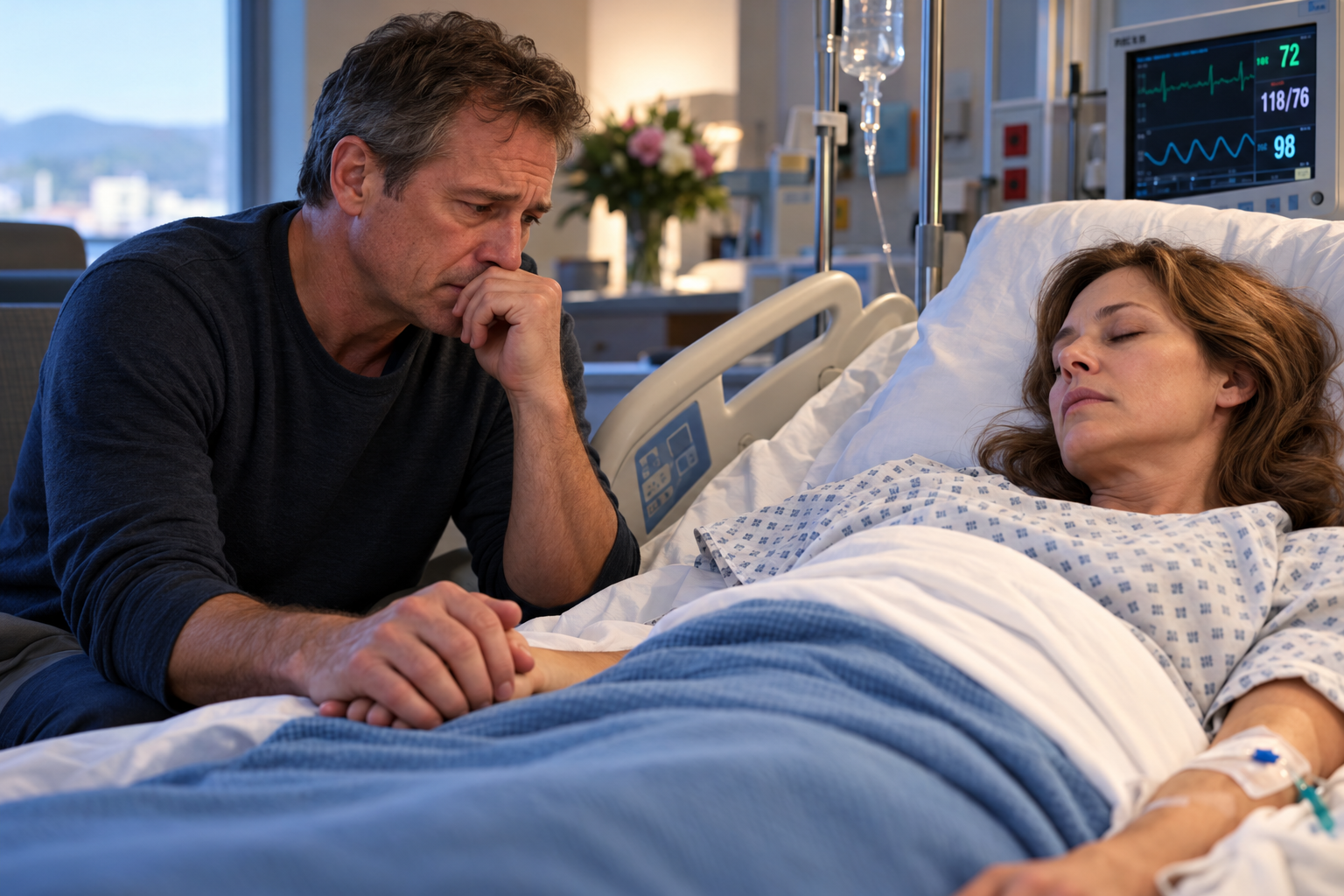
There was only Maggie in that bed and the hope that she would open her eyes.
I kept my phone beside me.
Every time it moved or made a sound, I reached for it.
Most of the time, it was nothing important.
A message about an ordinary matter.
A notification I would normally have ignored.
I began turning the phone facedown between calls because I couldn't stand the way I reacted to every little sound.
I had spent days waiting for Maggie to contact me.
Now that I was beside her, I wished I could take back all the time I had spent waiting at home.
I knew I couldn't.
That was the problem with regret.
It offered no useful place to go.
A nurse came in to check Maggie again.
I stepped aside and watched quietly.
When she finished, I asked whether Maggie seemed any more responsive.
The nurse explained that her condition was being monitored and that they needed to allow time for the effects of the medication to lessen.
I thanked her.
Then I returned to the chair.
The chair had a hard back and a narrow seat.
After a while, my legs began to ache.
I barely noticed.
I kept looking at Maggie's hand.
I had held that hand for years.
I had held it while we walked through crowded places, while we sat together in waiting rooms, and while we listened to difficult news about people we loved.
I had held it so often that I had stopped thinking about what it meant.
Now I was afraid to let go.
I remembered the morning she left.
She had carried her bag to the car without asking for help.
I had offered to drive her, and she had declined.
At the time, I thought nothing of it.
Now I wondered whether I should have insisted on taking her.
Perhaps I could have spent the drive talking to her.
Perhaps I would have noticed something that mattered.
Or perhaps the same thing would have happened regardless.
I had no way to know.
I tried not to build a different past in my head.
It was difficult.
At some point, I realized I was hungry.
I went to the hospital cafeteria and bought a sandwich.
I carried it back to the room and set it beside my phone.
I ate a few bites without tasting anything.
Then I folded the wrapper and put it in the bin.
When I returned to the chair, I noticed how quiet the room had become.
The sounds from the corridor were muffled by the door.
Maggie lay still beneath the blanket.
I wanted to ask her questions.
I wanted to know whether she remembered arriving in Knoxville.
I wanted to know what our son had told her.
I wanted to know whether she had felt sick before she became unable to answer her phone.
But asking those questions while she couldn't respond felt pointless.
So I waited.
Waiting had become something I knew how to do.
I only wished I had learned sooner when waiting was the wrong choice.
The doctor stopped by again to explain that the team was continuing to assess Maggie's condition.
I asked whether there was anything I could do.
She told me that being present and providing information about Maggie's usual health and medications could be helpful.
I explained that Maggie rarely took medicine.
I told her I knew of no strong sedative prescription she was using.
I tried to be precise.
I didn't want to make a statement that sounded more certain than I could honestly be.
There might have been something I didn't know.
That possibility bothered me.
A marriage could last for years without either person knowing every detail about the other's life.
I had always thought that was normal.
Now I wondered whether I had mistaken privacy for understanding.
The doctor listened and made a note.
She didn't treat my uncertainty as an answer.
She simply took it into account.
After she left, I looked at Maggie again.
“I wish you'd told me you were having trouble.”
I stopped.
I couldn't know whether she had been having trouble before she became ill.
I was speaking to the version of the story I had built in my head.
I corrected myself.
“I wish I knew what happened.”
That was the truth.
I wasn't angry with Maggie.
Not anymore.
I was frightened, and fear kept trying to turn itself into questions I couldn't answer.
I leaned back in the chair.
The hospital clock continued to move.
At home, I had watched a clock while waiting for her to call.
Here, I watched another one while hoping she would wake.
The difference was that I could no longer pretend the hours were ordinary.
A nurse asked whether I wanted to step out for a little while.
I told her I was all right.
She didn't argue.
She only reminded me that I could call for help if I needed anything.
I appreciated her kindness.
I also felt embarrassed that a stranger had to remind me to take care of myself.
Maggie would have told me to eat something.
She would have told me not to sit in one place until my back hurt.
She would have said I was no use to anybody if I made myself sick.
I could almost hear her saying it.
For a moment, the memory made me smile.
Then the smile disappeared.
I reached for her hand again.
I didn't know when she would be able to speak.
I didn't know what she would remember.
I didn't know whether the explanation would be simple or complicated.
But I knew I needed to hear her side of those four days.
Not because I wanted someone to blame.
Because I wanted to understand what had happened to my wife.
And because, for the first time in our marriage, I was afraid that there might be something important about her suffering that I had never noticed.
Click here to continue reading: PART 7: The More I Thought About Maggie’s Journey, the More I Realized That My Assumptions Had Left Me With Questions No One Could Answer Yet
I Thought My Wife Was Simply Busy Helping Our Son Until Four Days of Silence Turned an Ordinary Family Visit Into Something I Couldn’t Ignore
Part 6 of 16