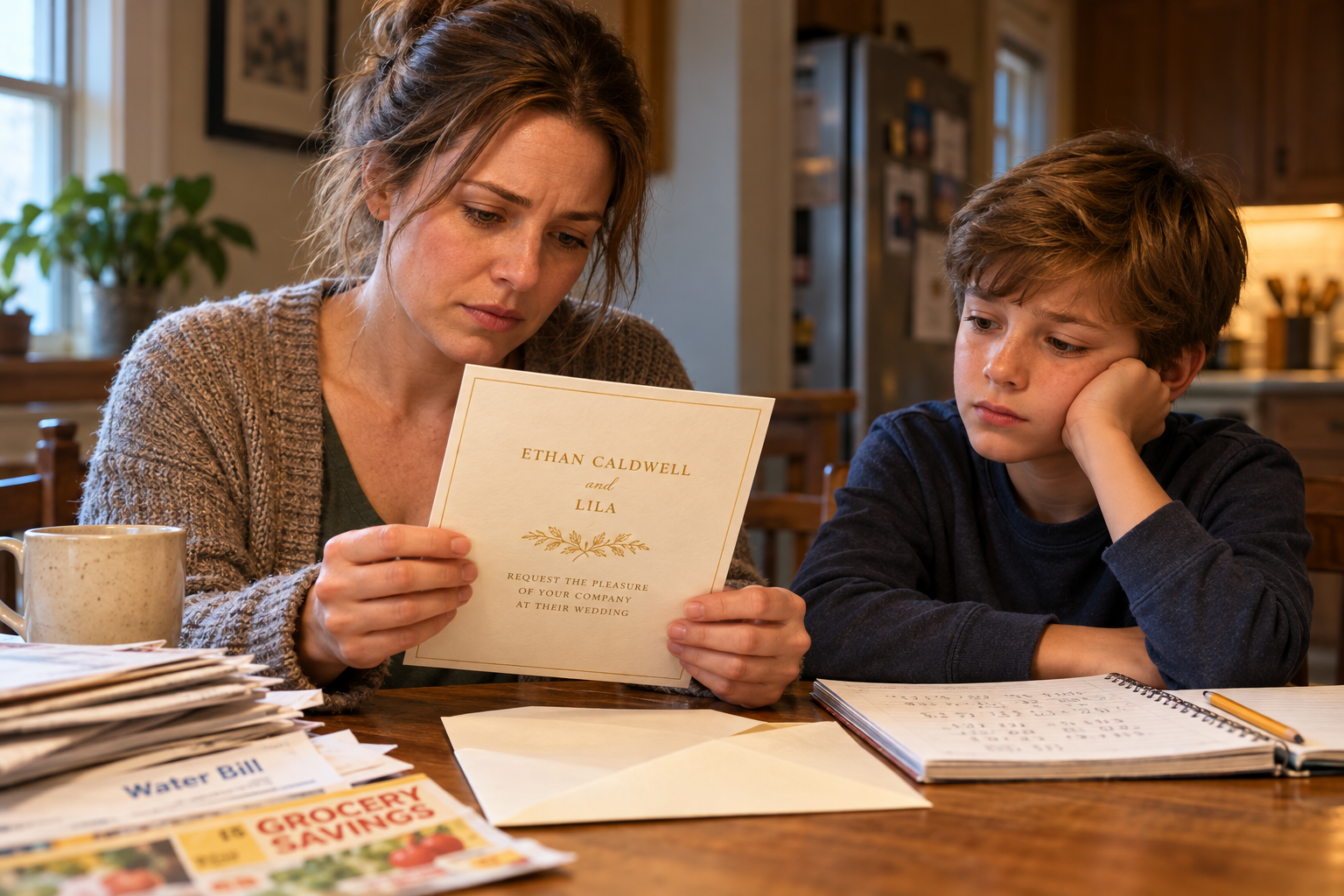
Over the next few days, the wedding invitation stayed in the kitchen drawer.
I didn't hide it because I was ashamed of it.
I kept it there because I didn't want Noah to feel that he had to look at it every time he entered the room.
He already knew the wedding was coming.
He didn't need a reminder.
On Saturday morning, he asked whether we could go to the grocery store together.
We usually shopped on Sundays, but I agreed.
He walked beside the cart, choosing apples and checking the prices on cereal boxes. He was old enough to notice when I picked the less expensive brand, though he had stopped asking questions about it.
At the checkout, he watched me count the money in my wallet.
"Are you worried about something?" he asked.
I looked up.
"Why do you ask?"
"You keep checking your phone."
I put it in my pocket.
"I'm waiting for a message."
"From Dad?"
I didn't answer quickly enough.
Noah looked away.
I hated that he could read my hesitation so easily.
"Yes," I said. "From your dad."
"What does he need?"
"I don't know yet."
We carried the groceries to the car.
On the drive home, Noah watched the houses pass outside his window. He had always liked looking at people's gardens, especially the ones with neat rows of flowers and small signs showing the names of the plants.
He pointed out a house with a bright yellow front door.
Then he went quiet again.
I knew he was thinking about the wedding.
I was too.
I remembered the early years of my marriage, when Ethan and I could make plans without turning them into negotiations. We had been young enough to believe that love meant wanting the same things at the same time.
When Noah was born, Ethan held him carefully and promised that he would never let our son feel unwanted.
I believed him.
I still believed he had meant it when he said it.
That was part of what made the divorce so difficult. People like to imagine that a marriage ends because one person stops caring.
Sometimes, two people can care and still hurt each other until the relationship becomes something neither of them knows how to repair.
Ethan and I had reached that point.
By the time we separated, I was tired of explaining why certain things mattered to me. He was tired of feeling criticized. Every disagreement seemed to become a contest over who had been misunderstood.
Eventually, we stopped trying to understand each other.
Six months later, he was preparing to marry Lila.
I didn't resent him for moving forward.
At least, that was what I told myself.
What I resented was the possibility that he could build a new life while expecting Noah and me to make the transition look easy.
That afternoon, I took the invitation out of the drawer and read it again.
The paper was heavy.
The lettering was precise.
There was nothing personal about it.
I imagined the guests receiving similar envelopes. Friends, relatives, acquaintances who knew Ethan through work or social events.
They would see his name beside Lila's.
They would see a man beginning a new chapter.
They might even ask how his son was doing.
Ethan could tell them Noah was fine.
He could say that he had invited him to the wedding and that he wanted him there.
And if Noah attended, there might be photographs.
A father and son standing together.
A family looking perfectly acceptable from the outside.
I put the invitation down.
I was making assumptions again.
That was the problem with a marriage that ended badly. Even after the arguments stopped, your mind kept trying to finish them.
I couldn't know what Ethan intended unless he told me.
So I called him.
He answered after several rings.
"Hello?"
"It's me."
"I know."
His voice was familiar enough to make me remember how many years I had spent listening for changes in his tone.
"Did you get my message?" he asked.
"I did."
"Good."
There was a pause.
I looked at the invitation on the counter.
"I wanted to talk about Noah."
"All right."
"He's not sure whether he wants to attend."
Ethan exhaled.
"Well, I hope he comes."
"I know. But he needs to understand what the day will be like."
"It's a wedding. People will be there. We'll have a ceremony and a reception."
"I understand that."
"What are you asking me, exactly?"
I pressed my fingers against the counter.
"I want to know what you've told him."
"I haven't spoken to him about it yet."
I closed my eyes.
"You haven't?"
"I thought you would explain the invitation."
For a moment, I couldn't speak.
Ethan continued before I could answer.
"I sent it to both of you. I assumed you'd discuss it."
I looked at the gold lettering again.
"You assumed I'd explain your wedding to our son?"
"I didn't say it like that."
"No. You didn't."
I heard my voice becoming sharper, and I tried to slow down.
"I'm not trying to make this difficult, Ethan. I'm asking you to speak to Noah yourself."
"I will."
"When?"
"Soon."
The answer sounded exactly like the answers he had given me during the final months of our marriage.
Soon.
Later.
When things settled down.
I had once treated those words as promises.
Now I understood that they could also be ways of ending a conversation without resolving anything.
"He's your son," I said.
"I know that."
"Then talk to him."
Ethan went quiet.
For a second, I thought he might argue.
Instead, he said, "I'll call him this weekend."
"Thank you."
I ended the call before I could say anything else.
My hands were shaking.
Not because the conversation had been terrible. It hadn't.
That was what made it difficult.
There had been no shouting, no insults, nothing dramatic enough to explain why I felt so exhausted.
Just the familiar feeling that I had once again been given responsibility for something Ethan should have handled himself.
I stood in the kitchen until the feeling passed.
Then I put the invitation back in the drawer.
That evening, Noah came downstairs while I was preparing dinner.
"Did Dad call?"
"Not yet."
He nodded.
I waited for him to ask another question.
He didn't.
Instead, he took two plates from the cupboard and set them on the table.
I watched him line them up carefully.
He was learning how to live with uncertainty by making small things orderly.
I recognized the habit because I had developed it myself.
After dinner, we sat together on the couch.
Noah leaned against me, something he had started doing less often as he grew older.
I put an arm around his shoulders.
"You know you don't have to protect my feelings about your dad, right?"
He looked up.
"What do you mean?"
"If you want to go to the wedding, you can go. If you don't want to go, that's okay too. You don't have to choose based on what you think I want."
He considered that.
"Would you be sad if I went?"
I thought about the question.
The honest answer was complicated.
I might feel lonely that day. I might wonder what Ethan and Lila's new life would look like. I might remember the things I had hoped my marriage would become.
But none of those feelings belonged to Noah.
"A little," I admitted. "But that doesn't mean you should stay home."
He rested his head against my shoulder again.
"Okay."
We watched television until his bedtime.
For the first time since the invitation arrived, I felt that I had done something useful.
I hadn't solved the problem.
I had simply stopped asking my son to carry a piece of it for me.
The following morning, Ethan sent a short message.
He said he planned to speak to Noah that evening.
I read it and put my phone down.
This time, I didn't reply.
There was nothing left for me to arrange.
Click here to continue reading: PART 4: When Ethan Finally Spoke to Noah, I Began to Understand Why the Invitation Had Felt Different From an Ordinary Wedding Announcement
The Wedding Invitation That Arrived Before I Was Ready to Explain What His Father Had Done
Part 3 of 20