I found myself thinking about the blue house more than the woman.
At first, I did not understand why.
Her face was what had caught my attention.
She resembled David.
She had appeared in a photograph carrying a message that sounded important.
It seemed natural that I would keep wondering who she was.
But the house stayed with me.
I remembered the faded paint.
The front of the old sedan.
The way the woman stood as if she had been photographed during an ordinary day.
There was nothing remarkable about the building itself.
That was what made it difficult to forget.
I wondered whether the house was connected to the sentence on the back.
Maybe the woman knew something about the place.
Maybe the place was where something had happened.
Maybe neither possibility was correct.
I had no evidence that the house was anything more than the setting for a photograph.
Still, I could not ignore the fact that David had chosen to preserve the image.
He could have written the sentence on a blank piece of paper.
He could have written a name.
Instead, he had left the words attached to a picture of a particular woman in front of a particular house.
I wondered whether that choice mattered.
I also wondered whether I was searching for meaning because I needed something to hold on to.
When a person you love leaves an unexplained message behind, it is tempting to treat every detail as a clue.
The difficulty is knowing which details truly matter.
I had learned that the hard way.
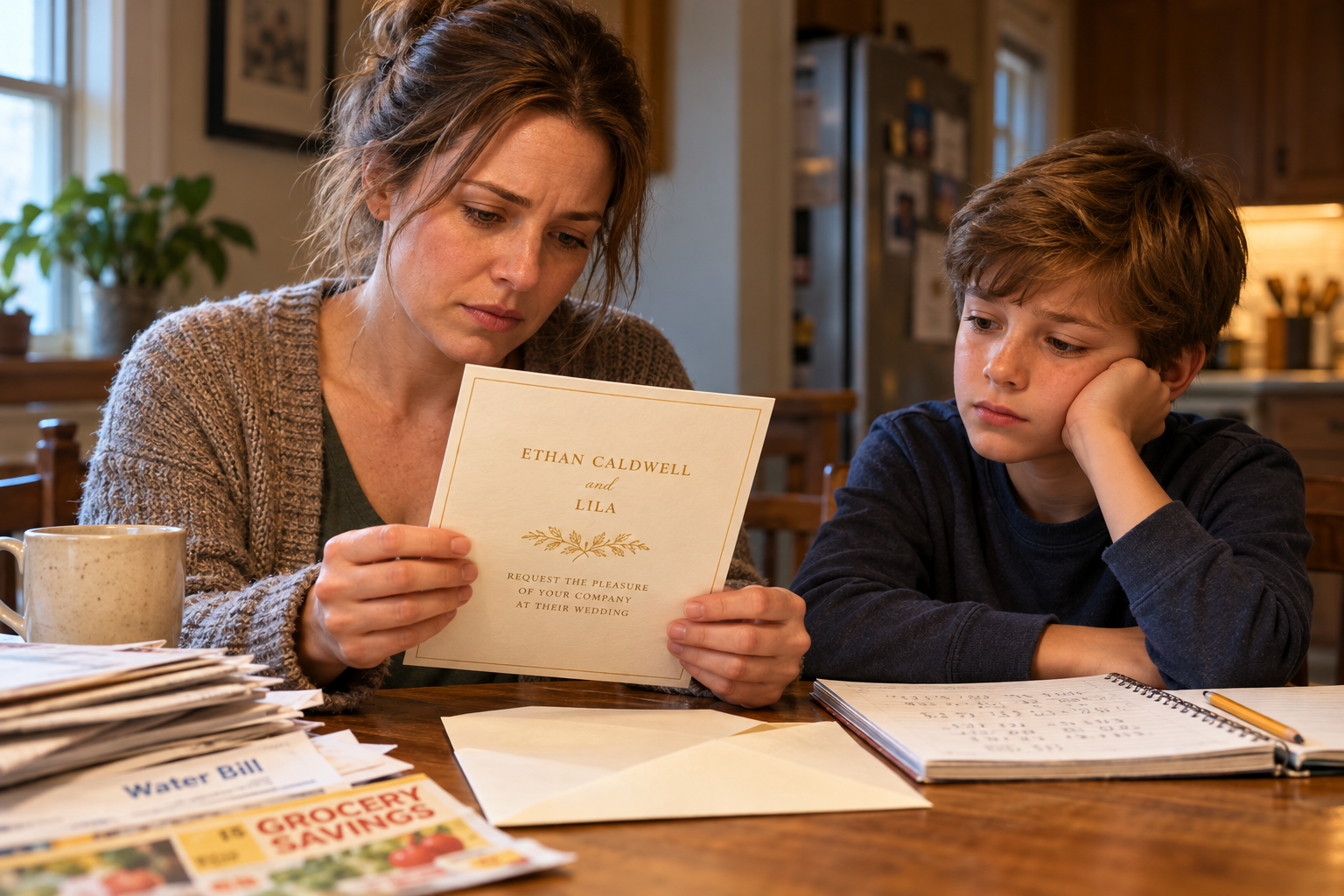
One afternoon, Ethan found me looking at the photograph again.
He pulled out a chair and sat across from me.
"You're looking at the house now."
I looked up.
"Am I that obvious?"
"A little."
I almost laughed.
It was the first time in days that the subject had felt even slightly ordinary.
I turned the photograph toward him.
"I keep wondering why Dad kept this particular picture."
Ethan studied the front.
"Maybe he knew the woman."
"Maybe."
"Or maybe he wanted someone to recognize the house."
I looked at him.
That was another possibility I had not been able to settle.
The sentence did not tell us whether the woman herself held the answer or whether she could lead someone toward it.
The wording suggested a connection.
It did not explain what kind.
I looked at the photograph again.
The woman had one hand resting on the car.
Her smile looked relaxed.
I tried to imagine the moment when the picture was taken, but I stopped myself before I invented too much.
I did not know who had held the camera.
I did not know whether the woman had known she was being photographed for a reason.
I did not know whether David had been there.
Those were important gaps.
Without answers, even the simplest imagined scene could lead us in the wrong direction.
I told Ethan that.
He nodded.
"I know. I'm just trying to think."
"I know you are."
I wanted him to keep thinking.
I only wanted us to remember that our ideas were possibilities, not facts.
That distinction had become important to me.
I had spent too many days feeling as though I had to turn uncertainty into something definite.
Now I was beginning to see that we could leave a question open without abandoning it.
Ethan leaned back.
"Do you think we'll ever find out?"
I looked at the photograph.
"I hope so."
It was an honest answer.
I did not know whether the truth was still within reach.
I did not know whether the woman could be identified from the picture.
I did not know whether David had left any other explanation behind.
I could not promise that the questions would eventually lead us somewhere.
But I could admit that I wanted them to.
Ethan seemed to accept that.
He looked at the blue house one more time before pushing the photograph gently toward me.
I placed it back on the table.
For a while, we talked about other things.
That was important, too.
We needed moments when our lives were not organized around the same unanswered sentence.
We needed to remember that we were still a mother and son, not just two people trying to understand a photograph.
I began paying attention to those ordinary moments.
When Ethan asked me a question, I tried to listen without searching for a hidden meaning.
When he told me something about his day, I let the conversation follow its own direction.
When he went quiet, I stopped assuming that silence meant trouble.
I was not always successful.
Sometimes my worry returned before I could stop it.
Sometimes I wanted to ask about 3025 even when the conversation had nothing to do with it.
But I tried.
That was all I could offer.
One evening, I picked up the photograph and turned it over.
David's sentence seemed even more deliberate in the quiet room.
She knows where the truth is.
I wondered whether he had written those words because he was afraid.
I wondered whether he had been trying to protect someone.
I wondered whether the sentence had been meant for a person who already understood part of the story.
Each possibility carried its own weight.
None could be proven.
I put the photograph down.
I was tired of allowing my imagination to turn one sentence into a dozen different explanations.
The message was important enough to preserve.
That much seemed clear.
Beyond that, I had to be patient.
I thought about the way Ethan had looked at me when he asked whether David had meant him to find the picture.
I remembered how carefully he had listened when I admitted I did not know.
I had wanted to protect him from disappointment.
Instead, I had discovered that honesty could make room for a different kind of trust.
I did not need to promise him a solution.
I needed to show him that I would not invent one.
That evening, Ethan came back into the room.
He looked at the photograph, then at me.
"I think we should keep it exactly as it is."
I nodded.
"I agree."
We did not write anything on it.
We did not mark the woman's face or try to add our own explanations.
We left David's words untouched.
The photograph had come to us with questions attached.
We would not make those questions harder to answer by pretending we already knew what they meant.
I put it away carefully.
The blue house remained in my mind, but I no longer tried to force it to tell me something.
I was beginning to understand that patience was not the same as giving up.
It was simply refusing to confuse a guess with the truth.
Click here to continue reading: PART 11: I Had Always Believed David Would Tell Me What Mattered, Until His Handwriting Made Me Question How Much of His Life I Had Never Seen
I Thought My Son Was Hiding Something Small Until One Question Made Me Wonder What He Had Been Carrying Alone
Part 10 of 20