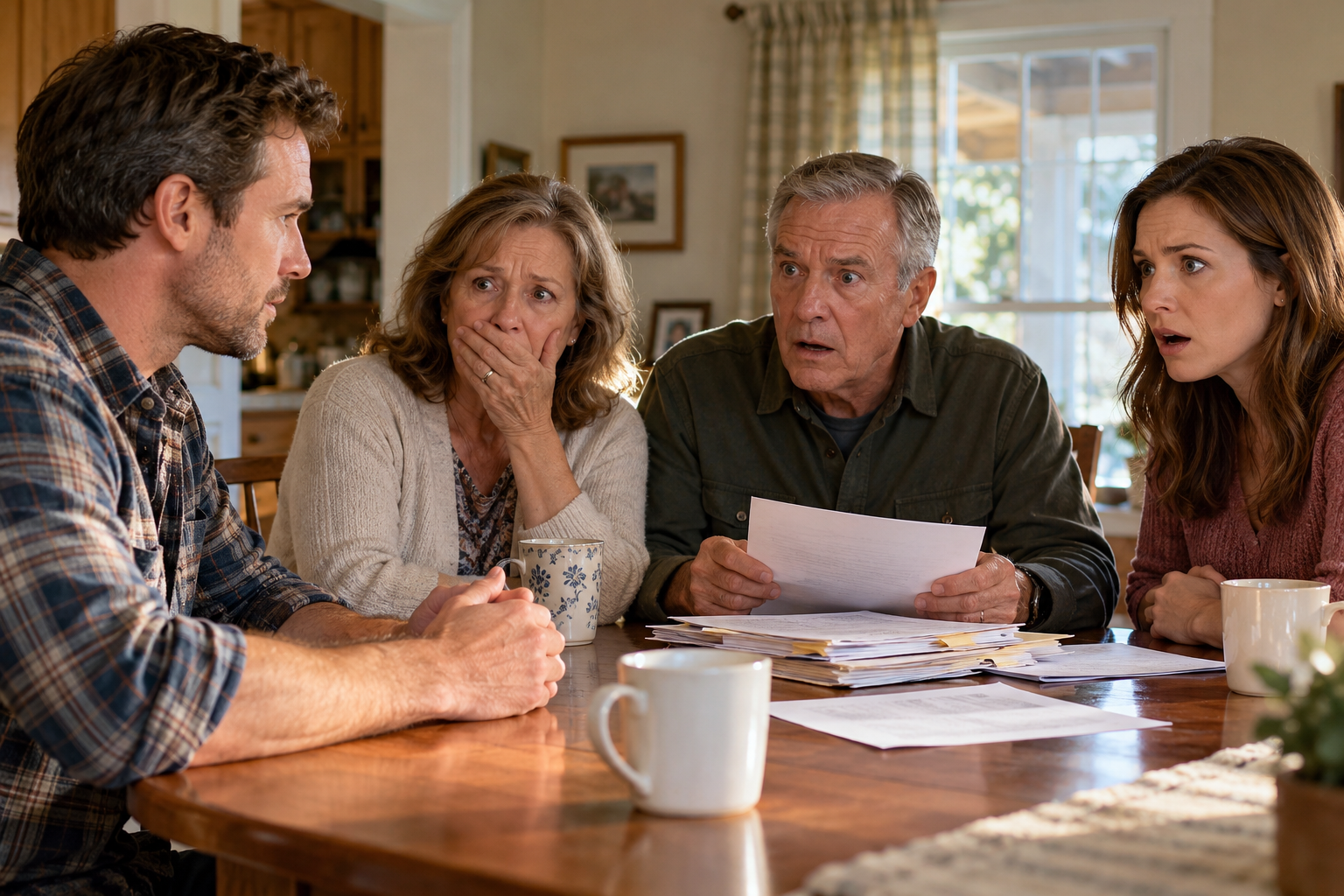
I gave my father the time he'd asked for.
I didn't call the next morning.
I didn't send another message that afternoon.
I tried to let him decide when he was ready to talk.
That was harder than it should have been.
I had spent years waiting for my father to acknowledge things he preferred not to discuss.
I knew how easily a promise could become an excuse for silence.
Still, I wanted to give him a chance.
The first day passed without a call.
On the second, I checked my phone more often than I wanted to admit.
On the third, I stopped checking it altogether for a few hours.
Nothing changed.
I kept thinking about the conversation we'd had.
He had said there were things about the family I didn't understand.
He had said my sister had been dealing with a lot.
He had said my parents were trying to help where they could.
But he hadn't explained why my name seemed connected to money I had never received.
I could have accepted that he needed time.
What troubled me was how carefully he had avoided the question.
I knew my father.
He wasn't a man who liked being questioned about decisions he'd already made.
When I was younger, I sometimes mistook his confidence for certainty.
As I grew older, I realized he could be wrong and still refuse to reconsider.
That didn't make him a bad father.
It made him difficult to understand when something went wrong.
I didn't want to assume the worst about him.
I also didn't want to keep making excuses for him.
The farm sale had given me a rare opportunity to look at my life without the constant pressure of making the next payment or managing the next season.
I had money.
I had time.
I had no reason to let fear decide what I asked my family.
So I returned to the kitchen table one morning and looked at the notes I'd written.
The list was still short.
My father had discussed money for Fay.
My sister had described me as financially incapable.
I had received nothing from my parents.
Neither of them had explained the connection.
I read the list twice.
Then I added one more line.
My father had promised to explain.
I left the pen beside the paper.
I wasn't going to turn the notes into a case against my family.
I only wanted to remember what had actually happened.
Later that day, my mother called.
I answered before the second ring.
"How are you doing?"
"I'm all right. How about you?"
She said she was fine.
For a few moments, we talked about ordinary things.
She asked whether I was keeping busy.
I told her I was taking care of some details following the farm sale.
I caught myself before saying anything more.
She didn't ask what details.
Instead, she asked whether I'd spoken to my father.
"Yes," I said.
"And?"
"He said we'd talk again."
My mother went quiet.
I could hear a faint rustling sound on her end of the line.
Then she said, "Your father doesn't always know how to explain things."
I looked toward the window.
"Is there something I should know?"
She hesitated.
"I don't want you and your sister fighting."
"Neither do I."
"Families can misunderstand each other."
"I know."
She seemed relieved that I hadn't argued.
Then she said something that made me sit straighter.
"You have to remember that your father and I have always tried to do what we thought was right."
I didn't know how to answer that.
It sounded like a defense offered before an accusation had even been made.
"I haven't said otherwise," I told her.
"I just don't want this to become a bigger problem."
I rubbed my forehead.
"Then I need to understand what the problem is."
She didn't answer directly.
Instead, she said she'd speak to my father.
Then the conversation moved back to ordinary subjects, as if we'd never approached anything difficult.
When we hung up, I sat quietly for a while.
My mother hadn't explained the money.
But she hadn't sounded surprised that I wanted an explanation.
That bothered me more than I expected.
I had always thought of her as the person who tried to keep everyone together.
She avoided arguments.
She softened my father's sharper comments.
She sometimes changed the subject when my sister and I disagreed.
I had assumed she did those things because she wanted peace.
Now I wondered how much she knew about the conversations happening when I wasn't around.
I didn't like the question.
I didn't want to turn every memory into evidence of a secret.
But I couldn't ignore the possibility that my mother understood more than she was willing to say.
That evening, I considered telling her about the sale.
I imagined explaining the amount and letting her react.
Maybe she would finally understand that I hadn't been waiting for my parents to rescue me.
Maybe she'd ask why I had kept the sale quiet.
Maybe the entire conversation would become easier once she knew.
Then I realized what I was doing.
I was trying to use the money to force an honest conversation.
If my mother reacted with surprise, I might mistake that for understanding.
If she reacted with excitement, I might mistake that for acceptance.
And if she became defensive, I might mistake that for proof of something worse.
The number would change the conversation before I had a chance to learn what she really thought.
So I kept quiet.
The next morning, I went outside early.
The air was cool, and the ground was still damp.
I walked around the yard without any particular destination.
For years, my mornings had belonged to the farm.
There was always something waiting for me.
A job that couldn't be delayed.
A problem that needed fixing.
A decision that had to be made before the day grew too hot.
Now I could walk without thinking about the next task.
I should have felt free.
Instead, I found myself thinking about the front porch at my parents' house.
I remembered the grocery bags pulling against my fingers.
I remembered my father's question.
Most of all, I remembered how ordinary the conversation had sounded before I realized it concerned something I knew nothing about.
That was what made it difficult to forget.
No one had been shouting.
No one had been making dramatic accusations.
My sister had simply spoken about my financial situation as if she understood it.
My father had simply asked about money he believed had already been given.
They had sounded comfortable discussing it.
As though the arrangement was familiar.
I stopped walking.
I had no proof that my family had deliberately misled me.
But I had enough reason to ask for an explanation.
I went back inside and picked up my phone.
There was still no message from my father.
I decided I would give him until the following day.
After that, I would ask him again.
Not because I wanted to pressure him.
Because I had already waited long enough for someone else to decide whether my questions deserved an answer.
Click here to continue reading: PART 10: When My Mother Finally Admitted She Knew More Than She Had Said, I Realized Our Family’s Silence Was Not an Accident
My Family Thought I Was Broke, Until I Heard My Father Ask Where the Money for My Sister Had Gone
Part 9 of 20