
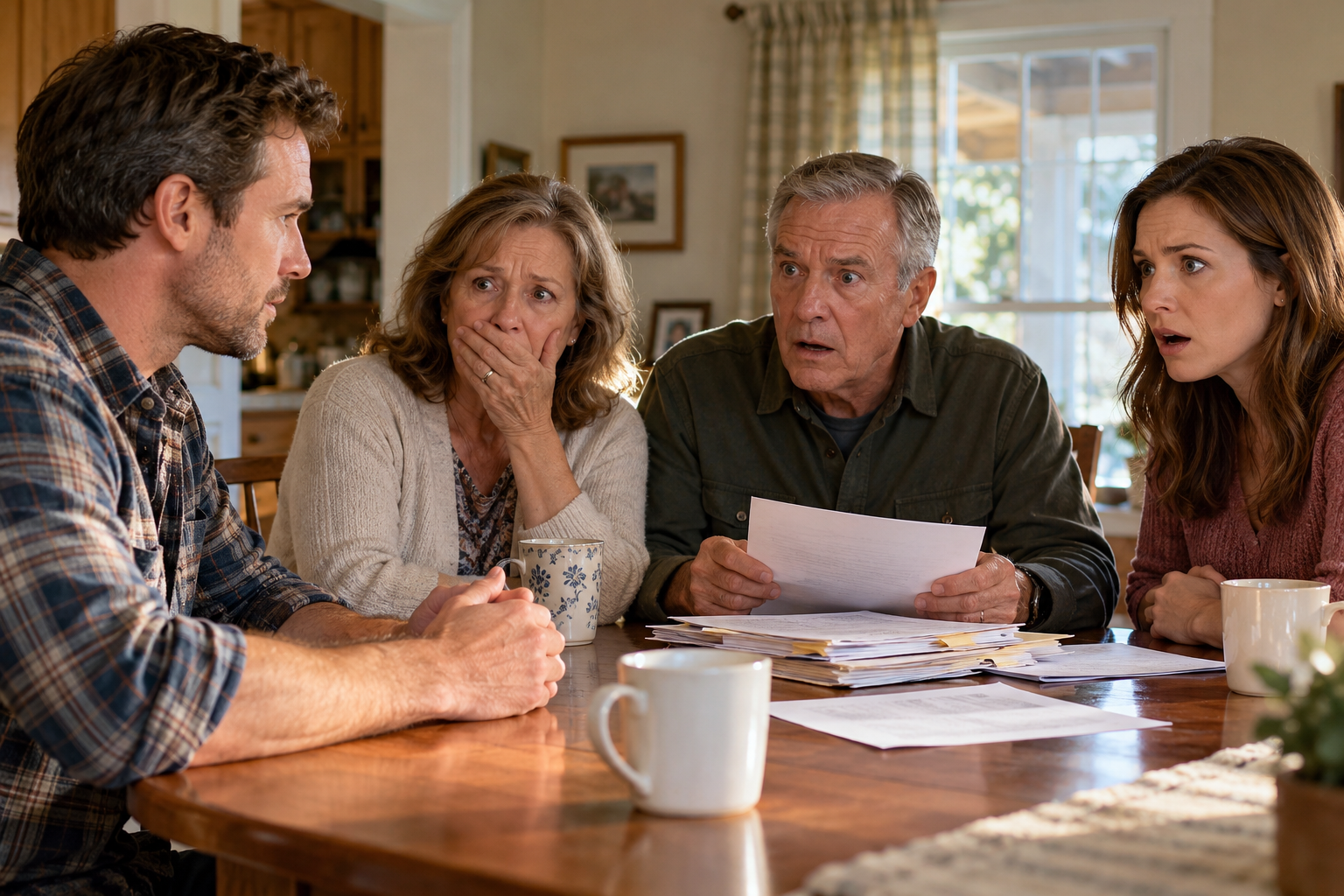
Nobody spoke for several seconds.
My mother was the first to move.
She lowered her hand and looked at me as though she were trying to decide whether she'd heard correctly.
"Thirty-nine million?"
"Yes."
My father looked at the papers in front of him.
Then he looked back at me.
"When did this happen?"
"Three days before I first came over with the groceries."
He seemed to search his memory.
The groceries.
The porch.
The day I'd heard him ask about the money for Fay.
I could see the pieces connecting in his mind.
My sister finally spoke.
"You sold the entire farm?"
"Yes."
"And you didn't tell anyone?"
"I wanted to keep it private until everything was settled."
She looked at me.
"But why?"
I considered the question.
There were several answers.
I hadn't wanted people treating me differently.
I hadn't wanted to spend the first days after the sale answering questions about my plans.
And I hadn't wanted the money to change how my family saw me.
I chose the simplest explanation.
"Because I wanted time to decide what came next."
My father nodded slowly.
"That's a lot of money."
"I know."
He looked as though he wanted to ask more questions, but he didn't.
My mother reached for her mug and then seemed to forget why she'd picked it up.
I watched them carefully.
This was the moment I had imagined when I sat alone at home, wondering how to reveal the sale.
I had expected surprise.
Perhaps disbelief.
Maybe even a little embarrassment.
I hadn't expected to feel so little satisfaction.
The money had not changed what happened on the porch.
It had not changed the fact that my parents had believed I was struggling.
It had not changed the way my sister had spoken about me.
And it had not made those years of feeling underestimated disappear.
I looked at my father.
"I didn't tell you because I didn't want the sale to become the only thing we talked about."
He nodded.
"I understand."
I wasn't sure he did.
But I continued.
"I also didn't want to use the money to prove that everyone had been wrong about me."
My sister looked down.
My father folded his hands on the table.
"We were wrong about your circumstances," he said.
"Yes."
"I should have asked you."
"Yes."
He accepted both answers without arguing.
That meant more to me than a speech about how proud he was.
My mother finally spoke.
"Why didn't you tell us you were doing so well?"
I looked at her.
"Because I didn't think I had to report my finances to anyone."
She nodded, but I could see that the answer hurt her.
I understood why.
Parents wanted to feel included in their children's lives.
They wanted to know when something important happened.
But there was a difference between being included and being entitled to every detail.
I had kept the sale private because I wanted to decide what it meant to me before it became a family event.
I wasn't sure whether they could understand that.
"I wasn't trying to shut you out," I said. "I just wanted to make the decision on my own."
My mother looked down at her hands.
"I wish you'd told us."
"I know."
My sister was still quiet.
Eventually, she asked whether I intended to buy another property.
I almost smiled.
The question arrived so quickly that it reminded me how easily the conversation could shift away from the reason we were sitting together.
"I haven't decided."
"Are you going to move?"
"I don't know yet."
"What are you going to do with the money?"
I looked at her.
"I haven't decided that, either."
She seemed dissatisfied with the answers.
For years, she had believed that my finances were an open question she needed to solve.
Now she was faced with a number so large that it changed the entire conversation.
I wondered whether she would begin offering advice about what I should do with it.
I wondered whether she would start asking for details.
I wondered whether my father's opinion of me would change because the sale had made me wealthy.
I didn't want to spend the afternoon guessing.
So I brought us back to the point.
"The sale doesn't change what I wanted to discuss."
My father looked at me.
"What do you mean?"
"I mean that I didn't need help before the sale. I don't need help now. And I don't want anyone assuming they know my circumstances without asking me."
My mother nodded.
My father answered first.
"That's fair."
I looked at my sister.
She took a breath.
"I didn't know you had that much money."
"That's why I kept it private."
She seemed ready to say something else, but she stopped.
I waited.
Finally, she said, "I suppose I was wrong about how you were doing."
I nodded.
"Yes."
The answer sounded blunt.
But I had spent fifteen years softening my words so that my family wouldn't feel uncomfortable.
I wasn't going to pretend the truth was less clear than it was.
My sister looked away.
"I really did worry about you."
"I believe you."
She looked back at me.
"But you didn't ask me," I added.
Her shoulders lowered slightly.
"No. I didn't."
It was the first time she'd acknowledged that part without trying to defend it.
I felt some of the anger I'd been carrying begin to loosen.
Not disappear.
Loosen.
There was a difference.
I didn't suddenly forgive every remark she'd made over the years.
I didn't forget the conversations I'd overheard.
But I could accept that she might have been wrong without having intended to hurt me.
That didn't make her assumptions harmless.
It did make it possible to talk about them.
My father asked whether the farm sale had been difficult.
I told him it had been a major decision, but one I had considered carefully.
He asked whether I was relieved.
I said I was.
Then he asked what I planned to do with my time.
I told him I didn't know yet.
For the first time in years, his questions didn't sound like a list of things I was failing to accomplish.
They sounded like questions.
I couldn't be certain that the difference would last.
But I noticed it.
My mother asked whether I would visit more often now that I wasn't tied to the farm.
I said I would try.
She smiled.
I knew I had no obligation to spend my new freedom proving that I was still a good son.
But I also knew I wanted a relationship with my parents that didn't depend on pretending nothing was wrong.
If we were going to rebuild trust, we would need to learn how to speak honestly.
That would take time.
The afternoon ended quietly.
My father gathered the papers about the money he'd given my sister.
My mother carried the mugs to the sink.
My sister remained seated for a moment, looking at the table.
I stood and walked toward the door.
Before I left, my father called after me.
"I'm proud of what you've accomplished."
I stopped.
For years, I had imagined hearing those words.
I had imagined how good they would feel.
Now that he had said them, I found myself wanting something more specific.
"I appreciate that," I told him. "But I want you to respect me even when you don't know how much money I have."
He stood quietly.
Then he nodded.
"You're right."
I stepped outside.
The afternoon light fell across the porch.
I remembered the grocery bags.
I remembered the question about Fay.
I remembered sitting in my truck with my phone in my hand, realizing that my family might have been living with a version of my life that didn't exist.
The sale had changed their understanding of my finances.
It hadn't yet changed the habits that had allowed the misunderstanding to grow.
That part would take longer.
I walked to my truck and opened the door.
For the first time since the sale, I felt that I could talk about the money without needing it to prove anything.
It was a fact about my life.
Nothing more.
And nothing less.
Click here to continue reading: PART 19: My Family Finally Knew About the Thirty-Nine Million, but I Still Had to Decide Whether Their New Respect Was Something I Could Trust
My Family Thought I Was Broke, Until I Heard My Father Ask Where the Money for My Sister Had Gone
Part 18 of 20

One Comment on “PART 18 – When I Told My Family What the Farm Had Sold For, Their Silence Finally Matched the Silence I Had Carried Home From the Porch”