Candice did not call that morning.
I did not expect her to.
After what had happened, I doubted either of us was eager to begin another conversation.
But I had spent enough time waiting for other people to decide when difficult things could be discussed.
I was not going to make that mistake again.
I waited until after lunch before reaching for my phone.
I did not want to call while I was still thinking about the empty nightstand or the way Candice had said, "Your belongings?"
That sentence had stayed with me.
It was the sort of remark that could sound small to someone who had not been there.
To me, it had captured the whole problem.
I had looked at my own belongings in her car and asked why they were packed.
She had answered as if I were intruding on something that belonged to her.
I wanted to understand whether she had realized what she was saying.
I found her number and pressed call.
She answered after several rings.
"Hello?"
"It's Evelyn."
A pause followed.
"Hi, Evelyn."
Her voice was careful.
I could not tell whether she had expected me to call.
"I'd like to talk about Sunday morning."
"I thought we were going to leave things alone for a while."
"I don't want to argue. I want to understand what happened."
"I don't know what there is left to understand."
I rested my hand on the table.
There was the first obstacle.
Candice seemed to believe the conversation was finished because the argument had ended.
But the argument had only revealed the problem.
"I saw my suitcases in your car," I said. "I saw the box with my name on it. I saw Arthur's photograph inside. I still don't know why you packed those things."
"I told you I was gathering things."
"You didn't tell me why."
"Because I thought we were trying to make things easier."
"For whom?"
She did not answer.
I waited a moment, then continued.
"Julian told me you had discussed Magnolia Gardens."
I heard her take a breath.
"So he told you."
"He told me it had come up in conversations about my living arrangements."
"Well, then you know we were trying to look at options."
"I know that now. I didn't know it on Sunday."
"You wouldn't listen to us before."
The answer caught me off guard.
I had expected her to defend the packing.
I had not expected her to claim that I had already refused to listen to something no one had explained to me.
"When did you ask me to consider moving?" I said.
"We've talked about things changing."
"What things?"
"Your situation."
I looked toward the window.
The word situation seemed to turn me into a problem on a piece of paper.
"What about my situation?"
"You're getting older, Evelyn. You live alone. The house is a lot to manage."
I let her finish.
I did not interrupt, even though I had heard variations of those statements before.
When she stopped speaking, I asked, "What have I been unable to manage?"
"That's not the point."
"I think it is."
"You shouldn't have to do everything yourself."
"That may be true. But it doesn't mean I have to move."
"Nobody said you had to."
"Then why were my things packed?"
She exhaled sharply.
"I was trying to prepare."
"Prepare for what?"
"To make the transition easier if we decided it was the right thing to do."
I sat very still.
The word transition was more revealing than I think she intended.
It suggested a process already underway.
It suggested that leaving the house was the expected outcome, and the only question was how to make it easier.
"Who is we?" I asked.
She paused.
"What?"
"You said, 'if we decided it was the right thing to do.' Who would make that decision?"
"Julian and I were trying to help you think about it."
"But I hadn't agreed to think about it."
"You don't have to agree with everything we suggest."
"I cannot agree or disagree with something I haven't been told."
There was a long silence.
For the first time, I wondered whether Candice had understood how much her actions had frightened me.
Perhaps she had imagined that I would be angry for a few minutes, then accept her explanation.
Perhaps she thought that because she had packed familiar things rather than throwing them away, the act itself was harmless.
I could not know.
I could only tell her what it had meant to me.
"When I saw that box," I said, "I thought someone had decided I was leaving my home before anyone had even spoken to me."
"I wasn't trying to frighten you."
"I understand that may not have been your intention."
"Then why are you making it sound so terrible?"
"Because it felt terrible."
She did not answer.
I continued carefully.
"You took the photograph from my nightstand. It was beside my bed when I went to sleep. The next morning, it was packed in a box in your car."
"I thought you would want to keep it with you."
"Why would I need to take it somewhere?"
"Because if you moved, you would want it."
I closed my eyes.
There it was.
Not a complete explanation, but an important part of one.
Candice had imagined me moving.
She had thought about what I might need to bring.
She had put Arthur's photograph in the box because she assumed I would want it wherever I went.
She might have believed she was being thoughtful.
But thoughtfulness without permission could become something else.
"You packed it because you thought I would be leaving," I said.
"I packed it because I didn't want it to get lost."
"Where would it get lost?"
"In the process of moving things."
I looked down at my hands.
She had not said that she expected me to leave that morning.
She had not admitted that she intended to carry the box into the house and tell me what would happen.
I did not want to put words in her mouth.
But she had confirmed that she had prepared for a move.
"Did you think I had agreed to move to Magnolia Gardens?" I asked.
"No."
"Did you think I had asked you to pack my belongings?"
"No."
"Then why didn't you talk to me first?"
"Because every time we try to discuss something difficult, you get upset."
I let the silence settle.
I knew that I could become emotional when I felt hurt.
I knew my voice sometimes trembled when I was trying not to cry.
I also knew that people could use those reactions to avoid the substance of what I was saying.
"Do you think being upset means I cannot make a decision?" I asked.
"No, that's not what I said."
"Then please don't treat my feelings as a reason to leave me out."
She was quiet.
I could hear faint background noise through the phone.
Neither of us spoke for several seconds.
At last, Candice said, "I didn't know how to bring it up."
"Then you could have started by asking whether I wanted to talk."
"I thought we were already at that point."
"We weren't. You and Julian may have discussed it. I had not."
She sighed.
"I didn't think it would turn into this."
"Neither did I."
That answer surprised both of us, judging by the pause that followed.
I had not called to humiliate her.
I had not called to demand that she apologize for every difficult conversation we had ever had.
I wanted her to understand that she had crossed a line, even if she had believed she was doing something sensible.
"I need to ask you one more thing," I said.
"All right."
"Why did you tell me not to go through your belongings when I asked about the box?"
She did not answer at once.
"I felt like you were accusing me."
"I was asking why my things were in your car."
"I was upset."
"So was I."
"I know."
It was the first time she had acknowledged my feelings without immediately correcting them.
It was not an apology.
But I heard the difference.
I took a breath.
"I am willing to discuss my future with you and Julian," I said. "If there are things you are worried about, I want to hear them. If you think I need help, tell me what kind of help you mean. If you think Magnolia Gardens might be worth considering, you can tell me why."
She remained silent.
"But I will not have my belongings packed before I have made a decision. I will not have a place chosen for me. And I will not agree to leave my home because the people around me have decided it would be more convenient."
"I never said it was about convenience."
"I didn't say you did. I am telling you what I will and will not agree to."
She breathed out slowly.
"What do you want me to do with the things in the car?"
"Bring them back into the house."
"All of them?"
"Yes. The suitcases, the box, and the photograph."
"I can do that."
"Thank you."
I did not ask her to bring them immediately.
I did not want to turn the conversation into another demand made in anger.
We agreed that she would return the belongings, and we ended the call without resolving everything between us.
I put the phone down and remained at the table.
My hands were trembling slightly.
I had not shouted.
I had not accused her of a secret plan.
I had asked direct questions and listened to her answers.
It should not have felt like such a difficult achievement.
Yet it did.
For years, I had believed that a good relationship required me to make room for everyone else's discomfort.
I was beginning to understand that a healthy relationship also required room for my own.
Later that afternoon, I heard a car pull into the driveway.
I looked through the window.
It was Candice.
She got out and opened the back door.
I watched her lift the blue Samsonite suitcase first.
She carried it toward the house and placed it just inside the doorway.
Then she returned to the car for the brown suitcase.
I stayed where I was.
I did not rush outside to help.
I did not want to turn the return of my belongings into a performance of forgiveness.
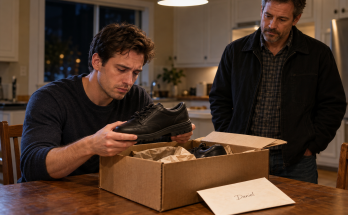
When she came back with the box, she held it carefully in both arms.
The black marker on the side was still clear.
EVELYN — MAGNOLIA GARDENS.
She set it beside the suitcases.
The photograph of Arthur was inside.
I could see the corner of its frame beneath the folded fabric.
Candice stood up and brushed her hands against her trousers.
"That's everything," she said.
I nodded.
"Thank you for bringing it back."
She glanced toward the box.
"I didn't mean for you to feel like you were being sent away."
"I believe you may not have meant that."
She looked at me, waiting.
"But that's how it felt," I continued. "And I need you to understand why."
She lowered her eyes.
"I'm sorry I packed everything without talking to you."
The words were quiet.
They did not erase what had happened.
They did not explain every conversation between her and Julian.
But they were an apology for something real.
"Thank you for saying that," I replied.
She nodded once.
"I should go."
"All right."
She walked toward the door.
Before she stepped outside, she turned back.
"Are you going to consider Magnolia Gardens at all?"
I looked at her.
"That is something I may consider if I decide I want to. I am not making that decision today."
She seemed about to say something more, then stopped.
"Okay," she said.
After she left, I closed the door and stood beside the suitcases.
They were back inside my home.
The box was back inside my home.
Arthur's photograph was back in my hands.
I lifted it out carefully and checked the frame for damage.
There was none.
I carried it to the bedroom and placed it on the nightstand.
For a moment, I looked at Arthur's familiar smile.
Then I set the photograph straight, turned off the bedroom light, and returned to the living room.
Nothing had been settled completely.
Julian and I still needed to talk again.
Candice and I still had things to understand about one another.
Magnolia Gardens remained an option someone else had considered on my behalf, and I had not yet decided whether it belonged anywhere in my own plans.
But the suitcases were no longer in her car.
The photograph was no longer packed.
And the next decision about my life would not be made while I was absent from the conversation.
I had finally said that clearly.
For now, that was enough.
*END PART 16**
Click here to continue reading: PART 17: After Candice Returned My Suitcases, I Had to Decide Whether I Was Ready to Hear What My Son Had Been Afraid to Tell Me
I Thought Owning My Home Meant I Could Never Be Made to Feel Like a Stranger Inside It
Part 16 of 20