I leaned back in my chair.
The table had become the center of the evening, although nothing about it had changed.
The same wood was beneath my hands.
The same chairs stood around it.
The same kitchen surrounded us.
Only the things on the table were different.
I had thought my father's absence was something I understood.
I had lived with it long enough.
I knew the silence that followed his death, and I knew the questions that had remained unanswered.
I had learned how to carry those things into ordinary days.
I had also learned how to avoid thinking about them when I needed to get on with my life.
The box had interrupted that routine.
It had brought my father's handwriting into my kitchen.
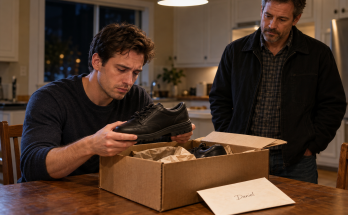
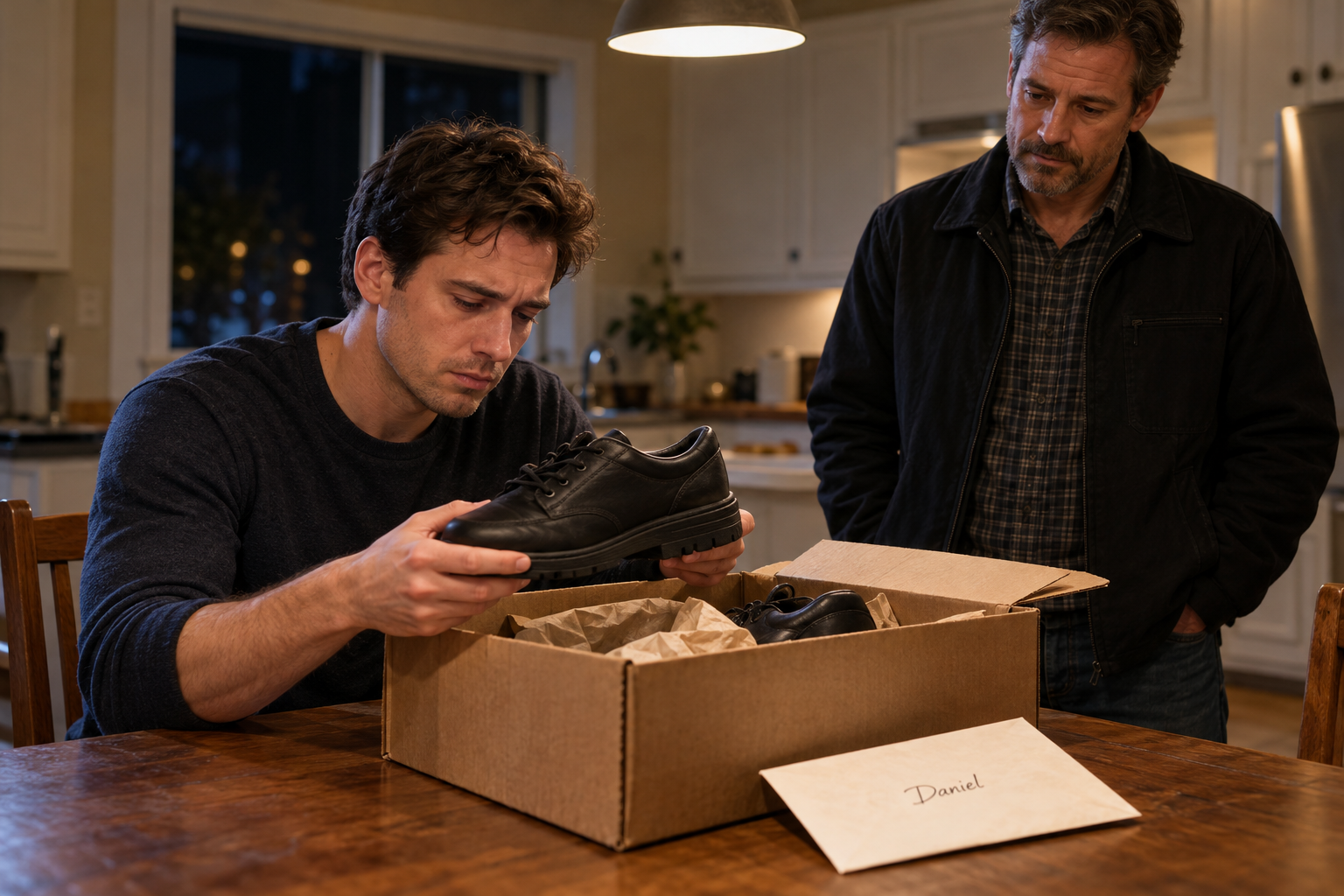
It had placed a pair of shoes in front of me that fit my feet.
Those were small details, but they had unsettled me more than I expected.
I kept thinking about how little I knew about the decisions behind them.
I didn't know when the shoes had been bought.
I didn't know what had made my father choose them.
I didn't know what he had hoped I would think when I found them.
I knew only that they had been placed in the box and delivered to me.
The letter was much the same.
I knew it had been written in his hand.
I knew he had addressed it to me.
I knew I had read it.
But even after reading it, I still had questions.
I had wanted a letter to be a clear answer.
Instead, it had reminded me how much could remain uncertain even when someone finally put something into words.
I glanced at Marcus.
He was sitting quietly, allowing me to work through the evening at my own pace.
I appreciated that more than I had said.
I had asked him questions because I wanted him to help me understand my father.
He had answered what he could.
When he had nothing more to offer, he hadn't pretended otherwise.
That was fair.
I had no right to demand that he turn my father's choices into a story that made sense to me.
I looked down at my hands.
For a long time, I had believed that understanding my father meant finding the reason behind every hurtful thing he had done.
I thought that if I could identify the reason, I could finally decide how I felt about him.
But people were not that simple.
A person could care and still cause pain.
A person could intend to help and still fail to explain himself.
A person could remember a small detail about someone while overlooking something that mattered far more.
I didn't know whether those things described my father.
I only knew that I had never given them much room in my understanding of him.
I had focused on the parts of our relationship that hurt.
Those memories were real.
I wasn't going to deny them simply because I now had a box of belongings in front of me.
But I also couldn't claim that the painful memories told me everything about him.
The shoes had made that difficult to ignore.
I looked at them again.
They weren't an apology.
They weren't an explanation.
They couldn't tell me what my father had thought about our relationship.
They were simply shoes he had chosen in my size.
I had to let that be enough for now.
I moved the envelope slightly so it sat beside them.
The two objects looked ordinary together.
There was nothing dramatic about them.
That was perhaps why I found them so difficult to dismiss.
They didn't announce what they meant.
They didn't offer an easy conclusion.
They simply existed, leaving me to decide how to approach them without claiming to know more than I did.
I took a slow breath.
I was beginning to understand that I didn't have to choose between believing my father had hurt me and believing he might have cared about me.
Both could be true.
That didn't mean I had to forgive him.
It didn't mean I had to forget the things I wished had been different.
It only meant that I could stop insisting that one truth erased the other.
I had spent years trying to make my memories fit into a single judgment.
My father had disappointed me, so I treated every silence as proof that I had never mattered enough.
Now I could see how much I had assumed.
I couldn't go back and ask him to correct those assumptions.
I could only be more careful with them now.
Marcus looked toward the box.
"You don't have to finish everything tonight," he said.
"I know."
This time, I meant it.
I didn't need to turn the evening into a test of how much I could endure.
I could take my time.
I could stop when I needed to.
I could leave the box open or close it later.
None of those choices would change what my father had left.
I glanced at the envelope once more.
Then I looked at the shoes.
I wasn't ready to put them away.
I wasn't ready to decide what I would do with them.
For the moment, I wanted to leave them where they were.
They had brought me to a question I had avoided for years.
Not whether my father had been a good man or a bad one.
Not whether I had been right to feel hurt.
The question was whether I could admit that I didn't know everything about him.
I had resisted that possibility because uncertainty felt like surrender.
It seemed to threaten the memories I had relied on to explain my life.
But admitting that I didn't know everything did not mean my memories were false.
It meant they were incomplete.
I could live with that distinction.
I looked at Marcus.
"Thanks for staying."
He nodded.
"Of course."
His answer was simple.
I didn't ask him to add anything.
Then I returned my attention to the box, ready to continue at my own pace.
Click here to continue reading: PART 15: I Had Wanted My Father to Leave Me an Answer, but I Was Beginning to See That I Could Not Decide What His Choices Meant for Me
I Thought My Father Had Left Me Nothing, Until One Ordinary Box Forced Me to Question Everything I Remembered About Him
Part 14 of 20