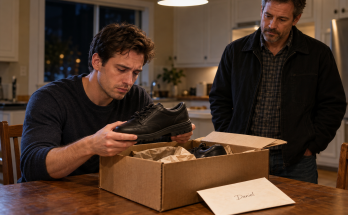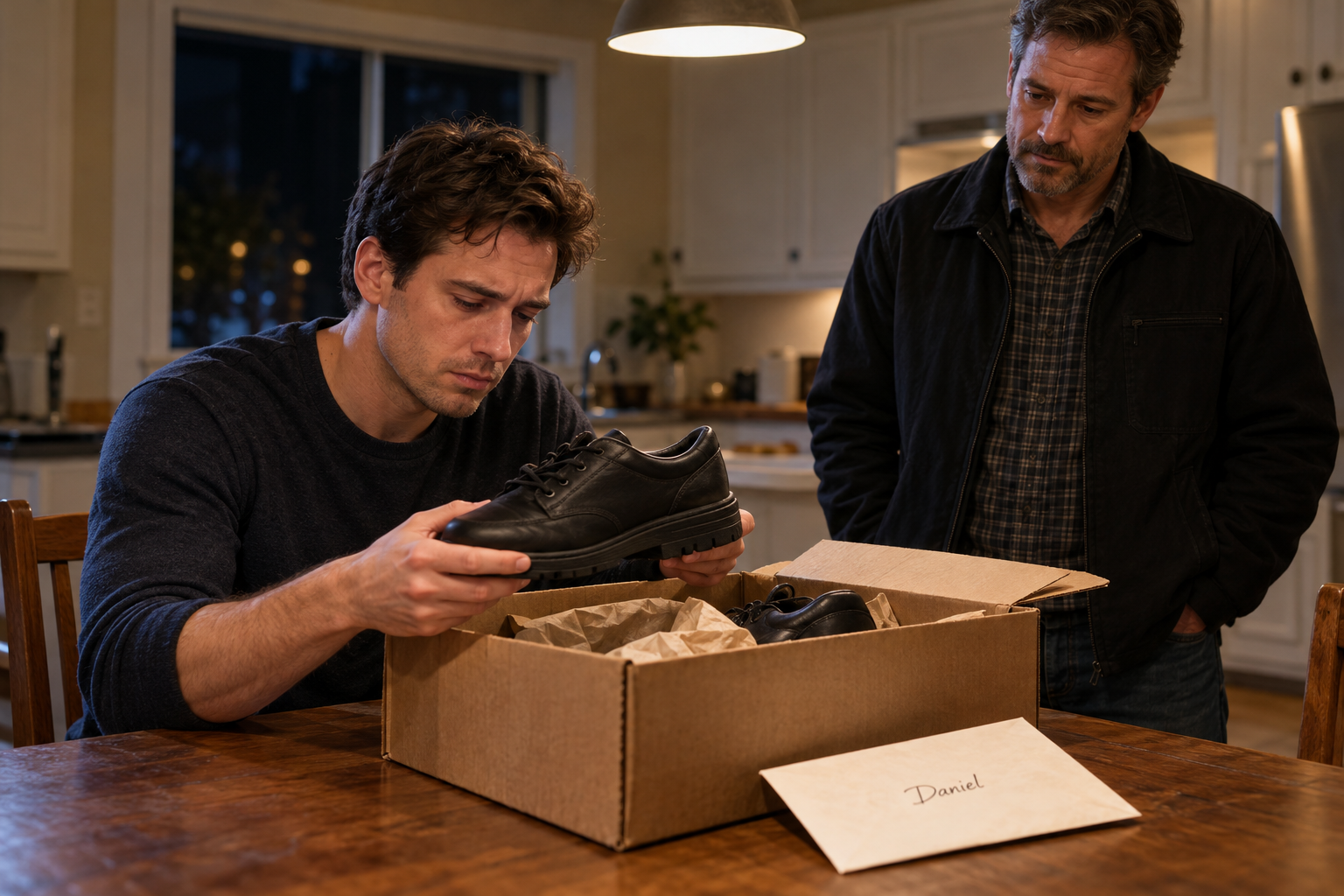
I stayed at the kitchen table after Marcus finished speaking.
The box was still open in front of me.
The shoes sat beside it, and the envelope lay where I had placed it.
Nothing had changed.
But I no longer felt the same way about the things I could see.
I had spent years believing that my father was easy to understand.
He was a practical man.
He worked, paid his bills, kept his belongings in order, and expected the people around him to do the same.
When he was disappointed, he rarely explained why.
When he was pleased, he rarely said so.
I had learned to recognize his moods by the sound of his footsteps and the way he placed his keys on the counter.
That had been enough to get through most days.
It had not been enough to understand him.
I looked at the black shoes again.
They were still ordinary shoes.
Their soles were clean, their laces were neatly arranged, and their size matched mine.
I could describe them without difficulty.
What I could not describe was the thought that had led my father to choose them.
Perhaps he had simply noticed that I needed a pair.
Perhaps he had bought them long before he decided what to do with the box.
Perhaps there had been a reason I had not considered.
I was learning that the number of possible explanations could grow quickly when the facts were few.
That did not make any one explanation more likely.
I pushed the shoes a little farther from the edge of the table.
Marcus watched me do it.
"You don't have to finish everything tonight," he said.
"I know."
I answered too quickly.
He did not challenge me.
That made me hear my own voice more clearly than I wanted to.
I had always been impatient with uncertainty.
If something went wrong, I wanted to know who had caused it.
If someone gave me an unexpected answer, I wanted to know what they were leaving out.
I had mistaken that impatience for good judgment.
Sometimes it had helped me solve problems.
Other times, it had made me decide what happened before I had enough information to know.
My father and I had been alike in that way.
Neither of us liked admitting that we did not know something.
The difference was that he could remain silent for days.
I usually kept asking questions until the other person became tired of answering them.
I looked at Marcus.
"Did he ever talk about me?"
The question came out quietly.
Marcus took a moment before responding.
"Your father mentioned you sometimes."
"About what?"
"Different things."
I waited.
Marcus looked down at the table.
"I don't want to make something up just because you want an answer."
I felt the first sting of disappointment.
Then I understood what he meant.
A vague memory from someone else could become something much larger in my mind.
I could take a passing remark and turn it into evidence that my father had been thinking about me all along.
Or I could decide that the lack of detail meant he had never cared.
Either conclusion would be easier than admitting that I did not know.
"That's fair," I said.
Marcus nodded.
He did not try to comfort me.
I was grateful for that, although I might not have admitted it at the time.
Comfort could be another kind of explanation.
Sometimes people told you what they thought you needed to hear because they could not stand watching you sit with a difficult feeling.
I had done that myself.
I had told people everything would work out when I had no idea whether it would.
I had called that kindness.
Now I wondered how often I had simply been trying to end an uncomfortable conversation.
I reached into the box and moved a piece of packing paper aside.
The paper folded beneath my fingers.
I smoothed it against the table instead of throwing it away.
It was an insignificant action, but I found myself paying attention to it.
I wanted to be careful.
I did not want to turn the things my father had left into a collection of symbols before I had finished looking at them.
That did not mean I could stop having feelings about them.
The shoes reminded me of the practical advice he used to give.
The envelope reminded me of all the conversations we had never managed to finish.
I could not separate those reactions from the objects.
I could only try to distinguish what I remembered from what I imagined.
That distinction had become important to me.
For years, I had remembered my father through the moments that hurt.
I remembered the conversations that ended too soon.
I remembered questions he answered with instructions.
I remembered the occasions when I wanted him to tell me that he understood and he told me what I should do instead.
Those memories were real.
They were not necessarily the whole story.
I had no reason to erase them.
I also had no reason to pretend that they were the only things that had happened between us.
I glanced toward the clock.
More time had passed than I realized.
The kitchen light hummed faintly above us.
Outside, the window reflected the room back at me, making the glass look almost black.
Marcus shifted in his chair.
"Do you want me to stay?" he asked.
I considered telling him that I was fine.
It was the answer I usually gave when I wanted a conversation to end.
Instead, I looked at the box before answering.
"Just a little longer."
"All right."
He settled back.
I appreciated the simplicity of that response.
He had not asked me to explain what I was feeling.
He had not told me how I should interpret the letter.
He had simply agreed to stay.
For once, I did not need anything more complicated than that.
I rested my hands on the table.
The cardboard box had become the center of the evening, but it was still only a box.
It could hold objects.
It could preserve things someone did not want to throw away.
It could carry something from one place to another.
It could not tell me why my father had made his choices.
That part would have to come from somewhere else, if it came at all.
I had spent years waiting for certainty from a man who rarely offered explanations.
I did not want to spend the rest of my life doing the same thing with his belongings.
I looked down at the shoes.
Then I looked at the envelope.
I was still curious.
I was still hurt.
I was still hoping there was something in all of this that I had not understood.
But I was beginning to see that hope did not have to become a conclusion.
I could leave the questions unanswered for another hour.
I could let the box remain open.
And I could keep looking without pretending that every object had already told me its story.
Click here to continue reading: PART 18: Marcus Didn’t Have the Answers I Wanted, and I Had to Stop Treating That as Another Disappointment
I Thought My Father Had Left Me Nothing, Until One Ordinary Box Forced Me to Question Everything I Remembered About Him
Part 17 of 20