I returned my attention to the box.
The packing paper had shifted while I was moving things around.
I straightened it, then paused with my hands resting on the cardboard.
I was tempted to arrange everything neatly before I continued.
That was another habit I had inherited from my father.
When something made me uncomfortable, I looked for a practical task.
I cleaned.
I organized.
I checked details that did not require checking.
The work gave me something I could control.
It also allowed me to avoid the parts of a problem that had no immediate solution.
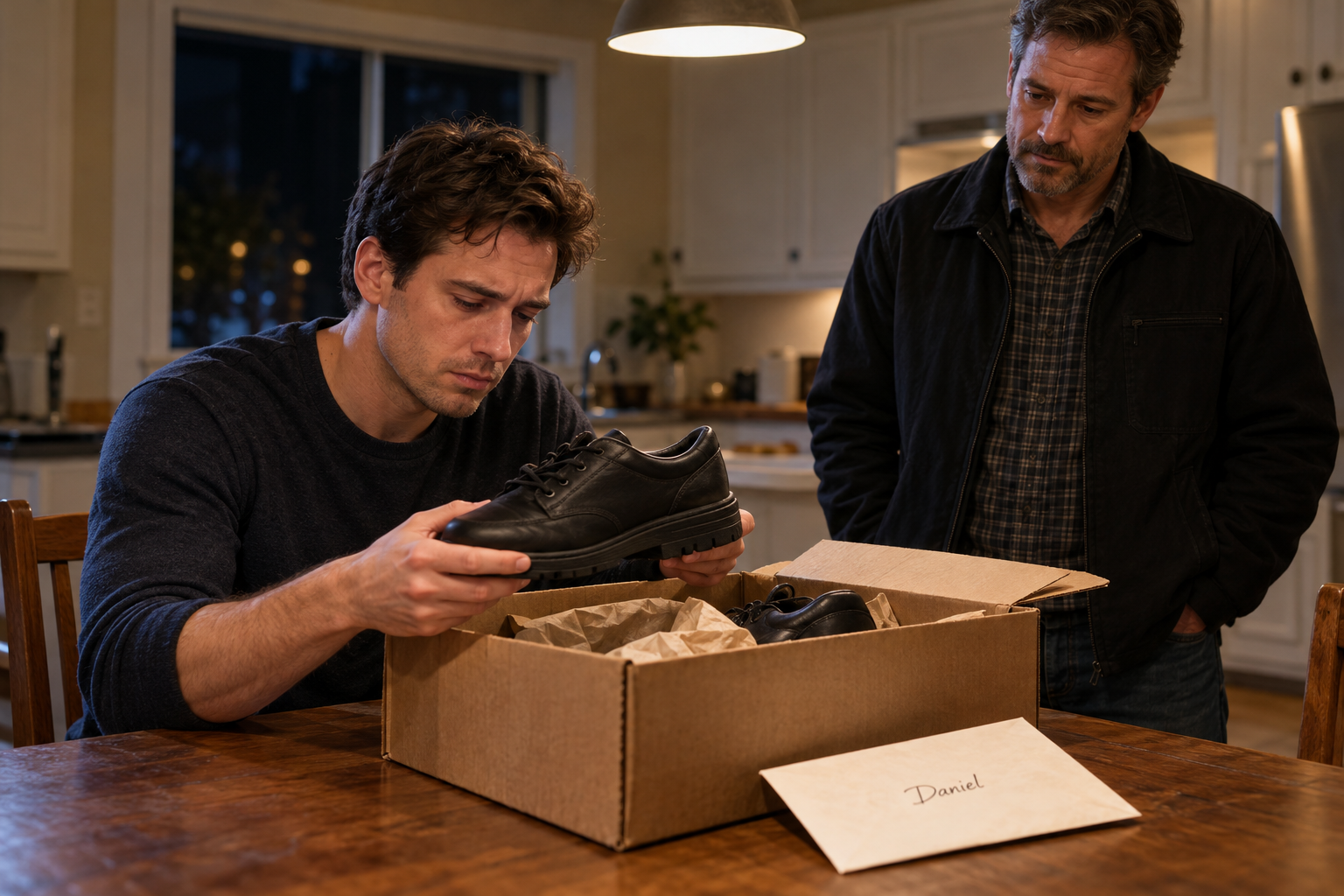
I looked at the shoes and understood why I was tempted to put them away.
If I placed them back in the box, I could close the lid.
I could tell myself I would return to the letter later.
I could move the whole matter out of sight and carry on with the rest of my life.
There would be nothing wrong with taking a break.
But I knew the difference between resting and avoiding.
I had used the second one often enough to recognize it.
I did not want to close the box merely because I was afraid of what it might mean.
At the same time, I did not want to keep examining the same things simply because I hoped repetition would produce an answer.
I sat with that contradiction for a while.
There was no clever way to resolve it.
I had to decide what I could do next without pretending that the decision would solve everything.
I could leave the shoes where they were.
I could leave the envelope beside them.
I could acknowledge that my father had intended both to reach me.
Those were small facts.
They were still facts.
I had spent too much time treating small things as worthless unless they led to something larger.
A conversation was meaningful only if it cleared up a misunderstanding.
An apology mattered only if it repaired the relationship.
A gift mattered only if I understood the thought behind it.
I had rarely allowed a gesture to exist without demanding that it explain itself.
I could not say whether my father had done the same thing.
I only knew that I had.
I looked at the shoes again.
They were plain black work shoes, not something I would have chosen to remember for the rest of my life.
Yet I was remembering them.
Not because they were remarkable, but because my father had left them for me.
That was enough to make me wonder.
It was not enough to tell me what I should believe.
I rubbed my thumb across the edge of the table.
There was a small rough spot in the wood where the finish had worn away.
I had noticed it many times before.
I could not remember ever doing anything about it.
My father would probably have repaired it.
He would have found the right material, cleaned the surface, and worked until the spot no longer caught against his hand.
I could imagine him doing it.
I could not know whether he would have bothered.
That was another small distinction I needed to learn.
Remembering someone's habits was not the same as knowing what they would do in every situation.
I had often told myself I knew exactly how my father would respond to a question.
Sometimes I had been right.
Other times, I had stopped asking because I had already decided what he would say.
I could not know how many conversations I had avoided that way.
The thought bothered me.
It also reminded me that the past was not something I could revise simply by regretting it.
I could acknowledge what I had done.
I could acknowledge what he had done.
I could not go back and create a different conversation.
I had to live with the ones we actually had.
Marcus stood and walked toward the counter.
He picked up his glass, took a drink, and returned it to the same place.
He did not ask what I was thinking.
I was glad.
I had spent so much of the evening trying to turn my feelings into questions that I had nearly forgotten they could simply be feelings.
I did not need to explain every silence.
I did not need to find a lesson in every memory.
Sometimes I could remember something and let it remain unfinished.
I thought about the envelope again.
My father's handwriting had always seemed so certain.
Even when he wrote a short note, his letters looked deliberate.
He did not scribble his name.
He did not leave a word half formed.
Looking at his handwriting now, I could not help wondering whether the man who wrote it had felt certain about what he wanted to tell me.
Perhaps he had.
Perhaps he had struggled over the words.
I had no way to know from the handwriting alone.
It was easy to confuse the confidence of someone's writing with confidence in what they were saying.
I had done that with him in person, too.
He could sound sure even when he had not explained his reasoning.
I had often taken that certainty as proof that further discussion was pointless.
Sometimes I had resented him for refusing to listen.
Sometimes I had stopped talking before giving him a chance.
Neither possibility made the other disappear.
I folded my hands together.
There was a time when I would have considered all of this useless thinking.
I would have wanted a concrete answer.
I would have asked what I was supposed to do with a pair of shoes and a letter from a dead man.
I still wanted to know.
But I was beginning to understand that there might be no single action that settled the meaning of either object.
I could use the shoes.
I could keep them.
I could put them away until I was ready to decide.
None of those choices would change the fact that my father had selected them.
The envelope was different because it contained words meant for me.
Even so, reading words did not guarantee that I would understand the person who wrote them.
I had learned that during my father's lifetime.
I was learning it again after his death.
I did not want to turn the letter into a test that I had to pass.
I did not want to decide that I had failed to understand my father if I could not make every part of his life fit together.
People were not puzzles that always produced a satisfying answer when all the pieces were arranged correctly.
Sometimes the pieces were missing.
Sometimes the picture changed depending on where you stood.
Sometimes you had to admit that you had been looking at only one side.
I looked around the kitchen.
Everything was familiar.
The table, the chairs, the counter, the light above us.
The room had not changed because my understanding of my father had become less certain.
That seemed important.
I could keep living in the world I knew while allowing my picture of him to become more complicated.
I did not have to settle the whole past tonight.
I only had to stop pretending that the first explanation I reached was necessarily the right one.
The shoes remained beside the envelope.
I left them there.
Click here to continue reading: PART 20: I Couldn’t Ask My Father What He Meant, but I Could Stop Pretending I Already Knew
I Thought My Father Had Left Me Nothing, Until One Ordinary Box Forced Me to Question Everything I Remembered About Him
Part 19 of 20