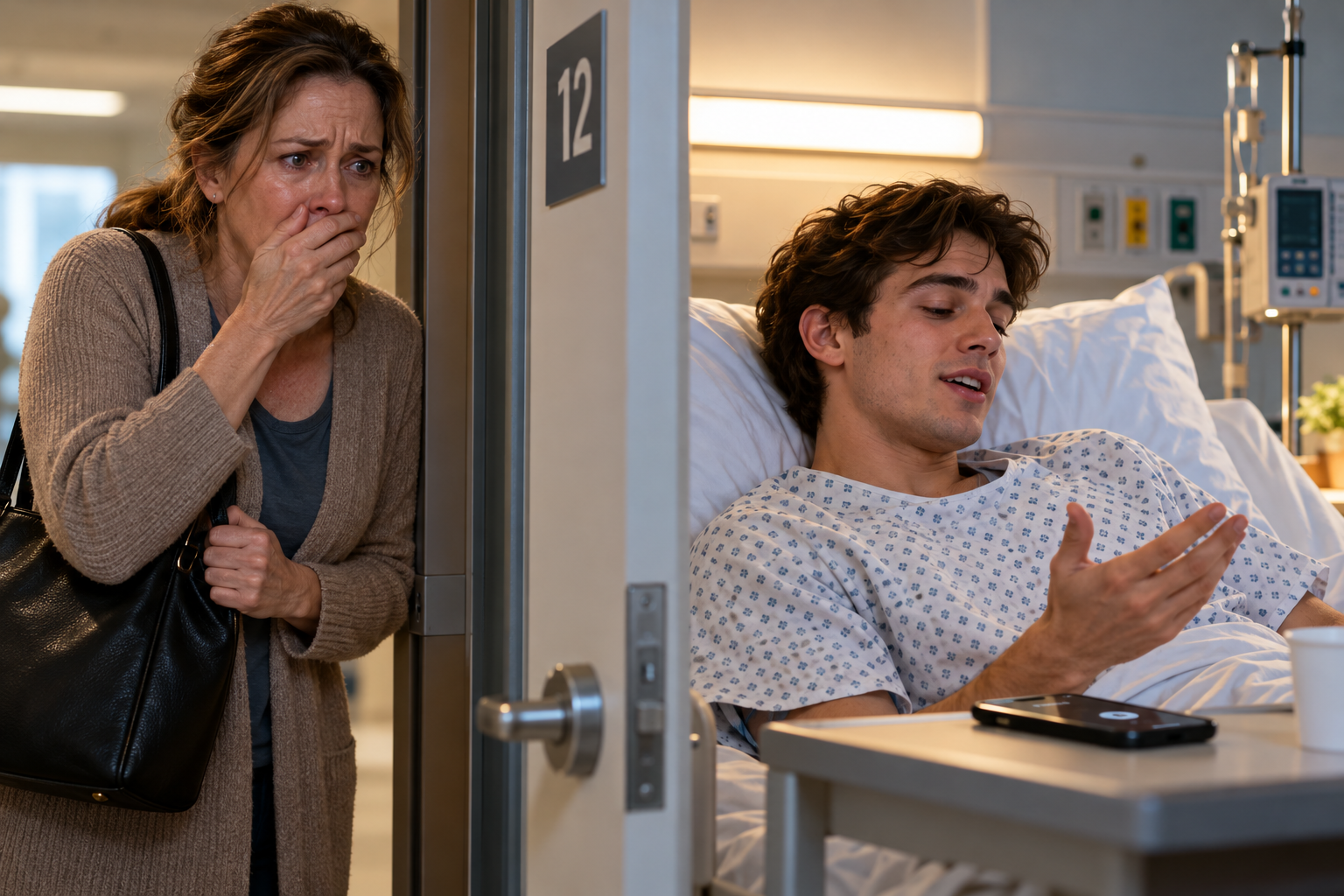
I stayed with Spencer for a while longer.
We talked about ordinary things.
He asked whether I had eaten breakfast.
I told him I had.
He asked whether the drive had been difficult.
I said the traffic wasn't too bad.
Our conversation moved along in small, familiar pieces, and anyone watching us might have thought there was nothing wrong.
That was what unsettled me most.
I had heard him say something cruel.
Yet he could still look at me with the same expression he had worn for years.
I could still answer his questions.
I could still worry about whether he was comfortable.
I could still find myself wanting to reach over and straighten the blanket near his feet.
Love didn't disappear when trust was damaged.
Sometimes it stayed right where it was, making the damage harder to face.
I looked at the bedside table.
His phone rested beside a few personal items.
I remembered hearing the other woman's voice through the speaker.
I wondered whether Spencer would call her again after I left.
I wondered whether he would tell her I had visited.
I wondered what he would say if she asked whether I had brought him anything.
I had no way to know.
And I couldn't build a whole story around questions I hadn't answered.
That was something I had to remind myself.
I knew what I had heard.
I didn't know everything else.
For months, I had treated my son's worries as instructions.
If he was concerned about an expense, I tried to find the money.
If he said something wasn't working, I looked for another solution.
If he sounded frightened, I did whatever I could to reassure him.
I had rarely stopped to ask what he expected me to do.
I had simply assumed that helping was the right response.
Maybe that assumption had begun long before he became sick.
Maybe I had taught him, without meaning to, that my first answer would always be yes.
I couldn't blame him for every decision he made.
He was responsible for the things he said and the choices he made.
But I was responsible for the way I had allowed fear to guide my own decisions.
I had given until I was frightened to look at my bank balance.
I had borrowed money without knowing how I would repay it.
I had sold things that mattered to me because I believed there was no other choice.
And every time I did those things, I told myself that a good mother would do the same.
Looking back, that belief makes me uncomfortable.
A mother can love her child without destroying every part of her own life.
I understood that in theory.
I had never learned how to live as though it were true.
Spencer moved his pillow and settled back against the bed.
I watched him carefully.
I wanted to know whether he was truly feeling worse.
I wanted to know whether the problems he had described to me were as serious as I had believed.
I wanted to understand what was happening to him.
But I didn't have answers, and I couldn't find them by staring at his face.
"Have you spoken to the doctors today?" I asked.
"Not yet."
"Do you know when they'll come by?"
He shook his head.
"Probably later."
I nodded.
The answers were brief.
I didn't press him.
I was afraid that if I asked too many questions, he would notice that something had changed.
Then I wondered why I was afraid of that.
If I was his mother, shouldn't I be able to ask how he was doing?
Shouldn't I be able to talk about the medical bills without feeling that I was stepping into dangerous territory?
Shouldn't I be able to say that I was worried, too?
I had become so accustomed to being the steady one that I had forgotten I was allowed to have doubts.
I glanced at the clock.
I had been there longer than I realized.
"I should let you rest," I said.
Spencer looked at me.
"You don't have to leave yet."
The words were simple.
They might have been an honest request for company.
They might have meant nothing more than that he didn't want to be alone.
I couldn't know.
I stayed seated for another moment.
Then I asked myself a question I had avoided for months.
If I stayed, would I be staying because I wanted to spend time with my son?
Or would I be staying because I was afraid that leaving might make him think I didn't care?
I didn't like the answer that came to mind.
I had spent so long trying to prove that I would never abandon him that I had begun to treat every ordinary decision as a test of my love.
I couldn't keep doing that.
Not if I wanted to understand what was happening between us.
"I'm going to take care of a few things," I told him. "I'll check on you again."
He nodded.
"All right."
I stood and reached for my handbag.
The envelope inside it remained untouched.
I hadn't told him about the lottery ticket.
I hadn't told him that I could pay the bills.
I hadn't promised to give him anything.
For once, I was leaving a conversation without making a financial decision.
The feeling was strange.
It was not relief exactly.
It was more like standing at the edge of a familiar road and realizing that I had never considered taking another path.
I leaned forward and kissed his forehead.
He closed his eyes briefly.
That small gesture nearly undid me.
For a moment, I saw the boy he had once been.
I remembered how naturally I had reached for him when he needed comfort.
I remembered how easy it had been to believe that love meant giving him whatever protection I could.
I wanted to believe that the same tenderness still connected us.
Perhaps it did.
But tenderness alone couldn't answer the questions I now carried.
I straightened.
"Get some rest," I said.
"I will."
I walked to the door.
My hand rested on the handle for a moment before I opened it.
I wanted to turn around and tell him about the ticket.
I wanted to watch his face brighten.
I wanted to hear him say that I didn't have to worry anymore.
But I couldn't make myself do it.
Not yet.
I stepped into the hallway and closed the door behind me.
The sound was soft.
Still, I stood there for a moment, looking at the same pale wall I had stared at before entering the room.
Nothing outside had changed.
The hospital continued moving around me.
A nurse walked past with a chart.
Someone called for assistance farther down the corridor.
A telephone rang at the nurses' station.
I held my handbag close to my side and began walking toward the exit.
I didn't know what the right decision would be.
I didn't know whether Spencer understood how deeply his words had hurt me.
I didn't know whether he would ask for more money the next time we spoke.
And I didn't know whether the winning ticket would bring us closer together or expose a distance that had been growing for longer than I wanted to admit.
But I knew one thing.
I couldn't spend twenty million dollars trying to buy back the certainty I had felt before hearing that conversation.
Money could pay bills.
It could make treatment easier to afford.
It could remove debts that had kept me awake at night.
But it couldn't tell me whether my son was being honest with me.
Only the truth could do that.
I reached the hospital entrance and stopped beside the glass doors.
For months, I had believed my only job was to find a way to keep Spencer from suffering.
Now I understood that I had another responsibility.
I had to stop pretending that my own suffering didn't matter.
I stepped outside into the morning air.
My handbag rested against my hip, the lottery ticket safely tucked inside.
I had arrived that day ready to give my son everything.
I left knowing that I needed to understand what giving everything would really mean.
And for the first time, I decided that I would not make that choice out of fear.
Click here to continue reading: PART 5: I Drove Home With Twenty Million Dollars Hidden in My Handbag, Wondering When Helping My Son Had Become Something He Could Count On
I Thought Twenty Million Dollars Would Finally Give My Son His Life Back, Until I Heard the Conversation Behind His Hospital Door
Part 4 of 20