Gary came home later that evening.
I heard his car turn into the driveway.
Then the engine stopped.
Usually, I would have stood up to meet him.
I might have asked whether he wanted something to eat or whether the claims office had been busy.
That evening, I stayed where I was.
The kitchen clock ticked behind me.
A few seconds later, the front door opened.
Gary stepped inside with his keys in one hand and his phone in the other.
He looked at me.
I looked at him.
Neither of us spoke.
Finally, he placed his keys on the counter.
"Linda called you."
It wasn't a question.
"Yes."
He rubbed the side of his face.
"I figured she would."
I waited.
He opened the refrigerator, looked inside, and closed it again without taking anything.
That was another of his habits.
When he was uncomfortable, he found something ordinary to do with his hands.
For years, I had mistaken that discomfort for guilt about small things.
A forgotten errand.
A bill paid late.
A promise he hadn't kept.
Now I wondered what else I had failed to see.
"What did you tell them?" I asked.
"The truth."
"Which truth?"
He looked at me.
"That we're married. That we've shared our lives for decades. That this money shouldn't be treated as if it has nothing to do with me."
I felt my shoulders tighten.
"I bought the ticket."
"We're married, Patricia."
"I know."
"Then why are you acting like this is only your business?"
I glanced toward the kitchen table.
The winning ticket wasn't there.
I had put it somewhere safe after we checked the numbers.
Gary knew where I kept important papers.
He had helped me organize the filing cabinet years earlier.
I wondered whether he had already looked through it.
"I wrote my name on the ticket before the drawing," I said. "You know that."
"I know you wrote something."
"You watched me do it."
He pulled out a chair.
"That doesn't change the fact that we're husband and wife."
I sat opposite him.
For a moment, I tried to find the man I had married in the face across the table.
I remembered him at twenty-eight, standing in a small apartment with a secondhand couch and a kitchen sink that leaked whenever we turned on the hot water.
We had almost no savings.
He used to joke that we were one broken appliance away from disaster.
I remembered how proud he had been when we bought our first house.
He had walked through every room twice before signing the papers.
He said he wanted our children to have a stable home.
I had believed him.
I still believed he had meant it.
But meaning something once didn't guarantee a person would honor it forever.
"Gary, what exactly do you want?"
He leaned back.
"I want us to be reasonable."
"About what?"
"About the money."
There it was.
Not our future.
Not the children.
Not what we could finally do together.
The money.
I folded my hands on the table.
"We can talk about how to use it. We can make plans. But you can't pretend I didn't buy the ticket."
He gave a short laugh.
"I'm not pretending anything."
"Then why were you arguing with Linda?"
"Because she was treating this like a personal account."
"It is a lottery claim."
"And we're married."
He repeated it as if saying it often enough would settle every question.
I felt something harden inside me.
"Being married doesn't mean you get to tell a different story about what happened."
Gary's face changed.
Only slightly.
But I saw it.
He was accustomed to my patience.
He was accustomed to me letting a disagreement cool down rather than pushing it further.
He had learned that if he waited long enough, I would often find a way to make peace.
Sometimes that was kindness.
Sometimes it was fear of conflict dressed up as kindness.
Looking back, that distinction makes me ashamed.
I had spent years believing that keeping a family together meant swallowing every uncomfortable truth.
I hadn't realized how much that habit could cost me.
Gary stood.
"I don't want to fight about this tonight."
"Neither do I."
"Good."
He started toward the hallway.
"Gary."
He stopped.
"Are you saying you think the money belongs to you?"
He turned around.
"I'm saying we're married, and that has to count for something."
Then he walked away.
I remained at the table.
The refrigerator hummed.
Somewhere upstairs, a floorboard creaked.
I listened to Gary moving through the bedroom, opening a drawer, and shutting it.
The sounds were so familiar that they made the situation feel even stranger.
A man could share a home with you for thirty-four years and still become a stranger in a single evening.
I didn't sleep much that night.
I kept replaying the conversation.
Every time I remembered his words, I heard something different beneath them.
We're married.
We built this together.
Be reasonable.
He had said nothing about the promise we made to each other when we first married.
Nothing about trust.
Nothing about the years when we had little money and no guarantee that things would improve.
He spoke as though our marriage were a document that entitled him to whatever he wanted.
The next morning, I found him sitting at the kitchen table with a cup of coffee.
He had already dressed.
His phone lay beside his hand.
I poured myself a cup and sat across from him.
"We need to talk about what happens next," I said.
He kept his eyes on the coffee.
"There's nothing to discuss until the office finishes reviewing everything."
"Then why were you so determined to convince them yesterday?"
He lifted his head.
"Because I don't want to be shut out of a decision that affects both of us."
"Neither do I."
He looked away.
I could tell he hadn't expected that answer.
For years, I had been the person who softened a disagreement.
I would say I understood his point.
I would offer a compromise.
I would make sure he knew I wasn't trying to hurt him.
That morning, I didn't do any of those things.
I simply sat there.
Gary took a sip of coffee.
"Patricia, money changes people."
"Sometimes."
"I don't want it changing us."
I almost laughed.
Not because it was funny.
Because he had managed to say the one thing I wanted to believe while behaving in a way that made it impossible.
"Then we should be honest with each other," I said.
He set his cup down.
"Of course."
But he didn't look at me when he said it.
The days that followed were filled with ordinary chores.
I washed clothes.
I watered the tomato plants.
I made grocery lists and paid the household bills.
Gary went to work and came home.
From the outside, our life looked the same.
Inside the house, every conversation had become a test.
When I asked whether he had heard from the claims office, he said no.
When I asked whether he had spoken to anyone about the money, he said he had only asked a few questions.
When I asked what questions, he said I was making things unnecessarily difficult.
I began to write down what he told me.
Not because I wanted to build a case against my husband.
Because I no longer trusted my memory when he insisted that something had happened differently from the way I remembered it.
I kept the notes in a small notebook beside the telephone.
The notebook had a bent corner and a faded red cover.
I had bought it years earlier to keep track of household expenses.
Now I used it to record dates and conversations.
At first, I felt foolish doing it.
Then I remembered the lottery ticket.
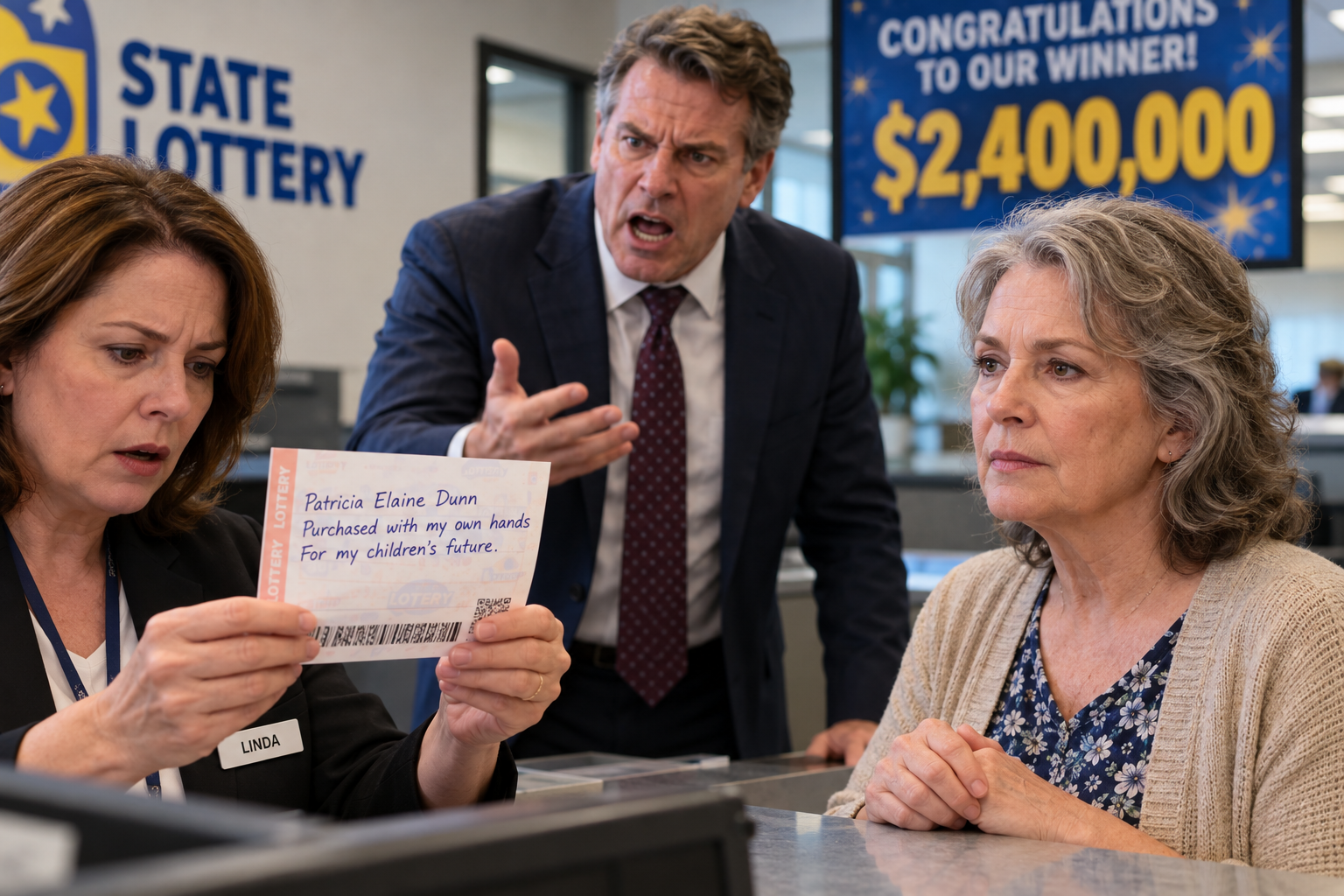
I remembered Linda asking whether I had signed it before the drawing.
I remembered Gary's voice in the background.
I began to understand that facts mattered most when people disagreed about what they wanted them to mean.
A week later, Gary came home and told me he had been thinking.
He stood in the doorway while I was putting away clean dishes.
"We need to consider what happens if we don't agree about the money."
I placed a plate in the cupboard.
"What do you mean?"
He took a breath.
"I've been wondering whether this marriage is still working."
For a moment, I thought I had misunderstood him.
"What does our marriage have to do with the lottery claim?"
He shook his head.
"It's not just about the ticket."
"Then what is it about?"
He looked around the kitchen as if the answer might be written on the walls.
"Things have changed."
I stared at him.
We had lived through job changes, family worries, bills, illnesses, and the ordinary disappointments that come with growing older.
We had survived years when we disagreed about almost everything.
But he had never suggested that our marriage should end because life had become complicated.
Until now.
"Are you asking for a divorce?"
He didn't answer immediately.
That silence told me more than any explanation could have.
Finally, he said, "Maybe it's time we admitted we're not happy."
I set the dish towel down.
I wanted to ask him when he had stopped being happy.
I wanted to know whether he had been planning this before the lottery drawing.
I wanted to know how long he had been looking at our life and seeing a way out.
Instead, I asked one question.
"Would you be saying this if we hadn't won the money?"
His face tightened.
"That's not fair."
"Is it untrue?"
He looked toward the hallway.
I had my answer.
I didn't cry.
Not then.
I felt something worse than sadness.
I felt foolish for believing that the life we had built would protect us from the worst things we could do to each other.
Gary said he needed time to think.
I told him I needed the same.
That night, I lay awake beside him and listened to his breathing.
I knew the sound of it better than I knew any song.
For thirty-four years, that sound had meant I wasn't alone.
Now I couldn't stop wondering whether I had been alone for longer than I realized.
The next morning, he left early.
His coffee cup remained on the counter.
I washed it, dried it, and put it away.
Then I opened the drawer where I kept our household papers.
I found the old notebook with the red cover.
I found receipts from the grocery store.
I found records of the bills we had paid together.
And I found a small slip of paper where I had written down the date I bought the winning ticket.
I stared at that date for a long time.
The drawing had happened afterward.
The seven words had been written before the numbers were announced.
Nothing Gary said could change that sequence.
I closed the drawer.
For the first time, I stopped asking myself how to persuade my husband to be fair.
I began asking what I needed to do if he refused.
Click here to continue reading: PART 3: The Divorce Papers Arrived Before the Lottery Dispute Was Settled, and I Finally Saw How Far My Husband Was Willing to Go
The Call That Made Me Question Thirty-Four Years of Marriage and the Seven Words I Had Written Without Ever Thinking They Would Matter
Part 2 of 4