The next morning, I woke up before the alarm.
For a few seconds, I couldn't remember why my cheek hurt.
Then I saw myself in the bathroom mirror.
The memory returned all at once.
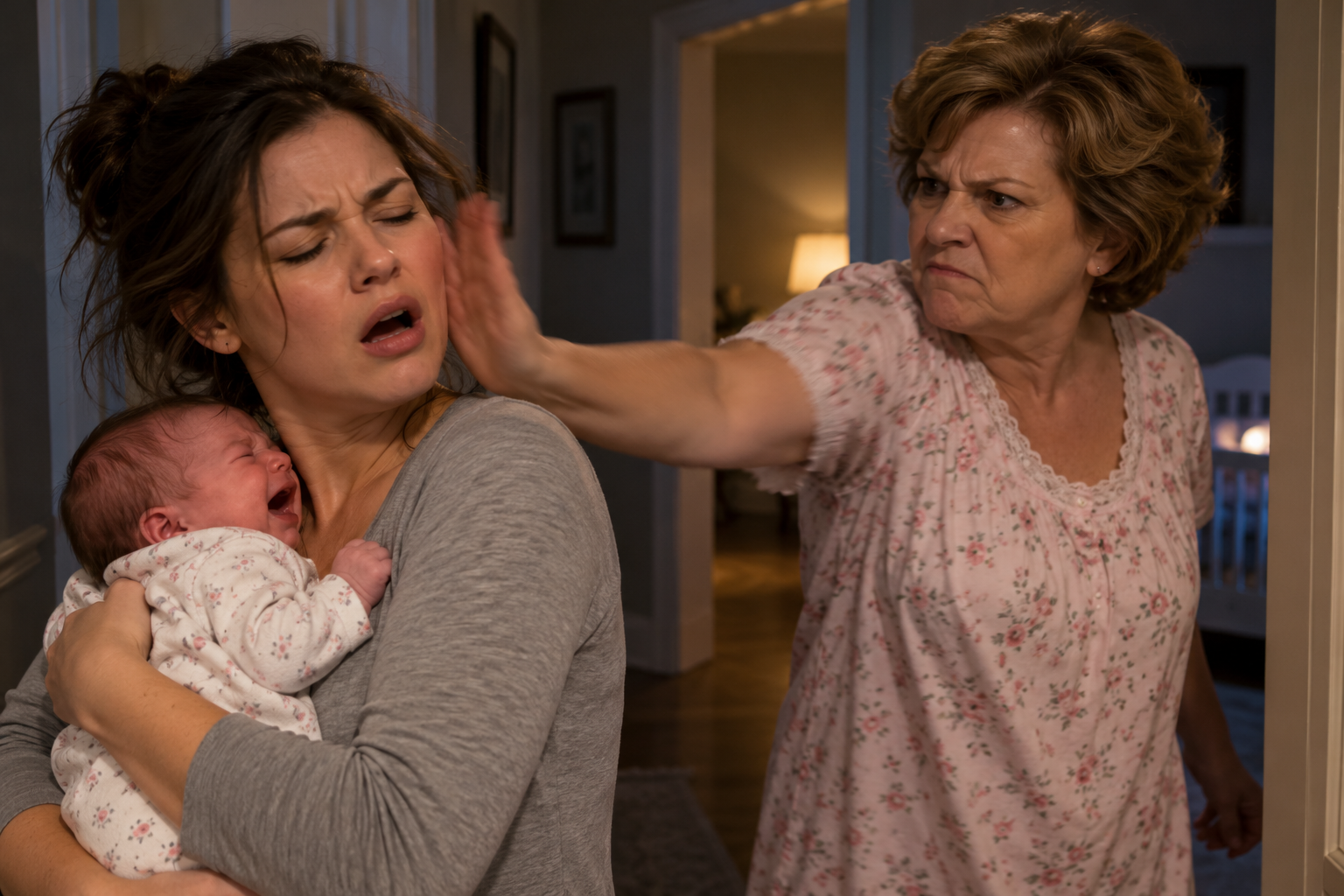
Patricia's raised hand.
The sharp sound.
Lily crying against my shoulder.
I stood there with my fingers resting against the sink.
I could have told myself it was an isolated incident.
I could have decided that exhaustion had made Patricia lose control for a moment.
That would have been easier.
It would also have meant ignoring the fact that she had chosen to hit me instead of helping with the baby.
I covered the mark on my cheek as best I could.
Then I went to check on Lily.
She was sleeping peacefully, her tiny hands resting near her face.
I watched her for a while.
She had no idea what had happened the night before.
She didn't know that the adults responsible for protecting her had left her mother alone with a problem that should never have existed.
She only knew that when she cried, I came.
So I picked her up.
I carried her downstairs.
Patricia was already in the kitchen.
She stood beside the counter, making coffee as though the previous night had been ordinary.
She glanced at me.
Then she looked away.
"Did you get any sleep?"
The question was so casual that I almost laughed.
"Not much."
She poured coffee into her mug.
"Babies are like that."
I waited.
I don't know what I expected.
Maybe she would finally acknowledge what she had done.
Maybe she would say she shouldn't have lost her temper.
Instead, she stirred her coffee and complained that the house was too cold.
I sat down with Lily in my arms.
My cheek still hurt, but I was more troubled by the ease with which Patricia had moved on.
She had struck me.
She had walked away.
And now she was standing in my kitchen, discussing the weather.
I wondered whether she thought I had forgotten.
Or whether she simply believed I had no choice but to accept it.
My husband came downstairs a few minutes later.
His name was never enough to explain the position I found myself in.
He was Lily's father.
He was Patricia's son.
And he was the person I needed to believe would protect our little family when it mattered.
He kissed the top of Lily's head.
Then he reached for a mug.
"How was the night?"
I looked at him.
I could have answered with everything that was sitting in my chest.
Instead, I glanced toward his mother.
Patricia was watching us.
"Long," I said.
He nodded as though that explained everything.
"She's still adjusting."
I looked down at our daughter.
So was I.
But I didn't say it.
I was still trying to decide how to tell him about the slap.
I wanted him to hear it from me before his mother found a way to describe the night in her own words.
At the same time, I was afraid of what would happen when I spoke.
That fear embarrassed me.
I was an adult.
I was his wife.
I had just given birth to his child.
I shouldn't have been afraid to tell him that someone had hit me.
But fear doesn't always follow the rules we think it should.
Sometimes it grows quietly, one small concession at a time.
I had become so accustomed to measuring my words around Patricia that I was beginning to do it with my husband, too.
After breakfast, he left for work.
He gave Lily another kiss and reminded me to call if I needed anything.
I watched him walk out the door.
Then Patricia began rearranging the kitchen cupboards.
She had been doing that since she arrived.
The mugs were moved.
The plates were stacked differently.
The things I used every day somehow ended up behind objects I rarely touched.
It was a small thing.
Most people would probably have laughed about it.
But it was part of a pattern I had struggled to explain.
Patricia didn't simply offer suggestions.
She behaved as though the house belonged to her.
She corrected how I folded the laundry.
She questioned what I cooked.
She told me when Lily should eat and how long I should hold her after a feeding.
Whenever I made a decision, Patricia found a reason to suggest another one.
If I disagreed, she reminded me that she had raised a child successfully.
Her child.
My husband.
I had tried to treat her advice with respect.
I had thanked her when she brought groceries.
I had listened when she talked about the first months of motherhood.
I had told myself that two women could love the same child in different ways.
But Patricia seemed to view every difference as a challenge to her authority.
And I had spent too long trying to prove I wasn't challenging her.
That afternoon, Lily began crying again.
I checked her diaper.
I fed her.
I walked with her near the living-room window.
Her cries eventually quieted.
Patricia watched from the sofa.
"You hold her too much."
I looked at her.
"She's three weeks old."
"She'll get used to it."
I shifted Lily against my shoulder.
"She's a baby. She needs comfort."
Patricia's expression tightened.
"You always have an answer."
I didn't respond.
I was learning that silence didn't prevent an argument.
Sometimes it only gave the other person more room to speak.
She continued watching me as though she were waiting for me to make another mistake.
I carried Lily upstairs.
I didn't want to spend the afternoon defending every ordinary thing I did as her mother.
Later, while Lily slept, I sat on the edge of our bed and looked at my phone.
My husband had sent a message asking whether we were doing all right.
I typed a reply.
I deleted it.
I typed another.
I deleted that one, too.
Finally, I wrote that Lily was fine and that I was tired.
It was true.
It was also incomplete.
I told myself I would speak to him that evening, when we could be alone.
I would explain what had happened.
I would tell him that I couldn't live with someone who thought hitting me was acceptable.
And I would ask him to make sure it never happened again.
The thought brought a small measure of relief.
For the first time since the night before, I had a plan.
Then the front door opened downstairs.
I heard Patricia greet someone.
A few seconds later, I heard her laugh.
I couldn't make out every word, but I recognized the tone she used when she wanted other people to see her as warm and generous.
It was the voice she used when guests were present.
The voice that made me question my own judgment because it sounded so different from the one she used when we were alone.
I went to the top of the stairs.
Patricia was talking to a visitor in the living room.
She glanced up and saw me.
Her smile disappeared for a fraction of a second.
Then it returned.
She turned back to the visitor and began talking about how exhausting the past few weeks had been.
She described the sleepless nights.
She explained how much work it was to help with a newborn.
She made herself sound like the only person in the house who understood what motherhood required.
I stood on the stairs with Lily in my arms.
The visitor looked at me with sympathy.
Patricia sighed.
"Some people just need more help than others."
I understood what she was doing.
She was telling her version of the story before I had even spoken about mine.
And if I challenged her, I would be the ungrateful daughter-in-law who couldn't appreciate everything her husband's mother had done.
I carried Lily back into the nursery.
I sat in the rocking chair.
I watched the afternoon light move across the floor.
For the first time, I understood that the slap had not happened in isolation from everything else.
It had happened in a house where Patricia expected obedience.
Where her comfort mattered more than my dignity.
Where I was supposed to be grateful even when she hurt me.
I had spent weeks trying to earn a kind of approval she had never intended to give.
That evening, I would have to decide whether I was ready to stop trying.
Click here to continue reading: PART 3: I Finally Tried to Tell My Husband What His Mother Had Done, but the Conversation Forced Me to Face a Painful Truth About Our Marriage
I Thought the Hardest Part of Motherhood Would Be the Sleepless Nights, Until My Husband’s Mother Hit Me While I Held My Newborn
Part 2 of 4