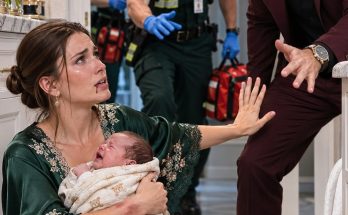
He went still.
Then his voice came through the phone.
“She won’t read them. She never reads the bank stuff.”
A pause.
Martha answered, “She’d better not. Once the refinance closes, you can put back what you borrowed before anyone notices.”
Something inside me seemed to tilt.
Claire stopped the recording.
No one spoke.
I heard the muted sounds of the hospital beyond the door—cart wheels, a telephone ringing somewhere, soft shoes moving along the corridor.
I looked at David.
“What did you borrow?”
He opened his mouth.
Nothing came out.
Claire took one step toward my bed.
“Sarah, don’t answer anything he says right now. And don’t sign anything.”
“I asked him a question.”
“I know.”
My voice sounded unfamiliar to me.
“What did you borrow, David?”
He rubbed one hand over his face.
“It isn’t what it sounds like.”
That sentence.
Of all the things he could have said, he chose the sentence I had heard in a hundred smaller ways over seven years.
You misunderstood.
You’re too sensitive.
You remember things differently.
That isn’t what happened.
Only this time, there was a recording.
Claire folded her arms.
“What does it sound like?”
David glanced at her.
“This is between me and my wife.”
“No,” Claire said. “At the moment, my sister is a patient in a hospital room, and you walked in after staff had already been told there were concerns about her safety. So you don’t get to decide who this is between.”
The door opened before he could answer.
The nurse who had examined me earlier stepped inside with a hospital social worker and a security officer standing discreetly behind her.
“Mr. Hayes,” the nurse said, “we’re going to ask you to leave.”
David stared at me.
For the first time in years, I did not try to make his expression easier.
I did not tell him I would call later.
I did not tell him everything would be all right.
I did not apologize.
He picked up the flowers.
Then, perhaps realizing how absurd that looked, he set them on the counter instead.
“Sarah,” he said quietly, “we need to talk.”
Claire answered before I could.
“Not tonight.”
David looked at Mia.
My whole body tightened, but he only said, “I love you, sweetheart.”
Mia moved closer to Claire.
David’s face changed.
Not dramatically.
That was almost worse.
He simply seemed to understand that something had shifted beyond his control.
Then security escorted him away.
The door clicked shut.
For several seconds I stared at it.
Mia climbed carefully onto the edge of the chair beside my bed.
“Mom?”
I looked at her.
Her small face was pale with exhaustion.
And suddenly the recording did not matter.
The refinance did not matter.
Whatever money David had taken did not matter.
Not compared with the fact that my eight-year-old had spent part of her childhood learning which adults told believable lies.
I held out my hand.
“Come here.”
She crossed the short distance immediately.
I wrapped my arms around her.
“I’m sorry,” I whispered into her hair.
Claire pulled the chair closer.
“Sarah.”
“No. I need to say it.”
Mia leaned back enough to look at me.
“For what?”
“For making you feel like you had to fix grown-up problems.”
Her eyes filled.
“But I helped.”
“You did,” I said. “You were very brave. But none of this should have been yours to solve.”
She glanced down at the old phone in her lap.
“Aunt Claire said I did the right thing.”
“You did.”
I swallowed.
“And now the grown-ups are going to do the rest.”
Claire nodded immediately.
“Yes. We are.”
Mia seemed to consider that.
“Can I stop thinking about it now?”
The question almost broke me more than anything else had.
“Yes,” I said. “You can.”
She leaned against me again.
And for the first time that evening, she looked like an eight-year-old instead of a witness.
Claire waited until Mia had fallen asleep in the reclining chair before she explained what she knew.
“I listened to the video three times on the drive here,” she said.
“You shouldn’t drive and watch videos.”
Despite everything, one corner of her mouth lifted.
“I listened. I did not watch.”
“That sounds like something a lawyer would say.”
“It is.”
I looked at the sleeping shape beneath the hospital blanket.
“So what papers were they talking about?”
“That’s what we need to find out.”
“I remember David mentioning refinancing.”
“When?”
“Last week. Maybe the week before.”
“And what did he say?”
“That interest rates had changed and we might save money.”
Claire’s expression tightened.
“Did you see paperwork?”
“There was an envelope on the kitchen counter yesterday.”
“Did you sign anything?”
“No.”
“Good.”
I stared at her.
“What do you think happened?”
“I don’t know yet.”
“Claire.”
“I mean that. I’m not going to fill in the blanks just because we’re angry.”
That was my sister.
Even as a teenager, she had hated guessing games.
Facts first, feelings second.
It had irritated me endlessly when we were younger.
That night, it steadied me.
She continued.
“Tomorrow, with your permission, we’ll pull your joint credit reports, contact the bank, and figure out whether there are any applications or loans you didn’t know about.”
“And if there are?”
“Then we deal with facts.”
I closed my eyes.
For years I had thought facts were dangerous.
Facts caused arguments.
Facts embarrassed families.
Facts could ruin birthdays, holidays, marriages.
So I had softened them.
Edited them.
Hidden them.
Now Claire was telling me they could also be a rope.
Something solid enough to hold.
“Claire?”
“Yeah?”
“Why did you tell me not to go home?”
She hesitated.
“Because David mentioned papers you hadn’t read. Because Martha clearly knew about money you didn’t. And because I didn’t want you walking back into a house tonight where everyone except you seemed to know what was happening.”
I looked toward the dark window.
The reflection showed a woman in a hospital gown with tired eyes and tangled hair.
I barely recognized her.
“I don’t have anywhere else to go.”
Claire almost laughed.
“You have my house.”
“You have one guest room.”
“I have a guest room, an office with a sofa, and a husband who has already moved half the office into our bedroom because he assumes Mia will steal his desk chair.”
Despite myself, I smiled.
“She does like that chair.”
“She spins in it until I get nauseous just watching.”
I looked down at my hands.
“What if I’m overreacting?”
Claire did not answer immediately.
Then she said something I would remember for years.
“You don’t need to decide the rest of your life tonight. You only need to decide where you’ll sleep tonight.”
A smaller decision.
That, I could make.
“Your house.”
“Good.”
The next morning, Claire’s kitchen smelled like coffee and cinnamon toast.
Her husband, Ben, had made pancakes shaped vaguely like animals.
Mia decided one was a rabbit.
Ben insisted it was a bear.
“It has ears,” Mia said.
“Bears have ears.”
“Not those ears.”
Ben looked offended.
“I’m an engineer. These are structurally excellent ears.”
I sat at the kitchen table wrapped in one of Claire’s cardigans and watched my daughter laugh.
Something inside me loosened.
No one asked her about the video.
No one asked what she had seen.
Claire had told Ben only what he needed to know, and he seemed to understand instinctively that Mia needed breakfast more than questions.
Afterward, Claire drove me to a branch of our bank.
“I’m not acting as your attorney,” she reminded me in the parking lot.
“You’ve said that four times.”
“I’ll probably say it four more. I’m your sister. I can help you understand things, but if you need representation, I’m referring you to someone who doesn’t share your childhood bedroom history.”
“You mean the history where you put tape down the middle of the room?”
“You crossed the border repeatedly.”
“I was six.”
“You were lawless.”
It felt strange to laugh.
Good, but strange.
Inside, a banking representative named Ms. Patel brought us into a small glass-walled office.
I explained that I wanted to review recent activity connected to our mortgage and joint accounts.
She typed for several minutes.
Then she looked up.
“There is a refinance application in progress.”
My fingers tightened around the strap of my purse.
“Did I sign it?”
“The application was initiated online. There is a co-borrower authorization that has not yet been completed.”
“So it can’t close?”
“Not without additional verification and signatures.”
Claire leaned slightly forward.
“And any disbursement?”
“Not from the refinance.”
I exhaled.
Then Ms. Patel’s expression changed.
“However, there is a home-equity line of credit associated with the property.”
I stared at her.
“What?”
“It was opened eighteen months ago.”
“I didn’t open a home-equity line.”
She turned the monitor slightly, careful not to expose more than necessary.
The account was there.
Our address.
David’s name.
And mine.
The room seemed to narrow.
“How much?”
Claire asked quietly.
Ms. Patel gave the figure.
Forty-eight thousand dollars.
I felt the air leave my lungs.
“What was it used for?”
“She may not be able to answer that from this account alone,” Claire said gently.
Ms. Patel nodded.
“I can provide the transaction history for accounts you are authorized to access.”
Most of the money had been transferred in several amounts.
Some went to our joint checking account and disappeared into ordinary expenses.
But three transfers stood out.
Ten thousand.
Twelve thousand.
Nine thousand.
All to an account I had never seen.
A business account.
HAYES HOME & GARDEN LLC.
I looked at Claire.
“David doesn’t have a business.”
Ms. Patel quietly corrected me.
“The account was established approximately two years ago.”
I stared at the printed page.
David had talked for years about opening a landscaping company.
He had once sketched a logo on a napkin.
A little green roof over the words Hayes Home & Garden.
I had encouraged him.
Then he had told me the idea was unrealistic.
Too much risk.
Too much paperwork.
Too expensive.
Apparently, he had done it anyway.
Just without me.
Back at Claire’s house, Mia was in the den building a cardboard village with Ben.
I sat at the dining-room table surrounded by printouts.
“It doesn’t make sense,” I said.
Claire opened her laptop.
“Then we don’t force it to make sense yet.”
“Why would he hide a business?”
“Maybe because it failed. Maybe because he was embarrassed. Maybe because Martha invested money. Maybe because he didn’t want you involved.”
“Or maybe because he knew I’d say no to borrowing against the house.”
Claire met my eyes.
“That’s possible.”
My phone had been turned off since the hospital.
I switched it on.
Thirty-seven messages arrived.
Most were from David.
A few from Martha.
I did not open them.
Then I noticed one from a number I did not recognize.
It had arrived at 6:13 that morning.
SARAH, THIS IS ELLEN MORROW. I WORKED WITH DAVID LAST YEAR. I HEARD SOMETHING HAPPENED. I THINK THERE ARE THINGS ABOUT THE BUSINESS YOU SHOULD KNOW. I’M SORRY I DIDN’T CONTACT YOU SOONER.
I showed Claire.
“Who is Ellen Morrow?” she asked.
“I have no idea.”
The message included a phone number.
Claire said, “You don’t have to call today.”
But suddenly I wanted to.
Not because I was ready for another secret.
Because I was tired of secrets existing in rooms I was not allowed to enter.
We called from Claire’s phone.
A woman answered on the third ring.
“Hello?”
“This is Sarah Hayes.”
There was a pause.
“Oh.”
“You texted me.”
“Yes.”
Her voice sounded older than I expected. Maybe fifty. Maybe sixty.
“I wasn’t sure you would call.”
“What do you know about Hayes Home & Garden?”
Silence.
Then a slow breath.
“I kept the books for six months.”
I looked at Claire.
“Why did you leave?”
“Because the business didn’t have the money David said it had. And because every time I asked where certain deposits came from, Martha told me to mind my own business.”
My skin prickled.
“Martha?”
“She was involved?”
“Very.”
I closed my eyes.
“What happened to the money?”
“I don’t know all of it. Equipment. Advertising. A truck lease. Jobs they underbid. Normal small-business mistakes, mostly.”
That surprised me.
No secret fortune.
No grand conspiracy.
Just bad decisions.
Pride.
Money.
Silence.
Ellen continued.
“But there’s something else.”
“What?”
“David told me the initial investment came from family money. I assumed he meant Martha’s.”
“And it didn’t?”
“I found a transfer record while reconciling the books. Twenty-five thousand dollars from an education account.”
I stopped breathing.
Claire straightened.
“What education account?” I asked.
Ellen’s voice softened.
“I’m sorry, Sarah. It had Mia’s name on it.”
My chair scraped backward.
“No.”
“That’s why I quit.”
“No. Mia’s college account is at Harland Investments. My father started it when she was born.”
“I know.”
I could hear papers moving on Ellen’s end.
“I kept a copy of the transfer confirmation because I was worried someone would eventually ask.”
My father.
A memory surfaced.
Dad sitting at our dining table on Mia’s first birthday, proudly explaining compound interest while I teased him that no baby needed a financial presentation before cake.
He had died four years later.
The account had been one of the last practical gifts he left behind.
I gripped the edge of the table.
“Can you send it?”
“Yes.”
“Please.”
Less than a minute later, Claire’s phone chimed.
She opened the attachment.
For a long time, she said nothing.
Then she turned the screen toward me.
The document showed the transfer.
Twenty-five thousand dollars.
From an account bearing Mia’s name.
To Hayes Home & Garden LLC.
Authorized twenty-two months earlier.
There was a signature line.
DAVID HAYES, CUSTODIAN.
I stared at it.
“He wasn’t the custodian.”
Claire looked at me sharply.
“Who was?”
“I was.”
She turned back to the document.
And then I noticed another name.
The person listed as having verified the request.
Martha Hayes.
I whispered, “How could she verify anything?”
Claire zoomed in.
Her expression changed.
“This wasn’t done through your investment company.”
“What?”
“This looks like a transfer from a secondary custodial account.”
“I don’t have one.”
“Maybe you didn’t open it.”
I felt cold.
“What are you saying?”
“I’m saying we need the original account documents.”
My phone buzzed on the table.
This time the incoming message was from David.
I almost ignored it.
Then I saw the preview.
SARAH, BEFORE CLAIRE TURNS THIS INTO SOMETHING IT ISN’T, YOU NEED TO KNOW YOUR FATHER WAS THE ONE WHO—
The message cut off.
I opened it.
The full sentence read:
SARAH, BEFORE CLAIRE TURNS THIS INTO SOMETHING IT ISN’T, YOU NEED TO KNOW YOUR FATHER WAS THE ONE WHO GAVE ME PERMISSION TO USE THAT MONEY.
For several seconds, the words made no sense.
My father had been dead for almost four years when the transfer occurred.
I handed the phone to Claire.
She read it twice.
Then she looked at the document Ellen had sent.
“Sarah,” she said slowly, “either David just made a very strange mistake…”
She pointed to a date printed in tiny type at the bottom of the transfer form.
“…or somebody has been using paperwork that predates your father’s death.”
I looked toward the den, where Mia was laughing because Ben’s cardboard library had collapsed.
Twenty feet away, my daughter was safe.
Right in front of me sat a document containing my dead father’s name, my daughter’s money, my husband’s business, and my mother-in-law’s signature.
For years I had thought the worst secrets in my marriage were the ones I already knew.
I was beginning to understand that some secrets survive precisely because everyone keeps looking in the wrong direction.
Claire closed the laptop.
“We need to find your father’s estate files.”
I swallowed.
“They’re in the attic.”
“At your house?”
I shook my head.
“No.”
And for the first time all day, I knew exactly where we needed to go.
“They’re at Mom’s.”
-END OF PART 2, –PRESS NEX PART IN BOTTOM OF PAGE TO READ NEXT PART
PART 3 THE RECORDING I COULDN’T HEAR: A FAMILY’S LONG ROAD BACK TO TRUST
My mother lived forty minutes outside town in the same brick ranch house where Claire and I had grown up.
Nothing about it seemed to understand that our lives had changed.
The brass numbers beside the garage were still crooked.
The maple tree still leaned over the driveway.
The front porch still had the faint white paint mark from the summer Claire and I attempted to repaint the railing without asking permission and discovered that enthusiasm was not the same thing as skill.
Mom opened the door before we knocked.
One look at my face and she stopped smiling.
“What happened?”
“I need Dad’s estate files.”
She looked from me to Claire.
“Why?”
Claire answered carefully.
“We found something connected to one of the accounts he set up for Mia.”
Mom’s hand tightened around the doorframe.
“Is Mia all right?”
“She’s with Ben,” I said. “She’s fine.”
That was the first question everyone should have been asking, I thought.
Not what happened to David.
Not what would people say.
Not whether the marriage could be saved.
Is Mia all right?
“Yes,” I repeated. “She’s safe.”
Mom stepped aside.
“Come in.”
Her name was Helen, though almost no one called her that.
To neighbors she was Mrs. Morgan.
To her book club she was Nell.
To Claire and me she was simply Mom, a title broad enough to contain cinnamon rolls, science-fair disasters, arguments about curfews, my wedding dress, Dad’s funeral, and every quiet Sunday dinner afterward.
She made tea while Claire and I carried two dusty banker’s boxes down from the hall closet.
“I thought these were in the attic,” I said.
“They were. I moved them after the roof leak.”
I ran my fingers over Dad’s handwriting.
TAXES.
INSURANCE.
MIA—SCHOOL.
My throat tightened.
He had labeled everything.
Dad had believed labels could defeat chaos.
Mom set three mugs on the table.
“Now tell me what’s going on.”
So I did.
Not everything.
I still could not describe the shed.
I could not yet say aloud how long I had been protecting my marriage by shrinking the truth.
But I told her about the hospital.
The recording.
The refinance.
The business.
The home-equity line.
And finally, the education money.
Mom sat very still.
When I finished, she looked down at her hands.
“I knew about the business.”
I stared at her.
Claire stopped turning pages.
“What?”
Mom swallowed.
“Not all of it.”
“How much?”
“David came to me about two years ago. He said he wanted to start a landscaping company.”
I almost laughed.
The sound that came out was nothing like laughter.
“Apparently everyone knew except me.”
“No.” Mom shook her head quickly. “I didn’t know he’d actually started it. He asked whether your father had ever mentioned helping him.”
“And had Dad?”
She looked toward the window.
“Once.”
“When?”
“Before he got sick.”
Dad’s final illness had been short.
Six months from diagnosis to funeral.
There were still days from that period I remembered only in fragments.
Medication charts.
Hospital parking.
Claire arguing with an insurance company.
Mom sleeping in a chair.
David bringing takeout and making everyone laugh.
He had been good then.
Or maybe I had needed him to be.
Mom continued.
“Your father thought David had talent. He told him that if he ever became serious about starting a business, he’d be willing to look at a proper plan.”
“So Dad gave him permission to take Mia’s money?”
“No.”
Her answer came so quickly that I believed it.
“Absolutely not. Your father would never have touched her education fund for that.”
Claire pulled a folder from the box.
“Did Dad ever make David a beneficiary of anything?”
“No.”
“Give him signing authority?”
“No.”
“Name him trustee or custodian?”
“No.”
Mom frowned.
“There was one account, though.”
My heart sank.
“What account?”
“When your father first started saving for Mia, he opened a small custodial savings account at Lakeside Community Bank. Just a few thousand dollars. Later he moved most of the money into the investment account.”
“Most?”
“He left some behind.”
“How much?”
“I don’t remember. Five thousand, perhaps.”
Claire looked at me.
“A secondary custodial account.”
The phrase from Ellen’s transfer record echoed in my mind.
Mom stood abruptly.
“There should be statements.”
We searched for twenty minutes.
Dad’s files were exactly what I remembered: painfully organized until the final year of his life, when the labels became less precise and papers began appearing in the wrong folders.
Then Claire found a thin blue envelope.
“Lakeside.”
Inside were statements from six years earlier.
The account title read:
EMILIA HAYES, MINOR
ROBERT MORGAN, CUSTODIAN
My father.
Not me.
I looked at Mom.
“I thought I was the custodian.”
“Of the investment account, yes.”
Claire turned through the pages.
“What happened to this one when Dad died?”
Mom’s face changed.
“I don’t know.”
“What do you mean?”
“I assumed it transferred to Sarah.”
“It would have required paperwork.”
“I had paperwork everywhere, Claire. Probate. Insurance. Hospital bills. Your father’s pension. I signed so many things that year I can’t remember half of them.”
She covered her mouth with one hand.
“Oh, God.”
I reached across the table.
“Mom, stop.”
“What if I signed something?”
“You didn’t take Mia’s money.”
“But what if I made it possible?”
Claire’s tone softened.
“We don’t know that.”
I watched my mother’s face and saw something I had not expected.
Fear.
Not fear of scandal.
Fear that during the worst year of her life, someone had taken advantage of the fact that she could barely think.
For once, I understood exactly how that felt.
Lakeside Community Bank had merged twice since Dad’s death.
The original branch no longer existed, but after several calls we reached an archival records department.
They would not give us account details over the phone.
That was reasonable.
It was also maddening.
We filled out requests.
Provided identification.
Sent copies of Dad’s death certificate.
Then we waited.
For three days.
Waiting turned out to be harder than discovering things.
Discovery gives the mind somewhere to go.
Waiting lets it wander everywhere.
During those three days, I stayed with Claire.
Mia went to school.
I met with a counselor recommended by the hospital social worker.
I also met with a family-law attorney named Priya Shah, one of Claire’s former classmates.
The first thing Priya said surprised me.
“You do not have to make every decision this week.”
Claire had said almost the same thing.
I looked between them.
“Is there a class lawyers take where you learn to say that?”
Priya smiled.
“Actually, yes. It’s called watching clients try to solve the next twenty years before lunch.”
She explained practical steps.
Financial records.
Temporary living arrangements.
Communication through written channels.
A clear schedule for Mia.
Nothing theatrical.
Nothing dramatic.
Just boundaries.
Paperwork.
Time.
For years I had believed leaving a broken situation required one enormous moment of courage.
Instead, it seemed to require dozens of small decisions.
Change the mailing address.
Freeze the joint credit line.
Send the school an updated pickup list.
Make an appointment.
Keep a copy.
Do not answer every message immediately.
Sleep.
Eat something.
Pick Mia up at three.
Ordinary acts began rebuilding my life long before I felt brave enough to call it rebuilding.
David sent messages every day.
Some apologetic.
Some defensive.
Some confusing.
I replied only about Mia, and only after Priya helped establish a temporary arrangement.
To his credit, he did not try to involve Mia in the adult details.
When they spoke by phone, the conversations were short and gentle.
“How was school?”
“Fine.”
“Did you finish your volcano project?”
“It’s not a volcano, Dad. It’s erosion.”
“Right. Erosion. I remember.”
I always remained nearby.
Not listening to every word.
Just present.
After one call, Mia handed me the phone.
“Dad sounds sad.”
I knelt beside her.
“He probably is.”
“Are you sad?”
“Yes.”
“Can two people be sad and still not live together?”
I thought about that.
“Yes.”
She nodded.
Then she asked whether we could make grilled cheese.
Children sometimes accept truths adults spend years trying to negotiate away.
The bank records arrived Thursday afternoon.
Claire printed them at her office and brought them home in a sealed envelope.
We waited until Mia had gone with Ben to her swimming lesson.
Then we sat at the kitchen table again.
This time Mom joined us.
The documents told a story.
Not the story I expected.
After Dad’s death, the small Lakeside custodial account had indeed required a successor custodian.
A form had been submitted six weeks after his funeral.
The successor listed was not me.
It was David.
My husband.
Attached to the form was a signed nomination.
ROBERT MORGAN.
My father’s name.
Dated eleven months before he died.
Mom leaned forward.
“That signature looks real.”
Claire studied it.
“So does mine,” I said.
Dad had nominated David?
Why?
Then we found the accompanying letter.
It was typed, but Dad had signed the bottom.
To whom it may concern,
In the event that I am unable to continue serving as custodian for Emilia Hayes’s Lakeside savings account, I nominate her father, David Hayes, as successor custodian. This account is intended solely for Emilia’s education and welfare.
I read it twice.
Then a third time.
My anger wavered.
Dad really had given David authority.
Not to use the money for a business.
But to control the account.
David’s message had contained a fragment of truth.
That made everything more complicated.
Claire turned to the later statements.
The balance at the time David took over had been $6,840.
Then deposits began appearing.
Large deposits.
Five thousand.
Ten thousand.
Seven thousand.
Mom frowned.
“Where did that come from?”
We traced the source.
Several transfers were from an account belonging to Martha Hayes.
I stared at the page.
“Martha put money into Mia’s account?”
“Looks that way,” Claire said.
Over eighteen months, Martha had deposited nearly twenty thousand dollars.
Then the entire balance—just over twenty-five thousand—had been transferred to Hayes Home & Garden.
Mom sank back.
“So part of the money was Martha’s.”
“Yes,” Claire said. “But once she deposited it into a custodial account for Mia, it wasn’t simply hers to take back.”
I thought of the recording.
Once the refinance closes, you can put back what you borrowed before anyone notices.
Not stolen for years.
Borrowed, in their minds.
A temporary solution.
A mistake they planned to repair before I discovered it.
That almost made it sadder.
Because it meant they had convinced themselves secrecy was acceptable as long as the ending eventually looked clean.
I knew that kind of thinking.
I had lived inside it too.
Hide the bad part.
Protect the appearance.
Fix it later.
Maybe that was the real inheritance moving through our family.
Not money.
Silence.
That evening, Mom remained after dinner.
Mia showed her the erosion project.
Ben made popcorn.
For an hour, nobody discussed banks or lawyers or marriage.
Then, after Mia went upstairs to brush her teeth, Mom touched my arm.
“There’s something I haven’t told you.”
I felt tired before she even continued.
“What?”
“About Martha.”
Claire looked up.
Mom folded her hands.
“A few months after your father died, Martha came to see me.”
“Why?”
“She said David was struggling.”
“With what?”
“Everything. Work. Money. Grief, apparently.”
“Grief?”
“She said your father had been like a father to him.”
That was true.
Dad had liked David.
Loved him, perhaps.
They had repaired the deck together.
Watched baseball.
Argued about charcoal versus gas grills.
David had cried at Dad’s funeral.
Mom continued.
“Martha told me David had become obsessed with making the business idea work because he believed your father had wanted that for him.”
I stared at her.
“Why didn’t you tell me?”
“Because I thought it was a passing thing. And because…”
She stopped.
“Because what?”
“She asked me not to.”
Claire gave a soft, humorless laugh.
“Apparently that was everyone’s favorite sentence.”
Mom flinched.
Then nodded.
“You’re right.”
I regretted Claire’s tone, but Mom did not defend herself.
“She said you were overwhelmed,” Mom continued. “Mia was little. Your father had just died. She said David wanted to protect you from another worry.”
I looked at the table.
Protect you.
Another familiar phrase.
People had protected me so thoroughly that I had become a stranger inside my own life.
Mom’s eyes filled.
“I thought I was helping.”
“I know.”
“No, Sarah. I should have trusted you with your own life.”
Something in me softened.
She was not asking me to erase what happened.
She was simply telling the truth.
“I wish you had.”
“So do I.”
We sat quietly.
Then Mom said, “There’s more.”
Claire groaned softly.
“Please tell me it’s something pleasant. A surprise inheritance. A secret family cabin.”
Mom almost smiled.
“No.”
She reached into her purse.
“I found this after you left yesterday.”
She placed an envelope on the table.
Dad’s handwriting was on the front.
SARAH.
My name.
Nothing else.
The envelope had been opened.
I looked at Mom.
“You read it?”
“Years ago.”
“Why didn’t you give it to me?”
Her face crumpled.
“Because I was angry.”
“With me?”
“With him.”
I stared at her.
“What did Dad write?”
“I think you should read it.”
The paper inside was only two pages.
Dad’s handwriting had grown shaky by then.
Sarah,
If you’re reading this, I probably waited too long to say things plainly, which is a Morgan family tradition we should stop pretending is charming.
I laughed once, despite myself.
Then I kept reading.
He wrote about Claire.
About Mom.
About Mia.
Then about David.
David wants very badly to prove he can build something of his own. I understand that. I also worry that he hears encouragement as obligation. I told him I would consider investing if he came to me with a plan, but I have decided I will not do it. He is chasing the business for the wrong reasons right now. Pride makes poor decisions sound urgent.
I looked up.
Mom wiped her eyes.
“Keep going.”
Dad’s next words were harder.
Please don’t confuse loyalty with silence. Your mother and I did that too often when we were young. We thought protecting a family meant keeping its difficult parts inside the house. Mostly it meant we carried problems longer than we should have.
I stopped.
The room blurred.
Dad had written the sentence years before my life would require it.
At the bottom he added:
If I get the chance, I’ll tell you this myself.
He never had.
Mom whispered, “I found it after the funeral.”
“Why were you angry?”
“Because he wrote that we had kept things inside the house. And he was right.”
She looked at Claire.
“Your father and I nearly separated when you girls were teenagers.”
Claire blinked.
“What?”
“We never told you.”
I remembered one summer when Dad slept in the guest room because he was “snoring too much.”
I remembered Mom taking a trip alone.
I remembered tension without explanation.
“You worked it out,” I said.
“We did. But not because silence saved us.”
Mom touched the letter.
“We worked it out when we finally stopped trying to look like a perfect family.”
The words settled over us.
Claire looked toward the staircase, making sure Mia was not nearby.
“So why keep the letter?”
“Because after Robert died, I wanted to remember us as happy.”
Mom’s voice broke.
“And that letter reminded me we had once almost failed.”
I reached for her hand.
“Mom.”
“I thought keeping the painful parts hidden made the good parts more real.”
I shook my head.
“It doesn’t.”
“I know that now.”
For years I had inherited a family story polished by love.
My parents had been happy.
My marriage was stable.
Martha was difficult but devoted.
David was charming but complicated.
I was fine.
We were all fine.
Maybe families did not break because their stories contained painful chapters.
Maybe they broke when no one was allowed to read them.
Two days later, David asked to meet.
Not alone.
He agreed to meet at Priya’s office, with her present.
I almost said no.
Then I thought about Dad’s letter.
Not forgiveness.
Not reconciliation.
Truth.
Those were different things.
So I went.
David looked older than he had a week earlier.
No dramatic transformation.
Just tired.
He sat across the conference table with his own attorney.
For the first ten minutes, lawyers spoke.
Finances.
Documents.
Temporary arrangements.
Then David looked at me.
“The money was supposed to go back.”
I believed him.
That surprised me.
“I know.”
His eyes widened slightly.
“Martha put most of it in that account because she wanted Mia to have something from her. When the business started failing, I told myself I was borrowing money that had mostly come from Mom anyway.”
“It belonged to Mia.”
“I know.”
“Did you know that then?”
He stared at the table.
“Yes.”
At least he did not pretend otherwise.
“Why didn’t you tell me about the business?”
“Because you would have said it was too risky.”
“I might have.”
“And your father believed in me.”
I pulled Dad’s letter from my folder.
“No.”
David looked up.
I slid a copy across the table.
“He cared about you. That isn’t the same thing.”
David read.
Halfway down the page, his face changed.
At the bottom, he closed his eyes.
“He never told me.”
“He didn’t get the chance.”
David folded the paper carefully.
“I spent years thinking I had disappointed him.”
“So you hid the business from me?”
“No.”
He looked directly at me.
“I hid it because I had disappointed myself.”
It was the first thing he had said that sounded entirely true.
I felt sorrow.
Not the kind that asks you to go back.
The kind that allows you to finally see someone clearly.
David continued.
“The refinance was supposed to pay off the home-equity line and replace the custodial money. Then I was going to close the business.”
“And you were going to tell me?”
His silence answered.
I nodded.
“That’s what I thought.”
Priya shifted slightly but did not interrupt.
David said, “Sarah, I know saying I’m sorry doesn’t—”
“No.”
He stopped.
“I don’t need an apology today.”
“What do you need?”
I surprised myself with the answer.
“Accuracy.”
He frowned.
“I spent years wondering whether I remembered things correctly. Whether I was unreasonable. Whether I made problems larger than they were.”
My voice stayed steady.
“I need a life where I don’t have to argue with myself about what is real.”
David looked down.
After a long time, he said, “I understand.”
Maybe he did.
Maybe he only understood the sentence.
Either way, it was enough for that day.
The meeting ended with practical agreements.
An independent accountant would review the business.
The refinance application would be withdrawn.
The home-equity debt would be accounted for during the separation.
David would begin restoring the custodial funds through a legally supervised arrangement.
Mia would continue spending time with him under the temporary schedule recommended by counsel and her therapist, in settings where she felt secure.
No grand ending.
No slammed doors.
No triumphant speeches.
Just signatures on temporary documents.
Outside the office, Claire waited in her car.
“How did it go?”
“I think my marriage is over.”
She nodded.
“I’m sorry.”
I looked through the windshield at people crossing the street.
“So am I.”
And I meant it.
Ending something could be necessary and still be sad.
I had spent years believing sadness meant I was making the wrong choice.
It turned out grief sometimes simply meant the choice mattered.
Then Claire handed me an envelope.
“What’s this?”
“Ellen dropped it at my office.”
Inside was a flash drive and a handwritten note.
I FOUND ONE MORE FILE IN MY OLD BUSINESS BACKUPS. YOU SHOULD SEE IT.
At Claire’s house, we opened the drive.
There were invoices.
Spreadsheets.
Tax documents.
Then one audio file.
A meeting recording.
The date was from eighteen months earlier.
Ellen’s voice came first.
Then David’s.
Then Martha’s.
Most of it was boring financial discussion.
Until Martha said:
“You have to tell Sarah.”
David answered, “Not yet.”
“You said that six months ago.”
“I’ll tell her when I fix it.”
Then Martha said something neither Claire nor I expected.
“I’m done helping you hide it. If you don’t tell her by Friday, I will.”
The recording ended.
I stared at the screen.
Claire stared too.
For the first time, Martha’s role no longer fit the simple shape I had given it.
She had known.
She had helped.
She had kept secrets.
But at some point, she had also tried to stop.
And suddenly one question mattered more than all the others.
“What happened on Friday?”
-END OF PART 3–PRESS NEX PART IN BOTTOM OF PAGE TO READ NEXT PART
PART 4 ( The End) THE RECORDING I COULDN’T HEAR: A FAMILY’S LONG ROAD BACK TO TRUST
Friday had been eighteen months ago.
I knew that because Claire checked the calendar.
I knew what had happened that day because I still had photographs.
Mia had lost her first tooth.
There she was in my phone, grinning at our kitchen table with a gap in the bottom row of her teeth while David held up a tiny envelope decorated with a cartoon fairy.
I remembered spaghetti for dinner.
I remembered calling Mom.
I remembered David taking Mia upstairs to find a better container for the tooth.
I remembered Martha arriving unexpectedly around seven.
At the time she said she had been nearby.
Now I wondered whether she had come to tell me the truth.
“What happened?” Claire asked.
“I don’t know.”
“You were there.”
“So were you at thousands of moments you can’t reconstruct.”
She leaned back.
“Fair.”
I scrolled through old messages.
At 7:14 that evening, Martha had texted:
Are you home?
At 7:19:
I’m coming by.
At 8:03:
We’ll talk another time.
That was all.
I stared at the last message.
“What stopped her?”
Claire asked.
“I don’t know.”
There was only one way to find out.
I did not call Martha immediately.
Not because I wanted to punish her.
Because I needed to know what I was asking for.
An explanation?
An apology?
A confession?
Permission to dislike her?
For years, Martha and I had lived inside a narrow relationship made mostly of polite irritation.
She thought I folded towels incorrectly.
I thought she treated Thanksgiving like a military operation.
She considered packaged pie crust a moral failing.
I considered any recipe with twelve steps suspicious.
But underneath all of that had always been something more complicated.
She loved David fiercely.
Sometimes so fiercely there had been little room left for anyone who challenged the version of him she preferred.
And yet the old recording said she had challenged him.
At least once.
I met with my counselor, Dr. Reynolds, before making the call.
“What would you want from the conversation?” she asked.
“Truth.”
“That’s broad.”
“I want to know why she didn’t tell me.”
“And if her answer disappoints you?”
“It probably will.”
“And if it doesn’t?”
That question caught me.
“I don’t know.”
She nodded.
“Then perhaps the goal isn’t to get an answer that makes you feel better. Perhaps it’s simply to get an answer.”
Accuracy.
Again.
Maybe accuracy was what recovery looked like before peace arrived.
Martha agreed to meet at a café near the library.
Public.
Quiet.
Ordinary.
I almost laughed at how normal it looked.
People drank coffee.
A college student typed on a laptop.
Two elderly men argued cheerfully about baseball.
No one knew that at the corner table, a sixty-three-year-old woman and her daughter-in-law were about to examine nearly a decade of unfinished sentences.
Martha arrived early.
Her hair was perfectly arranged.
Her lipstick precise.
But she looked tired.
“Sarah.”
“Martha.”
She sat.
For a moment, neither of us touched the coffee.
Then I placed my phone on the table and played the business recording.
Her face changed almost immediately.
“Where did you get that?”
“Ellen.”
Martha closed her eyes.
“I wondered if she kept copies.”
“You told David you were going to tell me.”
“Yes.”
“What happened?”
She looked through the window.
Then she said, “Mia lost a tooth.”
I stared at her.
“You remember?”
“I arrived at your house angry enough to walk straight through the door and tell you everything.”
She gave a small, sad smile.
“Then Mia came running down the hallway holding that ridiculous little envelope.”
My throat tightened.
“She was so excited. David was making a big performance of calculating the tooth fairy’s inflation rate.”
I remembered.
Mia had laughed so hard milk came through her nose.
Martha continued.
“You were happy that night.”
“That’s why you didn’t tell me?”
“Not exactly.”
“Then why?”
She folded her hands.
“Because David pulled me into the laundry room and said he had a contract beginning Monday that would fix most of the business debt. He showed me numbers. He told me within three months he could replace the custodial money.”
“Did you believe him?”
“Yes.”
“Why?”
“Because I wanted to.”
There it was.
No excuse.
Just a motive.
She looked down.
“I told myself there was no reason to ruin that evening if he could repair the damage before you ever needed to know.”
“But three months passed.”
“Yes.”
“Then six.”
“Yes.”
“And you still didn’t tell me.”
“No.”
“Why?”
“Because by then I was ashamed.”
I waited.
Martha’s voice became quieter.
“The longer I helped him keep the secret, the harder it became to admit I had helped at all.”
I understood that better than I wanted to.
She looked at me.
“Sarah, I spent most of my life believing that loyalty meant standing beside someone no matter what. My husband was like that. His father was like that. You didn’t discuss family problems outside the family.”
I thought of Dad’s letter.
Different house.
Same rule.
“My father wrote something almost exactly like that before he died.”
Martha gave a faint nod.
“Robert was smarter than I was.”
“He still made mistakes.”
“Of course he did.”
That surprised me too.
For years both our families had turned my father into something polished after his death.
Wise.
Patient.
Reliable.
The dead cannot correct their reputations.
Martha stirred her untouched coffee.
“I knew David was making financial mistakes. I knew he was hiding them. I told myself I was helping him get back on his feet.”
She swallowed.
“And somewhere along the way, helping him became helping him avoid consequences.”
I looked at her for a long time.
“What happened at the shed?”
Her face paled.
I raised one hand.
“I’m not asking for details. I don’t want to relive it.”
She nodded.
“I want to know why you were standing there laughing.”
Her eyes filled.
For once, Martha Hayes did not have an answer ready.
“I don’t know how to explain that without making it sound smaller than it was.”
“Then don’t.”
She looked down.
“I was angry.”
“At me?”
“At everything. At David. At the business. At myself. At you for saying things out loud that I had spent years pretending weren’t true.”
She took a breath.
“When people are ashamed, sometimes they become very invested in making someone else look like the problem.”
The café sounds continued around us.
A spoon clinked against a cup.
Someone laughed near the counter.
Martha wiped one tear quickly.
“I am sorry.”
I believed she meant it.
That did not create forgiveness.
Not instantly.
Maybe forgiveness was never supposed to be instant.
“I’m not ready to have a normal relationship with you,” I said.
“I know.”
“I don’t know what your relationship with Mia will look like.”
Her mouth trembled.
“I understand.”
“That will depend on what is healthy for her. Not what feels fair to you or me or David.”
“Yes.”
“And I need space.”
“You’ll have it.”
She reached into her purse.
For one tense second, I wondered what else could possibly emerge from one of our families’ purses.
Then she placed a small blue bankbook on the table.
The old-fashioned kind.
I recognized Mia’s name.
“What is that?”
“I opened a separate savings account last month.”
I did not touch it.
“I didn’t ask you to.”
“I know.”
“I don’t want secret accounts.”
“It isn’t secret.”
She slid a document toward me.
“The account is in my name for now. The beneficiary is Mia. But I brought the paperwork because I wanted you to know it exists.”
“Why?”
“Because I sold my share of the equipment.”
I looked up.
“I put the money there.”
“How much?”
“Not enough to replace everything David took. But some.”
I pushed it back.
“Martha—”
“I’m not asking you to accept it today.”
“That isn’t the point.”
“I know.”
Her voice remained steady.
“The point is that I spent years contributing money in ways that let me control what happened next. I don’t want to do that anymore.”
She took the bankbook back.
“If you decide someday that Mia should receive it, she will. If you decide otherwise, I’ll donate it toward scholarships.”
For the first time in our relationship, Martha had offered something without attaching herself to the outcome.
That did not fix the past.
But it changed the room.
“I’ll think about it,” I said.
She nodded.
“That’s all I hoped for.”
The separation lasted eleven months before the divorce was final.
People sometimes expect the end of a marriage to have a clear emotional climax.
Mine did not.
There were forms.
Appraisals.
Schedules.
A mediator who kept peppermints in a glass bowl.
There were evenings when I missed David so much I nearly called him simply to hear the familiar sound of his breathing on the other end.
There were other evenings when I found an old photograph and felt nothing except distance.
Both were true.
The accountant eventually determined that Hayes Home & Garden had not been a secret gold mine or an elaborate scheme.
It had been exactly what Ellen described.
A badly managed small business built on too much optimism and too little capital.
David had not hidden wealth.
He had hidden failure.
That distinction mattered legally.
Emotionally, it mattered too.
Not because hiding failure was acceptable.
Because understanding why someone did something is not the same thing as excusing it.
Priya helped me learn that.
Dr. Reynolds helped me learn it again.
David agreed to sell the remaining business assets and a recreational vehicle he had purchased through the company.
Between those proceeds and his structured repayments, the money taken from Mia’s custodial account was restored.
The home-equity line became part of the property settlement.
I kept the house.
Then, three months later, I sold it.
Everyone was surprised.
“You fought to keep it,” Claire said when I told her.
“No. I fought not to lose it.”
“That sounds suspiciously like lawyer language.”
“I’ve been contaminated.”
She laughed.
The truth was simpler.
I did not want the house.
I had wanted the ability to choose.
Once it belonged to me, I could finally admit I did not want to live there.
So Mia and I bought a smaller place fifteen minutes away.
Two bedrooms.
A little office.
A kitchen with yellow cabinets the previous owner had painted badly.
A narrow backyard with one enormous oak tree.
On moving day, Mia stood in the empty living room with her hands on her hips.
“It echoes.”
“It does.”
“Can I paint my room?”
“What color?”
“Purple.”
“What kind of purple?”
She considered.
“Confident purple.”
I had no idea what that meant.
We found it anyway.
David changed too.
Not overnight.
Not enough to undo anything.
But enough that I noticed.
He closed the business.
Found a salaried position with a landscaping company.
Started individual counseling.
For months our communication stayed formal and almost entirely about Mia.
Then one spring afternoon, he brought her home from a weekend visit and noticed the flower beds beside my porch.
“You put the hydrangeas too close together,” he said automatically.
I stared at him.
He stared back.
Then his eyes widened.
“Sorry.”
I laughed.
Actually laughed.
“I probably did.”
He looked at the plants again.
“They’ll survive.”
“Good.”
There was a time when such a small correction from him could have changed the temperature of my entire day.
Now it was simply about hydrangeas.
That felt like freedom.
Mia ran back to his car because she had forgotten her backpack.
David stood on the walkway.
“Sarah.”
“Yeah?”
“I got the final notice from the custodial account.”
I waited.
“The balance is restored.”
“I know. Priya sent me the confirmation.”
He nodded.
“I’m glad.”
“So am I.”
He rubbed his hands together, an old nervous habit.
“I’m sorry it took this long.”
“I know.”
“I’m not asking you to say anything back.”
That was new.
So I did say something.
“I hope you build a good life, David.”
His face tightened.
“You too.”
I meant it.
Not because everything was forgotten.
Because wanting him to fail would still have tied my future to his.
I wanted something quieter.
Distance.
Respect.
Consistency for Mia.
A life no longer organized around proving who had been right.
Martha did not see Mia for several months.
That was not punishment.
It was time.
Then, after conversations with Mia’s counselor and careful discussion between the adults, we agreed to a short visit at a botanical garden with David present.
Martha arrived carrying no gifts.
That mattered.
She did not overwhelm Mia with apologies.
That mattered too.
She simply said, “I’m glad to see you.”
Mia said, “They have butterflies.”
“I heard.”
“There’s a blue one that looks fake but it isn’t.”
“Will you show me?”
Mia looked at me.
I smiled.
“Go ahead.”
They walked toward the conservatory.
Martha did not reach for Mia’s hand.
She waited.
Halfway there, Mia reached for hers.
I watched from a bench.
Claire sat beside me with two lemonades.
“That’s complicated,” she said.
“Yes.”
“Are you okay?”
“Yes.”
And I was.
Not perfectly.
Not permanently.
But honestly.
That became my preferred kind of okay.
A year and a half after the hospital, Mom hosted Thanksgiving.
For the first time since Dad died, we changed the seating arrangement.
It sounds small.
It wasn’t.
Dad’s chair had remained empty at the head of the table for years.
No one discussed it.
No one sat there.
We simply built every holiday around absence.
That year, Mom put the chair in the garage.
Then she moved the table closer to the window.
Ben carved the turkey.
Claire burned the rolls.
“I did not burn them,” she insisted.
“You created charcoal briquettes,” I said.
“They’re rustic.”
“They’re dangerous.”
Mia laughed so hard she nearly dropped her fork.
Mom brought out Dad’s old gravy boat.
For a moment, the room became quiet.
Then she said, “Your father hated this thing.”
I blinked.
“What?”
“He thought it looked like a shoe.”
Claire started laughing.
“He never said that.”
“Of course not. His mother gave it to us.”
We laughed until Mom cried.
Then I cried too.
Not because Dad was gone.
Not only because he was gone.
Because for years we had remembered him too carefully.
That afternoon we told stories that made him human again.
The time he got lost driving to a wedding but refused to ask directions.
The summer he accidentally bought decaf coffee and spent a week convinced he had a mysterious illness.
The argument he and Mom once had about a dishwasher that ended with them eating Chinese food on the kitchen floor.
Imperfection did not make us love him less.
It made the love warmer.
More real.
Later, while helping Mom put leftovers away, I noticed Dad’s letter framed on a shelf.
Not the whole thing.
Just one sentence.
DON’T CONFUSE LOYALTY WITH SILENCE.
“You framed it?” I asked.
Mom closed the refrigerator.
“I thought I should stop hiding the parts of our marriage that taught me something.”
I touched the frame.
“I like it.”
“So do I.”
Then Mom said, “Are you happy?”
A year earlier, I might have tried to evaluate the question like an exam.
Career.
Marriage.
House.
Money.
Family.
Evidence for happiness.
Instead, I looked through the doorway.
Mia and Ben were trying to balance spoons on their noses.
Claire was telling them both they were ridiculous while secretly attempting the same thing.
“I’m becoming happy,” I said.
Mom smiled.
“I think that counts.”
The old phone stayed in my desk drawer for almost two years.
I never watched the video.
I did not need to.
The necessary copies existed where they needed to exist, and the legal matters had long since concluded.
But I could not throw the phone away.
It had become a symbol I did not know what to do with.
Then one Saturday morning, Mia found me cleaning the office.
She was ten now.
Taller.
Missing none of her front teeth.
She picked up the old phone.
“Is this the one?”
I knew what she meant.
“Yes.”
She studied it.
“Does it still work?”
“Probably not.”
She handed it to me.
“You can throw it away.”
I looked at her.
“You sure?”
“It’s just an old phone.”
To her, maybe it finally was.
I held it in my palm.
Two years earlier, it had felt like the object that changed everything.
But Mia had been right all along in a way neither of us understood.
The phone had not changed our lives.
The truth had.
And truth did not live in the device anymore.
It lived in bank records.
In court orders.
In boundaries.
In therapy appointments.
In difficult conversations.
In purple bedroom walls.
In hydrangeas planted too close together.
In my mother’s framed letter.
In Martha learning how to visit without controlling.
In David learning that apology and repair were not the same thing.
In Claire learning not to answer every problem like opposing counsel.
Mostly.
I dropped the phone into the electronics recycling box.
Mia looked pleased.
“Can we get ice cream?”
“It’s ten in the morning.”
“So?”
I considered the question.
There was a time when I believed responsible adults always knew the proper answer.
Now I knew better.
“Get your shoes.”
Three years after the night at the hospital, Mia’s school held a family writing night.
Parents sat at tiny desks while children read short essays.
Mia stood at the front of her classroom holding two pages.
Her topic was “A Place That Feels Like Home.”
I expected her to write about our little yellow-cabinet kitchen.
Or her purple bedroom.
Or Claire’s house.
Instead she wrote:
Home is not one building.
Sometimes home is Grandma Helen’s kitchen.
Sometimes it is Dad’s apartment where he makes pancakes too thin.
Sometimes it is Mom’s couch with the blue blanket.
Sometimes it is Aunt Claire’s office chair even though she says I am too old to spin in it.
The parents laughed.
Claire, sitting beside me, whispered, “She is too old.”
“She absolutely is not.”
Mia continued.
I think home is mostly the places where you know what is true and nobody makes you guess.
My eyes filled.
She did not know why that sentence mattered so much.
I hoped she never had to.
When she finished, the room applauded.
David sat two rows behind us.
Martha sat beside him.
Mom sat on my other side.
No one pretended we were one simple family.
We were not.
We were something harder won.
A family with separate homes.
Careful boundaries.
Old grief.
New habits.
Forgiveness in some places.
Distance in others.
And enough honesty to stop pretending those things canceled each other out.
Afterward, we walked into the school courtyard.
Mia ran ahead with her friends.
David approached me.
“She’s a good writer.”
“She gets it from my side.”
He smiled.
“Obviously.”
Martha joined us but kept a respectful distance.
Mom came out carrying Mia’s coat.
Claire complained about the folding chairs.
The evening air smelled like cut grass and rain.
For one brief second, I thought about the shed.
Not the pain.
Not Martha’s laughter.
The smell.
Damp earth.
Gasoline.
Rust.
I had once believed memory worked like a locked room.
That if I opened the door, I would always be trapped inside it again.
But memory changed when life changed around it.
That room still existed.
It was simply no longer where I lived.
Mia turned near the school gate.
“Mom! Come on!”
“I’m coming.”
I walked toward her.
Not quickly.
Not dramatically.
Just one step and then another.
That was how almost everything important had happened in the end.
One document.
One conversation.
One boundary.
One truth.
One ordinary morning when I realized I had slept through the night.
One afternoon when laughter did not make me nervous.
One holiday where nobody protected a perfect story.
One little house where every room belonged to the people actually living there.
Mia slipped her hand into mine.
“Can Claire come over?”
“Ask Claire.”
“Aunt Claire!”
Claire groaned behind us.
“You people need to stop treating my calendar like a public resource.”
“You’re coming,” Mia announced.
“Apparently I am.”
Mom laughed.
Even Martha smiled.
I looked around at all of them.
Some relationships had survived.
Some had changed.
One had ended.
None of that meant I had failed.
For years, I thought a happy ending meant getting my old life back after something went wrong.
I understand now that sometimes happiness arrives when you stop trying to return.
You build forward instead.
Carefully.
Honestly.
Together where together is healthy.
Apart where apart is necessary.
And with enough room for the people you love to become more truthful than they were before.
Mia tugged my hand.
“You’re doing the staring thing.”
“What staring thing?”
“The thing where you look at everyone like you’re in a movie.”
Claire laughed.
“She does do that.”
“I do not.”
“You absolutely do,” Mom said.
David smiled.
Martha looked down, hiding one of her own.
I shook my head.
“Fine. Ice cream?”
Mia’s face lit up.
“It’s almost nine.”
“So?”
She grinned.
I had heard that argument before.
This time, all of us laughed.
And as we walked toward the parking lot beneath the soft yellow school lights, I realized there was no secret left that I needed to chase.
No hidden paper waiting to change everything.
No sentence I had to swallow to keep the peace.
The truth was no longer frightening because it belonged to me too.
And for the first time in a very long while, so did my life.
– END OF PART 4 – LET SAY YES AND LIKE, SHARE THIS POST IN FACEBOOK SO THAT WE HAVE THE MOTIVATION TO SHARE MORE STORIES