
The number was no longer the hardest part.
That surprised me.
I had spent so long examining it that I thought it would remain the center of everything.
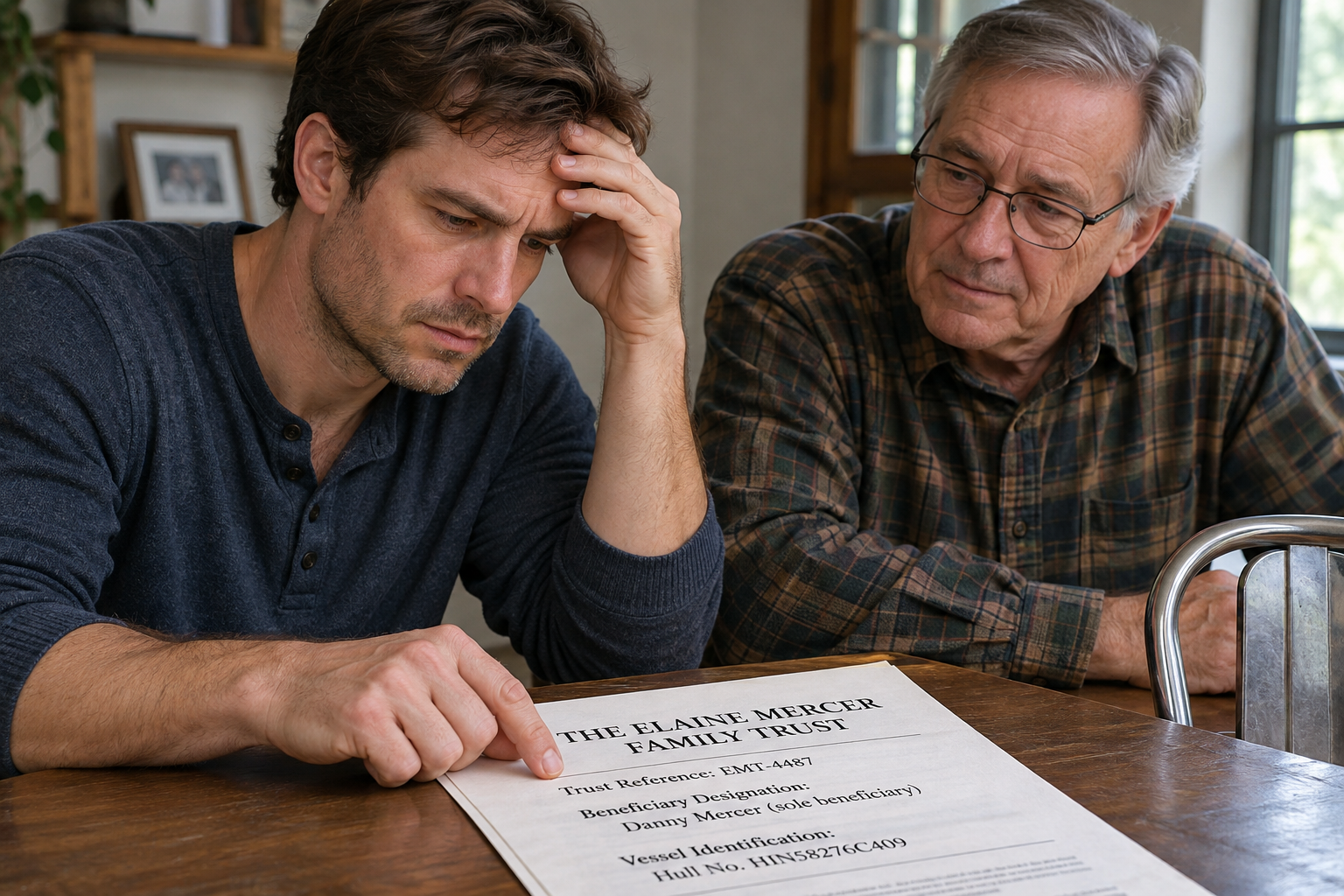
But once I knew it matched, my eyes returned to the beginning of the document.
To my mother's name.
I looked at the heading and felt a kind of embarrassment.
It was not embarrassment about the trust itself.
It was about how little I seemed to understand.
I had recognized the hull number.
I had read my name in the beneficiary section.
I had seen the connection.
Yet I was still sitting there as though the page might eventually offer a simpler answer.
Hank had not moved away.
His chair remained beside mine.
I could see the metal legs beneath the table.
I looked at them for a moment before returning to the paper.
That was something I kept doing.
Looking away.
Looking back.
Nothing changed between those two movements.
The document stayed exactly as it was.
I thought about how quickly I had asked Hank what it meant.
I had barely given myself time to read.
The sight of my mother's name had unsettled me so badly that I wanted someone else to take over.
I did not like admitting that.
I preferred to think I was capable of handling ordinary facts.
But these did not feel ordinary.
I knew the words.
I understood the sentences.
It was their connection to my mother that made me hesitate.
I traced the heading with my eyes.
Elaine Mercer.
Family trust.
My beneficiary designation.
The boat.
There was no explanation beside the heading telling me what to feel.
I suppose I had expected paperwork to be cold.
It was.
The page did not care whether I recognized the name.
It did not pause after identifying me.
It simply presented the information.
I leaned closer.
I read the beneficiary line again.
There was no one else listed.
I did not know what I expected to find by checking.
Another name, perhaps.
Something that would make my presence on the document feel less deliberate.
But there was only mine.
I sat back.
“That really is what it says,” I murmured.
Hank looked at me.
“What part?”
I pointed.
“Here.”
I did not need to say the words aloud.
He could see the same designation.
I lowered my hand.
I had not been doubting whether the text was legible.
I had been doubting whether I could accept it.
Those are different things.
I think I understood that only after I heard myself speak.
I took a breath.
The room was quiet enough that I could hear my own movement against the chair.
I looked at Hank.
I wanted to ask him what my mother had been thinking.
Then I stopped.
Nothing on that page told me what she had thought.
I had no right to pretend that it did.
There might have been an explanation elsewhere.
There might have been reasons I did not know.
But I could not put those reasons into her mouth.
So I asked something narrower.
“Does the document identify anyone else?”
Hank looked down.
I followed his eyes.
The beneficiary section was clear.
Only my name appeared there.
I nodded slowly.
It was not new information.
I had already read it.
But I needed to hear myself acknowledge it.
I was the one named.
I was not guessing.
I was not mistaking another person's record for mine.
My mother's trust identified me.
I thought about that for a moment.
Then I returned to the hull number.
It helped to have something exact.
Letters and digits could be checked.
They could be compared.
Either they agreed with the registration or they did not.
And they agreed.
I found some relief in that certainty.
Not much.
Enough to keep reading.
I moved my finger from the trust heading down toward the file reference.
The layout was straightforward.
The identifying information sat in its proper place.
I read the sequence once more.
I no longer expected to discover an error.
I only wanted to keep the facts clear in my mind.
Hank leaned slightly forward.
I could see that he was watching the part of the page I was studying.
I wondered what he thought of my silence.
Whether he understood how strange it felt to learn something about my mother through printed words.
Whether he was waiting for a question I had not yet found.
I almost asked him.
Instead, I looked down.
I did not want to turn his expression into another mystery.
I already had enough questions.
The document itself was the only thing I could examine with confidence.
I placed both palms on the table.
I began to speak slowly, more to myself than to Hank.
“The trust is named for Elaine Mercer.”
I paused.
“I'm listed as the beneficiary.”
Another pause.
“And this is the boat's number.”
Hank did not interrupt.
I looked at him.
“That much is right?”
He glanced at the page.
“Yes.”
I let the answer settle.
For a few seconds, I felt steadier.
Then my eyes reached the name at the top again.
Elaine.
My mother.
There was the difficulty.
I could repeat the facts in a calm voice.
I could identify the relevant lines.
But I still did not know what to do with the feeling that came when I saw her name attached to them.
I thought the most painful thing would be a complicated explanation.
Instead, it was the absence of one.
The paper told me what it recorded.
It did not tell me why my mother had chosen to be connected to the trust in that way.
I looked at the beneficiary section.
I was listed alone.
I did not know whether to feel grateful.
I did not know whether to feel confused.
Confusion was the honest answer.
I said nothing for a while.
Hank stayed beside me.
I appreciated that he did not try to fill the silence with guesses.
He could have said something comforting.
He could have told me what he thought the arrangement meant.
But neither of us had any reason to treat an assumption as a fact.
I looked down again.
The trust's heading remained in the same place.
My name remained beneath it.
The hull identification remained below the file reference.
I realized I had been trying to find the emotional meaning of the document before accepting its actual contents.
That was backward.
I could not know more than the page showed.
But I could stop refusing to acknowledge what it showed.
I moved the paper so that it lay straight in front of me.
The motion was small.
It changed nothing important.
Still, it helped.
I looked at Hank.
“I understand what's written here.”
He waited for me to continue.
“I don't understand why.”
He gave me time to say more.
I looked at my mother's name.
That was the question I could not answer.
Not from a hull number.
Not from a beneficiary designation.
Not from a formal heading.
The document established the connection.
It did not explain the intention behind it.
For the moment, I had to keep those things separate.
I stopped trying to force the page to tell me what was not there.
And I accepted that the information I had found was real, even though I did not yet understand it.
Click here to continue reading: PART 4: After Reading the Trust Again I Had to Admit What the Paper Proved and What It Still Could Not Tell Me
I Thought I Understood What My Mother Had Left Behind Until Hank Put a Document in Front of Me
Part 3 of 8


One Comment on “PART 3 – I Kept Returning to Elaine Mercer’s Name Because I Could Accept the Number More Easily Than What the Document Said About Me”