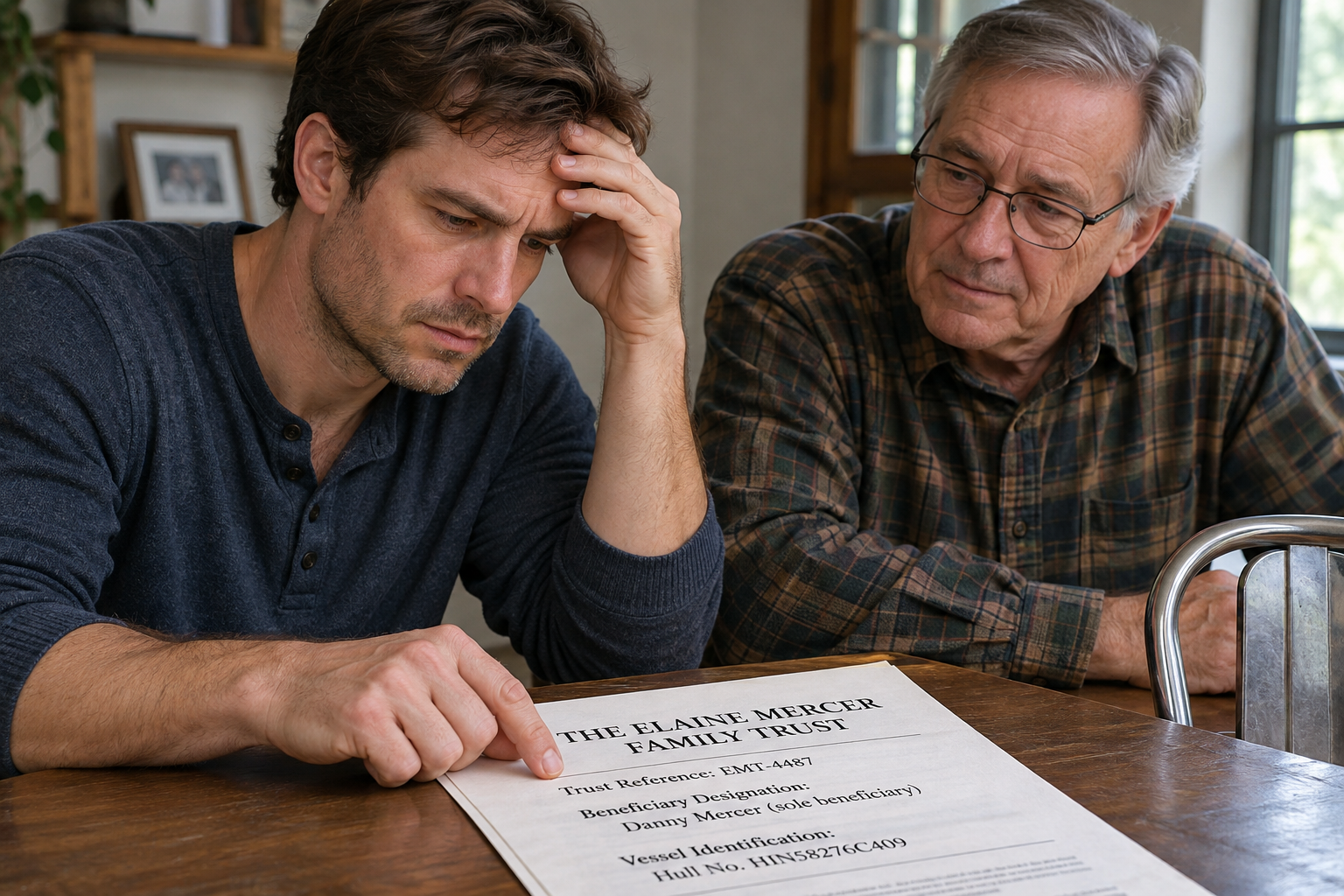
The hardest thing was admitting that I did not have the whole answer.
I had wanted one.
I had expected one.
When Hank first told me to continue reading, I thought the next lines would explain everything.
Instead, they gave me something I had not been prepared to see.
My mother's name.
My own name.
And the boat's hull number.
I had spent so long trying to connect those facts to an explanation that I nearly missed what they already established.
I looked at the paper.
It lay in front of me exactly as it had before.
The heading had not changed.
The beneficiary designation had not changed.
The hull number was still the same.
I was the one who had changed.
I was no longer looking for a mistake.
I was no longer expecting an ordinary record to provide a complete account of my mother's intentions.
And I was no longer willing to pretend that I understood more than I did.
I turned toward Hank.
He was still sitting beside me.
The metal legs of his chair rested against the floor.
I remembered the sound they had made when he pulled it closer.
I remembered looking up when he sat down.
I remembered how badly I wanted him to explain the document.
Now I understood that the answers I had been asking for were not necessarily his to give.
I looked back at the heading.
THE ELAINE MERCER FAMILY TRUST.
I read it slowly.
The name was familiar.
The setting was not.
I could accept both things.
My mother had been Elaine Mercer.
The trust document carried her name.
There was no reason to pretend those facts were difficult to read.
The difficulty was what I felt when I read them.
I had wanted to understand why the trust existed.
I had wanted to understand why I was named alone.
I had wanted to know how the boat had become connected to it.
Those questions remained.
But I had to be careful about how I answered them.
The paper established the connection.
It did not establish every reason behind it.
I looked at the beneficiary section.
My name appeared there.
I did not need to ask Hank to read it for me.
I did not need to check whether another name was hidden somewhere in the same designation.
The portion before me identified a single beneficiary.
Me.
I let myself consider that without forcing a feeling onto it.
I did not have to decide that it represented one particular message from my mother.
I did not have to pretend it explained our entire relationship.
I did not have to make it smaller than it was, either.
It was a significant thing to discover.
I could acknowledge that.
I lowered my eyes.
The hull number appeared below the trust reference.
I had nearly memorized it from checking it so many times.
Every letter.
Every digit.
The same sequence I recognized from the registration.
I had wanted a difference.
Something I could point to and say proved I was mistaken.
There had been none.
I thought about how relieved I might have felt if one character had been wrong.
Then I felt ashamed.
I had been hoping for an error because the truth was inconvenient to understand.
That was not a good reason to question evidence.
It was a human one.
But it was not a good one.
I looked at Hank.
“I think I owe you an apology.”
He turned toward me.
I looked down at the table.
“I kept wanting you to make this easier.”
I paused.
“And when you didn't, I got frustrated.”
He did not interrupt.
I was grateful.
“I was asking you for things the document doesn't explain.”
I looked up.
“That wasn't fair.”
I had wanted him to provide certainty.
But he could not make the printed words say something different.
He could not turn the hull identification into an explanation of my mother's choices.
He could not make me understand an arrangement simply by telling me how to feel about it.
I had to do the reading myself.
And then I had to accept what I found.
I looked at the heading again.
Elaine Mercer.
For a moment, I imagined how easily I might have overlooked that name if I had been reading someone else's document.
I would have treated it as an ordinary heading.
I would have looked for the beneficiary designation.
Then the relevant reference numbers.
I would not have spent so long staring at the top of the page.
But it was my mother's name.
That made the difference.
I had brought my memories and expectations into the room with me.
The document could not account for them.
I knew that now.
I rested my hands on the table.
I thought about everything I could truthfully say.
My mother's name appeared in the title of the trust.
The document identified me as its sole beneficiary.
A hull number matching the boat registration appeared beneath the trust reference.
Those facts were clear.
Everything beyond them required more information.
I would not pretend otherwise.
I looked at Hank.
“I know what I've found.”
He listened.
“I don't know all the reasons behind it.”
I paused.
“But I know what it says.”
The words sounded plain.
I was glad.
I had spent enough time trying to make something complicated out of facts that were already clear.
The complicated part was understanding their meaning.
And that was not the same as reading them correctly.
I glanced at the boat's identifying number.
It had carried the most immediate certainty.
Without it, I might not have recognized the connection between the trust record and the registration.
It was a small piece of information on the page.
Yet it had changed the way I understood the document.
I had almost resented that.
Now I was grateful for the precision.
Numbers did not explain motives.
But they could identify things.
This one identified the boat I already knew from its registration.
That was enough.
I did not need to ask it to do anything more.
I thought about my mother's name again.
I wished I understood the decision behind the trust.
I wished the document contained a personal explanation.
But wishing did not change what was written.
I had to face that.
The name Elaine Mercer appeared in the heading.
There were no words in the portion before me explaining what she had felt.
No statement of her personal intentions that I could safely quote.
No reason I could honestly claim to know.
I did not want to invent one.
Not anymore.
I realized that this was the part that mattered most to me.
I wanted to be fair to my mother.
That meant I had to accept the facts without placing unsupported thoughts or words in her mouth.
I could say that the trust bore her name.
I could say that I was identified as the beneficiary.
I could say that the trust document referred to the boat through its hull identification.
But I could not say why she had arranged it that way.
I did not know.
I looked down at the table.
For a moment, I felt disappointed all over again.
I had wanted the paper to settle everything.
It had not.
It had settled something specific.
And left the rest unresolved.
I sat with that feeling.
I did not push it away.
I did not turn it into anger.
I simply let myself be disappointed.
Then I looked at Hank.
“Thank you for sitting here.”
He glanced toward me.
I continued before I could change my mind.
“I know I've been going over the same things.”
I looked at the document.
“I needed to see them for myself.”
I could hear the truth in that sentence.
If someone had described the trust to me without letting me read it, I would have wanted proof.
If someone had told me the boat was identified in the trust record, I would have asked to compare the number.
If someone had said my mother's name appeared above mine, I would have wanted to see the page.
Now I had.
I had done the checking.
I had recognized the match.
I had seen my own name.
No one could take that experience away from me.
I looked at the paper again.
There was no need to read the whole thing another time.
I knew which lines mattered.
I knew what they established.
And I knew what they did not explain.
I thought about how frightened I had been when I first recognized my mother's name.
It had felt as though the ordinary world had suddenly shifted.
But the document had not done anything mysterious.
It had placed facts in front of me.
I was the one who had struggled to accept them.
I understood that now.
I wanted to remember it.
I placed my finger beside the trust heading one final time.
Elaine Mercer.
My mother.
Then I moved my hand to the beneficiary line.
Danny.
Me.
I looked down to the hull number.
The same boat.
The same identifying sequence.
I had been searching for a hidden explanation in those three details.
What I had actually found was a connection I could verify.
And perhaps the most important thing I had learned was how much care I needed to take with the questions that remained.
I could not call a question an answer.
I could not call an assumption a memory.
I could not call a possibility a fact.
Not when my mother's name was involved.
I looked at Hank.
“I think I've read enough to understand what this page establishes.”
He waited.
I glanced down once more.
“I still have questions.”
The admission no longer embarrassed me.
I had questions because I did not have all the information.
That was different from being unable to understand what was written.
I could live with that distinction.
It was not the ending I had hoped to find when I began reading.
I had hoped for something complete.
Something that would explain my mother and the boat in a way that left no uncertainty.
Instead, I had a document.
A trust bearing her name.
A designation naming me as the only beneficiary.
And a hull number matching the boat registration.
I would not pretend that was nothing.
It mattered.
It mattered enough that I knew I would remember the moment I recognized those details.
I would remember Hank moving the chair closer.
I would remember the scraping metal legs.
I would remember how long I stared at my mother's name.
And I would remember how many times I checked the number, hoping I had somehow made a mistake.
I had not.
That was what I finally accepted.
The record connected the boat to the trust.
The trust carried my mother's name.
And it identified me alone as the beneficiary.
Those facts stood together.
Whatever remained unexplained, I would not erase what I had actually seen.
I drew my hand away from the page.
For the first time, I was no longer asking the document to become something it was not.
I was simply looking at it.
And remembering that the name at the top belonged to my mother.
Not to a mystery I had the right to solve by guessing.
Not to an explanation I could invent because I wanted one badly enough.
To my mother.
Elaine Mercer.
I looked at her name again.
Then I looked at mine.
The document had brought them together in a way I had not expected.
I understood that much.
The full reasons remained beyond what I could prove from those lines.
I would have to leave them there.
Not forgotten.
Not explained away.
Just unanswered.
I finally understood that accepting the truth of what I had read did not require me to claim I knew the whole story.
And I would rather carry an honest question about my mother than give her a reason she had never told me.
The End
Read more original stories on Feel Every Story.
I Thought I Understood What My Mother Had Left Behind Until Hank Put a Document in Front of Me
Part 8 of 8