I sat at my desk long after Mabel had gone to bed.
My work schedule was lying in front of me.
Beside it was Pepper's registration folder.
Two things I had always kept separate.
My job.
My family.
For years, I'd believed that keeping them separate was how I protected both.
I went away to fight fires.
I earned the money.
I came home when the assignments ended.
The bills were paid.
There was food in the kitchen.
Mabel had a roof over her head.
I thought that meant I was doing my job as a father.
But a roof hadn't kept my daughter warm when she needed it.
Money hadn't kept Pepper fed.
And my marriage hadn't given Mabel the protection I'd promised myself she would have.
I looked at the schedule again.
There were still assignments I might be called for.
My crew depended on people showing up when they were needed.
I'd worked beside those men long enough to understand what that meant.
A missing person could change how a whole crew operated.
I couldn't simply disappear without explaining.
But I couldn't keep working exactly as I had before.
That was clear.
I picked up my phone.
Then I put it down.
It was late.
There was nothing that couldn't wait until morning.
For once, I wasn't going to rush into a decision just because I wanted a problem solved.
I put Pepper's folder away.
Then I checked the back door.
I looked through the window toward the barn.
The light was off.
The yard was quiet.
No trailer.
No headlights.
No stranger waiting to load a horse.
I reminded myself that things were different now.
But I still stood there longer than necessary.
The next morning, Mabel was already awake when I entered the kitchen.
She was sitting with a piece of toast in front of her.
She hadn't touched it.
Her eyes were fixed on the window.
I knew what she was looking for.
The barn.
I poured coffee.
Then I sat across from her.
"Did you sleep?"
She nodded.
"Most of the night."
I watched her hands.
She was picking at the edge of the toast.
"Did something wake you?"
She hesitated.
"I thought I heard a truck."
I felt my chest tighten.
"Outside?"
She nodded.
"I looked through the window."
"What did you see?"
"Nothing."
I reached across the table.
"There wasn't anyone here to take Pepper."
"I know."
But she didn't sound convinced.
That was when I began to understand that stopping the sale had only removed the immediate danger.
It hadn't removed the fear.
Mabel had spent too many nights expecting somebody to arrive.
Now an ordinary sound could bring it all back.
I wanted to tell her she had nothing to worry about.
But I'd already made that mistake once.
I'd told myself everything at home was fine because somebody else said so.
I wasn't going to replace one empty reassurance with another.
Instead, I told her what I was doing.
I explained that Pepper's documents were safe.
That the veterinarian was supervising her care.
That the attempted sale had been reported.
And that I was making arrangements so Mabel would never be left without somebody she trusted.
She listened carefully.
Then she asked the question I'd been avoiding.
"Does that mean you're quitting your job?"
I looked at her.
I hadn't decided that.
Not yet.
"I need to talk to my supervisor."
She lowered her eyes.
"Because of me?"
There it was again.
That same fear.
That everything difficult happening around her was somehow her fault.
I shook my head.
"Because I'm your dad."
She didn't answer.
I continued.
"My job matters. But making sure you're safe matters more."
Mabel looked toward the barn.
"Mom always knew what Pepper needed."
I swallowed.
"She did."
"She would have noticed."
I looked down at my coffee.
That hurt.
Not because Mabel was trying to blame me.
Because she was right.
Siobhan would have noticed the missing hay.
She would have seen Pepper losing weight.
She would have recognized the signs before the mare became so weak.
I had trusted Becca to do those things.
And I had been wrong.
I didn't try to defend myself.
"I should have noticed too."
Mabel turned toward me.
"You weren't here."
"I know."
I paused.
"But I should have made sure somebody was taking care of both of you."
She stared at me.
Then she nodded.
It wasn't forgiveness exactly.
She had never accused me of anything.
But I needed her to know I understood what I'd missed.
Later that morning, I called my supervisor.
I explained that there had been a serious family situation while I was away.
I didn't give every private detail.
I told him my daughter needed me at home while I arranged reliable care.
He listened.
Then he asked what I needed.
I told him I wanted to discuss time away from assignments and what options might exist for my schedule.
I didn't ask for special treatment.
I asked for a chance to handle a problem I couldn't ignore.
He told me we could discuss the practical arrangements.
That was enough for the moment.
When the call ended, I looked toward the barn again.
I knew I couldn't make my career fit perfectly around every emergency.
Wildfires didn't wait for family calendars.
But I could stop pretending that providing money was the same as providing protection.
I could build a plan.
I could make sure Mabel had adults she trusted.
I could arrange independent checks on Pepper's care.
And I could make sure my daughter's calls reached someone who would listen.
That was what I should have done before I left for Idaho.
I couldn't change that.
I could change the next assignment.
By midday, Dr. Porter returned to examine Pepper.
Mabel met her at the barn.
She had brushed her hair.
Her jacket was zipped.
She carried the small brush Siobhan had used with Pepper years before.
I recognized it immediately.
The wooden handle was worn smooth.
There were scratches near the back.
Siobhan had kept that brush for years.
Mabel treated it as if it were something precious.
Dr. Porter greeted her.
"How's our patient?"
Mabel looked at Pepper.
"She's drinking."
"That's good."
"And she lifted her head when Dad came in."
Dr. Porter smiled.
"Let's see how she's doing."
I stood back while she examined the mare.
She checked Pepper's hydration.
Her heart rate.
Her response to the feeding plan.
She looked carefully along the horse's ribs and back.
Mabel watched every movement.
I watched Dr. Porter's face.
I wanted good news.
I was afraid to expect it.
Finally, she straightened.
"There are some encouraging signs."
Mabel looked up immediately.
"Is she better?"
"She's responding to care. That's important."
My daughter smiled.
Then Dr. Porter added that Pepper was still in serious condition.
Recovery would take time.
There could be complications.
We needed to follow the feeding instructions carefully.
I nodded.
No shortcuts.
No sudden changes.
No assuming she was healthy because she looked slightly brighter.
I understood that.
After the examination, Dr. Porter asked to speak with me.
We stepped a short distance from the stall.
Mabel remained beside Pepper.
Dr. Porter opened her notes.
She explained that her findings supported significant neglect.
The mare's condition was consistent with inadequate nutrition over time.
I listened.
I had already reported what happened.
I'd already provided the records.
But hearing a professional say it plainly made the whole thing feel heavier.
It hadn't been a disagreement about whether an old horse was worth keeping.
Pepper had been allowed to deteriorate.
And my daughter had tried to stop it.
Dr. Porter asked whether the authorities had contacted me.
I told her the report was being handled and that I'd provided the ownership documents and details of the attempted sale.
She nodded.
"Keep everything."
"I will."
"Photographs. Receipts. Feeding records. Follow-up examinations."
I looked toward Pepper.
"I've started a folder."
"Good."
Then she glanced toward Mabel.
"How is she doing?"
I took a breath.
"She's sleeping inside again."
Dr. Porter looked at me.
"That's a start."
I nodded.
A start.
Those words stayed with me.
Because everything seemed to be a start.
Pepper was beginning treatment.
Mabel was beginning to feel safe.
I was beginning to understand the damage.
And my marriage was beginning the process of ending.
Nothing was settled.
Nothing was easy.
But at least the truth was no longer hidden.
That afternoon, I spoke with someone about the legal steps involved in separating from Becca.
I wanted to handle it properly.
There were household arrangements to discuss.
Money to account for.
Documents to prepare.
I didn't want Mabel caught in the middle of another argument.
I wasn't interested in punishing Becca through a messy confrontation.
I wanted boundaries.
I wanted a clear plan.
And I wanted my daughter protected.
When I returned home, Becca was sitting in the living room.
She looked at me as I entered.
"Where have you been?"
"Taking care of some arrangements."
She studied my face.
"You're really doing this."
"Yes."
She shook her head.
"I still can't believe you're throwing away two years."
I stood near the doorway.
I wanted to tell her that I hadn't thrown anything away.
That she'd done that when she stopped buying hay.
When she accepted money for a horse that wasn't hers.
When she dismissed a child sleeping in freezing temperatures.
But I had said those things already.
Repeating them wouldn't change what had happened.
So I answered quietly.
"I can't keep things the way they were."
Becca stared at me.
"What if I give the money back?"
I looked at her.
For a moment, I thought she meant the money intended for Pepper's feed.
Then she explained she meant the nine hundred dollars from Dean Rawlins.
I understood.
She still thought the sale was the main problem.
As if returning the cash would erase the rest.
I shook my head.
"That money needs to be dealt with."
She waited.
"But it doesn't undo what happened to Pepper or Mabel."
Her face tightened.
"You're never going to forgive me."
I didn't answer immediately.
Forgiveness wasn't a word I wanted to use carelessly.
I didn't know what I would feel years later.
I didn't know whether Becca would ever admit what she'd done.
I only knew I couldn't trust her to care for my child.
And trust was not something I could rebuild because someone demanded it.
"I'm not making decisions about forgiveness today."
She looked away.
"I'm making decisions about safety."
That ended the conversation.
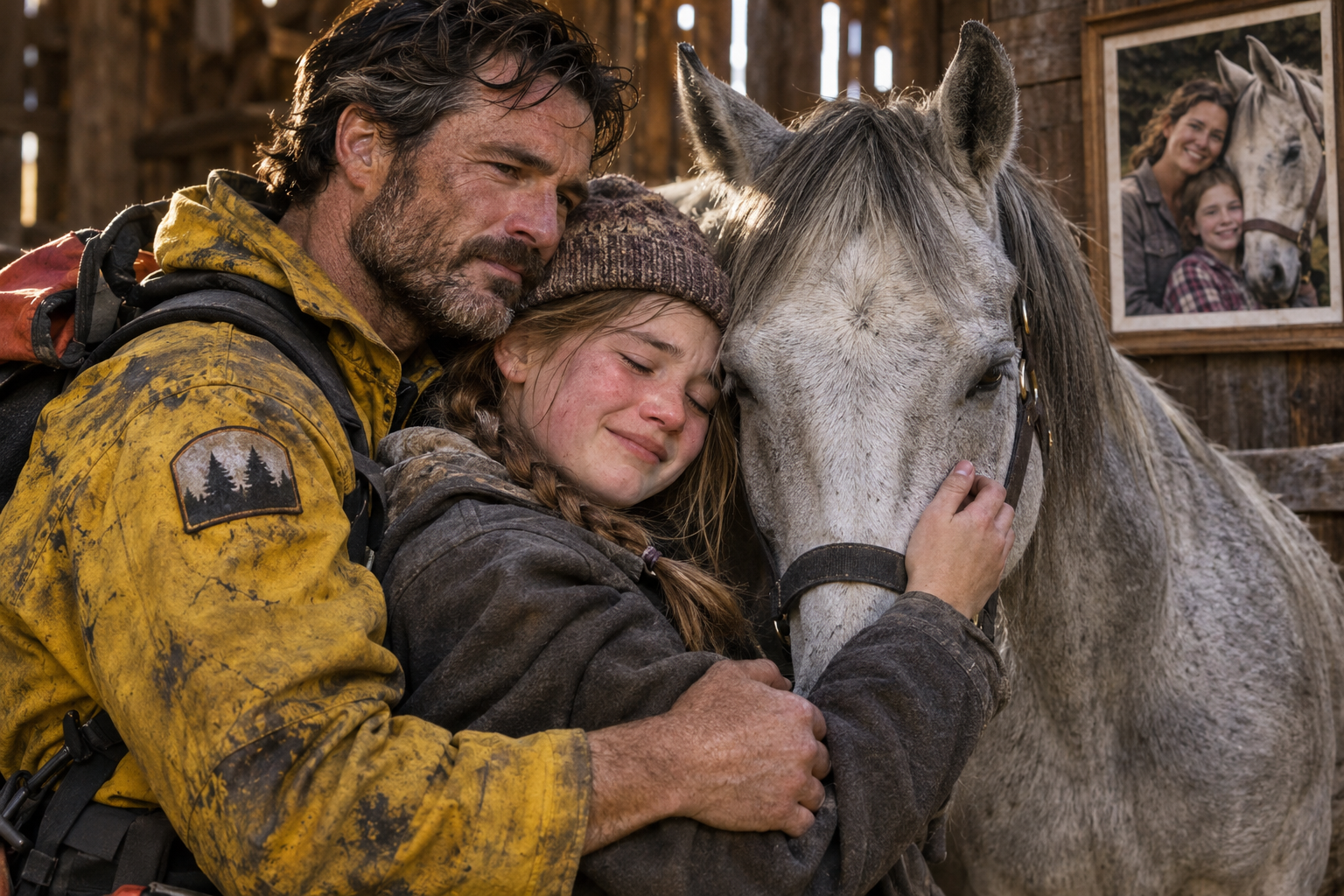
Later, I found Mabel sitting on the floor of her bedroom.
She had an old photograph in her hands.
I recognized it before I sat down.
Siobhan standing beside Pepper.
Mabel was much younger in the picture.
Her mother had one hand resting on the mare's neck.
Mabel was smiling up at her.
I remembered taking that photograph.
It had been an ordinary afternoon.
Nobody had dressed up.
Nobody had planned anything special.
Siobhan had asked me to take a picture because Mabel was trying to copy the way she stood beside Pepper.
I hadn't thought much about it at the time.
Now I was grateful I'd taken it.
Mabel handed it to me.
"Mom looks happy."
"She was."
She touched the edge of the picture.
"Do you think Pepper remembers her?"
I looked at the photograph.
Then at my daughter.
"I don't know exactly what horses remember."
Mabel nodded.
"But Pepper knew her for a long time."
"She did."
I looked again at Siobhan's hand resting on the mare.
"And I think they knew each other very well."
Mabel smiled faintly.
Then she leaned against me.
We sat there looking at the photograph.
I didn't try to turn it into a lesson.
I didn't tell her she needed to be strong.
I didn't tell her everything happened for a reason.
I had heard people say those things after Siobhan died.
They never helped.
Sometimes they made the grief worse.
So I stayed quiet.
After a while, Mabel asked whether she could put the photograph in the barn.
I thought about it.
Then I told her we could find a safe place for a copy, somewhere the weather wouldn't damage it.
She seemed pleased.
I looked at the worn edges of the original.
I remembered how many times she'd carried photographs of her mother around the house.
How carefully she'd kept them.
Pepper was part of that same need to remember.
The difference was that Pepper was alive.
She needed food.
Water.
Shelter.
Care.
And people who understood that love didn't replace responsibility.
That evening, I made a simple chart for Pepper's care.
Feeding instructions.
Water checks.
Veterinary appointments.
Notes about her condition.
I placed it where I could see it each time I entered the barn.
Mabel watched me.
"Can I help?"
"Yes."
She smiled.
I handed her a pencil.
"But the adult jobs stay with adults."
She looked at me.
"What does that mean?"
"It means you can brush Pepper when she's able. You can spend time with her. You can tell me when you notice something."
I paused.
"But making sure she has food, water, and medical care is my responsibility."
Mabel looked down at the pencil.
Then she nodded.
I knew she had been carrying too much.
I wasn't going to praise her so much for surviving it that she believed she should keep doing it.
She had helped Pepper.
That was true.
But she should never have been forced to become the mare's only protector.
That night, I checked the doors.
Then I checked on Mabel.
She was already in bed.
Her mother's photograph stood on the bedside table.
She looked up when I entered.
"Dad?"
"Yeah?"
"Do you think Becca hates Pepper?"
I sat beside her.
I considered the question.
I didn't know what was inside Becca's head.
I knew what she'd said.
I knew what she'd done.
I wasn't going to pretend I understood more than that.
"I think Becca made some very wrong decisions."
Mabel looked at me.
"Because Pepper was Mom's?"
I swallowed.
"I don't know all her reasons."
She nodded slowly.
"But none of those reasons make what happened right."
Mabel pulled the blanket closer.
Then she asked whether Pepper would still be there when she woke up.
I reached for her hand.
"Yes."
She studied me.
This time, I knew the promise had to mean something.
Not a pleasant answer on a phone call.
Not a hope.
A plan backed by action.
The doors were secure.
The ownership papers were safe.
I was home.
And Pepper was under veterinary care.
I had checked those things myself.
I told her again.
"Pepper will be here in the morning."
Mabel closed her eyes.
For the first time since I'd returned home, she didn't ask me to check the barn again.
I stayed until her breathing became steady.
Then I went into the hallway.
I looked toward the room Becca had been using.
The door was closed.
I knew there were still difficult days ahead.
The separation.
The financial questions.
The official report.
Pepper's uncertain recovery.
And the work I needed to do to rebuild my daughter's trust.
But I had stopped trying to solve everything with one reassuring sentence.
That was the lesson I kept coming back to.
Love wasn't proven by what I said before leaving for an assignment.
It was proven by what I made sure happened while I was gone.
I went to my desk.
I opened the work schedule one more time.
Then I began writing down the names of people I trusted enough to call when Mabel needed help.
I wasn't going to make another plan that depended on one adult and a promise that everything was fine.
Not again.
Click here to continue reading: PART 10: The Horse My Wife Tried to Sell Began Recovering, but My Daughter’s First Peaceful Morning Showed Me What We Had Really Lost
I Returned Home Before Anyone Expected Me and Found My Daughter Sleeping Somewhere No Child Should Ever Have to Spend the Night
Part 9 of 10