I used to think disappearance and death were two different kinds of grief.
When someone died, at least you knew what had happened.
When someone vanished, you kept wondering.
You wondered where they went.
Why they left.
Whether they were safe.
Whether they might come back.
That was how I had thought about Gabriel for three years.
Until Julian recognized the tattoo.
Then all those unanswered questions became something worse.
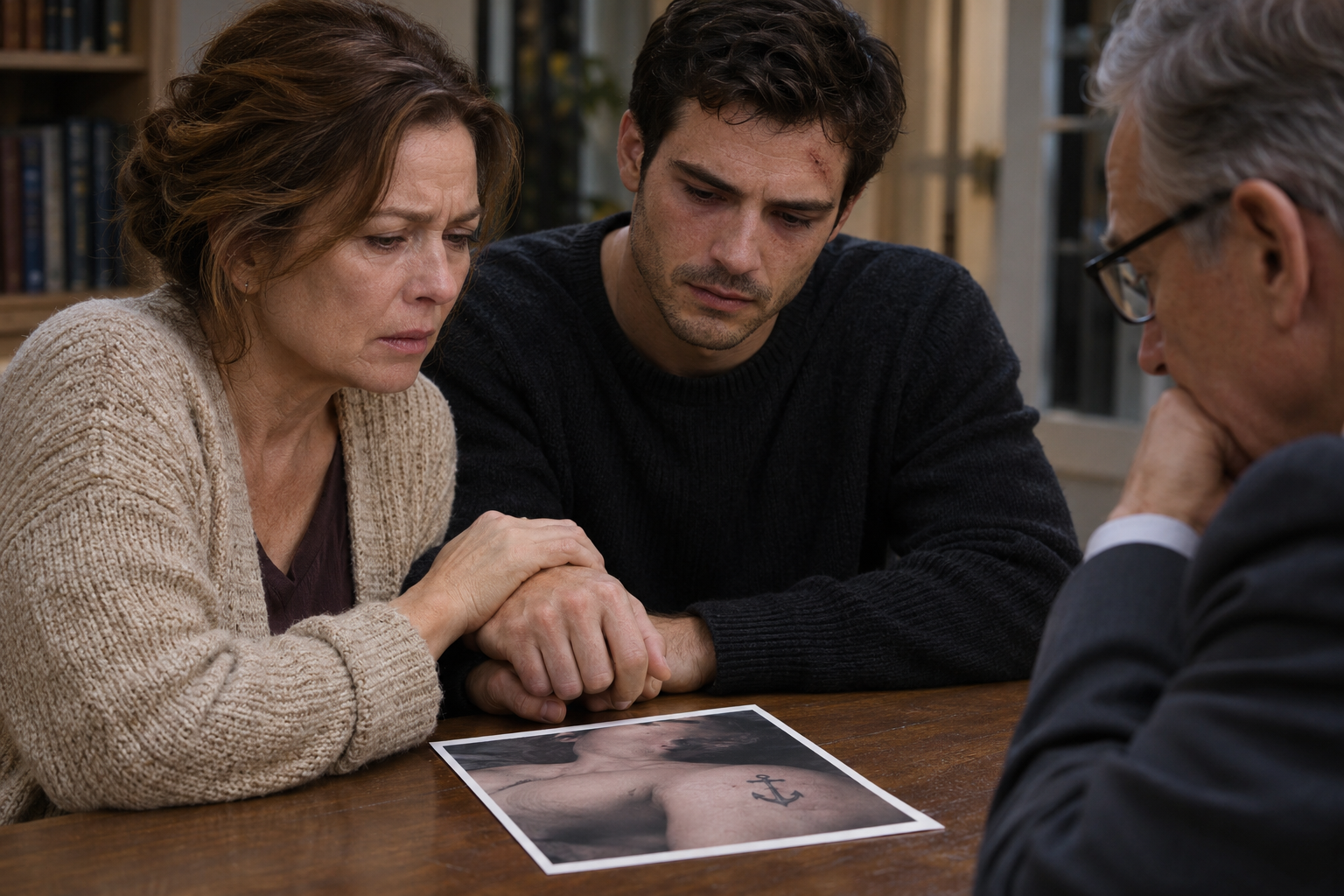
I sat across from my son and looked at the photograph lying between us.
Mr. Morris remained close enough to hear everything.
Nobody seemed eager to speak.
I understood why.
We were no longer discussing an unfamiliar dead man.
We were discussing Julian's cousin.
Gabriel.
A person who had belonged to our family long before Patricia's telephone call.
I tried to remember the last time we had known where he was.
Three years.
That was how long it had been.
Three years since Gabriel disappeared.
I had repeated that fact so often that it had almost lost its meaning.
Three years.
No word.
No certain answer.
And no explanation that had ever truly settled the matter.
At the time, people had connected his disappearance to gambling debts.
I remembered hearing about those debts.
I remembered how quickly they became the explanation everyone repeated.
Gabriel had owed money.
Then Gabriel had disappeared.
So the family assumed he had run away.
It seemed simple when said that way.
Too simple, perhaps.
But people want explanations when someone goes missing.
Even a painful explanation can feel better than having none.
I had accepted it.
That was the truth.
I did not enjoy admitting it.
There had been a search.
The family had looked for him.
The police had looked too.
Nothing had come of it.
No answer.
No Gabriel.
Eventually, the questions had become harder to ask.
I remembered how his name could change the feeling of a family conversation.
Someone would mention him.
People would stop for a moment.
Then the subject would move elsewhere.
Not because nobody cared.
Because nobody knew what else to say.
I had been one of those people.
I had stopped asking questions that never seemed to lead anywhere.
Now I was ashamed of that.
I looked at Julian.
"You really remember it?"
He nodded.
"The tattoo?"
"Yes."
I studied his face.
There was no excitement there.
No pleasure in having found something important.
He looked like a man who had just discovered that a painful memory might have been hiding something far more terrible.
Mr. Morris watched us.
He did not interrupt.
I was grateful for that.
I needed a moment to understand what Julian was telling me.
Gabriel had not simply become another missing person in our thoughts.
He had become a possible answer to the identity of the corpse.
That changed the meaning of the photograph.
It also changed the meaning of the past three years.
I looked down at the tattoo.
The mark was not an explanation by itself.
It did not tell us when Gabriel had died.
It did not tell us where he had been.
It did not tell us who had handled the body.
But it was the first thing in a long time that had made Julian connect Gabriel's disappearance to something happening now.
And I could see what that connection was doing to him.
I wanted to protect my son from it.
That instinct had never left me.
When Julian was younger, I could sometimes make a frightening problem smaller just by sitting beside him.
I could tell him what we knew.
Help him understand what we did not.
Remind him that one bad moment did not mean everything was lost.
But I could not do that now.
The facts were too serious.
And Julian was old enough to know when reassurance meant nothing.
"Everyone thought Gabriel left because of the money," I said.
Julian lowered his eyes.
"That's what we were told."
I heard the difference.
I had said what people thought.
He had said what people were told.
Neither sentence proved anything.
But together they made me uncomfortable.
I wondered when we had stopped separating facts from assumptions.
Gabriel had debts.
That was one part of the story.
Gabriel disappeared.
That was another.
The conclusion that he had run away had filled the space between them.
We had lived with that conclusion for three years.
Now a photograph was making it difficult to accept.
I looked toward Mr. Morris.
He seemed to be considering the same problem.
"People searched for him," I said.
It sounded almost like an excuse.
Julian nodded.
"I know."
"The police searched."
"I know, Mom."
His voice was gentle.
That hurt more than if he had been angry.
He understood what I was trying to do.
I was reminding myself that we had not abandoned Gabriel.
That people had made an effort.
That his disappearance had not been ignored.
I needed to believe that.
But the question was no longer whether we had cared.
The question was whether we had believed the wrong explanation.
Mr. Morris looked at the photograph.
Then at Julian.
"If the body is Gabriel's, what does that mean?"
My son did not answer immediately.
I could see him deciding how much to say.
That frightened me.
Because I suspected he had already followed the thought farther than I had.
I wanted him to stop.
I wanted him to say we were assuming too much.
Instead, he looked at the tattoo again.
"It means we may have been wrong about why he disappeared."
I closed my eyes for a moment.
There it was.
The sentence I had been avoiding.
We may have been wrong.
Three years of uncertainty had rested on the idea that Gabriel chose to leave.
What if he had not?
What if the decision had never been his?
I opened my eyes.
The photograph had not moved.
The tattoo was still there.
Julian was still sitting across from me.
But the past felt different now.
I began thinking about family gatherings.
That was when Patricia's face came into my mind.
It surprised me how ordinary the memory was.
I remembered her among relatives.
Smiling.
Talking.
Asking questions.
She had always seemed interested in what people were saying.
I had thought that was a good thing.
When someone married into a family, I wanted them to feel included.
I wanted Patricia to understand our history.
I wanted her to know the people Julian loved.
So when she listened, I had been pleased.
When she asked questions, I had answered them.
When she seemed interested, I had taken it as a sign that she wanted to belong.
Now those memories troubled me.
Not because asking questions was wrong.
Not because every smile concealed something terrible.
But because Patricia had just lied about Julian's death.
She had spoken as though his absence was a benefit.
And suddenly I could no longer think of her curiosity in the same innocent way.
I tried to be fair.
I told myself that suspicion was not proof.
Patricia's presence at family gatherings did not establish that she knew what happened to Gabriel.
Her questions did not prove she had been involved in his disappearance.
I understood that.
But I could not stop wondering what she might have learned while we believed she was simply being friendly.
I remembered her listening.
That was the part I kept returning to.
Listening.
I had done the same thing during her telephone call.
I had listened because her words could reveal what she believed.
What had Patricia learned by listening to us?
What details about Julian?
What details about Gabriel?
I did not have an answer.
The uncertainty made me feel sick.
I thought about how easily trust becomes a habit.
You see someone often enough.
You share meals.
You talk about relatives.
You stop thinking of that person as someone who might misuse what they hear.
I had done that with Patricia.
I had welcomed her into our family life.
And when I remembered it now, I felt foolish.
Not because kindness had been wrong.
Because I had never imagined what kind of information she might be collecting.
I looked at Julian.
He was watching the photograph.
"Do you remember Patricia asking about Gabriel?"
He seemed to consider the question.
I did not push him.
The source of my suspicion was clear.
But I did not want to turn suspicion into a memory that had never existed.
That would not help Gabriel.
It would not help Julian either.
We needed truth.
Not a story shaped by fear.
Mr. Morris leaned back.
His expression had changed.
He looked disturbed in a way that went beyond recognizing a missing family member.
I knew he was thinking about the corpse.
About the body that had been used in connection with Julian's supposed death.
About the possibility that it belonged to Gabriel.
I wanted to ask him to say what was on his mind.
But another part of me already understood.
If Gabriel's body had been used to represent Julian, then someone had access to more than a name.
Someone had a body.
Someone had made use of it.
And that meant the disappearance might have consequences far beyond the original search.
I swallowed.
"Gabriel may never have run away."
The words came out slowly.
Julian looked at me.
He did not smile.
He did not reassure me.
He only nodded.
It was a terrible thing to agree about.
For three years, we had imagined Gabriel somewhere beyond our reach.
Perhaps hiding.
Perhaps unwilling to come home.
Perhaps ashamed of his debts.
Now we had to consider that he had never been free to return.
I thought about every time someone had said Gabriel would contact us when he was ready.
I thought about how comforting that explanation had been.
It let us imagine he still had choices.
It let us believe his silence was his own decision.
I could no longer hold that belief as easily.
The photograph remained on the table.
I wanted someone to take it away.
I wanted a little time in which Gabriel could still be a missing man instead of a possibly dead one.
But that was not a choice the picture allowed.
I looked at Julian.
For the first time since Patricia's call, I understood that the attempt on my son's life might not be the beginning of this story.
It might be a later part of something that had started years before.
And Gabriel's disappearance might have been one of its earliest signs.
That realization changed what I wanted to know.
I no longer wanted only to understand why Patricia had announced Julian's death.
I wanted to know why Gabriel's tattoo was on the body in that photograph.
Click here to continue reading: PART 4: The Body Was Not Just Hidden, It Was Being Used As My Son, And I Finally Understood How Long Someone Had Been Preparing
My Daughter-in-Law Told Me My Son Was Dead, But She Had No Idea He Was Sitting Beside Me Hearing Everything
Part 3 of 10