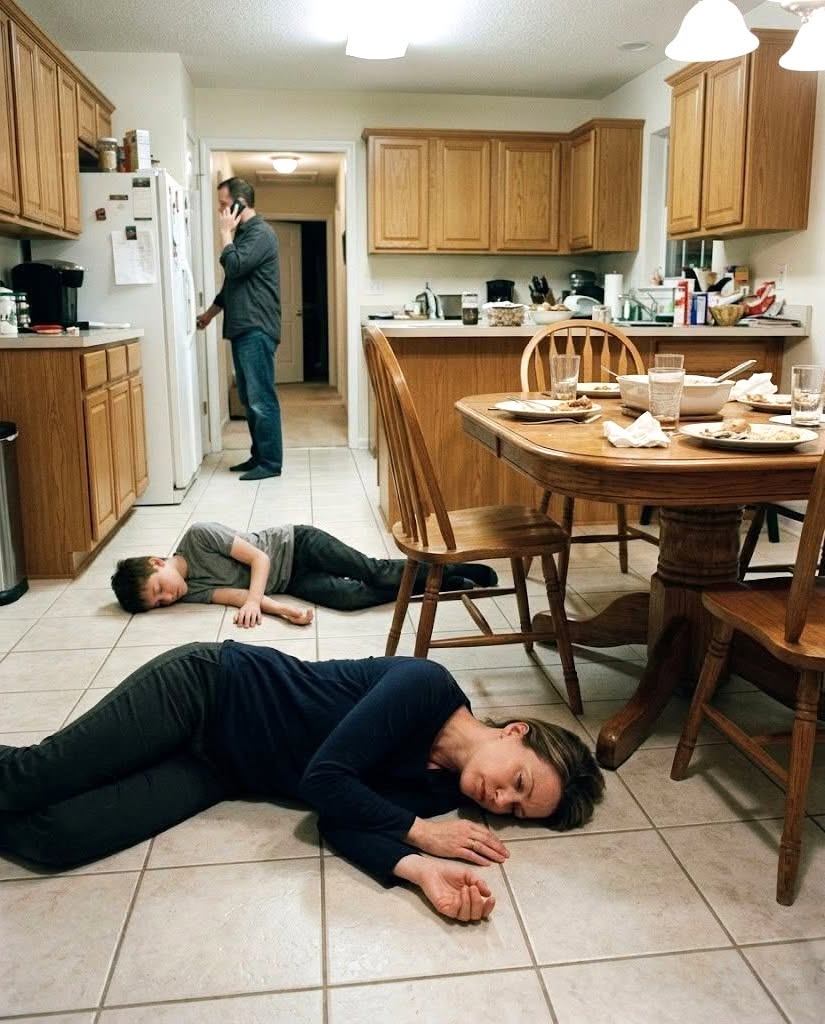
PART 2 Daniel stood just inside the kitchen for several seconds. I could hear his breathing. Then his shoes moved across the tile. Once.Twice. Closer.I fought the urge to open my eyes when he stopped beside me.
Something rustled.
A plastic bag.
Then the scrape of ceramic against the table.
He was taking the plates.
My heart hammered.
Daniel lifted Noah’s plate first.
Then mine.
I heard the refrigerator door open.
A cabinet.
Running water.
He was cleaning.
That realization frightened me almost as much as the phone call.
He believed there was something worth removing.
Daniel walked toward the sink.
Then suddenly stopped.
I heard him whisper:
“No.”
Silence.
My pulse seemed loud enough to expose me.
His footsteps returned.
He crouched beside me.
His fingers touched my waistband.
The freezer bag.
He had seen it.
Before he could pull it free, red-and-blue lights flashed across the kitchen ceiling.
Daniel froze.
A pounding came from the front door.
“POLICE! DANIEL CARTER, COME TO THE DOOR!”
His hand disappeared from my side.
For half a second, nobody moved.
Then Daniel ran.
I opened my eyes.
“Noah!”
My son immediately pushed himself upright.
Daniel disappeared through the garage door.
I grabbed Noah’s hand.
“Stay with me.”
The pounding intensified.
“POLICE!”
“WE’RE IN HERE!” I screamed.
My voice cracked.
“WE’RE IN THE KITCHEN!”
Seconds later officers entered through the front door.
Paramedics followed.
Everything happened quickly after that.
Noah and I were separated for evaluation.
Our blood pressure was checked.
Questions came from every direction.
What had we eaten?
How long after dinner had we collapsed?
Did we take medication?
Did we drink anything unusual?
I kept repeating the same thing.
“Please take the food.”
A paramedic looked confused.
“The food?”
I pulled the freezer bag from beneath my shirt.
“This.”
An officer took it carefully without opening it.
“I saved it before my husband came back.”
Another officer photographed the kitchen.
The sink.
The plates Daniel had moved.
The pot on the stove.
The glasses.
Everything.
An officer came through the garage ten minutes later.
“Your husband is gone.”
“What?”
“His vehicle is gone.”
Noah stared at me.
“He was outside the whole time?”
“We don’t know yet.”
That terrified me.
Because it meant Daniel may have been watching the house.
Waiting.
For what?
For us to stop breathing?
At the hospital, doctors treated our symptoms and kept us under observation while samples were collected.
I asked the emergency physician what Daniel might have put into the food.
She shook her head.
“We don’t know.”
“Can you tell?”
“Testing may help, but I don’t want to speculate.”
Noah sat beside me wrapped in a hospital blanket.
He was seventeen, nearly six feet tall, but in that moment he looked like the little boy who used to crawl into my bed during thunderstorms.
“Mom.”
“Yes?”
“Dad tried to kill us.”
My stomach twisted.
“We don’t know everything yet.”
“He said we’d both be gone.”
“I heard him.”
“Then why are you defending him?”
“I’m not.”
I took Noah’s hand.
“I’m making sure we don’t turn what we think into something investigators have to prove.”
He looked away.
A detective arrived shortly after midnight.
Detective Olivia Grant.
She introduced herself, pulled up a chair, and asked me to start from the beginning.
Not dinner.
Earlier.
“Has your husband behaved differently recently?”
“Yes.”
“How?”
“Secretive.”
“Financial problems?”
“I don’t know.”
“Affair?”
“Not that I know of.”
“Arguments?”
“Yes.”
“What about?”
I hesitated.
“Insurance.”
Her pen stopped.
“What kind of insurance?”
“Life insurance.”
Noah turned toward me.
I had never told him.
Detective Grant leaned forward.
“Explain.”
“About three weeks ago, Daniel asked me to sign paperwork increasing my life-insurance coverage.”
“How much?”
“From five hundred thousand dollars to three million.”
Noah whispered:
“What?”
I squeezed his hand.
“Daniel said it was part of a financial-planning review.”
“Did you sign?”
“No.”
“Why?”
“Because the beneficiary section had changed.”
“From whom?”
“Noah had been primary beneficiary.”
“And after?”
“Daniel.”
The detective wrote something.
“Did your husband know you noticed?”
“Yes.”
“What happened?”
“We argued.”
“What did he say?”
“That spouses normally name each other.”
“And your son’s policy?”
I stared at her.
“What son’s policy?”
Detective Grant looked at Noah.
Then back at me.
“I’m asking whether Noah has life insurance.”
“No.”
At least I thought he didn’t.
The detective’s expression was impossible to read.
She asked another question.
“Does Daniel handle your household finances?”
“Mostly.”
“Business accounts?”
“He owns a financial advisory company with his college friend, Martin Hale.”
Detective Grant wrote the name.
Then:
“Have you recently inherited money?”
My skin went cold.
“Yes.”
“How much?”
“About $4.2 million.”
Noah looked at me again.
My mother had died six months earlier.
Most of her estate was still being administered.
I had not discussed exact numbers with Noah because I had not wanted money to become the center of our grief.
“Where is that money now?” Grant asked.
“In a separate inherited account.”
“Can Daniel access it?”
“No.”
“Has he asked?”
“Repeatedly.”
The detective looked at me.
“For what purpose?”
“He wanted me to invest it through his firm.”
Now the room felt different.
Grant closed her notebook for a second.
“Mrs. Carter, has your husband ever asked you to sign a power of attorney?”
I felt sick.
“Two weeks ago.”
“What did you do?”
“I refused.”
“Why?”
“It was broad. Too broad.”
“What did Daniel say?”
“He accused me of not trusting him.”
Grant opened her notebook again.
“Did you?”
I thought about that.
Three weeks ago, I might have said yes.
Now?
“No.”
The preliminary hospital results did not immediately explain everything.
But doctors found enough unexpected abnormalities to keep us overnight and notify investigators that further toxicology analysis was warranted.
They would not tell me that Daniel had poisoned us.
They could not.
Not yet.
At 2:18 a.m., Detective Grant returned.
“We found your husband’s car.”
“Where?”
“At the airport.”
My heart dropped.
“Did he board a flight?”
“We’re checking.”
Then she asked:
“Do you know a woman named Vanessa Cole?”
“No.”
“Think carefully.”
I shook my head.
“Should I?”
Grant looked toward Noah.
Then back at me.
“She’s listed as an employee of your husband’s company.”
“What does she do?”
“Compliance.”
I almost laughed.
Of course.
“Why are you asking about her?”
“Daniel called her tonight.”
My stomach tightened.
“Was that who he was talking to?”
“We don’t know.”
“Can you find out?”
“We’re working on it.”
At 5:40 the next morning, my sister Rachel arrived.
She took one look at me and started crying.
I told her not to.
Then I started too.
Noah was sleeping.
Rachel sat beside me.
“Where’s Daniel?”
“Gone.”
“Why would he do this?”
“I don’t know.”
Then she said something I did not expect.
“Maybe because you were about to discover what he did to Mom.”
I stared at her.
“What?”
Rachel immediately looked frightened.
“What did you say?”
She lowered her voice.
“I thought you knew.”
“Knew what?”
“Mom changed her estate plan three months before she died.”
“I know.”
“No.”
Rachel shook her head.
“The version you received wasn’t the version she signed.”
My chest tightened.
“What are you talking about?”
Rachel pulled out her phone.
“Mom called me the week before she went into hospice.”
I could barely breathe.
“What did she say?”
“She said Daniel had been pressuring her about investments.”
“Daniel told me Mom asked for his help.”
“She didn’t.”
Rachel opened an old voicemail.
Our mother’s voice filled the hospital room.
Weak.
But unmistakable.
Rachel, I don’t want Daniel handling my accounts anymore. Something doesn’t feel right. Please tell Claire I need to speak with her alone.
I covered my mouth.
“Why didn’t you tell me?”
“I tried. You were dealing with Mom dying, Daniel said he had everything under control, and then—”
“You believed him.”
“So did you.”
That stopped me.
Rachel began crying.
“I found the voicemail again last night after you called.”
I closed my eyes.
The inheritance.
The insurance.
The power of attorney.
Daniel’s investment firm.
This was no longer only about dinner.
Detective Grant returned at 7:00 a.m.
I played the voicemail.
She listened without interrupting.
When it ended, she asked one question.
“Who prepared your mother’s final estate documents?”
I already knew the answer.
“Daniel’s business partner.”
“Martin Hale?”
“Yes.”
For the first time since the nightmare began, Detective Grant’s expression changed completely.
Then she said:
“We need to speak with your mother’s original attorney.”
PART 3
Her name was Evelyn Brooks.
She had represented my mother for almost twenty years.
And when Detective Grant contacted her, Evelyn said something that changed the investigation.
“I didn’t prepare Helen’s final amendment.”
Within hours, she was sitting across from us in a small hospital conference room.
Evelyn was seventy-one, silver-haired, precise, and furious.
She opened a file.
“Helen came to see me four months before she died.”
“What did she want?”
“To update her trust.”
“That happened.”
“No.”
Evelyn looked directly at me.
“She wanted to remove Daniel from every advisory role.”
I stopped breathing.
“What?”
“Your mother became concerned about several investment transactions.”
“What transactions?”
“Approximately $680,000 had moved through accounts associated with Daniel’s firm over three years.”
Rachel whispered:
“Oh my God.”
Evelyn continued.
“Your mother initially authorized some investments. Later, she questioned fees, valuation reports, and where certain funds had gone.”
“Did she accuse Daniel of stealing?”
“No.”
That distinction mattered.
“She asked for an independent accounting.”
“What happened?”
“She became ill before it was completed.”
“And the final documents?”
“The version filed after her death included language I never drafted.”
Detective Grant leaned forward.
“What language?”
“A provision encouraging Claire to maintain the family’s relationship with Carter Hale Financial and naming Daniel as a preferred investment adviser.”
I felt physically ill.
“That’s the document I received.”
“I know.”
“Did Mom sign it?”
Evelyn’s face hardened.
“That is now a question for forensic examination.”
The investigation widened.
Financial-crimes detectives became involved.
So did regulators.
Daniel’s company records were preserved through legal process.
His business partner Martin hired an attorney immediately.
Vanessa Cole, the compliance employee, did something different.
She came forward.
Not because she had been involved in hurting us.
Because she had been afraid of Daniel for months.
The phone call I heard after dinner had not been with Vanessa.
But Daniel had called her earlier that day.
She had saved messages.
Emails.
Internal reports.
And one spreadsheet Daniel apparently believed she had deleted.
The spreadsheet tracked millions of dollars moving through investment entities connected to clients who were elderly, seriously ill, or recently deceased.
Not all the transactions were improper.
Some were legitimate investments.
Others required serious explanation.
According to the eventual forensic review, approximately $3.4 million in client funds had been transferred through structures where documentation was incomplete, conflicted, or potentially misleading.
My mother’s money was one piece.
Not the whole picture.
And there was something else.
Insurance.
Investigators found applications connected to multiple clients.
Policies.
Beneficiary changes.
Financial-planning documents.
Then they found Noah.
My son did have a policy.
I had never signed it.
Neither had Noah.
It had been created four months earlier.
Coverage:
$1.5 million.
Beneficiary:
Daniel Carter.
I stared at the document for so long the words blurred.
Noah stood beside me.
“He insured me?”
My attorney, Melissa Grant, answered carefully.
“There appears to be an application. Investigators are determining whether signatures and authorizations are valid.”
“Dad did this?”
“We don’t know yet who completed each part.”
Noah walked out of the room.
I found him sitting on the courthouse steps twenty minutes later.
He was crying.
“I thought he loved me.”
I sat beside him.
“He may have.”
Noah stared at me.
“What?”
“People can love someone and still do terrible things.”
“That doesn’t make sense.”
“No.”
I put my arm around him.
“It doesn’t.”
For weeks, Daniel remained missing.
His abandoned car at the airport had been a distraction.
Investigators determined he had left through another route.
I will not pretend I slept normally during that time.
Every noise outside terrified me.
Noah and I stayed with Rachel.
Police helped us put safety measures in place.
We did not try to find Daniel ourselves.
We did not post his location online.
We let professionals handle it.
Thirty-two days after dinner, Daniel was located in another state.
He was taken into custody without the dramatic confrontation I had imagined in my nightmares.
No chase.
No gunfight.
No final speech.
Just investigators doing their jobs.
The criminal and financial cases took a long time.
Years, in fact.
That surprised people who followed the story.
They wanted one clean explanation.
One evil plan.
One courtroom scene.
Reality was messier.
Testing supported the conclusion that Noah and I had been exposed to something capable of causing the symptoms we experienced, but the medical and legal analysis required experts to determine what could be proven about dose, timing, and intent.
I deliberately avoided learning unnecessary technical details.
I did not need to know how someone could reproduce what happened.
I only needed the truth about what Daniel had done.
Investigators recovered communications showing he expected Noah and me to become incapacitated.
They recovered evidence connecting him to the unexplained substances.
They found financial motives prosecutors argued were significant.
But every allegation still had to be tested in court.
Daniel denied intending to kill us.
His attorneys argued he had expected only temporary incapacitation.
That claim did not make me feel better.
The financial evidence was even broader.
Forensic accountants reviewed years of Carter Hale Financial transactions.
Martin Hale insisted he did not know about Daniel’s most serious misconduct.
Some evidence supported that he had been kept out of certain activities.
Other evidence showed he had ignored warning signs.
Regulators handled those issues separately.
Vanessa became one of the most important witnesses.
Months after everything began, I finally met her.
She was forty-two.
Quiet.
Exhausted.
She apologized the moment she saw me.
“I should have reported him earlier.”
I shook my head.
“You reported what you could when you were ready.”
“I knew the accounts were wrong.”
“You didn’t know about dinner.”
“No.”
She looked horrified.
“I swear.”
“I believe you.”
Then I asked:
“Who was Daniel talking to when I heard him say it was done?”
Vanessa looked at my attorney.
Then at me.
“That’s the part you haven’t heard?”
My stomach tightened.
“What part?”
The call had been to my mother’s former home-health aide.
A woman named Pamela Reed.
For a few horrifying hours, I thought that meant Pamela had helped Daniel harm my mother.
But the evidence did not support that conclusion.
The truth was different.
Pamela had discovered paperwork Daniel had left at my mother’s house months earlier.
Copies of account statements.
An unsigned trust amendment.
Notes about my inheritance.
She had taken photographs because something felt wrong.
Daniel had recently learned she still had them.
The call after dinner was about getting those records back.
When he said:
“They won’t be a problem after tonight,”
investigators believed he was speaking about Noah and me.
But the person on the other end was not his accomplice.
Pamela had secretly recorded part of the call because she had already become suspicious of him.
She eventually gave everything to police.
That recording became another piece of evidence.
Not the entire case.
A piece.
That became the lesson I learned repeatedly.
Real investigations are built from pieces.
A freezer bag.
A voicemail.
A declined signature.
A compliance spreadsheet.
A phone record.
A document someone forgot to destroy.
No single piece told the whole story.
Together, they did.
My mother’s estate was eventually corrected through civil proceedings after examination of the disputed documents and financial transactions.
Some money was recovered.
Some was not.
I stopped caring about the exact number.
My mother had not spent her life saving so I could become consumed by recovering every lost dollar.
I wanted Noah safe.
I wanted myself back.
And I wanted Daniel’s choices to stop defining our lives.
Two years after that dinner, Noah graduated from high school.
When his name was called, I stood before anyone else.
He looked toward me from the stage.
For a second, I saw the seventeen-year-old lying beside that kitchen chair, pretending not to move while his own father stood over him.
Then Noah smiled.
And I saw something else.
Survival.
After graduation, he hugged me.
“You know what I remember most?”
I expected him to say the phone call.
Or the police lights.
Or the hospital.
“What?”
“You telling me not to move yet.”
I laughed.
“That’s what you remember?”
“Yes.”
“Why?”
“Because you sounded calm.”
“I was terrified.”
“I know that now.”
He hugged me tighter.
“But I didn’t know it then.”
That broke me.
I had spent years wondering whether I had done the right things that night.
Should I have run sooner?
Should I have noticed Daniel changing earlier?
Should I have questioned the insurance?
Should I have listened when my mother seemed uncomfortable?
Trauma creates endless imaginary versions of the past where you somehow know everything before it happens.
Eventually, therapy taught me to stop living inside them.
I knew what I knew when I knew it.
When the danger became clear, I acted.
That had to be enough.
I sold the house.
Not because I hated it.
Because I never wanted Noah to walk into that kitchen and see the floor where we had lain pretending to be unconscious.
We bought a smaller place near the lake.
No formal dining room.
No expensive kitchen.
I loved it.
Rachel lived fifteen minutes away.
Noah eventually went to college.
He studied criminal justice for exactly one semester before deciding he hated it.
He switched to architecture.
I was secretly relieved.
He deserved a life unrelated to what happened.
As for me, I began volunteering with a financial-abuse prevention organization.
Not because every strange insurance form means someone is dangerous.
It doesn’t.
Not because spouses should distrust each other automatically.
They shouldn’t.
But people deserve to understand documents carrying their names.
They deserve independent advice.
They deserve to ask why.
And nobody should be shamed for refusing to sign something they do not understand.
Daniel once told me my questions proved I didn’t trust him.
For years, that accusation worked.
Now I understand something.
Trust is not the absence of questions.
Healthy trust survives them.
On the anniversary of that night, Noah and I have dinner together.
We order pizza.
Nobody cooks.
The first year, that was deliberate.
Now it is tradition.
Sometimes Noah jokes:
“Still checking the food?”
I tell him:
“Always.”
Then we laugh.
Not because what happened was funny.
Because fear no longer owns the memory.
The night Daniel cooked dinner, I thought the worst thing I could discover was that my husband wanted us gone.
I was wrong.
Behind that moment was a trail of financial manipulation, questionable documents, insurance arrangements, missing client money, and secrets connected to my mother’s final months.
But there was something Daniel underestimated.
Evidence survives.
People talk.
Backups exist.
Victims wake up.
And sometimes the difference between losing everything and getting another chance is a seventeen-year-old boy lying perfectly still while his mother whispers:
“Don’t move yet.”
THE END! THANKS FOR READING!