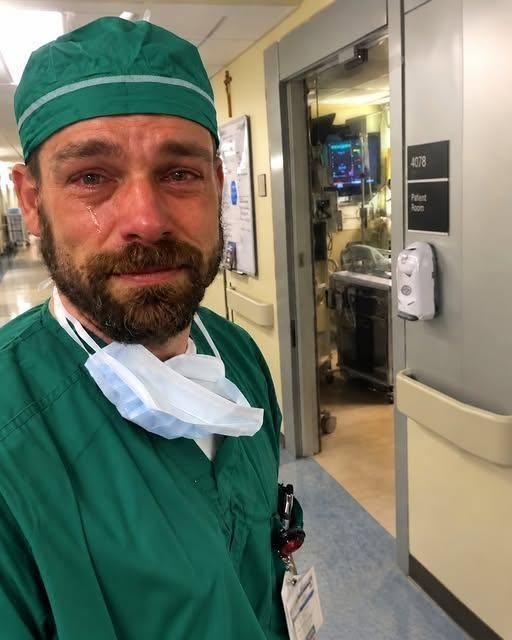
The first morning Ben prepared to return to the hospital, I woke before he did.
I lay beside him and listened to his breathing.
For eleven years, I had heard that sound almost every night.
Sometimes it was the only reminder that my husband was still part of our home.
He would return long after midnight, exhausted, barely able to speak.
By morning, he would be gone again.
I had spent so much time being careful not to disturb him that I had forgotten what it felt like to simply be his wife.
Now things were different.
At least, we were trying to make them different.
Ben had been offered the position of director of the hospital's patient assistance program.
He wasn't returning to his old responsibilities as chief surgeon.
His work would still involve patients who needed help, but the assistance would be organized openly.
No secret payments.
No unauthorized use of hospital supplies.
No hidden arrangements that left me wondering what was happening to our family.
That was what we had agreed.
Yet when I opened my eyes and saw Ben preparing for the day, I felt the old fear returning.
His hospital badge was lying nearby.
I stared at it longer than I should have.
It was such an ordinary object.
A small piece of identification.
His name.
His photograph.
Something he had worn throughout our marriage.
But I remembered the badge clipped to his jacket in Room 814.
I remembered finding it on the chair while searching for him.
And I remembered wondering whether I would ever see him alive again.
I turned toward him.
"Ben?"
He looked at me.
"You're awake."
"I couldn't sleep."
He sat beside me.
For a moment, neither of us spoke.
I wanted to tell him I was happy about the job.
I was.
But there was another feeling underneath it.
A fear I didn't want to admit.
He noticed.
"Are you worried about me going back?"
I looked at the badge.
"Yes."
He nodded.
I waited for him to reassure me.
A year earlier, he would probably have told me everything was fine.
He would have kissed my forehead and gone to work.
Then I would have spent the day wondering whether he meant it.
But this time, he stayed beside me.
"What worries you most?"
I thought about that question.
There were many possible answers.
The hospital.
The investigation.
Mrs. Carter.
The people who had stolen medication and falsified records.
The memory of Emily disappearing.
The possibility that Ben might once again become so consumed by helping others that he forgot the people waiting at home.
I could have named all of them.
Instead, I told him the simplest truth.
"I'm afraid you'll disappear into your work again."
He looked down.
I continued before I could lose my nerve.
"I don't mean physically. I mean the way you did before."
He nodded slowly.
"I understand."
"I don't want to wake up one morning and realize we've stopped talking."
He reached for my hand.
I let him take it.
"I don't want that either."
I studied his face.
He looked serious.
Tired, but not defeated.
For the first time, I understood that returning to the hospital might frighten him too.
He had nearly lost his medical license.
He had faced an investigation that lasted almost a year.
He had watched people he knew become involved in crimes against patients.
And he had finally confronted a secret about his brother's death that had followed him for twelve years.
The hospital was not the same place to him anymore.
I wondered whether he felt that every time he walked through its doors.
"Are you scared?" I asked.
He looked at me.
"A little."
I almost smiled.
It was such a small admission.
But it meant everything.
Ben had spent years trying to appear strong.
He had believed admitting fear would make his problems more difficult for us.
Now he was saying it without being forced.
I squeezed his hand.
"Then we're both scared."
He gave a small smile.
"Apparently."
I leaned against him.
There was no dramatic speech.
No promise that nothing bad would ever happen again.
We simply sat together and admitted that we were frightened.
And somehow, that made the morning easier.
Later, I stood in the kitchen while our daughter ate breakfast.
Ben sat beside her.
He wasn't rushing through the room.
He wasn't answering questions with one hand already on the door.
He was listening.
Our daughter talked about the ordinary things that mattered to an eight-year-old.
Ben answered her.
I watched them quietly.
I thought about her birthday.
The one he had missed.
I remembered trying to make the day feel complete without him.
I remembered how carefully I had spoken whenever she asked where Daddy was.
I had told her he was helping patients.
That had been true.
But the truth hadn't stopped her from missing him.
I knew we couldn't give her that birthday again.
We couldn't replace Thanksgiving or our anniversary either.
Time didn't work that way.
But watching Ben sit beside her reminded me that the days ahead still mattered.
We had already lost enough ordinary moments.
I didn't want to lose more.
When breakfast was finished, Ben stood.
He looked toward me.
I knew he was ready to leave.
For a brief moment, I felt the old tightness in my chest.
Then he walked over.
"Can we talk tonight about how the day went?"
I looked at him.
"Yes."
He smiled.
"Good."
I watched him pick up his badge.
I remembered the Tuesday I had gone to surprise him with lunch.
I had watched him leave that morning too.
I had believed he was simply going to work.
I hadn't known about the little girl receiving treatment.
Or the medication fraud.
Or the brother whose death had shaped so much of his life.
That day, I had decided to bring him apple pie.
I had wanted to make him smile.
Instead, I had walked into a hospital full of people who seemed afraid to tell me anything.
I could still picture Arnold.
His pale face.
His tearful eyes.
His hesitation before handing over the white envelope.
That memory hadn't disappeared.
But this morning was different.
Ben had told me where he was going.
He had told me what he would be doing.
And he had asked to discuss it with me afterward.
It should have been ordinary.
For us, it felt like progress.
I kissed him goodbye.
Then I watched him leave.
I didn't feel completely peaceful.
But I no longer felt helpless.
That evening, Ben came home.
I heard him enter.
The sound was familiar.
For years, I had listened for it while trying not to fall asleep.
Sometimes I had waited until midnight.
Sometimes he hadn't come home at all.
Now I stood in the kitchen and heard him approaching.
I looked up.
He seemed tired.
I noticed that immediately.
But he wasn't avoiding my eyes.
He smiled when he saw me.
"How was your day?" I asked.
He set his things down.
"Different."
I almost laughed.
"That's a beginning."
He sat at the kitchen table.
I joined him.
For a moment, we looked at each other.
Then he began telling me about the work.
He spoke about the patient assistance program.
About helping families who couldn't afford treatment.
About wanting the process to be clear enough that people wouldn't have to depend on private arrangements or hidden favors.
I listened.
I didn't understand every detail of hospital administration.
I had told him that when he first offered to involve me.
But I understood what it meant to need help.
And I understood what happened when people were too frightened or ashamed to ask.
I had lived beside a man who thought asking for help was a kind of failure.
I knew how dangerous that belief could become.
"Do you think the program will make a difference?" I asked.
Ben thought for a moment.
"I think it can."
I nodded.
I liked that answer.
He wasn't promising to save every patient.
He wasn't pretending that money would never be a problem again.
He was talking about something he could work on with other people.
That was new.
I asked whether he still thought about Emily.
"Of course."
He looked down at his hands.
"I probably always will."
I understood.
Emily had survived the accident that killed her parents.
She had required expensive treatment.
She had become involved in a terrible situation because other people had chosen profit over patients.
And Ben had risked nearly everything to help her.
I would always be grateful she was alive.
I would also always remember what his secrecy had cost our family.
Both feelings belonged together.
"Do you ever regret how you helped her?" I asked.
He was quiet.
Then he looked at me.
"I regret the things I hid from you."
I waited.
"And I regret putting my license at risk."
He looked down again.
"But I don't regret trying to keep her alive."
I reached across the table.
"I wouldn't ask you to."
That was important.
I didn't want Ben to believe loving his family meant abandoning his compassion.
I had fallen in love with that part of him.
The man who couldn't walk past someone who needed help.
The man who cared about patients who couldn't pay.
The man who remembered promises.
But I wanted him to understand that compassion needed honesty too.
Without it, even kindness could hurt people.
We talked for a long time.
Not about every detail of the investigation.
Not about every person who had been charged.
There were things we still didn't know.
And there were things we had no control over.
But we talked about what mattered to us.
Our daughter.
Our marriage.
The work he was doing.
The limits we needed to respect.
The things we had promised to change.
At one point, Ben became quiet.
I waited.
Then he told me he had been thinking about his brother.
I looked at him.
He didn't often mention him without being asked.
That alone made me pay attention.
"Because of the hospital?" I asked.
He nodded.
"Because of everything."
I thought about the old photograph.
Two boys beside their mother.
The photograph I had found years before.
The one he had taken away when I asked who the other boy was.
I had spent eleven years believing it was an unimportant part of his past.
Now I knew it represented someone he had loved and lost.
Someone whose death had been recorded as an overdose.
Someone Ben believed had been killed.
And someone whose memory had never stopped affecting him.
I looked at my husband.
"Do you wish you'd told me about him sooner?"
He nodded.
"Yes."
"Why?"
He thought for a moment.
"Because you might have understood me better."
I felt a sharp sadness.
He was right.
I might have understood some of his fear.
Some of his determination.
Some of the sadness he carried home.
But understanding wouldn't have meant agreeing with every decision.
I wanted him to know that.
"I would have understood more," I said.
He looked at me.
"But I still would have told you when something was wrong."
He smiled faintly.
"I know."
"And I still would have wanted you home for our daughter's birthday."
His expression changed.
"I know."
I leaned forward.
"That's what marriage is, Ben. We don't have to agree about everything."
He nodded.
"We just have to tell each other the truth."
He reached for my hand.
I held it.
The next few days passed without anything dramatic happening.
I found that strange.
For so long, our lives had been shaped by emergencies.
Late-night calls.
Missed dinners.
Worry.
Explanations that never seemed complete.
Now Ben came home and talked.
Some days he was tired.
Some days I was too.
There were still disagreements.
There were moments when I remembered something painful and needed to say it.
But he listened.
And I stopped pretending I was fine when I wasn't.
That was the biggest change.
We no longer treated discomfort as something that had to be hidden.
One evening, I remembered the little note I had placed under the fork in his lunch bag.
I had written that he didn't need to care for everyone alone.
I had wanted to help him.
I hadn't known how badly he needed someone to insist on that.
"Do you remember what I wrote?" I asked.
Ben looked at me.
"In the lunch bag?"
I nodded.
He smiled sadly.
"I remember."
I looked down.
"I meant it."
He squeezed my hand.
"I know you did."
I thought about how different that conversation was from the one Arnold and I had shared at the hospital.
Back then, every answer had led to another frightening question.
Now I could ask my husband something directly.
And he answered.
It wasn't extraordinary.
It was what we should have been doing all along.
Later, our daughter sat beside us at the table.
She had been drawing again.
I watched Ben look at her work.
He listened as she explained it.
I didn't interrupt.
I simply watched.
There was something healing about seeing him give her his attention without looking at the clock.
He had spent so much time trying to save strangers.
Now he was learning that being present for his own child mattered too.
I didn't want him to feel guilty every time he looked at her.
Guilt alone wouldn't help us.
I wanted him to enjoy being her father.
To understand that he was allowed to be happy at home.
That he didn't have to earn his place in our family by suffering for everyone else.
When our daughter finished talking, she leaned against him.
He put his arm around her.
I looked away for a moment.
I was crying.
Not because something was wrong.
Because I had missed that sight.
I had missed having my husband home.
I had missed hearing our daughter laugh with him.
I had missed the man I had married.
And even though he was sitting right there, I was still learning how to believe he would stay.
That night, after our daughter had gone to bed, Ben found me sitting quietly.
He asked what was on my mind.
I told him.
"I'm still afraid sometimes."
He sat beside me.
"Of what?"
"That things will go back to the way they were."
He nodded.
I watched his face.
I was waiting for him to tell me not to worry.
Instead, he said something better.
"Then tell me when you feel that way."
I looked at him.
"Even if it happens more than once?"
"Even then."
I leaned against him.
For the first time, I understood that rebuilding trust wasn't about never feeling afraid.
It was about knowing I could speak when fear returned.
And knowing the person beside me would listen.
We sat together without talking.
I thought about the hospital.
The investigation.
Mrs. Carter's arrest.
Emily's survival.
The brother Ben had finally told me about.
All those things had changed our lives.
But the choice we were making now was quieter.
We were learning how to live without secrets.
I didn't know exactly how long that would take.
I didn't need to.
When Ben reached for my hand, I held it.
And when he asked whether I was ready for us to keep moving forward, I told him the truth.
"Yes. But together this time."
He nodded.
"Together."
I believed him.
Not because he had finally found the perfect words.
Because he had begun showing me what they meant.
Click here to continue reading: PART 10: After Eleven Years of Loving a Man Who Tried to Save Everyone Else, I Finally Understood What Our Family Needed Most
I Went to Surprise My Husband With His Favorite Homemade Apple Pie, Never Expecting to Learn He Had Asked People to Keep Me Away
Part 9 of 10