I used to think the hardest part of a call like Emily's would be reaching the house in time.
I was wrong.
Getting there was only the beginning.
The real responsibility continued after the emergency lights were turned off.
After the medical vehicle left.
After Thomas could no longer interfere.
After the bedroom door stood open.
I understood that more clearly as the investigation continued.
Emily was receiving professional care.
Her immediate safety had been addressed.
The appropriate investigators were reviewing the evidence.
And Thomas's actions at the house were part of that investigation.
I could not decide what the final legal outcome would be.
That was not my role.
My responsibility was to tell the truth about what I had seen and help protect the child who had called us.
I took that responsibility seriously.
There were details I knew firsthand.
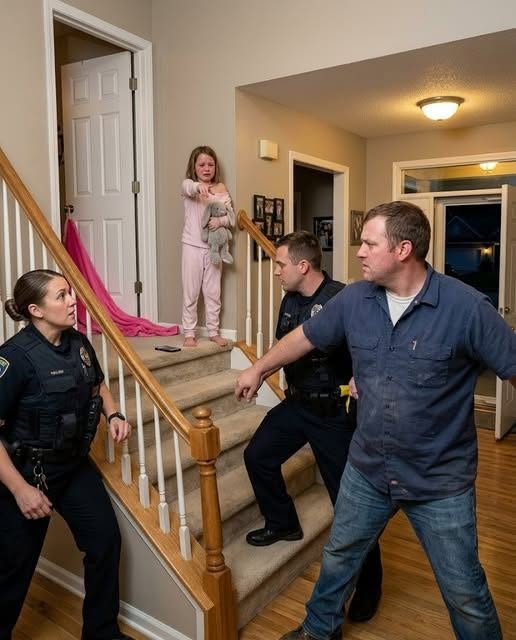
Thomas's refusal to let us see Emily.
His instruction for her to return upstairs.
Her frightened reaction when he spoke.
The way he tried to prevent Daniel from reaching the bedroom.
And the way Emily watched the staircase during the confrontation.
Those were facts.
I returned to them whenever I felt tempted to make assumptions about things I had not witnessed.
There were also details from Claire's emergency call.
Emily had described her fear using the word snake.
She had said her father wanted the matter kept secret.
She had whispered for help when she believed he was returning.
The recording preserved those words.
But the responsibility for understanding what Emily meant belonged to trained professionals.
I knew it was important not to make her repeat painful experiences simply because adults wanted a clearer story.
Her words deserved to be heard carefully the first time.
I thought about that often.
Especially when I remembered the question she had asked me.
"Did I do something bad?"
I could still hear her voice.
Soft.
Uncertain.
Almost apologetic.
She had called 911 because she was frightened.
And afterward, she worried that asking for help had been wrong.
That was the part I could not accept.
Not from her.
Not from anyone.
A child should never feel responsible for the consequences of an adult's harmful behavior.
Yet Emily seemed to carry that worry everywhere.
In her questions.
In her silence.
In the way she watched her father's movements.
I wanted her to understand that responsibility belonged to the adults.
Not to her.
I knew she might need to hear that many times.
From more than one person.
Over more than one day.
That was why continued support mattered.
The evening at Maplewood Drive had ended.
But Emily's need for care had not.
I thought about the medical team.
How carefully they had approached her.
How they had explained things before moving closer.
How they had given her time to answer.
Those small choices mattered more than people sometimes realize.
For a child who had been frightened, knowing what was about to happen could make an unfamiliar situation a little easier.
Emily had watched every movement.
Every face.
Every doorway.
I could not change what had taught her to be so cautious.
But I hoped the adults caring for her would continue showing her that not every interaction had to be frightening.
I remembered Bunny.
The worn stuffed rabbit with the twisted ear.
I had seen Emily hold it through the entire confrontation.
When Daniel's voice rose upstairs, she squeezed it.
When the house became quiet, she continued holding it.
When the medical team arrived, she asked whether she could keep it.
And before leaving, she made certain it could travel with her.
I had said yes every time.
It was one of the easiest decisions I made that night.
And one of the ones I remembered most clearly.
Because there were so many things Emily had not been able to control.
She had not controlled her father's reaction.
She had not controlled the confrontation upstairs.
She had not controlled the police response.
But she could choose to keep Bunny close.
She could decide whether to hold its ears.
She could ask questions.
And she could receive answers without being punished for asking.
I hoped those small moments would matter later.
I knew they could not repair everything.
Nothing that simple could.
Still, I believed they were worth protecting.
One afternoon, I reviewed the final wording of my account of the response.
I read the portion describing our arrival.
The white fence.
The quiet street.
Thomas opening the door.
His claim that his daughter was sleeping.
Then Emily appearing on the stairs.
I stopped reading.
For a moment, I saw her exactly as she had been.
Pink pajamas.
Swollen eyes.
One sleeve slipping from her shoulder.
Bunny twisted in her fist.
I remembered the way she looked at her father before deciding whether to come downstairs.
It had taken her time.
She looked at Daniel.
Then at me.
Then back at Thomas.
As though every possible choice carried a risk.
I wished I had understood that expression sooner.
But I had understood enough to keep talking gently.
Enough to stay with her.
Enough not to force her into explaining everything.
I continued reading.
The dispatcher warning.
Emily's gesture toward the hallway.
The phone on the carpet.
The blanket partly dragged into the landing.
The bedroom door.
Then Thomas moving to stop Daniel.
The sequence was plain on the page.
There was nothing theatrical about it.
No need for dramatic language.
The facts told the story of a child asking for help and an adult attempting to prevent officers from checking the place she had indicated.
I remembered how hard Daniel had worked to keep the confrontation controlled.
Thomas had resisted.
Daniel had stopped him.
And the room was no longer concealed behind his refusal.
That did not answer every question.
But it allowed the investigation to move forward.
I finished reading the report.
Then I signed the portion that belonged to me.
I knew there would still be work ahead.
The evidence would be evaluated.
The necessary decisions would be made through the proper process.
Emily's care would remain important regardless of those decisions.
I could not promise an outcome I had not witnessed.
And I would not invent one simply because I wanted the story to end neatly.
Life does not always give frightened children an ending that arrives all at once.
Sometimes safety begins with an emergency call.
Sometimes it continues with medical care.
Sometimes it requires adults to listen patiently while a child slowly learns that she is allowed to speak.
That was the future I hoped Emily would have.
A future where she could ask for help without feeling ashamed.
Where she did not have to monitor every change in an adult's voice.
Where a doorway was simply a doorway.
And a bedroom was somewhere she could rest.
I hoped she would one day hold Bunny because she wanted to.
Not because she was frightened.
I hoped the rabbit would return to being an ordinary toy.
Something to carry around.
Something to leave on a pillow.
Something to forget for an afternoon because she was busy enjoying herself.
Those were simple hopes.
But they felt important.
I thought again about Claire Johnson.
She had been the first adult to hear Emily's emergency.
Not the first adult in Emily's life.
Not the first person who had ever spoken to her.
But the first person involved in our response who understood that the strange description might be hiding something serious.
Claire had listened beyond the word snake.
She heard the fear.
She heard the warning about a secret.
She heard the child become quiet when someone approached.
And she took action.
That decision brought Daniel and me to Maplewood Drive.
I would always be grateful for it.
One day, I spoke with Daniel about the call again.
We were reviewing what had happened, and he mentioned how quickly Thomas's behavior had changed.
I remembered it too.
The polite greeting.
The explanation about a sleeping child.
The request that we leave her undisturbed.
Then the refusal.
Then the confrontation.
Daniel shook his head.
"He thought he could keep us away from that room."
I looked at him.
"But Emily had already shown us where to look."
He nodded.
Neither of us said anything for a moment.
I thought about how much courage that small gesture had required.
Emily had raised a trembling hand.
She had pointed toward the hallway.
She had done it while her father stood nearby.
She had not given a long explanation.
She had not made a speech.
She had simply shown us where she wanted us to look.
I remembered watching her face when she did it.
The fear was obvious.
But she pointed anyway.
That gesture mattered.
So did everything that followed.
Daniel had moved toward the room.
Thomas had tried to stop him.
The confrontation had been resolved.
And Emily had been taken somewhere she could receive care.
I looked down at my notes.
There was still no neat sentence that could contain everything I felt.
I was relieved we had responded.
Angry that Emily had been frightened.
Sad that she had doubted whether anyone would believe her.
And worried about the long process ahead.
All those feelings existed together.
I had learned that they could.
I didn't need to choose just one.
But none of them could replace the work.
That was the lesson I kept returning to.
Feeling sorry for a child was not enough.
Believing that something might be wrong was not enough.
Adults had to listen.
They had to respond.
They had to protect.
They had to handle the evidence carefully.
And they had to remember that the child would still need support after the immediate emergency ended.
I thought about Emily asking whether Thomas would be angry.
I thought about her asking if she had done something bad.
And I remembered the answer I had given her.
"No."
It was one of the few things I could say without hesitation.
She had not been wrong to ask for help.
She had not been wrong to call 911.
She had not been wrong to point toward the hallway.
The responsibility for what happened inside that home did not belong to her.
I hoped the people helping her would keep repeating that truth until she could believe it herself.
I looked out the window.
The day was ordinary.
People were going to work.
Children were going to school.
Families were opening doors and preparing meals.
Somewhere, another dispatcher was answering a call.
Another officer was approaching a house.
Another child might be struggling to explain something frightening.
I wanted the adults listening to remember Emily.
Not because every unusual statement meant the same thing.
Not because every frightened child would have the same experience.
But because a child's limited words should never be treated as a reason to ignore their fear.
Emily had said something that sounded impossible if taken literally.
A snake belonging to her father.
A secret.
Pain.
A plea for help.
Claire had not waited for the child to explain it perfectly.
She had recognized the need to respond.
And that mattered.
I returned my attention to the paperwork on my desk.
I closed the file I had been reviewing.
For a moment, I rested my hand on the cover.
I knew that the official records could preserve the important facts.
The times.
The statements.
The evidence.
The officers' actions.
But they could not fully capture how it felt to stand beside Emily at the bottom of that staircase.
They could not show how quietly she listened.
How tightly she held Bunny.
How her shoulders lifted whenever a sound came from above.
Or how much relief appeared on her face when I told her she could keep the rabbit.
Those memories stayed with me.
I didn't want to forget them.
They reminded me why careful police work mattered.
Not just securing a room.
Not just stopping resistance.
Not just writing a report.
But making sure the person who needed help was treated with patience and dignity.
Emily's immediate safety had been addressed that night.
Thomas could no longer control whether we reached the bedroom.
Her emergency call had been preserved.
Her medical care had begun.
The investigation was continuing through the appropriate process.
Those were the outcomes I could speak about truthfully.
The rest of Emily's future was still hers to live.
I hoped it would be gentle.
I hoped it would give her room to trust again.
I hoped she would eventually have more ordinary days than frightening ones.
And I hoped she would remember that someone answered when she called.
That was what stayed with me most.
Not the struggle.
Not the bedroom door.
Not Thomas's careful smile.
The little girl with the rabbit.
The child who was afraid nobody would believe her.
The child who found enough courage to ask for help anyway.
I remembered her final look toward the doorway.
She had stopped staring at the staircase.
She was preparing to leave.
And when she stepped outside with Bunny beneath her arm, she was no longer facing the situation alone.
I could not erase what had brought us there.
I could not promise that everything afterward would be easy.
But I could remember the moment she was heard.
And I could keep doing the work that helped make that possible for another child.
That was the truth I carried away from Maplewood Drive.
A child should never have to find perfect words before an adult takes her fear seriously.
Emily hadn't found perfect words.
She had found a telephone.
She had called.
And somebody listened.
The End
Read more original stories on Feel Every Story.
I Thought I Understood Why Emily Was Afraid Until Her Father Blocked the Bedroom Door and Everything Changed
Part 10 of 10