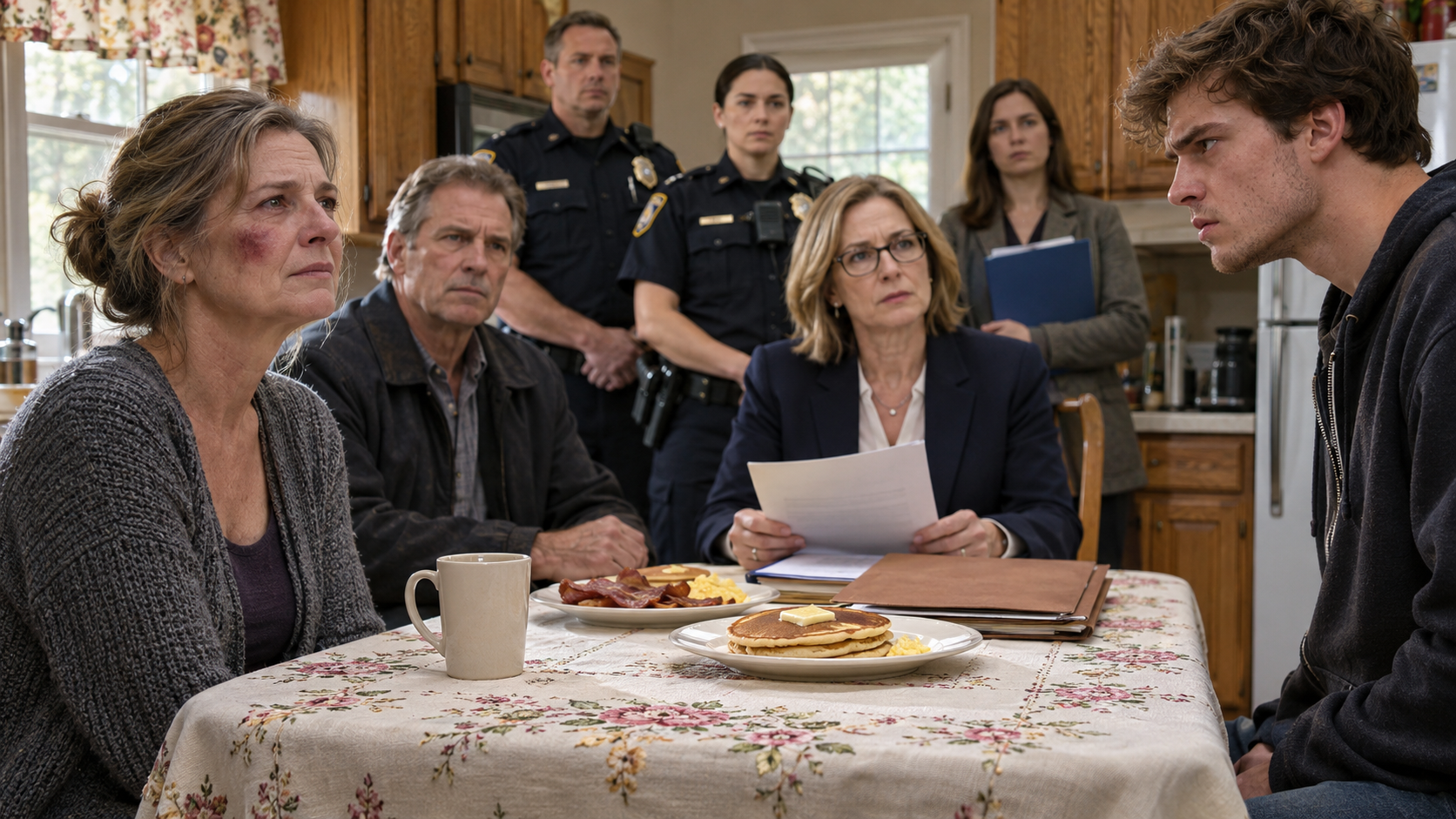
I had spent years studying my son's moods.
I didn't think of it that way at the time.
I thought I was being careful.
A careful mother.
A patient mother.
A mother who knew when an argument wasn't worth having.
But there were things Tyler did that I had learned to recognize before he even opened his mouth.
His foot would begin moving against the floor.
His eyes would narrow.
Sometimes he would stare without blinking, as though he were deciding what to say next.
Those small things had become warnings to me.
I didn't need him to shout.
I didn't need him to threaten anything.
I could feel myself preparing to give in before the argument had properly started.
That was how things usually went.
Tyler wanted something.
I hesitated.
He grew impatient.
And I found a way to make the situation easier.
Sometimes it was money.
Sometimes I agreed to do something for him.
Other times, I apologized even though I hadn't done anything wrong.
I told myself the apology didn't matter.
It was only a few words.
If saying them meant the argument would end, what harm could they do?
That was the excuse I kept making.
I had grown used to treating my own feelings as something less important than his.
If Tyler was unhappy, I felt responsible.
If he became angry, I tried to repair the situation.
And if he wanted money, I often found myself considering how much I could spare before I even asked what he intended to do with it.
That evening, I couldn't keep doing it.
"I don't have a thousand dollars for you," I said.
Tyler's expression hardened.
"You're pretending you don't have it."
I felt the familiar urge to explain myself.
I could have started talking about bills.
I could have gone through my expenses.
I could have tried to convince him that I wasn't withholding money to punish him.
That was what I usually did.
I explained.
Then I explained again.
And somehow I always ended up feeling as though I needed to justify having money of my own.
But the amount he wanted wasn't small.
A thousand dollars mattered to me.
It mattered because I had a mortgage.
It mattered because I had obligations that would still be there after Tyler spent whatever I gave him.
It mattered because the savings he was talking about had a purpose.
They weren't sitting there waiting for him.
They were there to help me keep my house.
"My savings aren't available for this," I told him.
He didn't seem interested in that distinction.
"Then take some out."
"I can't."
"You mean you won't."
I looked down at the counter for a moment.
That was the part that always exhausted me.
It didn't matter how carefully I answered.
He turned every explanation into another argument.
If I said I couldn't afford something, he accused me of choosing not to help.
If I mentioned my responsibilities, he acted as though I was making excuses.
The conversation never seemed to be about whether I could give him what he wanted.
It was about how long he would have to argue before I surrendered.
And I knew my own history.
I had surrendered plenty of times.
I had called it avoiding a fight.
I had told myself I was making the sensible choice.
But I wasn't sure I believed that anymore.
Tyler's fingers tightened around the chair.
He seemed to be waiting for the moment when I would start bargaining.
Perhaps he expected me to offer part of the money.
Perhaps he thought I would promise to find it later.
I had given him enough reasons to expect those things.
That was difficult to admit.
His behavior was his responsibility.
But my habit of surrendering had become part of our relationship.
I had spent years trying to prevent difficult evenings.
Now I was facing one anyway.
And I was beginning to understand that everything I had given him had never purchased the lasting peace I wanted.
It had only postponed the next demand.
Click here to continue reading: PART 3: He Told Me to Use My Mortgage Savings, and I Remembered Every Bill I Had Paid While Calling His Problems Temporary
I Had Spent Twenty-Three Years Keeping My Son Happy, but One Question About Money Made Me See What I Had Become
Part 2 of 10