I kept thinking about the moment Emily heard her father say her name.
It was such a small thing.
A father addressing his daughter.
Something that happened in households every day.
But I couldn't forget what happened to her body.
She had flinched.
Not after an argument.
Not after a threat that anyone had stated openly.
Just after hearing her name spoken in that tone.
I had to remind myself not to jump beyond what I knew.
The habit was important.
An officer couldn't make decisions based only on an emotional reaction.
I needed facts.
I needed careful observations.
I needed to distinguish what Emily had told us from what I feared might be true.
But none of that meant pretending I hadn't seen her fear.
That would have been a mistake too.
Daniel had requested additional help.
We were waiting for that response.
Thomas hadn't suddenly become cooperative.
He remained unhappy about what was happening.
And Emily remained aware of him.
I tried to make the space around her feel less tense.
That wasn't easy.
The disagreement had already happened in front of her.
She had already spoken about her father's anger.
And he'd reacted by addressing her sharply enough that she recoiled.
Nothing I said could undo that moment.
So I didn't try to force a cheerful expression.
I simply stayed present.
Sometimes adults make the mistake of trying too hard to reassure children.
We tell them everything will be fine.
We promise there is nothing to worry about.
We speak as though our confidence can change their experience.
I had done that before.
Looking back, I'm not proud of it.
I had wanted frightened children to feel better so badly that I sometimes reached for words before I knew whether those words were true.
With Emily, I was more careful.
I wasn't going to promise an ending I couldn't guarantee.
I was going to listen.
And I was going to make sure we didn't overlook what she'd already told us.
Daniel continued to handle Thomas.
I could hear the patience in his voice.
It wasn't weakness.
It was restraint.
There was a difference.
He was maintaining a professional boundary without turning the conversation into a contest.
Thomas wanted to remain close to his daughter.
Daniel had explained why we needed space.
Thomas had refused.
So Daniel had taken the next available step.
He'd asked for help.
That decision mattered more than anything either man could say in an argument.
We weren't there to prove which adult could speak the loudest.
We were there because a child might need protection.
I watched Emily's face.
I couldn't tell exactly what she was thinking.
I wouldn't pretend otherwise.
But I could see that she hadn't stopped monitoring what happened around her.
I wondered how much energy that required.
To stand quietly.
To follow every change in someone's expression.
To wait for the moment an ordinary conversation might become something frightening.
I didn't want to imagine what it would feel like to live that way.
And I didn't have proof that she did.
That distinction stayed with me.
I was concerned.
Deeply concerned.
But concern was the beginning of the work.
It wasn't the conclusion.
The response Daniel requested would bring people with different responsibilities.
A supervisor could help us manage the situation.
Child Protective Services could assess Emily's safety and needs.
A detective could determine what further investigation might be necessary.
Another officer could help us keep the scene secure.
Each role mattered.
And none of those requests meant we had already established every fact.
They meant the circumstances deserved attention.
Careful attention.
I knew Daniel understood that.
It was why his radio call had been so controlled.
He hadn't exaggerated.
He hadn't tried to tell dispatch a complete story we didn't yet possess.
He had simply identified the resources we needed.
That was how he worked.
And it was one of the reasons I trusted him.
I thought about Claire at dispatch.
She had heard him identify his unit.
She had heard his requests.
And she had arranged the additional response.
She knew Daniel's habits well enough to recognize the seriousness behind his calm delivery.
That mattered.
A dispatcher often heard only voices.
No facial expressions.
No movements.
No frightened child standing nearby.
Just words coming through a radio.
Claire couldn't see Emily covering her ears.
She couldn't see the way Thomas turned toward her.
She couldn't see the child's reaction to hearing her name.
But she could hear that Daniel wanted a supervisor, child protection, a detective, and another unit.
She understood that those requests were not routine for an uncomplicated conversation.
She acted.
I was grateful for that.
The officers on scene were responsible for recognizing what they observed.
The dispatcher was responsible for helping get the right people involved.
Neither job was simple when a situation was uncertain.
And this situation was very uncertain.
I kept returning to the same question.
What had Emily been trying to tell us?
Not just through her words.
Through the way she held herself.
Through the way she watched her father.
Through the way she tried to shut out the disagreement before anything louder happened.
We had one clear statement from her.
She said her father became angry when others didn't comply.
That was important.
But it left questions unanswered.
What did angry mean to Emily?
What had she seen?
What was she afraid might happen?
We couldn't answer those questions for her.
We needed to let her speak in her own time, with the right people and the right safeguards.
I was beginning to understand that patience wasn't merely about being kind.
It was about not contaminating what a child might tell us.
It was about not suggesting answers.
Not treating assumptions as memories.
Not turning a frightened child's words into something more specific than they actually were.
That responsibility weighed on me.
I wanted to protect her.
But wanting to protect someone didn't allow me to decide their story in advance.
I had to remember that.
Thomas's resistance had made the task more difficult.
Still, his refusal didn't give us permission to rush.
It gave us a reason to proceed more carefully.
Daniel had chosen that course.
And I supported him.
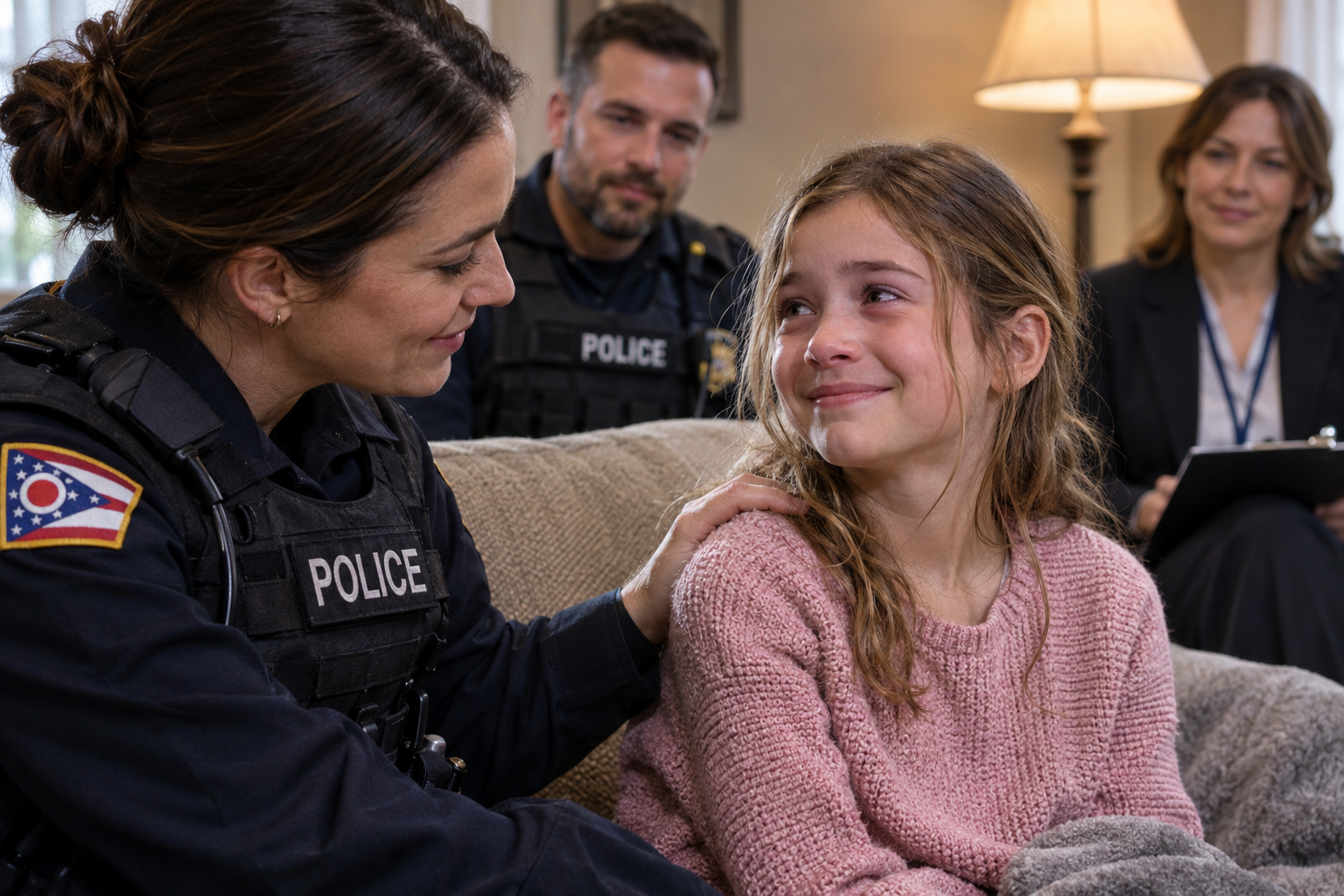
I looked at Emily again.
She seemed so young to be caught in the middle of an adult disagreement.
I wished Thomas would understand that his daughter needed space.
I wished he could see how frightened she appeared.
But I couldn't control his response.
I could control mine.
I could choose not to argue in front of her.
I could choose not to demand that she repeat herself immediately.
I could choose to treat her reaction as something important rather than inconvenient.
Those were small choices.
But they were the choices available to me.
The sound of the radio stayed in my mind.
Unit Twenty-Four.
A request for a supervisor.
A request for child protection.
A request for a detective.
Another unit on the way.
Such ordinary professional language.
And yet, in that room, those words represented a decision.
We weren't going to end our involvement simply because the conversation had become uncomfortable.
We weren't going to allow Thomas's refusal to settle the matter.
And we weren't going to ignore the fear we'd seen in Emily.
I knew more people would soon be involved in assessing what had happened.
I also knew their arrival wouldn't automatically make the little girl feel safe.
That concerned me.
A child could become frightened by the very process meant to help her.
We had to remain aware of that.
We had to remember she was a person, not a problem to be passed from one professional to another.
She was a little girl standing in her own home.
She had spoken only a few words.
And those words had required courage I couldn't begin to measure.
I didn't tell her she was brave.
Not then.
I didn't know how she'd receive it.
I didn't want her to think she was expected to say more simply because an adult praised her.
Instead, I remained quiet.
I stayed close enough to listen.
Daniel continued keeping the situation steady.
Thomas remained where he was.
And we waited for the people Claire had sent.
I understood that the next steps would have to be decided with the help of those arriving.
We would need to share exactly what we'd observed.
Nothing more.
Nothing less.
I would tell them that Emily had watched her father closely.
I would tell them she had covered her ears during the disagreement.
I would explain what she'd said about his anger.
And I would describe the immediate physical reaction I'd witnessed when he addressed her.
Those details belonged together.
Not because they proved an entire history.
But because they explained why we were concerned enough to request further help.
I wanted the next person who spoke with Emily to understand that she had already shown us how frightened she was.
I wanted them to recognize how much her father's presence seemed to affect her.
And I wanted them to give her the chance we hadn't yet been able to provide.
A chance to speak without watching him.
That was all I could honestly ask for at that point.
I hadn't uncovered what was behind her fear.
I hadn't learned everything that had brought us to that room.
The full truth was still unknown.
But I knew one thing.
We couldn't disregard her reaction and call the situation resolved.
So we stayed.
We continued observing.
And we kept our attention where it belonged.
On Emily.
The little girl who had barely raised her voice.
The little girl who had tried to cover her ears before an argument grew worse.
The little girl whose fear had convinced us that leaving without further assessment would be the wrong decision.
That was where things stood when we waited for additional help.
No answers yet.
No final judgment.
Just a child who needed to be heard, and officers who had decided to make sure someone could listen properly.
Click here to continue reading: PART 5: The Backup Officers Arrived, but It Was One Small Question From Emily That Made Us Realize Her Fear Had Not Ended
I Thought We Were Answering an Ordinary Call Until a Little Girl Made Me Question Everything About Her Home
Part 4 of 10