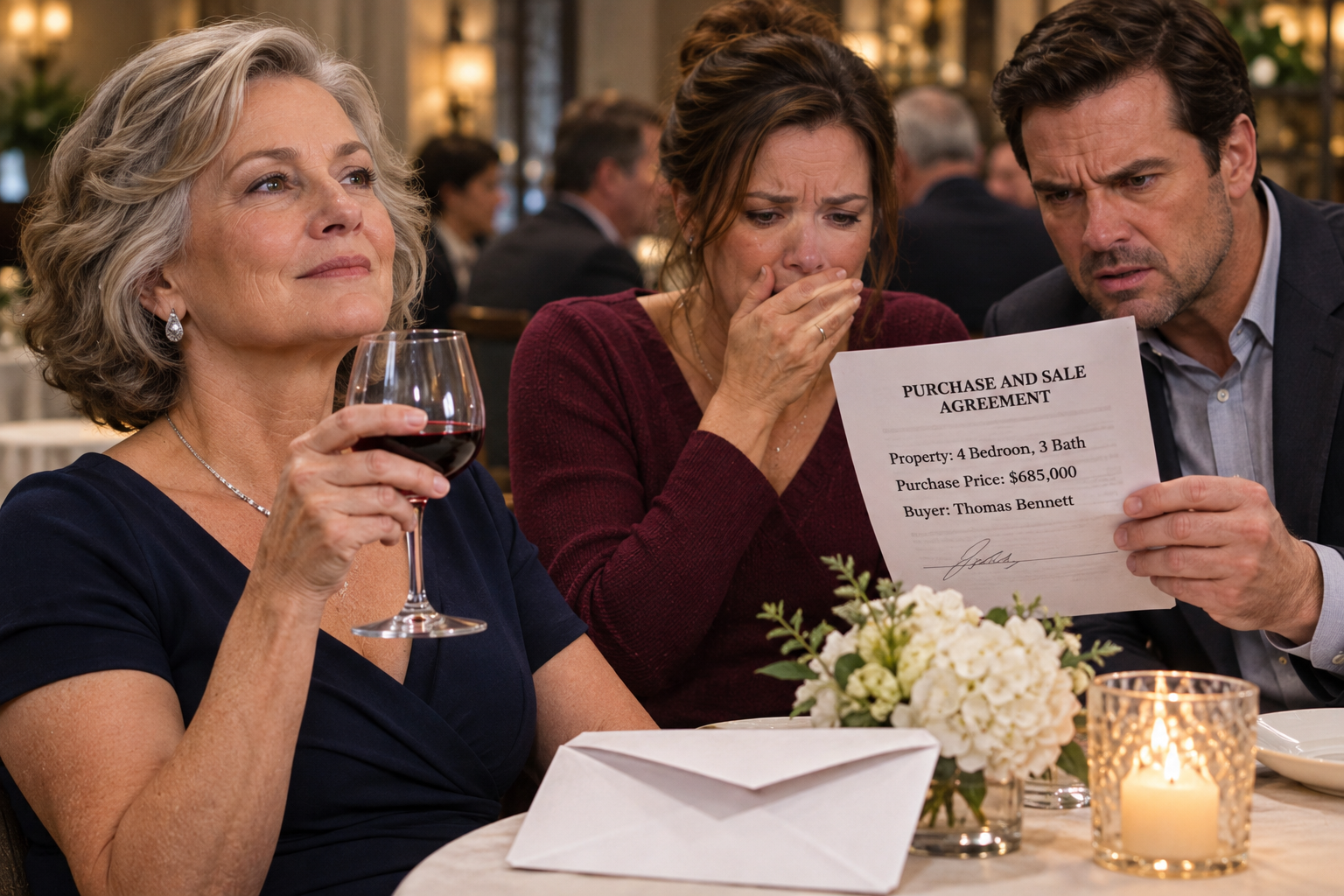
Greg was still holding the agreement when I realized he had forgotten something important.
He had forgotten who owned the house.
Not who lived there.
Not who used the biggest bedroom.
Not who parked in the garage or decided what belonged in the kitchen.
Who owned it.
I looked at the paper in his hand.
Then I looked at Sarah.
She had become very quiet.
A few minutes earlier, my daughter had been explaining why I needed to find somewhere else to live.
Now her husband was telling me I had no right to sell the place they wanted me to leave.
I found that difficult to understand.
Not because their behavior surprised me.
I had been watching it for three years.
But hearing those two positions spoken at the same birthday dinner made something clear.
They wanted me gone.
They wanted my house to stay.
And they had never seriously considered that I might make a decision of my own.
Greg leaned forward.
“Are you listening to me?”
I looked at him.
“I heard you.”
“Then you understand this isn't happening.”
I glanced at the agreement.
“It's already happening.”
His mouth tightened.
Sarah reached toward him.
“Greg.”
He barely acknowledged her.
I could see that he was angry enough to forget where we were.
The restaurant was still busy around us.
Someone at another table laughed.
A waiter moved past carrying plates.
The bottle of wine Sarah had ordered stood beside our glasses.
Everything looked normal.
Except the three people sitting at our table.
I looked down at my untouched dessert.
I had turned sixty that day.
Sixty.
I had imagined getting older would mean gradually giving up certain things.
A little strength.
Some energy.
Perhaps a few plans I had once believed would be easy.
I had not imagined my daughter would expect me to give up my own home.
And I certainly had not expected her to call that arrangement reasonable.
Sarah finally spoke.
“Mom, why didn't you tell us?”
I looked at her.
“Would you have listened?”
She did not answer.
I could see she wanted to say something.
But Greg was still examining the document.
He looked as though he expected another page to explain why the first one did not count.
I remembered the day they moved into the house.
Sarah had been crying when she called.
Greg had lost money through investments that had not worked out.
Their rent had gone up.
They needed help.
She said it would only be temporary.
I believed her.
Or perhaps I wanted to believe her.
There is a difference.
Looking back, I can admit that.
She was my daughter.
I had spent so many years helping her through ordinary problems that opening my front door seemed natural.
I never thought of it as a sacrifice.
Not at first.
I had four bedrooms.
There was space.
I lived alone after my husband died.
The house felt quieter than it once had.
I thought having Sarah there might even make it feel like a family home again.
That was what I told myself.
The first few weeks were pleasant.
Greg cut the grass.
Sarah prepared dinner occasionally.
They paid the utility bills.
They thanked me.
They talked about finding another place once their finances improved.
I believed we understood one another.
I was helping them.
They were my guests.
And eventually they would leave.
But nothing happened all at once.
That was the part I failed to recognize.
No one announced that my house was becoming theirs.
They simply began making decisions.
Small ones.
Then larger ones.
Sarah first suggested changing bedrooms.
She and Greg had more belongings than I did.
She said the master bedroom would be better for them.
I remember standing beside the doorway while she explained it.
She spoke as though the change were already settled.
I could have refused.
I know that now.
Instead, I thought about how difficult their situation had been.
I told myself a bedroom was only a bedroom.
So I moved.
My clothes went into the guest-room closet.
My photographs came with me.
My late husband's belongings were packed more tightly.
I tried not to make Sarah feel guilty.
I did not understand that she had already stopped feeling guilty.
Soon Greg needed the garage.
He bought exercise equipment.
Weights.
A treadmill.
Machines that took up more space than I expected.
My car was moved outside.
Greg seemed pleased with the arrangement.
I told myself he would be happier if he had somewhere to exercise.
And perhaps he was.
But the garage had been part of the home my husband and I had worked to pay for.
I was standing in that house every day, quietly surrendering pieces of it.
A bedroom.
A garage.
A cabinet.
A shelf.
I kept telling myself none of those things mattered very much.
I was wrong.
They mattered because nobody was asking anymore.
Sarah stopped treating my agreement as necessary.
Greg stopped treating my presence as important.
And I stopped speaking when something upset me.
That was my contribution to the problem.
I wanted peace so badly that I kept accepting less of it.
At the restaurant, I watched Sarah touch the edge of the white envelope.
She was no longer looking at Greg.
She was looking at me.
“You could have discussed it with us.”
I nearly asked her when she had last discussed a household decision with me.
But I didn't.
I remembered my grandmother's baking sheets.
Sarah had thrown them away because they occupied space she wanted for her juicer.
Those trays were old.
I knew that.
Their edges had darkened.
Their surfaces were scratched.
They were not expensive.
But my grandmother had used them.
I had kept them because they connected me to her.
Sarah had looked at them and seen clutter.
I had looked at them and seen part of my life.
That afternoon, I had tried to explain.
She had barely listened.
Her juicer needed the cabinet.
That was the entire discussion.
I remembered standing in the kitchen afterward.
I had not raised my voice.
I had not demanded an apology.
I had simply looked at the empty space where the baking sheets had been.
And for the first time, I wondered whether my daughter understood that the house belonged to someone other than herself.
Greg interrupted my thoughts.
“Thomas Bennett. Who exactly is he?”
I looked at him.
“He's the buyer.”
“I can read that.”
“Then you have your answer.”
He put the paper down.
Sarah picked it up immediately.
She studied the first page again.
I let her.
I wanted her to understand what she was holding.
Not because I enjoyed seeing her upset.
I didn't.
She was still my daughter.
Seeing her frightened was not something I had ever wanted.
But I had spent too long protecting her from the consequences of her own behavior.
I had given her space.
Then money.
Then privacy.
Then the right to make decisions I should have made myself.
And when there was almost nothing left to give, she asked me to leave.
I thought about the day Greg lost his job.
At first, I had felt sorry for him.
Losing work is frightening.
I understood that.
My pension began covering groceries.
Then other bills.
Property taxes.
Electricity.
The expenses kept coming.
I paid because someone had to.
When Greg found another job, I assumed things would change.
They didn't.
The bills continued arriving.
And I continued paying.
Sarah never seemed interested in asking whether that was difficult for me.
She had become accustomed to the money.
Just as she had become accustomed to the bedroom.
And the garage.
And the kitchen.
I was useful when something needed paying.
Less useful when someone needed to make room.
That was difficult to admit.
Especially about my own daughter.
Sarah lowered the document.
“Mom, you're making a huge decision.”
I nodded.
“I know.”
“You can't just do something like this without thinking about us.”
I looked at her for a long moment.
I remembered how she had spoken about senior living earlier that evening.
How easily she had suggested I should start looking.
She had not asked whether I wanted to leave.
She had not asked what would happen to the things I loved.
She had simply explained what she and Greg needed.
More room.
A home office.
A different future.
And a house they expected to keep.
“I have thought about you,” I said.
Sarah looked relieved for a second.
Then I continued.
“I've spent three years thinking about you.”
She looked away.
I knew she understood at least part of what I meant.
The restaurant had grown quieter to me.
Not because everyone had stopped talking.
They hadn't.
But I was no longer trying to imagine the right words to keep my daughter happy.
For three years, that had been my habit.
Choose the harmless answer.
Avoid the disagreement.
Give her what she wants.
Make tomorrow easier.
I had become very good at it.
Too good.
Greg reached for his wineglass.
He took a drink.
Then he looked at the document again.
I could see he was trying to regain his confidence.
“This affects both of us,” he said.
“It does,” I answered.
“Then we should have been involved.”
I thought about that.
There were things I could have told them earlier.
There were conversations I could have insisted on having.
I was not pretending I had handled every moment perfectly.
But I also remembered what happened whenever I tried to say no.
Sarah had once followed me through the hallway because I refused to give her additional money.
She had accused me of living in the house without contributing.
My house.
The house my husband and I had paid off.
I could still hear the certainty in her voice.
She truly believed she was providing me with somewhere to live.
That was when I understood how far things had gone.
I had answered calmly.
I told her the arrangement needed to be reconsidered.
She smiled.
I remember that smile.
She believed I was finally accepting her authority.
She did not know I had already begun making different plans.
I looked at her across the restaurant table.
The same woman who had smiled in the hallway was now reading an agreement she had never expected to see.
I did not feel triumphant.
I felt tired.
Tired of arguments that had not happened because I was afraid to begin them.
Tired of explaining things that should have been obvious.
Tired of trying to prove that I deserved a place in a home I owned.
Sarah folded the top page back.
Her hands were unsteady.
“Is this why you've been clearing out your room?”
I looked at her.
“Yes.”
For the first time that evening, I saw recognition move across her face.
The empty shelves.
The missing photographs.
The nearly bare closet.
All the little things she had accepted without a second thought.
They had meant something.
And now she knew.
Click here to continue reading: PART 6: Sarah Finally Understood Why My Bedroom Was Almost Empty, and Greg Began Asking Questions He Should Have Asked Three Years Earlier
I Watched My Daughter Pull a Paper From the White Envelope, Knowing She Was About to Learn What I Had Already Decided
Part 5 of 10