The agreement remained on the table.
Nobody seemed eager to touch it again.
Sarah looked tired.
Greg looked angry.
I felt something I had not expected.
Sadness.
Not because I regretted the decision.
I didn't.
But I had imagined my sixtieth birthday would feel different.
I had not expected an expensive dinner.
I had not wanted a grand celebration.
I would have been happy with a quiet evening.
A meal.
A little conversation.
Perhaps the feeling that my daughter was pleased to spend time with me.
Instead, I had listened to her explain why I was no longer wanted in my home.
I remembered how carefully she had spoken at first.
She set down her wineglass.
She looked at Greg.
Then she began talking about the future.
Their future.
Not mine.
She explained that my pension had been useful.
She said I was becoming difficult to accommodate.
She talked about needing more space.
Greg wanted an office.
Their lives could not remain on hold.
I remembered listening.
I had not interrupted.
Partly because I had suspected what was coming.
Partly because I wanted Sarah to finish.
I needed to hear whether she truly believed the things she was saying.
Then she suggested senior living.
As though she had found a reasonable solution to a problem.
I had not asked to be moved.
I had not asked them to take responsibility for me.
I was sixty.
I was making decisions.
I was paying bills.
I was handling my own affairs.
And I owned the house.
Yet she spoke as though I had become someone who needed to be placed somewhere convenient.
Greg had sat beside her.
He did not object.
He looked comfortable.
Relieved, even.
That was difficult to forget.
I wondered whether Sarah would have spoken so confidently without him sitting there.
I could not answer that.
I knew only what I had witnessed.
She continued until she reached the part about keeping the house.
That was when everything became clear.
She did not merely want me to leave.
She believed the house would remain available to her and Greg afterward.
I remembered placing my fork beside my plate.
I did it slowly.
My hands were steady.
I was proud of that.
There had been years when Sarah's disappointment was enough to make me change my mind.
A raised voice.
A few tears.
An accusation that I did not care.
I had become frightened of upsetting her.
At the dinner table, that fear was still there somewhere.
But it no longer controlled what I did.
I looked at Greg.
Then at Sarah.
I reached into my purse.
The white envelope felt ordinary in my hand.
Paper.
Nothing more.
Yet I had spent a long time preparing the decision represented by what was inside.
I placed it between us.
Sarah looked confused.
Greg leaned forward.
For the first time that evening, neither of them knew what I intended to say.
I let Sarah open it.
She had been confident enough to discuss my future without asking what I wanted.
Now I wanted her to read something that concerned my future directly.
A document.
Not an argument.
Not an accusation.
An agreement.
She found the heading.
She read it.
Then she began turning pages.
I could see her confusion deepen.
She asked whether I was selling the house.
I confirmed that I was.
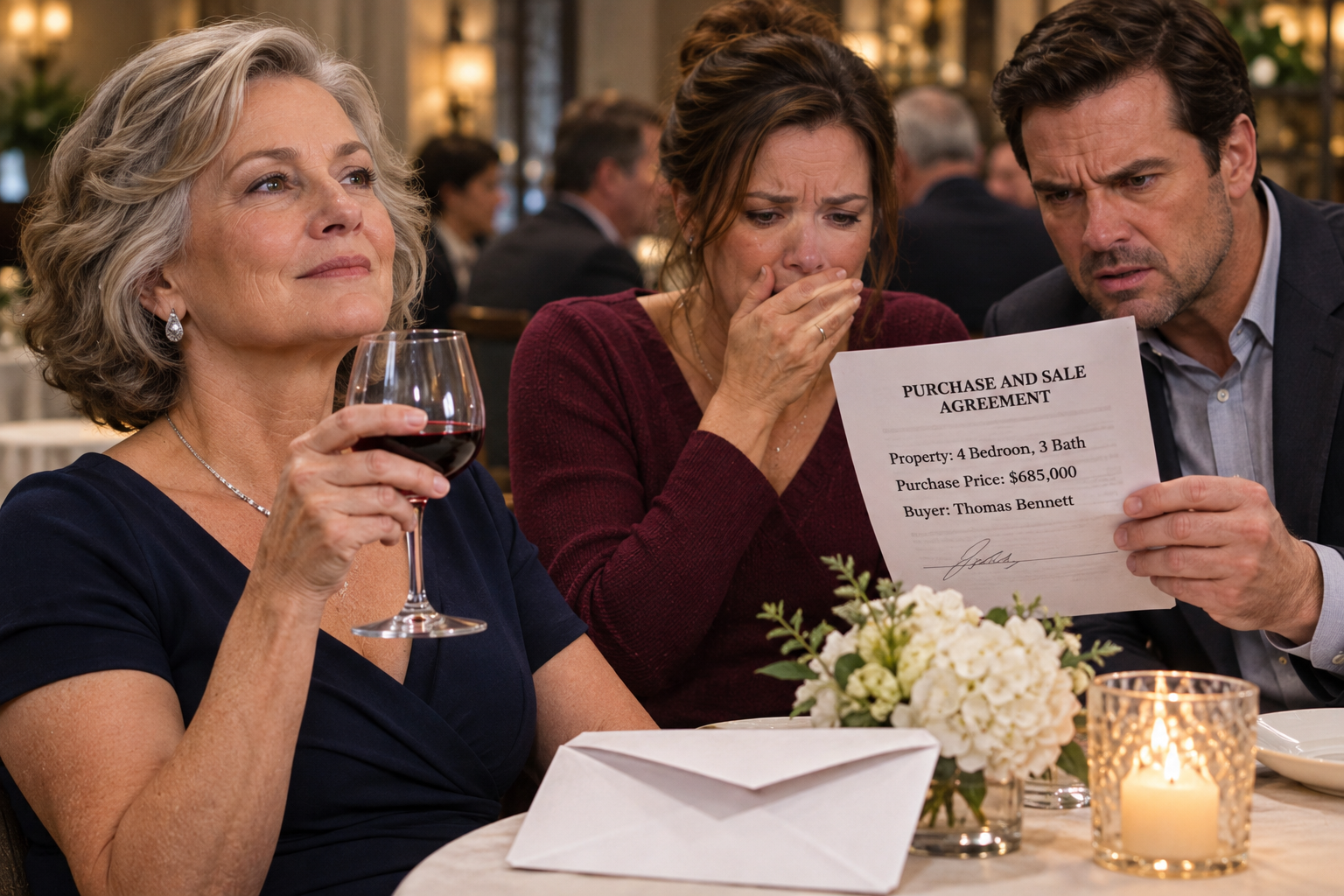
Greg took the agreement from her.
He found the price.
$685,000.
He found Thomas Bennett's name.
He saw the buyer's signature.
Then he told me I could not sell.
I had expected resistance.
But there was still something remarkable about hearing the words.
Minutes earlier, they had expected me to accept a decision about where I should live.
Now Greg refused to accept that I had made a decision about my own property.
I looked at the open envelope.
I thought about my husband.
He had worked hard.
So had I.
We had bought the house when Sarah was young.
We had raised her there.
We had celebrated birthdays.
Christmases.
Ordinary evenings.
We had paid the mortgage until nothing remained.
When my husband died, I stayed because I could not imagine leaving all those memories behind.
For a long time, I believed that staying was a way of honoring him.
Maybe it was.
But I had begun confusing the house with the life we had shared.
The house was bricks.
Rooms.
A garden.
A garage.
The life had been people.
Conversations.
Small acts of care.
The feeling of belonging.
I had lost that feeling long before I decided to sell.
Sarah looked at me.
“Mom, are you sure?”
I nodded.
“Yes.”
She looked down again.
I could see she was still struggling to accept it.
I understood that.
She had lived there for three years.
She had made herself comfortable.
The master bedroom had become hers.
Greg's exercise equipment filled the garage.
Their belongings occupied rooms that had once held my things.
They had stopped thinking of the arrangement as temporary.
Perhaps they had stopped remembering it had ever been temporary.
I remembered the evening Sarah called me crying.
She needed somewhere to stay.
Only until they recovered financially.
I had said yes.
No hesitation.
I believed that was what a mother should do.
I still did not regret helping her.
I regretted allowing the arrangement to become something else.
I regretted moving bedrooms without insisting on a conversation.
I regretted staying silent when my things were discarded.
I regretted letting my pension become the answer to every financial difficulty.
Most of all, I regretted believing that asking for respect would make me a bad mother.
It wouldn't have.
I knew that now.
But knowing it at sixty did not erase the years I had spent learning it.
Greg moved the agreement slightly.
The paper made a faint scraping sound against the table.
“There's no reason to rush into anything.”
I looked at him.
I remembered how he had spoken before Sarah opened the envelope.
He had seemed pleased with the idea of me leaving.
Now he wanted time.
I did not need to ask why.
The difference was obvious.
When Sarah suggested senior living, they thought the house would remain theirs to use.
When they saw the agreement, they understood the house itself might no longer be available.
That changed the conversation.
I looked at Sarah.
“Did you really believe I would move out and leave the house for you?”
She lowered her gaze.
I waited.
Greg shifted in his chair.
Sarah finally looked up.
“We thought it would be best.”
I nodded slowly.
I had heard that phrase before.
Best.
It was a word people often used when they wanted something and did not want to explain who would benefit.
I thought about what Sarah had told me.
They needed room.
Greg needed an office.
They wanted to move forward.
I had become an inconvenience.
And keeping the house would make sense.
For them.
I looked down at my hands.
I felt the familiar temptation to soften the moment.
To reassure Sarah.
To tell Greg we could discuss everything later.
To take the agreement back and pretend it was only an idea.
That was how I had handled difficult conversations for years.
I knew exactly how to do it.
A small apology.
A promise to reconsider.
A few gentle words.
Then everything could return to normal.
But normal was the problem.
Normal meant another bill arriving.
Another request for money.
Another cupboard being emptied.
Another room becoming unavailable.
Another day of feeling unwelcome.
I did not want that normal anymore.
I lifted my eyes.
“I've made my decision.”
Sarah looked at me for a long moment.
There was no smile now.
No confident explanation about senior living.
No suggestion that I should simply understand what she and Greg needed.
She looked at the white envelope.
Then at the agreement.
I wondered whether she remembered the way she had invited me to dinner.
Her bright voice.
The promise of a proper birthday celebration.
The casual mention of discussing the future.
I had understood what she meant then.
And I understood something else now.
She had expected our conversation to end with my agreement.
Instead, it had ended with her discovering mine.
I picked up my wineglass.
The wine was no longer especially enjoyable.
But I took a small sip.
Then I set it down again.
I did not feel victorious.
I did not enjoy seeing my daughter upset.
I knew there would be difficult conversations ahead.
I knew that selling a home where other people lived involved more than placing a document on a restaurant table.
I had spoken to professionals because I understood that.
I wanted everything handled properly.
No shouting in the driveway.
No belongings thrown outside.
No humiliation.
I wanted the same careful process I had been planning from the beginning.
Sarah reached for the agreement one more time.
She studied Thomas Bennett's signature.
Then she looked at me.
For the first time that evening, she was no longer telling me what my future should be.
She was asking questions about a future I had chosen for myself.
I had waited three years to make that difference clear.
And as I watched her read the document again, I realized I no longer needed to convince her that I was serious.
The agreement was real.
The house was mine.
And I was no longer willing to disappear inside it.
Click here to continue reading: PART 9: Sarah Asked Whether I Could Undo the Sale, but I Had Already Learned What Happened Whenever I Put Her Needs Before My Own
I Watched My Daughter Pull a Paper From the White Envelope, Knowing She Was About to Learn What I Had Already Decided
Part 8 of 10