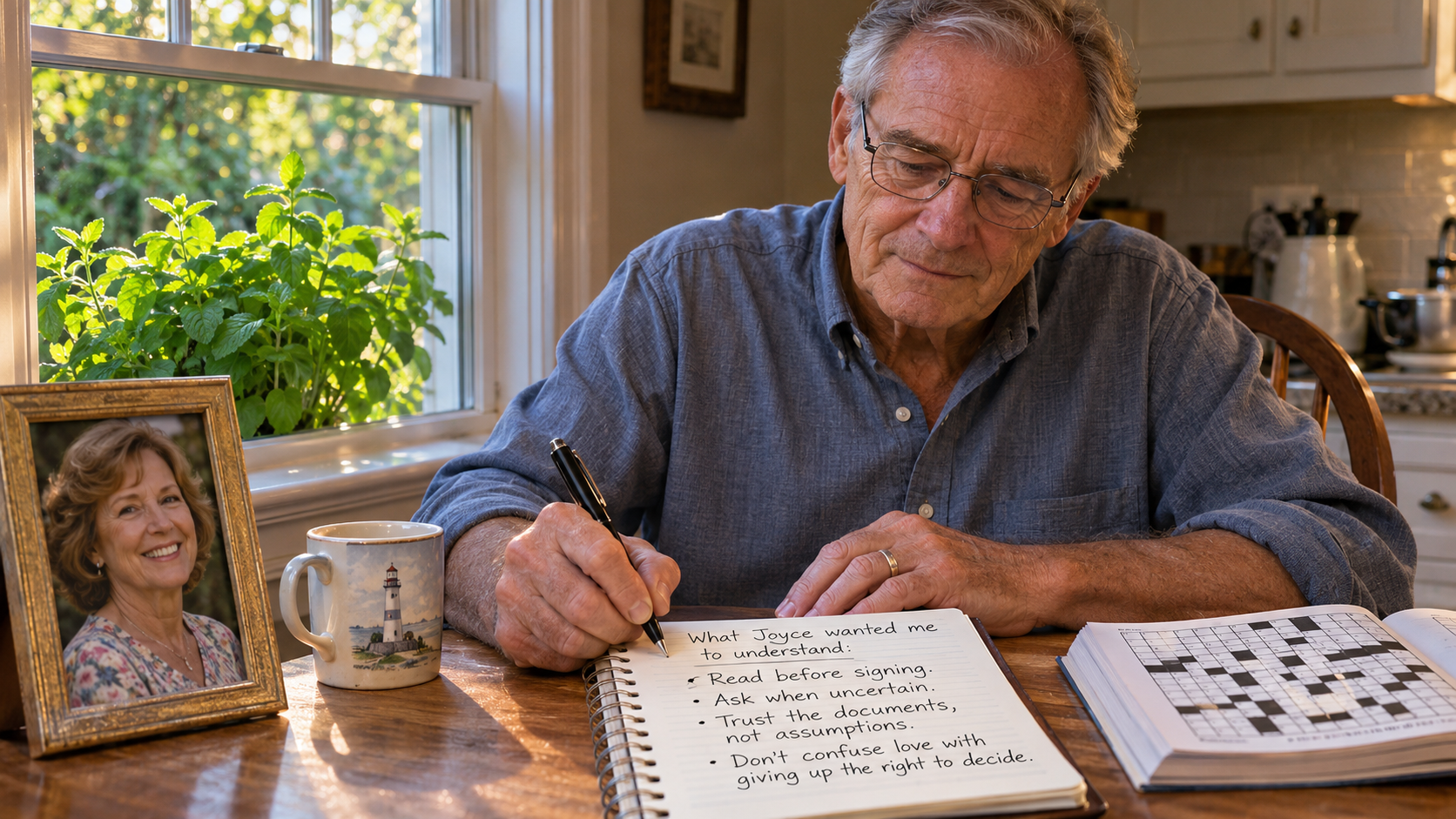
There was one thing about Joyce's filing system that had always stood apart.
She was protective of certain papers.
More protective than I expected.
That was true even by Joyce's standards.
She was careful with everything related to money.
I had already grown used to that.
A receipt mattered to her.
An investment record mattered.
A password mattered.
She treated information as something worth preserving.
But some documents received a different level of attention.
I knew that because I had seen the difference.
I couldn't have explained it.
I hadn't tried very hard.
Perhaps that was what bothered me most as I thought about those years.
I had noticed something unusual.
Then I had allowed myself to stop wondering about it.
I didn't know whether that had been a mistake.
But it was difficult not to question it now.
Thirty-four years gave me plenty of memories.
It also gave me plenty of chances to remember what I hadn't asked.
Joyce's financial records were a familiar part of our life together.
The way she sorted things.
The way she recorded things.
The way she kept information long after I would have stopped thinking about it.
Those habits had seemed harmless.
Useful, even.
If I needed to know something about our investments, Joyce had the records.
If an old financial question came up, she could usually answer it.
The details were there.
Organized.
Accessible to her.
And I had accepted that arrangement because it worked.
I didn't think of myself as someone who was being kept away from anything.
I thought of myself as a husband whose wife happened to be much better at paperwork.
That distinction mattered to me.
It still did.
I had no proof that Joyce's caution meant anything beyond what I had always believed.
I wasn't entitled to turn an old habit into an accusation.
And I didn't want to.
She was the woman I had loved for thirty-four years.
I wasn't trying to make her into somebody else because I felt uncertain.
But the memory of those carefully protected documents wouldn't leave me alone.
They were there among everything else she had kept.
And unlike the ordinary envelopes or the spreadsheet, they had never felt completely open to me.
I tried to remember how I had reacted at the time.
I hadn't been angry.
I hadn't treated the matter as a serious disagreement.
In fact, I had made jokes about it.
That was often how I responded to Joyce's habit of keeping everything in order.
I would make some remark about how efficiently she worked.
She would respond.
And the moment would pass.
There was one exchange I remembered particularly well.
It concerned the filing cabinet.
I had made fun of how much she could organize.
It was an affectionate joke.
That was how I had intended it.
She had smiled when she answered.
I remembered the smile.
I remembered the ease of the moment.
But I also remembered what she told me about one particular drawer.
That was the part that had stayed with me.
Not the envelopes.
Not the investments.
Not even the extraordinary way she could recall a tax payment from 2009.
A drawer.
Something so ordinary that I hadn't thought it required an explanation.
I had accepted her words because they came from Joyce.
Because she was my wife.
Because I trusted her.
And because, at the time, I hadn't imagined that I might someday find myself thinking about that conversation while driving to see her lawyer.
Click here to continue reading: PART 4: I Once Joked That Joyce Could Organize Anything, but Her Answer About the Lowest Drawer Stayed With Me Long Afterward
I Was Driving to My Wife’s Lawyer When I Realized There Were Things About Our Marriage I Had Never Understood
Part 3 of 10