I held the photocopy until my fingers started hurting.
The little brass key seemed harmless on the page.
Nothing special.
Just a household key.
But I knew exactly where the original was.
Kaitlyn had it.
I had seen it hanging from her key ring on the morning Jared told me he had quit his job.
I remembered asking for it.
I remembered the way she dropped it into her bag.
And I remembered her answer.
She would return it when everything was organized.
I hadn't challenged her.
That was becoming a familiar pattern.
People made decisions around me.
I allowed them to.
Then I told myself I was being patient.
Looking back, I was letting my grief make me passive.
Laura watched me study the picture.
"Joyce was concerned about that key."
"Why give it to Kaitlyn in the first place?"
"During her illness, she needed help accessing certain records."
I nodded.
That much made sense.
In January, Joyce had needed more help than either of us wanted to admit.
Some mornings she could barely sit upright.
Her medications made her tired.
Her appetite had almost disappeared.
We had relatives coming through the house.
Groceries arrived.
People helped with errands.
Kaitlyn had offered to assist with paperwork.
I remembered being grateful.
"Joyce trusted her," I said.
"At first," Laura answered.
I looked up.
"What changed?"
Laura turned to another page.
"Joyce became concerned that information from her records was being discussed outside the household."
I thought about Ronald.
About Jared telling him there would be millions.
About the way Ronald asked when the money would arrive.
Nobody had asked me what I knew.
They had simply assumed.
"Did Kaitlyn copy something?"
"We know she had access. Joyce documented concerns about certain papers being handled without her permission. We don't know everything that was done."
That was enough to make me feel sick.
I had spent January worrying whether Joyce was comfortable.
Whether she was eating.
Whether she needed another blanket.
I had paid no attention to who was walking through her study.
"Why didn't Joyce take the key back?"
"She tried."
I stared at Laura.
"When?"
"According to her notes, she asked for it more than once."
The words felt heavier than they should have.
A key.
A simple brass key.
My wife had been ill.
She had wanted something returned.
And apparently she hadn't received it.
"Why didn't she tell me?"
Laura glanced at the letter in my hands.
"I think she tried to explain that."
I unfolded the first page.
Joyce's handwriting was smaller than I remembered.
The lines weren't perfectly straight.
I could tell writing had taken effort.
My eyes filled before I read the first sentence.
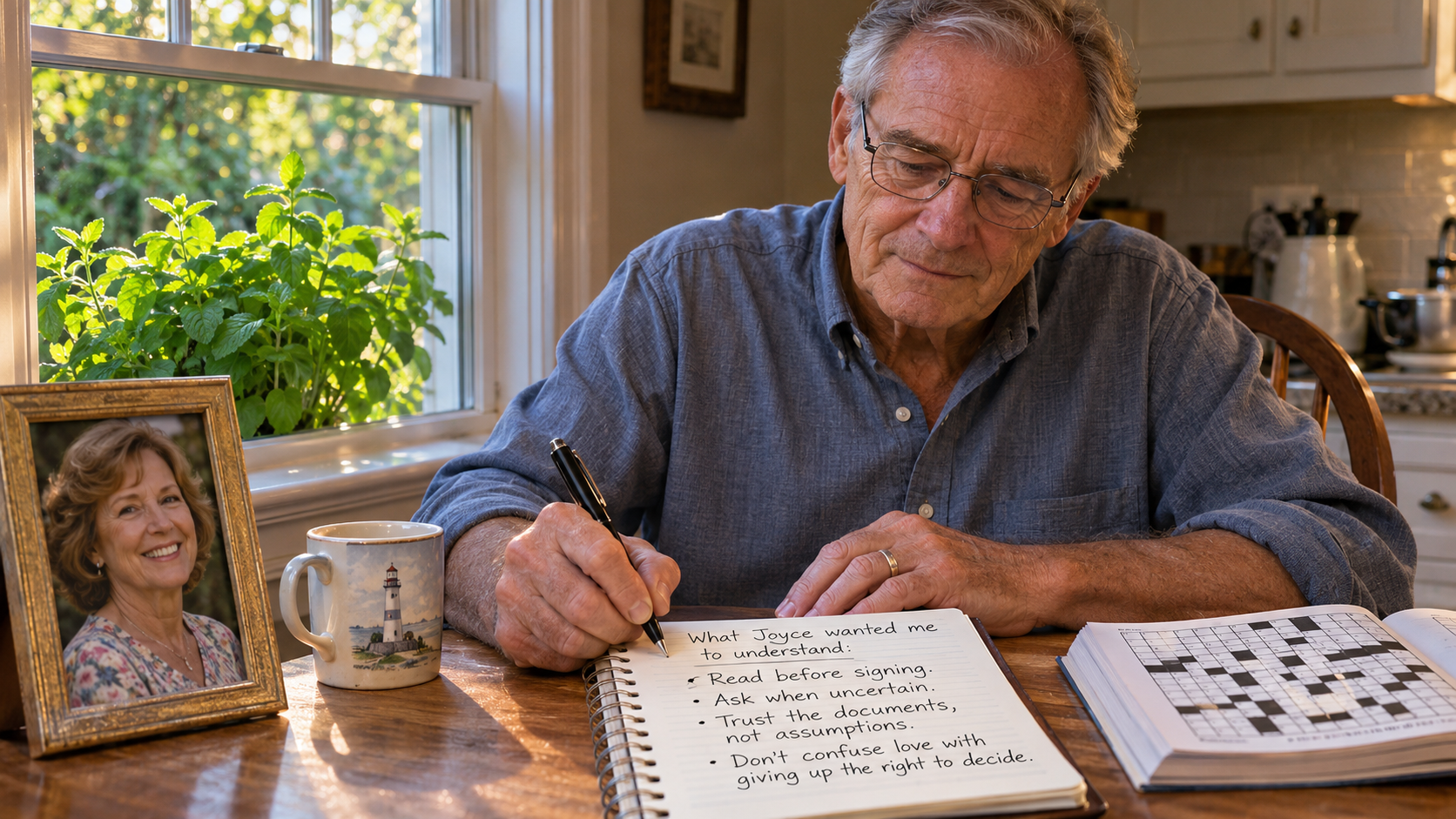
Dale, I know you will be upset that I handled this without you.
I stopped.
Thirty-four years.
I had known her for thirty-four years.
And even at the end, she knew exactly how I would react.
I continued.
She wrote that she hadn't wanted our final months together to become an argument about money.
She knew how much I loved Jared.
She knew I would want to believe there had been a misunderstanding.
She also knew I would blame myself if I discovered something after she was gone.
That part made me put the letter down.
Because she was right.
I already blamed myself.
Not for what Jared might have done.
For failing to notice what had been happening inside my own house.
Laura said nothing.
I picked up the letter again.
Joyce explained that she had begun noticing questions about her investments.
Questions that were too specific.
Amounts.
Dates.
Account locations.
Details she had never discussed openly with Jared.
At first, she assumed he was concerned about the future.
Then she learned he was discussing property purchases.
Not ordinary purchases.
Expensive ones.
Plans that depended on money she had not promised him.
She wrote that she loved our son.
But loving him did not mean surrendering every decision to him.
I had to stop reading.
That sentence hurt.
Joyce had understood something I was only beginning to see.
Jared wasn't waiting to learn what his mother wanted.
He had already decided what her money should do.
I looked toward the window.
Cars moved along the street outside Laura's office.
People were going to work.
Buying coffee.
Carrying on with their ordinary Monday.
I wanted to be one of them.
Instead, I sat with a letter from my dead wife explaining why she had been afraid of what our son might do.
"There's more," Laura said gently.
I looked back down.
Joyce wrote about the filing cabinet.
She said the lower drawer contained records she had collected while checking the financial discrepancies.
Not every document was proof of wrongdoing.
She made that clear.
Some were simply dates.
Copies.
Notes about conversations.
But together, they explained why she had changed her estate plan.
I remembered her smiling at my old joke about organizing Ohio.
I remembered her asking me not to open the bottom drawer without her.
At the time, she hadn't been afraid of me seeing the papers.
She had wanted to be there to explain them.
Now she couldn't.
So she had left a letter.
I pressed the paper flat against Laura's desk.
"What do I do?"
"First, get the original key."
"And then?"
"Bring the contents of the drawer here. Don't sort them yourself. Don't discard anything."
I nodded.
"Should I tell Jared?"
"Not yet."
"Should I tell Kaitlyn why I want it?"
"You can ask for your property back without explaining the contents of your wife's estate."
That sounded simple.
It wasn't.
Jared had always known how to make a conversation feel like an argument I had started.
If I asked too many questions, he became defensive.
If I pressed him, he accused me of not trusting him.
And when I backed down, he treated that as agreement.
I had never looked at the pattern very closely.
Now I could see it.
"There's something I haven't told you," I said.
Laura waited.
I reached into my jacket and took out the little notebook I had carried as a county building inspector.
Its cover was worn.
The corners had curled.
I had used notebooks like it for most of my working life.
They helped me remember what I saw at a construction site.
An unfinished railing.
A missing inspection.
A date somebody insisted was different.
I opened it to the page I had written on Sunday night.
Longboat house.
Yacht.
April.
Signatures.
Laura leaned forward.
"What is that?"
"Things I heard yesterday."
I told her about Ronald Simmons.
About the wine.
About Jared discussing the three-point-one-million-dollar house.
About the Viking yacht.
And about the way he assured Ronald I would sign whatever was necessary.
Laura listened without interrupting.
When I finished, she asked one question.
"Did he say you had already agreed?"
"No. He said I would."
"Keep that notebook."
I almost smiled.
"Joyce would have told me the same thing."
Laura's expression changed.
"Yes," she said. "I believe she would."
For the first time that morning, we both seemed to remember Joyce as more than the woman whose papers were spread across the desk.
She had been funny.
Stubborn.
Careful.
And terribly difficult to persuade once she believed something mattered.
I folded her letter slowly.
"Did she know Jared was planning to quit?"
"I don't know."
"Did she know about Ronald's yacht?"
"Not from anything she told me."
I nodded.
There were still things we couldn't answer.
I didn't like that.
But I was beginning to understand that questions weren't a reason to surrender control.
I stood.
Laura gathered the documents.
She made copies of my notebook page with my permission.
Then she handed me Joyce's letter.
"Take this home."
I looked at the envelope.
"Are you sure?"
"She wrote it for you."
I slipped it into my jacket.
As I reached the door, Laura spoke again.
"Dale."
I turned.
"Don't sign anything Jared brings you."
"I won't."
"And don't let anyone convince you that grieving makes you incapable of making your own decisions."
I stood there for a moment.
Then I nodded.
Outside, I sat in my truck without starting the engine.
I thought about Jared squeezing my shoulder.
Eat something.
We've got a plan for you, too.
At the time, I had heard concern.
Now I heard something else.
I pulled out my phone.
Kaitlyn's number was near the top of my recent calls.
I typed a short message.
I need Joyce's brass key returned today. Please bring it to the house.
Then I sent it.
No explanation.
No apology.
I sat there looking at the screen.
A minute passed.
Then another.
Finally, her reply appeared.
Why do you need it?
I read the question twice.
My wife had died.
Her key was still in somebody else's possession.
And somehow I was being asked to explain why I wanted it back.
I typed my answer.
Because it belongs to Joyce, and I'm asking for it.
Kaitlyn didn't respond.
I started the truck.
For the first time since the funeral, I wasn't driving home simply because I didn't know where else to go.
I was going home to take responsibility for something Joyce had trusted me to finish.
Click here to continue reading: PART 7: When I Asked for My Wife’s Key, My Son Arrived With Papers for Me to Sign and Learned I Was No Longer Agreeing
I Was Driving to My Wife’s Lawyer When I Realized There Were Things About Our Marriage I Had Never Understood
Part 6 of 10