
The first thing Gavin did after we changed our dinner rule was ask whether three favorite moments would be allowed on special occasions.
I told him not to push his luck.
He grinned and reached for another piece of the giant cookie.
There wasn't much left.
Just a few uneven pieces on a white plate, with chocolate crumbs scattered around them.
I watched him choose the smallest piece.
Then he pushed the plate toward me.
"You can have the rest."
I shook my head.
"You bought it."
"That's why I get to decide."
I laughed.
He had learned that argument from me.
And he knew it.
I took a piece.
He looked satisfied.
It was such a small thing that I almost forgot it by bedtime.
But later, while I stood at the kitchen sink, I kept thinking about the way he had pushed that plate toward me.
There had been no audience.
No teacher watching.
No school principal ready to praise him.
He had simply wanted me to have something he enjoyed.
That was becoming familiar.
Not because Gavin was especially well behaved.
He wasn't.
The next morning, he left his wet towel on the bathroom floor and argued that the laundry basket was too far away.
It was six steps from the shower.
I counted them for him.
He said I was missing the point.
I told him the point was to pick up the towel.
He did.
Slowly.
With an expression suggesting I had assigned him hard labor.
Then he came downstairs and asked whether I wanted him to make my toast.
I looked at him.
"Are you trying to avoid another chore?"
"Maybe."
I handed him the bread.
He made the toast.
He also burned one slice.
We ate it anyway.
I didn't want to turn every kind thing he did into a lesson.
That was something I had begun watching in myself.
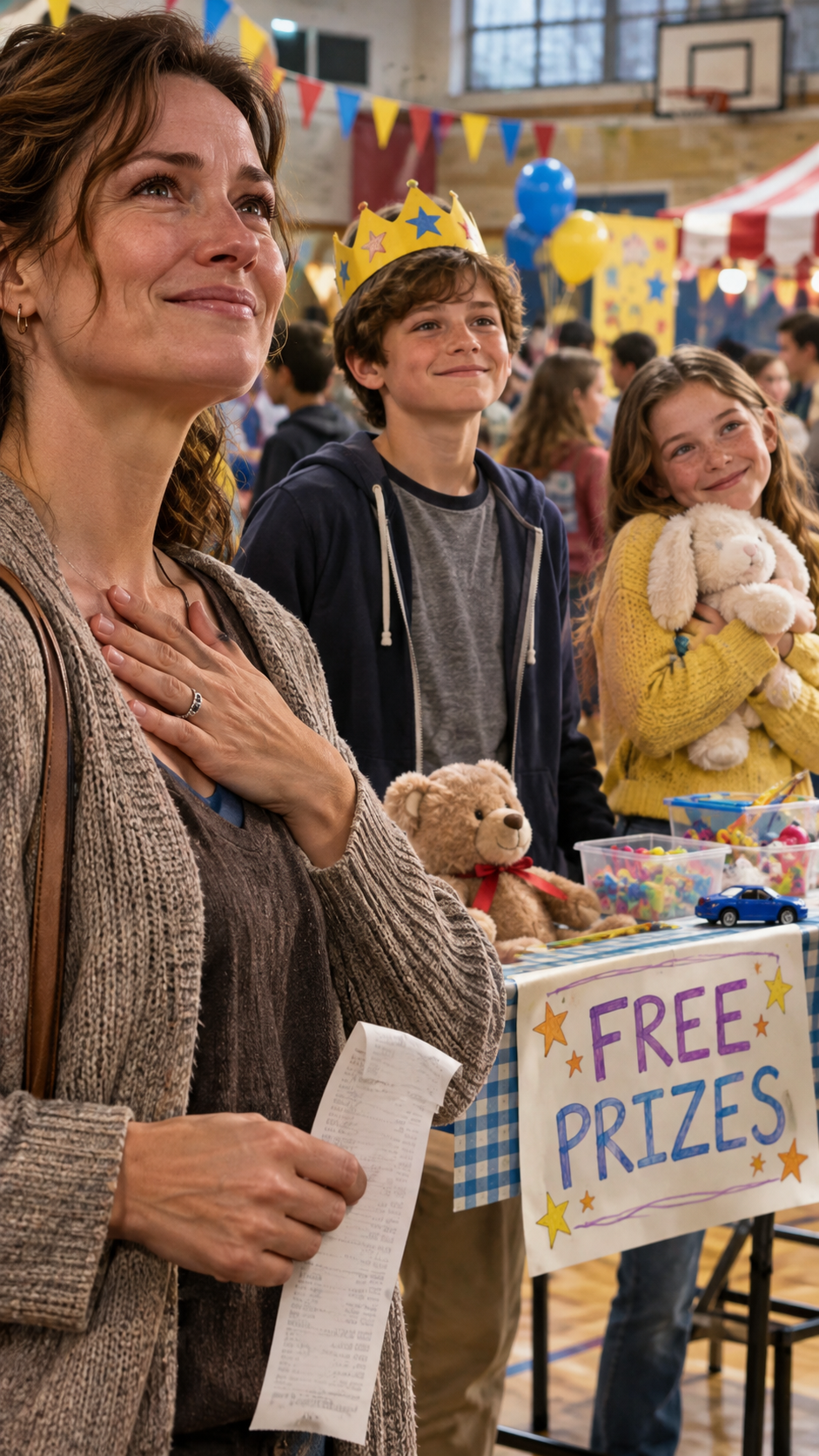
After the fair, I had been tempted to tell everyone about him.
My coworkers.
Our neighbors.
The woman who cut my hair.
Anybody who happened to ask how school was going.
I was proud.
But Gavin had asked me not to make a big fuss.
I needed to respect that.
He had done something meaningful without expecting attention.
I didn't want to teach him that kindness mattered only when somebody noticed.
So I kept most of my pride to myself.
Sometimes that was harder than I expected.
One Tuesday, about three weeks after the second school fair, I came home late from work.
There had been a problem with a report.
My supervisor needed it corrected before morning.
By the time I pulled into our driveway, I had a headache and a grocery bag cutting into my fingers.
Gavin was sitting at the kitchen table.
His math workbook lay open in front of him.
A half-finished glass of water stood beside it.
He looked up.
"Rough day?"
I set the groceries down.
"Something like that."
He glanced at the clock.
"You're later than usual."
"I know."
"Did you eat?"
I shook my head.
He closed the workbook.
Then he got up.
"I can heat the leftovers."
I told him I could manage.
He opened the refrigerator anyway.
"Sit down, Mom."
I almost argued.
That was my habit.
I was the parent.
I made dinner.
I handled the bills.
I fixed the problems.
I didn't like feeling as though I needed help with ordinary things.
But my feet hurt.
And I was tired.
So I sat down.
Gavin found the container of pasta from the night before.
He put it in a microwave-safe bowl.
I reminded him to cover it.
He rolled his eyes.
"I know."
He didn't know.
He had forgotten.
But he covered it when I pointed toward the lid.
A few minutes later, he placed the warm bowl in front of me.
There was a fork on the napkin.
And a glass of water.
Nothing fancy.
I looked at the food.
Then at him.
"Thank you."
He shrugged.
"You looked hungry."
He went back to his homework.
I ate the pasta while he worked on fractions.
For a few minutes, the kitchen was quiet.
Then he pushed his workbook toward me.
"Can you check number seven?"
I looked at the page.
He had written the answer neatly.
I went through the problem.
It was correct.
I told him so.
He smiled.
"Good. Because I did that one three times."
I handed back the workbook.
He picked up his pencil.
And I realized something.
I had been so focused on the big thing Gavin did at the fair that I hadn't noticed the smaller ways he was growing.
The fair had made a good story.
A boy with fifty dollars.
A frightened girl.
A white rabbit.
A table full of prizes.
But this mattered, too.
A tired mother.
A bowl of reheated pasta.
A boy who noticed.
I finished eating.
Then I washed the dishes.
Gavin put away his books.
We went through our usual evening routine.
Nothing remarkable happened.
At least, that was what I thought.
Two days later, I received another email from Mrs. Gallagher.
She wanted to know whether I could come to a short meeting at the school the following week.
The subject line mentioned the Second Chance Table.
I assumed it was about next year's fair.
I opened the message.
Mrs. Gallagher explained that several teachers had been discussing ways to make the same feeling of inclusion part of ordinary school days.
The free table had worked well.
The children enjoyed it.
And some of the students who had previously kept to themselves had started participating more often.
That was encouraging.
But the teachers didn't want belonging to happen only once a year.
They wanted students to feel welcome on regular Tuesdays.
During lunch.
At recess.
In group activities.
On days when there were no balloons, games, or prizes.
I read the email twice.
Then I looked toward the refrigerator.
The two photographs were still there.
One from the original fair.
One from the following spring.
I thought about Chloe.
Her yellow sweater.
Her nervous joke.
Her white rabbit.
I remembered how frightened she had looked when the other children watched her.
Then I thought about the newer photograph.
She was smiling beside Gavin.
Helping another child.
That change had taken time.
A whole year.
It had not happened because somebody handed her a toy.
The toy was part of it.
But there had been patience.
Practice.
Encouragement.
People who made room for her.
I replied that I would attend the meeting.
Then I went upstairs.
Gavin was on his bedroom floor building a complicated arrangement of toy cars and books.
The books had become parking garages.
The cars were lined up by color.
He looked offended when I stepped too close.
"Careful. That's the entrance."
I moved my foot.
"Sorry."
He pointed toward a narrow opening between two books.
"That's where the cars go."
I nodded.
"Very professional."
He grinned.
Then I sat on the edge of his bed.
"Mrs. Gallagher emailed me."
His expression changed immediately.
"Am I in trouble?"
I laughed.
"No."
"Are you sure?"
"Quite sure."
He looked relieved.
I told him about the meeting.
The teachers wanted to make school feel more welcoming throughout the year.
Not just during the fair.
Gavin listened.
Then he looked back at his cars.
"That makes sense."
I waited.
He moved a red car into the makeshift garage.
"Sometimes recess is worse."
I frowned.
"Worse than what?"
He shrugged.
"Just worse."
I knew that tone.
He was deciding whether to tell me something.
I didn't rush him.
He moved another car.
Then he said some children always had somebody to play with.
Others didn't.
The same groups met every day.
The same children chose teams.
And the same children were often left waiting.
I looked at the cars arranged in neat rows.
"Does that happen to you?"
He shook his head.
"Not really."
"Then how do you know?"
He looked at me.
"Because I can see it."
I felt that answer more than I expected.
Of course he could see it.
That was what he had done at the fair.
He had seen the children near the wall.
I asked whether teachers knew.
He said some did.
But the playground was big.
And the teachers had a lot to watch.
Then he told me about a boy named Ethan.
Ethan was in another class.
He liked drawing.
He didn't enjoy sports very much.
At recess, he often stood near the benches with a sketchbook while the other children played.
I asked whether Ethan preferred being alone.
Gavin considered the question.
"Sometimes."
Then he added something that stayed with me.
"But I don't think he likes being alone every single day."
I nodded.
Gavin looked down at his cars.
"I asked him to play once."
"What happened?"
"He said no."
I asked whether that had bothered him.
He shrugged.
"A little."
Then he told me Ethan had asked to join them the following day.
The boys were playing a game involving chalk drawings and imaginary cities.
Ethan helped design the streets.
Apparently, he was very good at it.
Gavin smiled while describing the maps.
He said Ethan had drawn a hospital, a fire station, and an enormous parking garage.
I looked at the books on the carpet.
"Like this one?"
Gavin nodded.
"His was better."
I laughed.
Then he became serious again.
"But sometimes other kids still leave him out."
I asked why.
He didn't know.
He said Ethan was quiet.
Some children thought that meant he didn't want to play.
Others had already chosen their friends.
I understood.
It was easier to keep doing what you had always done.
Even when somebody else stood outside the circle.
I told Gavin about the meeting.
I asked whether he had any ideas.
He leaned back against his bed.
Then he looked thoughtful.
"What if there was a place where kids could go when they wanted somebody to play with?"
I nodded slowly.
"What kind of place?"
He considered it.
"Maybe a bench."
I waited.
"Not a sad bench," he added quickly.
I smiled.
"What would make it different?"
He said the bench could have a sign.
Something cheerful.
Something that told other children they were welcome to come over and invite someone to join a game.
No prizes.
No tickets.
No money.
Just a place where somebody could say they wanted company without having to shout across the playground.
I thought about that.
It sounded simple.
But I could see the problem it might solve.
A child who wanted a friend didn't always know how to ask.
Sometimes they needed another child to notice.
I asked what he would call it.
Gavin thought for a while.
Then he smiled.
"The Come Sit With Us Bench."
I repeated the words.
They sounded a little long.
But they were clear.
I told him I liked the idea.
He grinned.
Then he picked up a green toy car.
"Can I finish my parking garage now?"
I laughed.
"Of course."
I went downstairs and wrote the suggestion on a piece of paper.
The Come Sit With Us Bench.
I put the note beside my laptop.
For the next few days, I kept thinking about it.
I wondered whether it would work.
I wondered whether children would feel embarrassed using it.
I wondered whether some children might make fun of the idea.
I didn't want to create something that made lonely children feel even more visible.
At the meeting, I brought that concern up.
Mrs. Gallagher agreed.
Principal Caldwell was there, along with two teachers and three other parents.
We sat around a table in the school library.
There were paper cups of coffee.
A plate of store-bought cookies.
And a stack of notes from the fair.
I explained Gavin's suggestion.
I told them about Ethan.
Not his private details.
Just the general problem Gavin had noticed.
Children who wanted company sometimes didn't know how to ask for it.
The teachers listened.
One of them said there were already similar ideas used at other schools.
They could adapt the approach carefully.
They discussed supervision.
They discussed how to make sure children weren't singled out.
They agreed that the bench should be open to anyone.
A child could sit there because they wanted company.
Or because they wanted to invite somebody else to play.
Teachers could introduce the idea in class so it wouldn't feel strange.
I listened while they talked.
Then Mrs. Gallagher asked whether Gavin would like to help explain it to students.
My first instinct was to say yes.
He had suggested it.
He had helped at the fair.
He might enjoy speaking about something he cared about.
But I remembered Chloe.
The nervous silence.
The way Gavin had given her time to decide whether she wanted to speak.
So I said I would ask him first.
Mrs. Gallagher smiled.
"That's fair."
We spent another twenty minutes discussing the plan.
By the end, Principal Caldwell agreed to find a suitable location near the playground.
The teachers would prepare a short explanation for students.
And the school would make sure the idea remained voluntary.
Nobody would be required to sit there.
Nobody would be required to approach.
It would be an invitation.
Not another school rule.
When I got home, Gavin was watching a cartoon.
I sat beside him.
He looked at me.
"How was the meeting?"
I told him his idea had been taken seriously.
His eyes widened.
"Really?"
I nodded.
The school wanted to try it.
He sat up.
"An actual bench?"
"An actual bench."
He looked delighted.
Then he asked whether it would be painted.
I said probably.
He wanted to know the color.
I told him that hadn't been decided.
He considered it.
"Blue."
I smiled.
"Why blue?"
He shrugged.
"Looks friendly."
I laughed.
Then I told him Mrs. Gallagher had asked whether he wanted to help explain the idea.
He went quiet.
That surprised me.
At the fair, he had stood in front of dozens of children.
He had organized games.
He had worn a paper crown.
I thought speaking in class would be easy for him.
But he stared at the television without watching it.
"Do I have to?"
I shook my head.
"No."
He looked relieved.
I waited.
Then he said he didn't want everybody to think the bench belonged to him.
I looked at him.
"Why not?"
"Because then it would be my bench."
I didn't understand at first.
He tried again.
"It's supposed to be everybody's."
I sat quietly.
He had thought about something I hadn't.
Names mattered.
Ownership mattered.
If children believed the bench belonged to Gavin, they might treat it like another project started by one popular kid.
That wasn't what he wanted.
He wanted a place anybody could use.
I told him he didn't have to give a speech.
The teachers could explain it.
He nodded.
Then he asked whether he could help paint the bench instead.
I smiled.
"That sounds possible."
A week later, the school chose a bench near the edge of the playground.
It was plain wood.
A little weathered.
It had been sitting beside the fence for years.
The maintenance staff cleaned it.
A parent volunteer sanded the rough edges.
Then a small group of students helped paint it.
Gavin was one of them.
So was Chloe.
And Ethan.
I stood nearby with other parents while the children worked.
They wore old shirts over their school clothes.
Blue paint covered the wooden slats.
Gavin got some on his elbow.
Chloe accidentally painted a stripe across one of her fingers.
Ethan worked carefully on the lettering.
He had the steadiest hand.
When the paint dried, the words were clear.
COME SIT WITH US.
Small painted stars decorated the corners.
Nothing fancy.
Just a blue bench.
I took a photograph.
Gavin saw me.
He pointed his paintbrush at me.
"Don't put that on the refrigerator."
I smiled.
"No promises."
He groaned.
Chloe laughed.
And Ethan, who had been quiet most of the afternoon, smiled down at the letters he had painted.
I watched them standing together.
Three children who had known different kinds of loneliness.
Three children working on something meant for everybody.
For a moment, I thought about the white rabbit.
The paper crown.
The fifty-dollar receipt.
I realized that the fair had not ended when the last prize disappeared.
Its lessons had followed my son into ordinary school days.
The bench was placed near the playground the following Monday.
The teachers explained what it was for.
Some children were curious.
Others barely noticed.
A few sat there just to test it.
Gavin told me the first day had been awkward.
I asked why.
He said several children had sat on the bench together and started arguing about who was supposed to invite whom.
I laughed.
He didn't think it was funny.
"Nobody understood."
I told him new things sometimes took practice.
He sighed.
Then he said Mrs. Gallagher had helped explain it again.
By Wednesday, the children seemed to understand.
On Thursday, a boy from second grade sat there during recess.
He had nobody to play with.
Two older children noticed him.
They invited him to join their game.
Gavin told me about it at dinner.
I asked whether he had been one of the older children.
He shook his head.
"No."
I waited.
He smiled.
"That's the good part."
I looked at him.
He explained that other children had helped without being asked by him.
He hadn't needed to organize anything.
He hadn't needed to stand behind a table.
He hadn't needed fifty dollars.
The children had simply noticed someone sitting alone.
And they had made room.
I set down my fork.
I thought about everything that had happened since the first school fair.
The receipt.
The rabbit.
The Second Chance Table.
The photographs on our refrigerator.
And now the blue bench.
I had been afraid the fair would become a memory we talked about once a year.
Instead, my son had helped turn it into something children could practice on an ordinary afternoon.
I looked at Gavin.
He was busy trying to persuade me that finishing his vegetables should count as his least favorite moment of the day.
I told him it didn't.
He disagreed.
We argued about the rules.
He laughed.
Then he ate another carrot.
And I realized that the best thing about the bench wasn't that Gavin had suggested it.
It was that other children had begun using it without him.
He had wanted everybody to belong.
Now the idea belonged to everybody.
Click here to continue reading: PART 6: When a Boy Sat Alone on the Blue Bench for Three Days, I Learned That Giving Someone a Place to Belong Was Only the Beginning
I Gave My Eleven-Year-Old Son Fifty Dollars for a School Fair, Then His Teacher Called Me in Tears and Asked Me to Come
Part 5 of 10

One Comment on “PART 5 – I Thought Gavin’s School Fair Story Was Finished, Until an Ordinary Tuesday Showed Me How Much He Still Carried With Him”