I didn't have to ask anybody where to begin.
This was the kind of work I understood.
I knew the difference between somebody announcing a death and an official record establishing that death.
Most people never had a reason to think about that distinction.
I dealt with it every working day.
There was a certain comfort in returning to something familiar.
My conversation with Lorna had left me questioning my own judgment.
The records wouldn't accuse me of abandoning my mother.
They wouldn't tell me that I lived too far away.
They would either contain the information I was looking for or they wouldn't.
I sat at my desk.
I accessed the records system and began looking for my mother's information in the Illinois death index.
Evelyn Mulligan.
Born March 2, 1949.
I knew her birth date without having to consult anything.
It was a strange experience entering information about my own mother into a system used to establish whether someone had died.
I had never expected to find myself in that position.
Especially not six months after being told that her remains had already been cremated.
I completed the search.
There was no matching record.
I looked at the result.
Nothing.
For a moment, I found myself wanting the record to appear.
Not because I wanted my mother to be dead.
Because I wanted the world to make sense again.
A death certificate would have supported what Lorna had told me.
It would have meant the nurse was mistaken.
It would have meant my sister had been telling the truth.
But there was no certificate.
I couldn't find documentation from a funeral home.
There was no record of the authorization that should have accompanied a cremation.
I stared at the screen.
I understood what was missing.
This wasn't a disagreement about a family memory.
It wasn't a matter of two sisters remembering a conversation differently.
Lorna had told me something had happened that should have produced official paperwork.
I could find none of it.
I thought about the photograph again.
That wooden box had once represented the end of my mother's life.
It had caused me more pain than I could explain.
Now it represented something else.
A claim that had never been supported by anything I could verify.
My sister had shown me a container.
And I had supplied the rest of the meaning myself because I trusted her.
I felt foolish.
There was no other word for it.
I worked in vital records.
I understood why documentation mattered.
Yet when my sister had called me crying, I hadn't requested a single document.
I hadn't wanted to burden her.
I hadn't wanted to make her explain something painful.
I had assumed that asking for proof would amount to questioning her honesty.
That assumption had cost me six months.
Six months during which my mother had apparently been living in a place I didn't know existed.
I wondered how many times she had asked someone about me.
I wondered how many days she had sat beside that window.
The nurse had told me she was unhappy.
I hadn't understood the full weight of that statement when I first heard it.
Now I couldn't stop thinking about it.
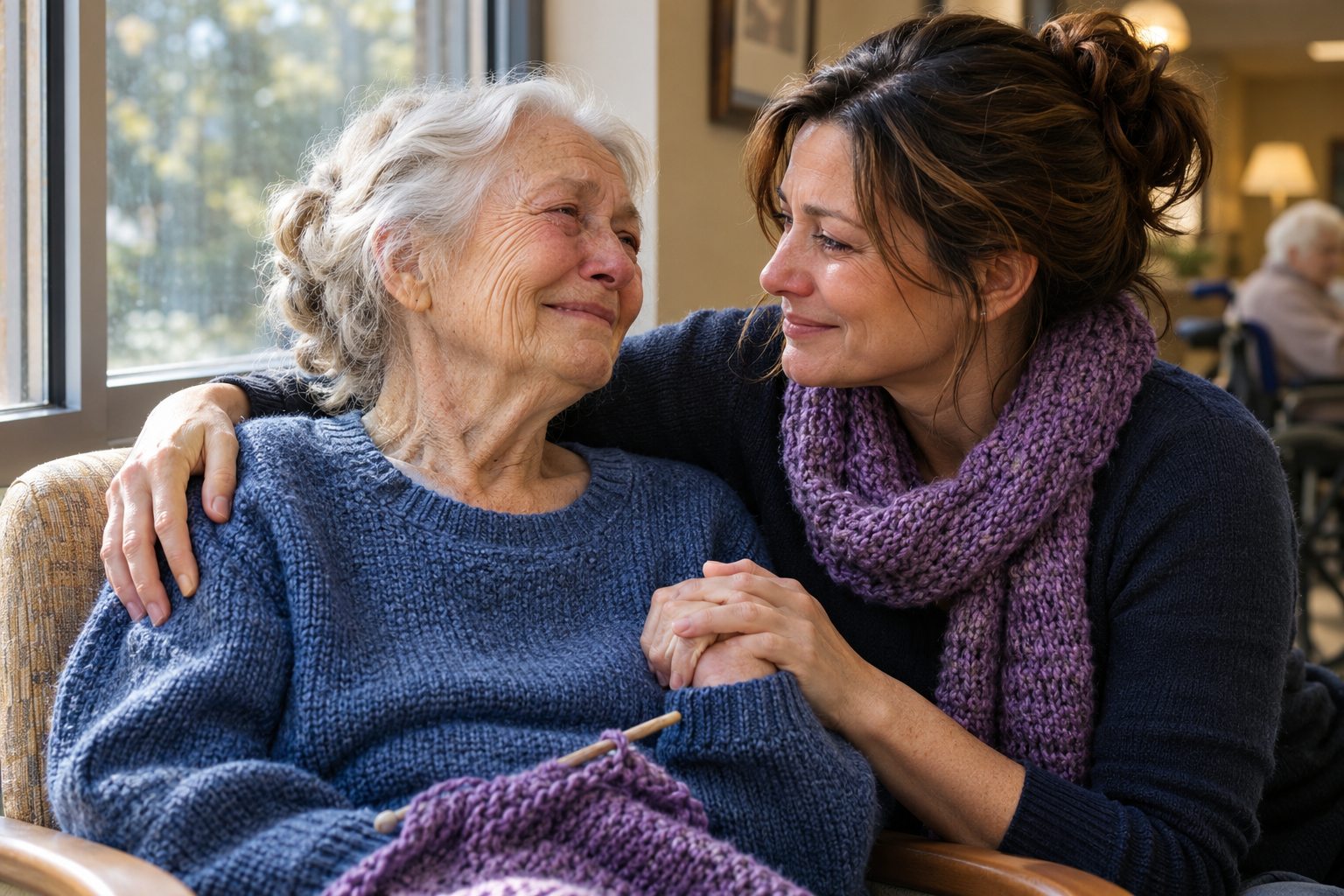
My mother had been making a scarf for a daughter who believed she was dead.
I had been grieving for a woman who might have been wondering why her daughter never came to visit.
There was something almost unbearable about those two experiences happening at the same time.
Neither of us had known what the other was going through.
All because I had accepted the information given to me by Lorna.
I wasn't ready to stop searching.
The missing death record was important.
But there was another thing my sister had told me in the weeks surrounding Mom's supposed death.
The house.
Our mother's house in Rockford.
Lorna had explained that it needed to be sold because of debts.
She had made it sound like an unpleasant financial responsibility she had been left to manage.
I hadn't argued with her.
I hadn't expected an inheritance.
I hadn't wanted money from Mom's death.
The idea of discussing what might be left for us had made me uncomfortable.
When Lorna told me there wouldn't be anything remaining, I accepted that.
What mattered to me was that my mother was gone.
The house was secondary.
Now I understood that I needed to look at it differently.
There would be property records.
A sale would leave a record that existed independently of my sister's explanation.
I began searching for information about Mom's house in Rockford.
It didn't take long to locate what I needed.
The property had indeed been sold.
That much of Lorna's account was true.
But the date caught my attention.
May.
One month after the morning she had called me in tears.
I looked more closely at the transaction.
What mattered wasn't simply that the house had been sold.
It was how the sale had been completed.
I examined the information identifying the seller.
My sister's name was there.
Lorna Mulligan.
Beside her name was the authority she had used to act on behalf of the property owner.
Power of attorney for Evelyn Mulligan.
I read it again.
There were few things I understood more clearly at that moment.
A person's authority under a power of attorney ends when the person who granted that authority dies.
Lorna had supposedly lost our mother in April.
Yet in May, she had acted as though Mom were still alive.
Those two accounts couldn't both be correct.
I felt my stomach tighten.
My sister had told me the house needed to be sold to cover Mom's debts.
She hadn't told me that she had completed the transaction using the authority Mom had given her while she was alive.
That detail changed everything.
Lorna hadn't simply been mistaken about the circumstances surrounding a death.
The documents suggested that she had known our mother was alive when the property was sold.
I sat very still.
I didn't want to reach a conclusion I couldn't support.
But I had to acknowledge what was in front of me.
There was no death certificate.
There was no cremation record.
There was a property transaction completed after the supposed date of death.
And there was a nurse in Carbondale who had personally spoken to my mother.
The pieces were beginning to fit together in a way that frightened me.
Mom had lost her house.
She had been placed in a state-funded nursing facility far from Rockford.
I had been told that she was dead.
The distance between the nursing home and my sister's house was approximately two hundred miles.
The distance between me and both of them was considerably greater.
I couldn't ignore how conveniently that arrangement had kept me away.
I hadn't visited Mom because I believed there was nobody left to visit.
I hadn't questioned why she wasn't living in her own house because I believed she no longer needed it.
I hadn't looked for her because Lorna had told me there was no reason to look.
The wooden box had been enough to convince me.
I felt sick thinking about it.
There was still plenty I didn't know.
I didn't know precisely what had happened to the money from the house.
I didn't know what my mother understood about her circumstances.
I didn't know how much she remembered.
But those questions could wait.
There was one thing that couldn't.
I needed to see her.
I needed to walk into Willow Bend Care Center and look at the woman Femi had described.
I needed to find out whether she was the same woman who had raised me in Rockford.
I wasn't going to call Lorna for permission.
I wasn't going to tell myself that living in Denver made me incapable of helping.
I had spent enough time allowing distance to make decisions for me.
That evening, I booked a flight.
Click here to continue reading: PART 8: I Traveled to Willow Bend Care Center Expecting to Find My Mother, but I Wasn’t Prepared for the First Thing She Told Me
I Spent Six Months Mourning My Mother Before a Stranger Called and Told Me She Had Been Asking for Me
Part 7 of 10