
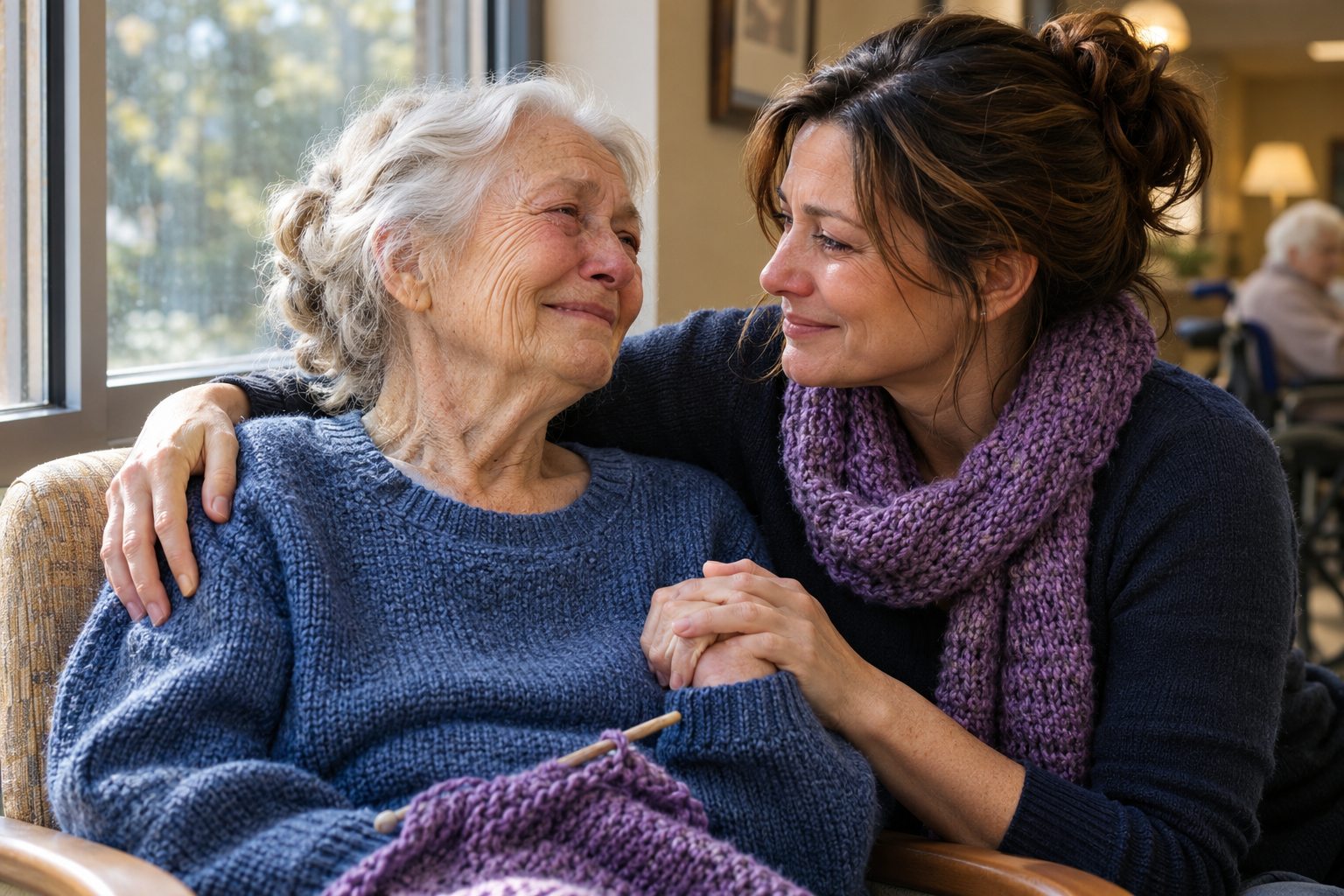
“Mom, I'm right here.”
I moved toward her chair and knelt beside it.
She reached for my face.
Her fingers touched my cheek, then moved toward my forehead as though she needed to make certain I was real.
I covered her hand with mine.
“It's me, Mom.”
She began to cry.
I had seen my mother cry before, but never like that.
Her shoulders shook beneath her blue sweater.
The unfinished scarf slipped from her lap.
I picked it up and placed it beside her.
Then I held her.
Neither of us spoke for a while.
There was nothing I could have said that would have explained away six months of pain.
I felt how thin she had become.
Her shoulders seemed smaller than I remembered.
But her arms still went around me in exactly the way they had when I was a little girl.
“Where were you?”
She pulled back and looked at me.
“Why didn't you come?”
I swallowed.
“Lorna told me you had passed away.”
Mom stared at me.
“She told you that?”
“Yes.”
Her mouth opened slightly.
Then she looked down at her hands.
I wished I could have spared her that knowledge.
Finding out that I was alive should have been enough happiness for one afternoon.
Instead, she was discovering that her other daughter had deceived her.
I wanted to explain everything.
The missing records.
The photograph.
The sale of the house.
But I couldn't bring myself to put all of that in front of her at once.
Femi stood nearby.
I looked toward her.
“Thank you.”
She gave me a small nod.
I wondered how many times she had listened to Mom asking about me before deciding to find my number.
Without her, I might have spent the rest of my life believing my mother was gone.
“Mom, where's your Bible?”
She pointed toward the little table beside her chair.
I reached for it.
The cover was worn from years of use.
I opened it carefully.
There was my name.
Below it was my telephone number.
Mom had written both by hand.
I ran my finger beside the writing.
She had kept a way of reaching me even after being told there was nobody left to reach.
That detail broke my heart.
“I'm glad you kept this.”
She looked at the Bible.
“I didn't want to forget your number.”
I turned away briefly.
I didn't want her to see how hard those words had hit me.
She had been struggling with her memory.
Yet she had done something practical to make sure she wouldn't lose her connection to me.
Meanwhile, I had allowed my sister to become my only connection to her.
I couldn't change that now.
But I could make certain it never happened again.
I pulled a chair closer.
“Can you tell me how you came here?”
Mom looked toward the window.
“Lorna said I couldn't manage the house anymore.”
I waited.
“She said I needed people to look after me.”
I could understand how my mother might have accepted that explanation.
What I couldn't understand was why she had been brought so far away from Rockford.
“Did you know she sold your house?”
Mom turned toward me.
“Sold it?”
I immediately regretted asking the question so directly.
She looked genuinely confused.
“I thought I was going back.”
There was a long silence.
I held her hand again.
I didn't want to upset her further, but I couldn't pretend that everything was fine.
“We'll figure it out, Mom.”
She looked down at the scarf.
“I was going to finish that.”
“For me?”
She nodded.
I picked it up.
The stitches weren't perfectly even.
Some were tighter than others.
It was the most precious thing anybody had ever made for me.
“You don't have to hurry.”
Mom smiled faintly.
I had almost forgotten what her smile looked like when it wasn't trapped inside a memory.
We spent the next few minutes talking about ordinary things.
Denver.
My work.
How long it had taken me to get there.
Every so often, she would reach for my hand again.
I let her.
She needed reassurance that I wasn't going to disappear.
I needed it, too.
Eventually, I asked Femi whether we could speak privately.
I didn't want to discuss Mom's circumstances in front of her.
Before getting up, I leaned toward my mother.
“I'm just going to talk to the nurse.”
“You're coming back?”
The question was quiet.
“Of course.”
I left the Bible beside her and walked into the hallway with Femi.
I explained what Lorna had told me in April.
I described the wooden box on her mantel.
I told her about the property records and the missing death documentation.
Femi listened without interrupting.
When I finished, she looked troubled.
“I knew your mother was unhappy,” she said.
“I didn't realize why.”
I asked what information the facility had about Mom's admission and who was responsible for her affairs.
Femi explained that the administration would need to review the records and determine what information could legally be shared with me.
I understood.
I worked with confidential documents myself.
There were procedures that existed for good reasons.
I wasn't asking anybody to ignore them.
I wanted the proper people to understand what had happened.
I wanted my mother's situation investigated.
Most importantly, I wanted her protected.
Femi agreed to help me speak with the appropriate staff.
I thanked her again.
Then I took out my telephone.
Lorna's number was still there.
For a moment, I considered calling her.
I imagined telling her that I was standing inside Willow Bend Care Center.
I imagined describing the blue sweater.
The Bible.
The scarf.
I wanted her to understand that every lie she had told me had fallen apart.
But I knew another argument wouldn't protect Mom.
My sister had already denied everything when I confronted her with the nursing home's call.
I wasn't going to give her another opportunity to confuse the situation.
Instead, I began writing down what I knew.
The date of the telephone call in April.
The explanation about the heart attack.
The claim that a cremation had taken place.
The photograph she had sent me.
The sale of the Rockford house in May.
The name of the nurse who had contacted me.
I recorded everything as accurately as I could.
I separated what I knew from what I suspected.
I wasn't interested in exaggerating.
The truth was bad enough.
That afternoon, I spoke with the facility's administration.
I explained my concerns about possible financial exploitation and my mother's isolation.
I asked how I could arrange for an independent review of her care and financial circumstances.
I also made it clear that Mom had believed I was dead.
That fact disturbed everyone who heard it.
I could see it in their expressions.
There was no innocent misunderstanding that could explain both of us receiving such terrible information.
I requested that the circumstances be documented.
Then I arranged to seek legal assistance.
I wanted someone qualified to examine the power of attorney and the property sale.
I wasn't going to make promises to Mom that I couldn't keep.
Getting her house back might not be possible.
Finding the money might take time.
There were questions about her care that needed professional attention.
But I could begin.
And I did.
Later, I returned to Mom's room.
She was still beside the window.
The scarf was back in her lap.
When she saw me, her face relaxed.
“You came back.”
I sat beside her.
“I told you I would.”
She reached for my hand.
I looked at the Bible resting on the table.
Then I looked at her.
I realized that I had spent much of my adult life believing that being responsible meant keeping my distance from things other people could handle better.
That was what I had told myself when Lorna took over.
It had sounded reasonable.
It had sounded considerate.
But responsibility also meant paying attention when somebody depended on you.
I had forgotten that.
Or perhaps I had allowed myself to forget it because accepting Lorna's assurances had been easier.
I couldn't excuse what she had done.
I also couldn't undo my own absence.
All I could do was make different decisions from that moment forward.
“Mom?”
She looked at me.
“We're going to get you some help with everything.”
“Everything?”
“Your money. Your paperwork. All of it.”
She looked uncertain.
“Will I have to go somewhere else?”
“Not until we know what's best for you.”
I wanted her involved in every decision she was capable of making.
She wasn't a collection of documents.
She wasn't a house that could be sold.
She was a person.
My mother.
She had the right to understand what was happening to her.
I stayed beside her until the afternoon began turning into evening.
We didn't discuss Lorna again.
There would be time for that.
For now, I wanted Mom to experience something she hadn't been given enough of during the previous six months.
Company.
Conversation.
The simple knowledge that somebody she loved was still alive.
She lifted the scarf and showed me where she had stopped working.
“I've got a little more to do.”
I smiled.
“That's fine. I'm not going anywhere just yet.”
She settled back into her chair.
For the first time since arriving, I felt her hand loosen around mine.
She was beginning to believe me.
Click here to continue reading: PART 10: My Sister Eventually Had to Answer for Her Decisions, but the Most Important Thing I Recovered Was Never Inside That Wooden Box
I Spent Six Months Mourning My Mother Before a Stranger Called and Told Me She Had Been Asking for Me
Part 9 of 10

One Comment on “PART 9 – I Finally Held My Mother’s Hand Again, and Together We Began to Understand What My Sister Had Taken From Both of Us”