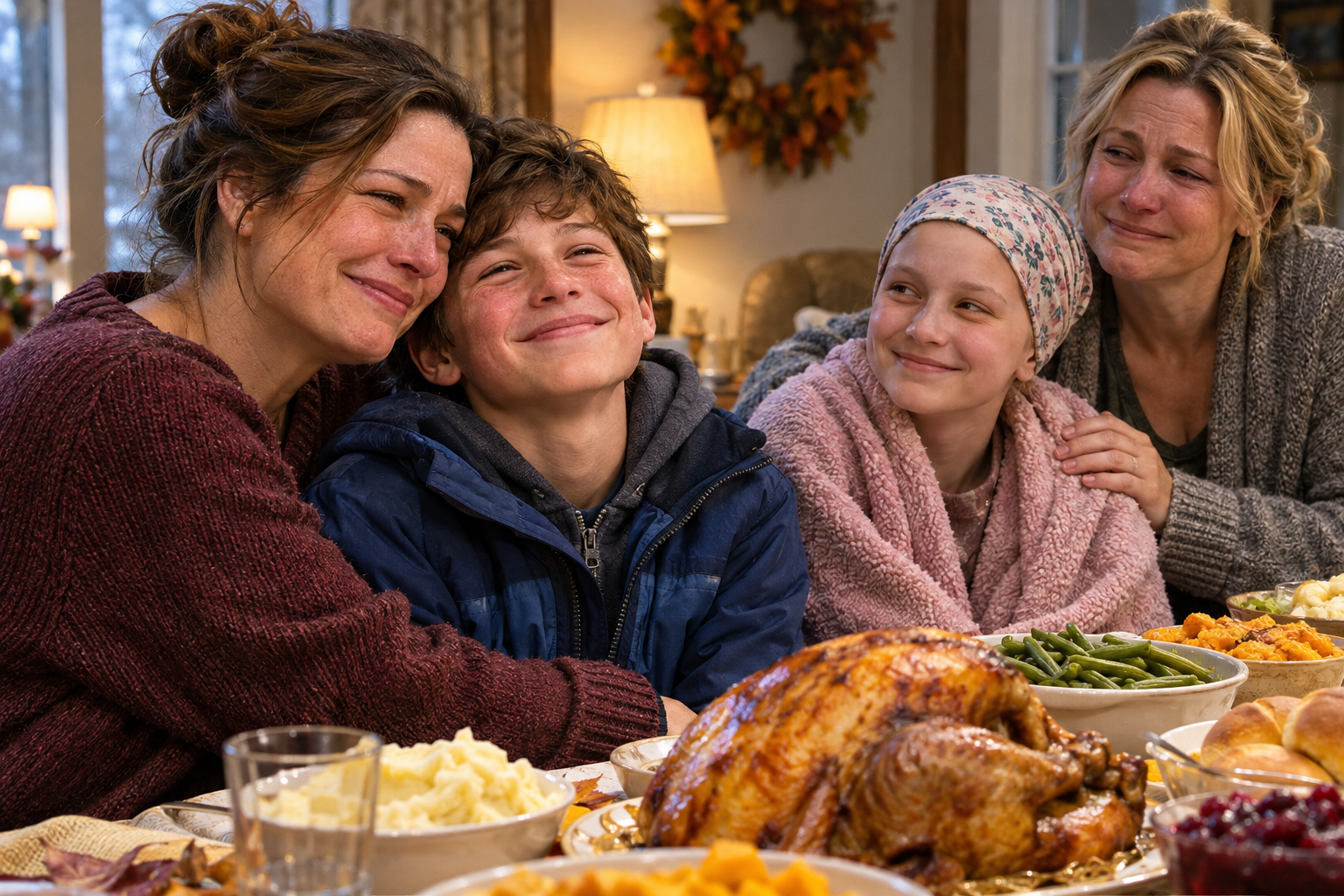
Noah reached for his fork, then put it down again.
“Wait.”
Linda stopped passing the potatoes.
“What is it, honey?”
Noah looked at me.
“Can we do what Dad used to do?”
I knew exactly what he meant.
My husband had always made us say one thing we were grateful for before eating Thanksgiving dinner.
It didn't have to be something important.
It didn't have to sound clever.
He just wanted us to remember something good about the year we'd lived through.
When Noah was little, his answers were usually about toys or ice cream.
One year, he said he was grateful for his dinosaur pajamas.
My husband had laughed so hard that he nearly spilled his drink.
I hadn't thought about those pajamas in years.
“Of course we can,” I told Noah.
He looked pleased.
Linda rested her hands on the table.
“Who wants to start?”
Ellie raised her hand.
“I do.”
We turned toward her.
She adjusted the blanket around her shoulders before speaking.
“I'm thankful Noah comes over to play with me.”
Noah smiled at her.
“And that he doesn't get mad when I'm too tired to finish a game.”
Linda pressed her lips together.
I could see her trying not to cry again.
Ellie looked at the food.
“And I'm thankful we have Thanksgiving dinner.”
She said it so simply.
No complaints about the months she'd spent feeling sick.
No mention of the things she'd missed.
Just gratitude for a friend and a meal.
Linda reached over and touched her daughter's shoulder.
Then she took her turn.
“I'm thankful for the people who remembered us today.”
Her eyes settled on Noah.
“Especially one person.”
Noah lowered his head.
He was never comfortable when adults made a fuss over him.
His father had been the same way.
I remembered people thanking my husband for his work as a firefighter.
He usually shrugged and said he was just doing his job.
I used to tell him that accepting someone's gratitude was a kindness, too.
Now I was watching our son struggle with the same thing.
“Your turn, Mom,” Noah said.
I looked down at my plate.
There were so many things I could have said.
I was grateful that my son was safe.
I was grateful that Linda and Ellie had food.
I was grateful to the strangers who had opened their hearts to a twelve-year-old boy.
But something else was sitting heavily in my chest.
“I'm thankful I got to see something beautiful today.”
Noah tilted his head.
“What?”
“You.”
He looked confused.
I smiled.
“I'm thankful I get to be your mother.”
His cheeks turned pink.
He reached for his glass of water.
I knew he was trying to hide his embarrassment.
Then it was his turn.
He looked around the table.
For a moment, he didn't say anything.
Finally, he looked at the empty space between the serving dishes.
“I'm thankful Dad taught me about Thanksgiving.”
Nobody moved.
“I miss him,” he added.
I put my hand over his.
“Me too, sweetheart.”
He swallowed.
“But I think he'd like this.”
I looked at Linda.
Then at Ellie.
“Yes,” I said.
“I think he would.”
We began eating.
The turkey wasn't the most perfectly prepared turkey I'd ever tasted.
The vegetables weren't arranged beautifully.
The dinner rolls were slightly uneven in color.
None of it mattered.
Noah put potatoes on Ellie's plate when she asked for some.
Linda reminded her to eat slowly.
I passed the cranberry sauce.
For a while, we were simply four people having dinner.
I hadn't realized how much I'd missed that feeling.
There had been a time when Thanksgiving meant the sound of my husband's laughter coming from the kitchen.
It meant Noah running around the house while we tried to finish cooking.
It meant somebody forgetting something and somebody else offering to fetch it.
After my husband died, the house became quieter.
I still prepared Thanksgiving dinner every year.
I still bought cranberry sauce.
I still tried to make Noah excited about the holiday.
But I had been counting what was missing.
That afternoon, I finally noticed what was still there.
My son's laugh.
The pleasure he took in helping someone.
The way he remembered his father's words.
Those things hadn't disappeared when my husband died.
They were sitting right beside me.
“Mom, can I have another roll?”
I passed him the basket.
“Help yourself.”
He took one and offered the basket to Ellie before putting it down.
Such a small thing.
Something I might not have noticed on another day.
That afternoon, I noticed everything.
Halfway through dinner, Linda asked Noah about the people at the supermarket.
“Did you get their names?”
“Some of them.”
He pointed toward his notebook.
“I wrote them down.”
He brought it to the table.
The first pages contained his shopping calculations.
Thirty dollars at the top.
Then the prices of the things he had hoped to buy.
Farther down, the writing changed.
There were names beside the groceries.
Some were written neatly.
Others looked hurried.
He had even included a description for a customer whose name he hadn't learned.
“The man with the brown hat.”
Linda smiled when she read that.
“Why did you write all this?”
“So we could thank them.”
He turned another page.
“I didn't want to forget anybody.”
I stared at the notebook.
I'd assumed it was simply a shopping list.
Instead, my son had been keeping track of every person who had helped him.
Not because he owed them money.
Because he felt they deserved to be remembered.
“Maybe we could make thank-you cards,” Ellie suggested.
Noah's face brightened.
“That's what I was thinking.”
Linda nodded.
“We certainly can.”
I looked at the notebook again.
Beside one of the names, Noah had drawn a tiny check mark.
Beside another, he'd written the word butter.
The ordinary little details made the whole morning feel real in a way it hadn't before.
A stranger had bought butter for us.
Another had purchased potatoes.
Somebody had chosen dinner rolls.
None of those people had needed to stop.
They could have finished their shopping and gone home.
Instead, they had helped a child who wanted to share Thanksgiving dinner with his sick friend.
I wondered whether they realized what their kindness had meant.
I wanted them to know.
When we finished eating, Linda tried to collect the dishes.
I stopped her.
“You've done enough.”
“You cooked, too, Sarah.”
“And I'll help clean.”
Noah stood up immediately.
“I can do the plates.”
I gave him the lighter ones.
Ellie remained at the table, looking through his notebook.
She seemed fascinated by the different kinds of handwriting where Noah had asked people to write their names.
“Can I decorate the cards?” she asked.
“Absolutely,” Linda answered.
Her daughter smiled.
I watched Linda watching her.
For months, much of their daily life had revolved around Ellie's illness.
Appointments.
Rest.
Medicine.
Waiting for answers.
Now Ellie was thinking about crayons and thank-you cards.
Linda looked relieved to see her daughter excited about something so ordinary.
We finished washing the dishes.
I wrapped some of the leftovers while Linda cleared the table.
She insisted that Noah and I take food home.
I almost refused out of habit.
Then I stopped myself.
There was plenty.
Accepting some didn't mean taking anything away from Ellie.
“Thank you,” I said instead.
Linda smiled.
Noah carried the notebook into the living room.
He and Ellie began discussing what their cards should say.
I sat beside Linda for a few minutes.
The house was quieter now.
She looked tired, but there was something different about her face.
“I don't know how to thank him,” she said.
“You don't have to do anything.”
“But he gave us something I couldn't give her today.”
I understood the pain behind that sentence.
I'd been afraid of failing Noah in exactly the same way.
“Linda, you're taking care of your daughter.”
She looked down.
“Sometimes that doesn't feel like enough.”
“I know.”
I didn't offer advice.
I didn't tell her everything would suddenly become easier.
Neither of us knew what the coming months would bring.
But we could sit together and admit that things had been hard.
That was something we'd both avoided for too long.
She reached for my hand.
“I'm glad you came over.”
“So am I.”
From across the room, Noah called my name.
“Mom, look.”
He held up a page from his notebook.
He had started writing a message for the supermarket employees.
The words were simple.
He thanked them for helping four people have dinner together.
Then he had added another sentence.
He hoped they had enjoyed their own Thanksgiving.
I read it twice.
“That's lovely, sweetheart.”
“Should I write more?”
“No. I think that's enough.”
He nodded.
Ellie leaned closer to see what he'd written.
They continued working together.
I reached into my coat pocket and felt the folded bills.
Thirty dollars.
The same amount I had handed Noah that morning.
Nothing about the number had changed.
But something about the way I looked at it had.
Before leaving home, I'd seen that money as proof of everything I couldn't provide.
Now I understood that money wasn't the only thing we had.
We had neighbors.
We had people willing to help.
We had a child who understood how to bring those people together.
When it was time to leave, Noah hugged Ellie carefully.
“See you tomorrow?”
She nodded.
“Bring the game.”
“I will.”
Linda helped us gather the containers of leftovers.
At the front door, she hugged me.
Neither of us said much.
There wasn't any need.
Noah stepped outside beside me.
The air had grown colder.
He carried a bag in one hand and his notebook in the other.
We walked the short distance home.
This time, those three houses didn't seem far apart at all.
Click here to continue reading: PART 10: The Thirty Dollars Returned to My Wallet, but What My Son Brought Home That Thanksgiving Was Something I Could Never Put a Price On
I Had Only Thirty Dollars Left for Thanksgiving When a Phone Call From My Neighbor Made Me Forget All About Dinner
Part 9 of 10