The first refund letters went out on a Monday morning.
I insisted that each affected guest receive a clear explanation.
There would be no vague references to accounting adjustments.
No suggestion that the hotel was providing money as a favor.
No language designed to disguise what had happened.
The company had collected charges that were not authorized.
We were returning them.
I reviewed the letter before approving it.
There was an apology near the bottom.
I moved it to the beginning.
People deserved to hear that before reading anything about payment arrangements.
Over the following weeks, responses began arriving.
Some guests were grateful.
Others were angry.
A few told us they had complained at the time and had been dismissed.
One woman explained that she had spent months believing she had misunderstood the hotel's advertised prices.
She hadn't.
Another guest said he had accepted an unexpected charge because his wife was exhausted and they had been traveling all day.
His message remained with me.
He hadn't wanted an argument.
He had wanted his wife to rest.
That was the position I had been in when I arrived.
The difference was that I knew the company's policies, and I had the ability to demand answers.
Most people didn't have those advantages.
We processed the confirmed refunds and established a direct contact channel for anyone whose transaction required additional investigation.
Every claim would be examined.
I authorized reasonable costs associated with tracing and returning the money.
I didn't want a complicated procedure becoming another obstacle for the people we had already inconvenienced.
The final employment decisions followed the completed review.
Sterling was dismissed.
The reasons were documented.
Unauthorized billing procedures, serious breaches of company financial controls, misleading representations to guests, and misconduct involving the separate merchant arrangement.
The company pursued recovery of the diverted funds through its legal representatives.
The relevant findings were also referred to the appropriate authorities for independent consideration.
I wasn't interested in announcing what punishment Sterling might eventually receive.
That decision belonged elsewhere.
My responsibility was to protect the business and ensure that the evidence was properly handled.
Sterling asked to see me before leaving the property.
I agreed.
We met in the same office where he had first learned who I was.
His desk had been cleared.
Several personal belongings sat inside a cardboard box.
His phone rested on top.
He looked older than he had on the night we met.
"I wish things had happened differently."
"So do I."
He sat down.
"I've worked in hospitality for a long time."
I nodded.
"I never thought my career would end here."
I didn't know whether it would.
That depended on matters beyond my authority and on what he chose to do afterward.
But his employment at my hotel was finished.
He looked at the box.
"I suppose you're pleased."
"No."
He appeared surprised.
I continued.
"I would have been pleased if you'd been running this place honestly."
He looked away.
"I would have been pleased if the receipt you handed me had matched the price on the wall."
He remained silent.
"I would have been pleased if none of this had been necessary."
For several seconds, he stared at the empty desk.
Then he asked something that confirmed how little he had understood.
"Would everything have been different if I'd recognized you?"
I shook my head.
"It would have been worse."
He frowned.
"If you'd recognized me, you would have given me a reasonable bill, probably upgraded my room, and made certain I left happy."
He looked at me.
"And I might never have discovered what was happening to everyone else."
He lowered his eyes.
I stood.
There was nothing more I needed to say.
He collected his cardboard box.
At the doorway, he paused.
"I'm sorry."
I nodded.
I hoped he meant it.
Then he left.
I didn't watch him walk through the lobby.
There was no satisfaction in seeing a man carry his possessions out of an office he had once controlled.
The damage he had caused was satisfaction enough for nobody.
Kendall's situation required a separate decision.
She had participated in collecting unauthorized charges.
She had also admitted that her treatment of certain guests depended on their appearance.
Those were serious matters.
But the review established that Sterling had designed the billing procedures and instructed reception staff to follow them.
There was no evidence that Kendall had controlled the separate account or personally received the diverted funds.
She had also provided information that helped identify the concealed instructions.
I considered those facts carefully.
Ultimately, she received a formal disciplinary warning and was removed from independent reception duties while completing additional training.
Her continued employment depended on demonstrated improvement and compliance with the company's policies.
It wasn't forgiveness without consequences.
It was an opportunity.
When I explained the decision, she sat opposite me with her hands folded tightly together.
"You're letting me stay?"
"Under specific conditions."
She nodded quickly.
"I understand."
"I need you to understand something more important than the conditions."
She looked up.
"You were twenty-three, working under someone who had given you instructions you weren't entirely comfortable with."
She nodded.
"I understand how difficult that position can be."
Her eyes began filling with tears.
"But nobody instructed you to make that remark about my pickup."
She wiped her cheek.
"No."
"You made that decision yourself."
"I know."
"That's the decision I want you to think about."
She sat quietly.
After a moment, she spoke.
"My father drives an old truck."
I hadn't expected that.
She gave a small, embarrassed smile.
"He's had it for years."
I waited.
"He works outside. His clothes are usually dirty when he comes home."
Her smile disappeared.
"He would have looked just like you that night."
She began crying.
Not loudly.
She simply covered her face with one hand and tried to regain her composure.
I pushed a box of tissues toward her.
When she finally spoke again, her voice was quiet.
"I wouldn't want anybody talking to him the way I talked to you."
I nodded.
"Then don't talk to anybody else's father that way."
She took a tissue.
"I won't."
I couldn't know whether that promise would survive the next difficult customer or the next stressful shift.
Only time would establish that.
But I believed she finally understood what I had been trying to explain.
After the investigation, I spent several additional days meeting employees from different departments.
Housekeeping.
Maintenance.
Reception.
Kitchen staff.
People who had worked in the hotel longer than Sterling.
People who had joined only recently.
I wanted them to speak freely.
Several told me they had become accustomed to management dismissing their concerns.
One employee had stopped reporting problems because nothing changed.
Another worried that complaining might cost her working hours.
Those conversations forced me to examine my own decisions.
I had trusted management reports too readily.
I had looked at occupancy figures and operating revenue without spending enough time asking how those results were achieved.
The numbers had looked reassuring.
I had allowed myself to be reassured.
Looking back, that was my mistake.
Sterling was responsible for his misconduct.
But I was responsible for building an organization in which employees could report concerns and guests could obtain fair treatment.
I couldn't separate myself from that responsibility simply because my signature appeared on the ownership documents.
We appointed new management through the company's established hiring process.
We strengthened the financial controls.
All guest payments had to be properly recorded through approved systems.
Any optional service required clear disclosure and the guest's agreement.
The hotel's rate information was made easier to understand.
Employees received direct channels for reporting misconduct without going through local management.
Guest complaints were reviewed independently.
We also changed the way management performance was assessed.
Revenue still mattered.
A hotel couldn't operate indefinitely without paying its employees and meeting its expenses.
But revenue obtained through deception wasn't success.
Neither was profitability achieved by humiliating people who asked questions.
Before leaving the property, I found the employee who had cleaned the wet floor on the night I arrived.
He was working near the entrance.
I thanked him again.
He looked puzzled.
"For cleaning the floor?"
"For how you treated me."
He smiled.
"I was just doing my job."
"Exactly."
I shook his hand.
His response stayed with me.
He hadn't needed to know who I was.
He hadn't checked the vehicle I drove or examined the brand of my jacket.
He had seen someone apologizing for bringing rainwater into a building.
And he had responded kindly.
That was hospitality.
It was uncomplicated.
Several months passed before I returned.
I deliberately chose not to announce my visit.
I drove the same pickup.
I carried the same canvas bag.
And I wore the same old jacket.
The weather was considerably better that day, although a light shower began shortly before I reached the property.
I parked near the entrance.
For a moment, I sat behind the wheel and looked at the hotel.
I remembered the previous visit more clearly than I expected.
The rain.
The receipt.
The smile that had accompanied the suggestion that I sleep in my truck.
I wondered what I would find this time.
Inside, the marble floor was clean.
The room rates were prominently displayed behind reception.
There was also a clearly written explanation of taxes and optional services.
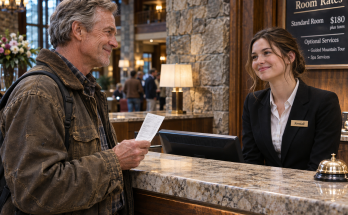
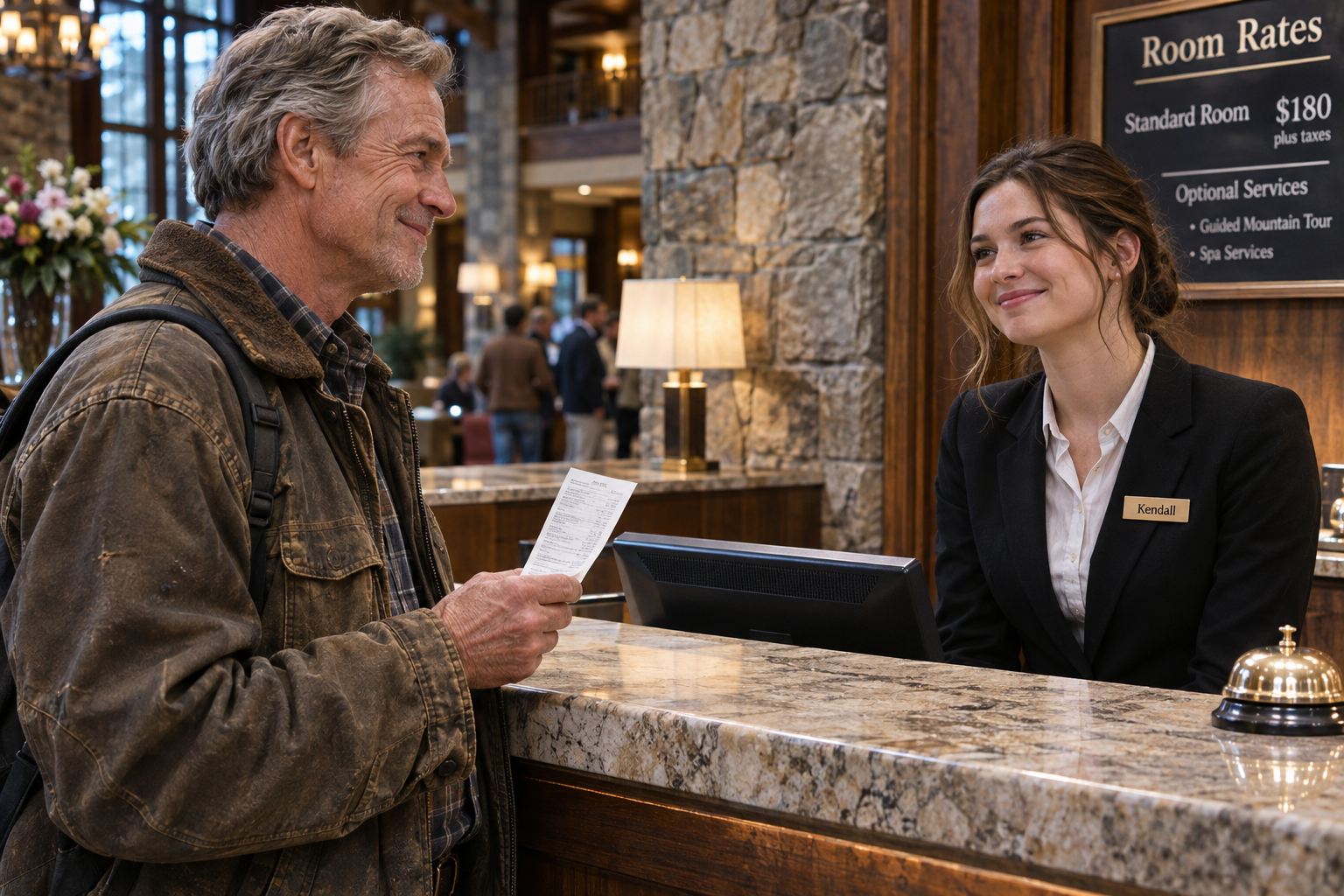
I approached the counter.
A receptionist I hadn't met before smiled.
"Good afternoon. How can I help you?"
"I'd like a room for the night."
"Of course."
She asked a few ordinary questions.
Then she explained the price.
One hundred and eighty dollars, plus the applicable taxes.
I looked at the display.
"Are there any additional compulsory charges?"
"No, sir."
"Nothing for heritage preservation?"
She shook her head.
"No."
I smiled.
She probably wondered why I found the answer so pleasing.
I reached for my wallet.
Before I could complete the transaction, someone emerged from the administrative area.
It was Kendall.
She recognized me immediately.
Her expression brightened.
"Good afternoon, sir."
"Hello, Kendall."
The other receptionist glanced between us.
Kendall didn't interrupt the transaction.
She waited until her colleague had finished.
I received my receipt.
I examined it through my reading glasses.
Everything was correct.
Kendall looked at the paper.
"Does everything look all right?"
"Everything looks fine."
She smiled.
This time, there was nothing unpleasant about it.
I collected my room key.
Then I noticed a man entering the lobby.
He was carrying a battered suitcase, and his work boots were covered with dirt.
His jacket looked as though it had spent most of its life outdoors.
He approached the reception desk cautiously.
"Do you have anything available tonight?"
Kendall turned toward him.
"Certainly, sir. How many guests?"
"Just me."
She explained the room rate.
He reached into his pocket and took out his wallet.
"That's a little more than I was hoping to spend."
I stopped beside my overnight bag.
Kendall didn't look toward the parking lot.
She didn't study his clothes.
Instead, she explained the available accommodation options and checked whether any approved discounts applied.
Her voice remained respectful.
The man listened.
After a moment, he nodded.
"That sounds fair."
She completed his reservation.
Then she handed him his room key.
"Enjoy your stay. Let us know if you need anything."
He thanked her.
As he walked toward the elevator, Kendall noticed me standing nearby.
Our eyes met.
She didn't say anything.
Neither did I.
There was no need.
I picked up my canvas bag and went upstairs.
In my room, I placed the new receipt on the bedside table.
Then I took an envelope from the inside pocket of my jacket.
It contained the two receipts from my previous visit.
I had kept them through the investigation.
The original fourteen-hundred-dollar bill still bore Sterling's handwritten corrections.
The other showed the legitimate room rate.
I placed the new receipt beside them.
Three pieces of paper.
They told me more about the business than many of the reports I had received over the years.
One showed what happened when authority went unchecked.
Another showed what happened when someone finally questioned it.
The third showed that we had begun doing things properly again.
I stood beside the window.
My pickup was visible below.
It looked just as old as it had on my previous visit.
My jacket hung over the back of a chair.
The cuffs were still worn.
There were newer jackets available, and I could easily afford a more expensive vehicle.
But I had no intention of replacing either simply to influence how strangers treated me.
I shouldn't have needed to.
Nobody should.
Later that evening, I went downstairs for dinner.
The lobby was busy.
Families were checking in.
Employees were carrying luggage.
A tired-looking woman asked for directions to the elevator.
Someone immediately helped her.
I sat near the window and watched for a while.
Nobody knew I was conducting an inspection.
Nobody was performing for the owner.
They were simply doing their jobs.
That mattered to me more than any special welcome ever could.
The next morning, I checked out.
Kendall was at reception.
She handed me the final receipt.
"Was everything satisfactory?"
"Yes, thank you."
She smiled.
"We hope you'll come back."
"I expect I will."
I picked up my overnight bag.
Before leaving, I turned toward her.
"Kendall?"
"Yes, sir?"
"Keep treating people the way you treated that gentleman yesterday."
She understood immediately.
"I will."
I nodded and walked toward the entrance.
The employee who had cleaned the marble floor months earlier held the door open for me.
"Have a safe drive, sir."
"Thank you."
Outside, the air smelled of wet stone and pine trees.
I placed my canvas bag on the passenger seat and climbed into the pickup.
Before starting the engine, I looked back at the hotel.
I had owned that building long before the night Sterling refused to give me a reasonable price.
But ownership had never entitled me to greater dignity than anyone else.
It had given me greater responsibility.
There was a difference.
The guests who entered that hotel deserved clean rooms, honest prices, and respectful service.
Whether they arrived in expensive vehicles or worn-out pickups.
Whether they carried designer luggage or an old canvas bag.
Whether they could influence someone's career or had no influence at all.
I started the engine.
The truck made its familiar sound.
I smiled.
Months earlier, someone had looked at that same vehicle and decided its owner wasn't worth treating properly.
Now hundreds of guests had received their money back, dishonest practices had been exposed, and the people entrusted with the hotel understood what was expected of them.
I hadn't accomplished that by wearing a better jacket.
I had accomplished it by refusing to accept a dishonest answer.
As I drove away, I reached toward the passenger seat and touched the envelope containing those receipts.
I intended to keep them.
Not as a reminder that I was wealthy enough to own a hotel.
Not as a trophy from someone else's humiliation.
But as a reminder that the most important guest in any business was the one standing at the counter when nobody important appeared to be watching.
The End
Read more original stories on Feel Every Story.
I Had Only Asked for a Room for the Night, but the Young Woman Behind the Desk Had Other Ideas
Part 10 of 10