
Marcus was already sitting inside the little restaurant when I arrived.
It was a place we had visited many times during our relationship.
Nothing elaborate.
Wooden tables, inexpensive coffee, and sandwiches served on plain white plates.
He stood when he saw me.
“Hey.”
“Hi.”
He pulled out a chair.
I thanked him and sat down.
For a moment, everything felt familiar.
Then he looked at my left hand.
I saw the disappointment on his face.
He sat opposite me.
“I ordered your usual coffee.”
“Thank you.”
The waitress brought two cups.
Marcus waited until she walked away.
Then he folded his hands on the table.
“I've been thinking about what you said.”
I nodded.
He told me he understood that his mother had been difficult.
He admitted that Vanessa's video had been inappropriate.
He acknowledged that he should have spoken up during the first dinner.
I listened carefully.
These were things I had wanted to hear for weeks.
He sounded sincere.
For a moment, I felt the old hope return.
Perhaps the difficult conversations had finally reached him.
Perhaps we could find a way through this.
Then he continued.
“But I need you to understand my position too.”
I waited.
“My family isn't going anywhere.”
“I know.”
“And I'm not going to destroy my relationship with my mother because she made a couple of mistakes.”
“I've never asked you to destroy that relationship.”
He nodded.
“I know. But that's how it feels.”
I picked up my coffee.
“Would setting boundaries destroy your relationship with her?”
He looked uncomfortable.
“She's not good with boundaries.”
I understood that.
What I needed to understand was whether he intended to establish them anyway.
He looked through the restaurant window.
Then he explained that Patricia had always been heavily involved in family decisions.
She had strong opinions.
She worried about her children.
Sometimes she expressed those concerns badly.
I listened.
None of it surprised me.
When he finished, I asked him the question I had come to ask.
“Would you tell your mother she was wrong, even if she refused to accept it?”
He stared at his coffee.
“I'd try to explain things to her.”
“And if she wouldn't listen?”
He rubbed his hands together.
“Then we'd have to find some way to compromise.”
I nodded slowly.
I already knew who would be expected to provide that compromise.
I had been sitting in the distant chair long enough to understand.
Marcus continued talking.
He said he was willing to discuss separate accounts.
He would consider meeting with a financial adviser.
He might even be prepared to speak with an attorney about a prenuptial agreement.
Those were meaningful concessions.
I acknowledged them.
Then he asked whether I would agree that any agreement should protect his future lifestyle as well as my existing assets.
I looked at him.
“What do you mean by your future lifestyle?”
He shifted.
“Well, if we were married for several years, I'd become accustomed to certain things.”
“What things?”
“A particular house. Certain expenses. The standard of living we established together.”
I took a sip of coffee.
He was entitled to obtain independent legal advice about any financial arrangement.
I had never suggested otherwise.
But the way he spoke made something clear.
He was already imagining a standard of living that depended on my income.
We hadn't even agreed on a wedding.
“Marcus, what if I decided to leave my company?”
He blinked.
“Why would you do that?”
“Maybe I'd want to work somewhere else.”
He frowned.
“But you have a great job.”
“Yes.”
“And you earn an incredible amount.”
“I know.”
He appeared confused.
I continued.
“What if I decided that earning less would give me more time to enjoy my life?”
He thought about it.
“Well, we would have to discuss that.”
“Of course.”
“Especially if we'd already bought a house.”
I nodded.
“And what if I wanted to keep living exactly as I do now?”
He stared at me.
“In that apartment?”
“Yes.”
“For how long?”
“As long as I was happy there.”
He shook his head slightly.
“I don't really see the point of earning that much money if you're not going to enjoy it.”
I looked around the restaurant.
I enjoyed my life.
I enjoyed quiet mornings in my apartment.
I enjoyed having reliable transportation and knowing my bills were paid.
I enjoyed being able to make decisions without worrying about whether someone else would approve.
Money had given me choices.
It hadn't given me an obligation to choose the most expensive option.
Marcus didn't seem to understand that.
Perhaps he never would.
I placed my cup down.
“Do you remember what I told you about my grandmother?”
He nodded.
“She raised you.”
“Yes.”
“And she owned businesses.”
I smiled slightly.
He remembered that part now.
I told him again about her little house and aging car.
I explained that she had been financially successful without feeling any need to advertise it.
I told him about the letter she had left me.
He listened.
When I finished, he leaned back.
“So you were testing us?”
I considered his question carefully.
“In a way, I suppose I was watching how your family treated me.”
He looked hurt.
“That doesn't seem fair.”
I nodded.
“I should have been clearer with you about my work. I accept that.”
He waited.
“But I didn't ask your mother to insult me. I didn't ask Vanessa to record me. I didn't ask you to remain silent.”
He looked down.
“I know.”
I reached into my handbag.
My fingers found the small ring box.
I took it out and placed it between our coffee cups.
Marcus stopped moving.
“Don't.”
I looked at him.
“I'm sorry.”
He shook his head.
“We can fix this.”
I wished I believed him.
I really did.
There was a part of me that wanted to put the ring back on and return to the apartment where we had spent so many pleasant evenings.
I wanted the man I remembered from the beginning.
But I couldn't separate that man from the one sitting opposite me.
They were the same person.
I had to make my decision about the whole person.
Not just the parts I loved.
“I don't think we should get married.”
His eyes filled with tears.
I felt my own beginning to sting.
“Because of my family?”
“Because of what happens between us when your family is involved.”
He lowered his head.
I pushed the ring box gently toward him.
“I can't spend my marriage asking whether I'm entitled to basic respect.”
He didn't touch it.
“I love you.”
“I know.”
“Then how can you do this?”
I took a slow breath.
“Because loving someone isn't the same as being able to build a healthy life with them.”
He covered his face briefly.
I waited.
The restaurant continued around us.
Someone laughed near the counter.
The waitress carried plates toward another table.
A coffee machine hissed.
Nobody knew that the future I had imagined was ending beside two half-finished cups of coffee.
Eventually, Marcus picked up the ring box.
He opened it.
Then he closed it again.
He put it in his jacket pocket.
“Are you sure?”
I nodded.
He looked toward the window.
Neither of us spoke for a while.
When the waitress returned, Marcus paid for his coffee.
I paid for mine.
It was a small, familiar arrangement.
The sort of arrangement we had made throughout our relationship before my salary became the most interesting thing about me.
Outside, he offered to walk me to my car.
I agreed.
My old Subaru was parked near the entrance.
He stopped beside it.
For a moment, he looked as though he wanted to say something else.
Instead, he hugged me.
I hugged him back.
Then I stepped away.
“Take care of yourself, Marcus.”
He nodded.
I climbed into the car.
When I drove home, the seat beside me was empty.
My left hand felt strange against the steering wheel.
I cried when I reached my apartment.
There was nothing triumphant about it.
Ending an engagement wasn't a victory over Patricia.
It wasn't revenge against Vanessa.
It wasn't proof that I was stronger than Marcus.
It was simply a painful decision I believed was necessary.
The following morning, Patricia called.
I answered because I didn't want to leave anything unresolved.
She sounded distressed.
“Marcus told us what happened.”
“Yes.”
“I think you've made a terrible mistake.”
I sat beside my kitchen window.
“I understand that you feel that way.”
“You two had such a wonderful future ahead of you.”
I didn't argue.
She told me that Marcus was devastated.
She said the wedding arrangements had been progressing beautifully.
She reminded me how difficult it was to find someone who genuinely cared.
Then she mentioned the possibility of a larger home and a comfortable life together.
I closed my eyes.
Even now, she was describing the financial opportunities I was supposedly abandoning.
She still hadn't asked whether I had been happy.
“Patricia, I won't be reconsidering my decision.”
She became quiet.
“You're really throwing everything away?”
“No.”
I looked around my apartment.
“I'm choosing a different future.”
She sighed.
“I hope you don't regret this.”
“So do I.”
I ended the call politely.
Vanessa sent me a message that afternoon.
She said she hadn't realized I would take everything so seriously.
I read her words carefully.
Then I replied that I hoped she would remember to respect people's boundaries in the future.
I didn't ask for another apology.
I didn't need one anymore.
Richard sent a short message the next day.
He wished me well.
He said he was sorry things hadn't worked out.
I thanked him.
Of the four Whitmores, he was the only one who hadn't tried to persuade me that my decision was wrong.
I appreciated that.
Over the following weeks, life became quieter.
Marcus collected the few belongings he had left in my apartment.
I returned a sweater, a phone charger, and a book he had been reading.
We exchanged polite messages about practical matters.
Then the messages became less frequent.
Eventually, they stopped.
I removed myself from the family group chat.
I didn't publish Vanessa's recording.
I didn't send it to Patricia's friends.
I didn't want strangers judging people I had once hoped would become my family.
The video had served its purpose.
It had reminded me that what I experienced was real.
One afternoon, I deleted my saved copy.
I didn't need the evidence anymore.
I trusted my own memory.
That was enough.
Work continued.
A project I had spent months developing finally reached an important milestone.
My colleagues congratulated one another.
I celebrated with a quiet dinner at home.
I cooked something I liked and opened a bottle of sparkling water.
There was no expensive restaurant.
No photograph posted online.
Just a pleasant evening after a long period of hard work.
My monthly income remained approximately $37,000.
My apartment remained the same.
So did my car.
A few months later, I took the Subaru in for routine maintenance.
The mechanic told me it was still in good condition.
I laughed when he said that.
He had no idea how many conversations that vehicle had caused.
I paid the bill and drove home.
That afternoon, I decided to organize some of my grandmother's belongings.
I opened the wooden jewelry box and took out her gold earrings.
Beneath them was the folded letter she had left me.
I carried it to the dining table.
The paper was worn from years of handling.
I read the passage about watching how people behave when they believe there is nothing to gain.
Then I read the rest of the letter.
I thought about how differently Patricia had greeted me after seeing the employment statement.
How quickly Vanessa had discovered that my navy dress was elegant.
How eagerly Marcus had begun imagining new houses and expensive vacations.
My grandmother hadn't needed to warn me against any particular kind of person.
She had given me a way to recognize behavior for myself.
And I had finally understood another part of that lesson.
It wasn't enough to notice someone's character.
Sometimes I had to be willing to act on what I noticed.
That had been the difficult part.
I had recognized Marcus's silence during the first dinner.
I had recognized his excuses afterward.
I had recognized his dependence on Patricia's approval.
For a while, I kept hoping that recognizing those things would somehow make them disappear.
It hadn't.
Accepting them had required something more painful.
I had to give up the future I wanted because it wasn't the future I was actually being offered.
I folded the letter carefully.
Then I returned it to the wooden box.
That evening, I invited several colleagues to my apartment for dinner.
I moved my laptop from the dining table.
I borrowed two folding chairs.
I bought groceries from the same ordinary store I always visited.
One colleague brought bread.
Another brought dessert.
Someone helped me wash the vegetables.
We talked about work for a little while, then about our families, our interests, and the things we were looking forward to.
Nobody asked what my furniture cost.
Nobody commented on my car.
When another colleague arrived unexpectedly, I fetched an additional plate.
I looked at the table.
There wasn't much room.
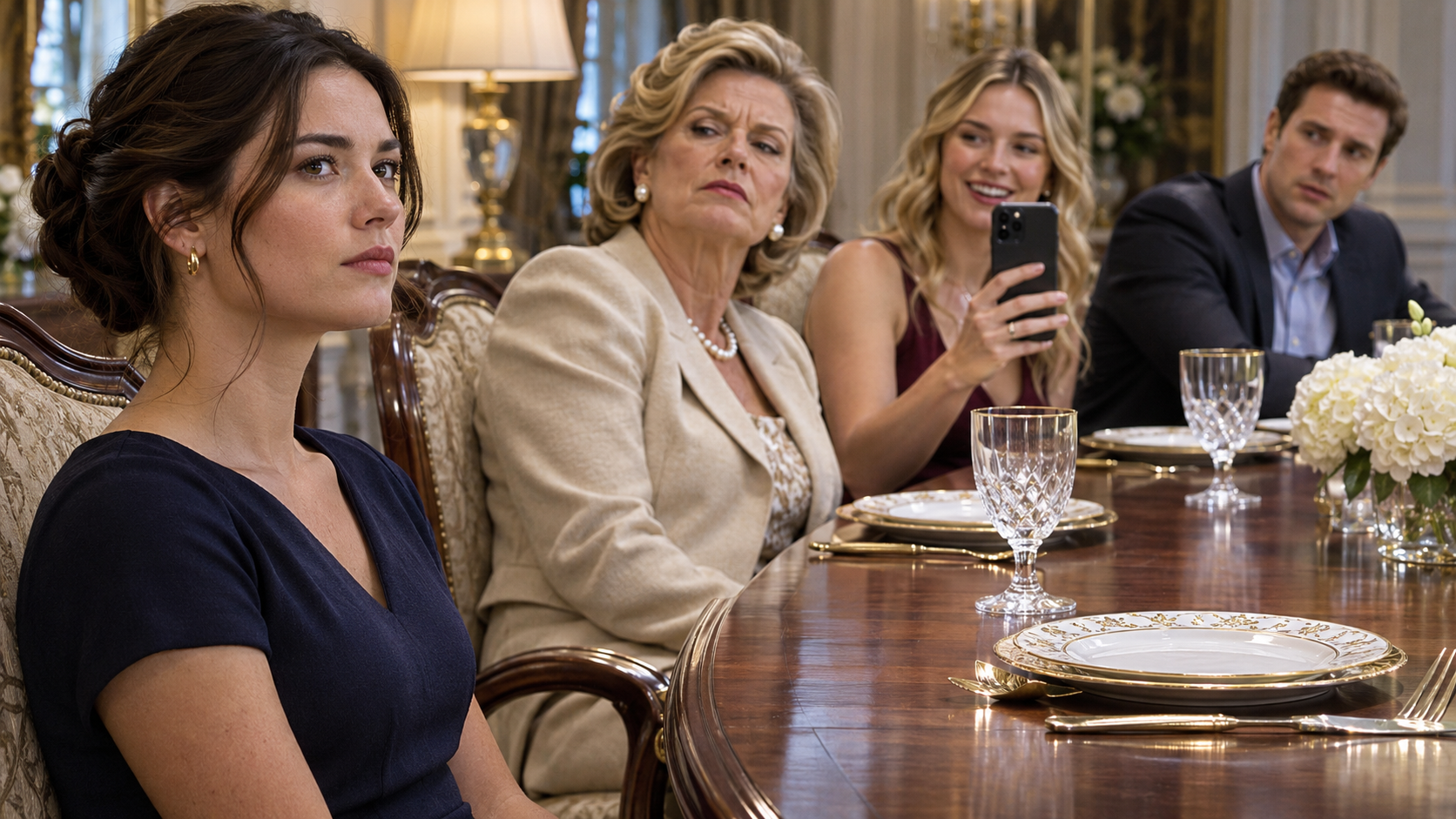
For a moment, I remembered Patricia's dining room.
The extra place setting.
The distant chair.
Vanessa's raised phone.
I remembered how it had felt to sit somewhere deliberately chosen to remind me that I didn't belong.
I moved my own chair closer to the window.
Everyone shifted slightly.
We made room for the newcomer between two other guests.
It took less than a minute.
Nobody complained.
Nobody treated it as an inconvenience.
We simply made room.
Later, while everyone was laughing over dessert, I touched one of my grandmother's earrings.
I wished she could have been there.
She would have liked the evening.
She would have appreciated the ordinary food, the borrowed chairs, and the conversation that had nothing to do with anyone's financial status.
When my guests eventually left, I washed the dishes.
I dried the extra plate and returned it to the cupboard.
Then I sat at the dining table with a cup of tea.
My apartment was quiet again.
There were still evenings when I missed Marcus.
I didn't pretend those feelings had vanished.
Sometimes I remembered a joke he had made or a place we had visited together.
Sometimes I wondered whether things might have been different if we had communicated more honestly from the beginning.
I accepted those questions without allowing them to undo my decision.
I had made mistakes.
So had he.
I hoped he would learn from his.
I intended to learn from mine.
The empty ring box was gone.
My grandmother's jewelry box remained.
I opened it before going to bed.
Her earrings rested beside the folded letter.
There was no longer an engagement ring between them.
For the first time in months, that absence didn't make me sad.
I closed the lid.
Then I turned off the bedside lamp.
I was thirty-two years old.
I had meaningful work, financial security, and a life I had built through years of effort.
But none of those things was the reason I deserved kindness.
I would have deserved it without the patents.
Without the conferences.
Without the $37,000 monthly income.
I should never have needed to produce an employment statement to earn a place beside the man who intended to marry me.
My grandmother had spent years teaching me that lesson through the quiet way she lived.
I understood it now.
And whenever somebody came to my home, whether they arrived wearing expensive clothes or ordinary flat shoes, I remembered the difference between providing a seat and making someone feel welcome.
At my table, nobody would ever have to prove what they were worth before I made room for them.
The End
Read more original stories on Feel Every Story.
I Let My Fiancé Believe I Earned an Ordinary Salary Until an Invitation to His Parents’ House Showed Me Something I Could Not Ignore
Part 10 of 10

One Comment on “PART 10 – I Returned His Ring Without Raising My Voice, and Months Later I Finally Understood What My Grandmother Had Been Trying to Teach Me”