The morning after the storm, I woke before sunrise.
For a few seconds, I did not know where I was. Then I felt Arvind's hand resting lightly over mine, and the memory returned.
The old pillow was gone.
The secret was no longer a secret.
And the man beside me had finally stopped sleeping as though an invisible line divided the mattress.
Arvind opened his eyes.
“You're staring.”
“I was checking whether you were real.”
He smiled.
“Unfortunately.”
I laughed quietly.
The kitchen smelled of ginger and cardamom when I made tea. Arvind came in wearing his old gray sweater, the one with the loose thread near the cuff. He leaned against the doorway and watched me.
“What?”
“Nothing.”
“You've been saying nothing too often lately.”
He smiled.
“I like watching you.”
The sentence was so ordinary that it startled me.
Eighteen years earlier, I would have taken such words for granted.
Now I held them carefully.
He sat at the table.
“Today I want to go through the old papers.”
My hand stopped over the sugar jar.
“What papers?”
“The medical records.”
I turned toward him.
“Why?”
“Because the doctor told us everything he could find. But I don't think that was everything.”
There was something in his voice.
Not fear.
Something closer to unfinished business.
I brought the tea over.
“What do you think is missing?”
He looked at the cup without drinking.
“The name of the doctor who treated me first.”
“Why does that matter?”
“Because he told me something that night.”
I waited.
Arvind rubbed his thumb across the rim of the cup.
“He said the infection might not have come from what you think.”
My heart tightened.
“You mean Sameer?”
He nodded.
“That's what I believed.”
“And now?”
“I don't know.”
The words remained between us.
I sat down.
For eighteen years, I had carried one explanation for everything. I had betrayed my husband. The consequences followed. He became ill. He kept me away. That was the story I knew.
But if the first doctor had questioned the source of his illness, then perhaps there had been another truth buried beneath the one I had spent years accepting.
“Why didn't you tell me?”
Arvind looked embarrassed.
“Because I didn't want to reopen that night.”
“But you remembered it.”
“Every day.”
He went to the bedroom and returned with a thin metal box.
I had seen it before.
I had never opened it.
He placed it on the table.
“This is everything I kept.”
Inside were hospital slips, pharmacy receipts, old laboratory reports, a discharge summary, and several folded letters.
The paper had yellowed.
Some corners were soft from years of handling.
I picked up the first laboratory report.
The date matched the week after my confession.
My name was not on it.
Only Arvind's.
The report contained medical terms I did not understand.
But one handwritten line stood out.
“Source uncertain.”
I looked at him.
“You knew this?”
“Yes.”
“You never told me.”
“I was afraid that if I told you, you'd think I was trying to escape responsibility.”
“Responsibility for what?”
“For everything.”
I placed the report down.
“Arvind, you can't spend the rest of your life confessing to crimes nobody asked you to commit.”
He gave me a tired smile.
“That's what I have been doing.”
We went through the papers together.
The first doctor had written that Arvind's condition required further investigation.
A later report recommended additional testing.
That test had never been completed.
“Why?”
“Money.”
I looked at the pharmacy receipts.
Then at the old school-fee receipts.
“You chose the children.”
“Yes.”
“And my mother.”
“Yes.”
“And me.”
“Yes.”
I shook my head.
“You always say yes as if that makes everything acceptable.”
“It doesn't.”
“Then why?”
He looked directly at me.
“Because I thought I had already lost my right to ask you for anything.”
The sentence silenced me.
I understood then that Arvind had not merely been protecting me from disease.
He had been punishing himself for loving a woman who had hurt him.
He had believed that sacrifice could somehow balance betrayal.
It couldn't.
No amount of suffering makes pain disappear.
A knock came at the door.
We both looked up.
It was Rohan.
He entered carrying a paper bag filled with fruit.
“Mom, Dad, why are you both sitting like you're investigating a murder?”
I looked at Arvind.
He looked at me.
“Something like that,” I said.
Rohan laughed.
Then he noticed the metal box.
“What is it?”
“Old medical records.”
His expression changed.
“Is everything okay?”
“Yes.”
I hesitated.
“We found something incomplete.”
“What?”
Arvind answered.
“An old diagnosis.”
Rohan sat down.
For the first time, we told him that his father's original diagnosis had never been fully explained.
He listened quietly.
Then he asked, “Does this change anything?”
I looked at Arvind.
“Maybe.”
Rohan nodded.
“Then find out.”
There was no accusation in his voice.
Only concern.
After he left, I turned toward Arvind.
“You heard him.”
“I did.”
“We're finishing the investigation.”
He smiled.
“You sound like a detective.”
“I've spent eighteen years waiting for answers.”
We returned to the clinic the following week.
The doctor who had treated Arvind recently examined the old file again.
He frowned at the handwritten notes.
“There was a recommendation here for additional testing.”
“Yes.”
“Why was it never done?”
Arvind looked at me.
“Financial problems.”
The doctor nodded.
“That was common then.”
He studied another page.
Then he looked up.
“There is a name here.”
“Whose?”
“A consulting physician.”
He read it again.
“Dr. Mehta.”
I recognized the name.
“Is he still practicing?”
“No,” the doctor said. “He retired years ago.”
“Where is he now?”
The doctor gave us an old clinic address.
It was in a neighborhood I had not visited in years.
Arvind folded the paper.
“I don't think we should go.”
I stared at him.
“You just spent eighteen years refusing to ask questions.”
“I know.”
“So we're going.”
He smiled faintly.
“You haven't changed.”
“Neither have you.”
We went two days later.
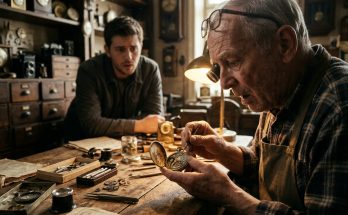
Dr. Mehta lived above a small pharmacy.
An elderly man opened the door.
His hair was completely white.
His glasses sat low on his nose.
When Arvind introduced himself, the man's expression changed.
“I remember you.”
Arvind nodded.
“I hoped you would.”
The old doctor looked at me.
“And you are?”
“My wife.”
Something passed across his face.
Not surprise.
Recognition.
“Come in.”
The room smelled of old books and eucalyptus oil.
Dr. Mehta listened while Arvind explained why we had come.
When he mentioned the date, the doctor closed his eyes.
“I remember that week.”
“Do you remember my diagnosis?”
“Yes.”
“Do you remember what you told me?”
The doctor looked at me.
“I told you that the diagnosis was not enough.”
Arvind's shoulders tightened.
“What did you mean?”
“I meant that the source was uncertain.”
“Why?”
The doctor sighed.
“Because your medical history did not fit neatly with the assumption everyone was making.”
I felt the room grow smaller.
“What assumption?”
The doctor looked at me.
“That your wife's infidelity had caused your infection.”
My face burned.
Arvind immediately said, “She was never diagnosed.”
“I know.”
“Then why did people assume it?”
“Because people prefer simple explanations.”
The doctor stood and walked to a cabinet.
He returned with an old notebook.
“I kept notes from difficult cases.”
He opened it.
There was Arvind's name.
My hands began trembling.
The doctor pointed to a paragraph.
“There were two possibilities I wanted to investigate.”
“What were they?”
He looked at Arvind.
“One was an older medical exposure.”
Arvind frowned.
“What exposure?”
“An improperly screened transfusion.”
The room went silent.
I stared at my husband.
“You had a transfusion?”
He nodded slowly.
“After the accident.”
I remembered the accident.
A workplace fall when Arvind was thirty.
He had spent several days in the hospital.
He had never mentioned receiving blood.
Dr. Mehta continued.
“The screening standards were not what they are now.”
Arvind's face had gone pale.
“Why didn't you tell me this then?”
“I tried.”
The doctor's voice became softer.
“You were terrified. You told me you did not want your wife to know anything that might bring her back into danger.”
I looked at Arvind.
“You refused further testing.”
He nodded.
“Why?”
He looked ashamed.
“Because I had already decided I was the problem.”
I closed my eyes.
The doctor said something that changed everything.
“The test could not prove where the infection came from. But I always believed you needed to investigate the old transfusion before blaming yourself—or anyone else.”
Arvind stared at the floor.
I reached across the table and took his hand.
He squeezed it.
We had come searching for a missing detail.
Instead, we had found a door.
Behind it was a question neither of us had been prepared to ask.
What if the betrayal had never caused his illness?
What if the story that had governed our marriage for eighteen years had been built on an assumption?
Dr. Mehta gave us copies of his old notes.
As we stood to leave, he stopped me.
“Mrs. Naina.”
I turned.
He looked at me carefully.
“Do not let a mistake you made become the explanation for every suffering that followed.”
I nodded.
Outside, the afternoon sun was harsh after the dim apartment.
Arvind stood beside me.
“Are you angry?”
“Yes.”
“At me?”
“No.”
“At myself?”
He smiled sadly.
“Maybe.”
I shook my head.
“No. I'm angry at all those years.”
He looked at the old papers in his hand.
“So am I.”
We walked toward the car.
Neither of us knew what the new answer would be.
But for the first time, we understood that the past might contain a truth more complicated than guilt.
And if we wanted to know it, we would have to keep digging.
Click Here to continue read next: PART6: A Forgotten Hospital Record Revealed a Second Possibility, and the Truth Could Either Free Our Marriage or Break It Beyond Repair
The Doctor Opened an Eighteen-Year-Old File, and Suddenly the Silence Between My Husband and Me Had an Explanation
Part 5 of 16