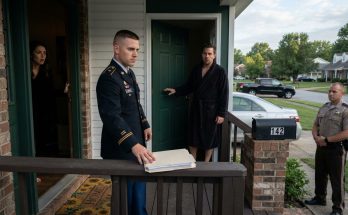
The final court decision came nearly a year after the night we found Daniel.
By then, the headlines had disappeared.
The investigators had finished reviewing the financial records.
The fraudulent transfers had been reversed where possible.
The remaining properties were placed into the three trusts exactly as the original documents required.
Ella received her share.
Jonah received his.
And I received mine.
The fourth property remained mine separately.
Nobody could take it.
Nobody could claim that I had stolen it.
The records showed exactly where the money came from and exactly why my grandfather had established the trust.
For once, paperwork told the truth.
Eric accepted responsibility for the forged loan.
Because he cooperated fully and provided evidence against Martin, his case did not end the way I had feared.
He still had consequences.
He lost money.
He lost trust.
He had to rebuild his life without expecting me to rescue him.
That was probably the most difficult lesson of all.
Dad sold the business equipment he still owned.
He moved out of the Willow Creek house for several months.
When he returned, he did so under an agreement that gave me control of the property.
Mom moved into a smaller home nearby.
She and I spoke often at first.
Then less often.
Our relationship never returned to what it had been.
But it became more honest.
She stopped asking me for money.
I stopped pretending everything was fine.
Sometimes honesty is not a bridge back to the past.
Sometimes it is simply a clean road forward.
Daniel continued helping with the estate records.
He kept the original documents in a secure archive.
Samuel survived the attack and eventually gave a formal statement.
He confirmed everything on the recording.
Martin's legal battle continued for years.
The evidence was too extensive to disappear.
His companies were investigated.
The fraudulent transactions were traced.
Several properties were recovered.
The system my grandfather had built did not vanish overnight.
But it finally became visible.
That mattered.
One spring morning, I returned to Willow Creek alone.
The house looked different without the secrecy.
Sunlight came through the kitchen windows.
The old sugar jar still sat on the counter.
I remembered the first letter.
The warning.
Do not sell the house.
At the time, I had thought the message was about a property.
Now I understood.
It had always been about preserving the evidence.
I walked through the house slowly.
The basement room remained.
The shelves had been removed.
The hidden door had been repaired.
The ledger was no longer there.
Neither were the letters.
They belonged in the archive.
But I kept one photograph.
Evelyn holding me as a baby.
I placed it in a frame.
Beside it, I put photographs of Ella and Jonah.
Three children.
Three names.
One family.
Not because blood had suddenly solved everything.
Because we had chosen to know one another.
That distinction mattered.
Ella visited the house the following month.
She stood in the doorway and smiled.
“I never thought I'd see this place.”
“Neither did I.”
She walked into the kitchen.
“This is where she left the note?”
“Yes.”
She touched the counter.
“She knew you'd find it.”
“I wish I'd found it sooner.”
“You weren't supposed to.”
I looked at her.
“What do you mean?”
“She knew the truth would only help if we were ready to face it.”
I thought about that.
Maybe Evelyn had been right.
At twenty, I might have run.
At thirty, I might have tried to fix everyone.
At thirty-six, I finally understood that saving people and surrendering yourself were not the same thing.
Jonah came later.
He brought a box.
Inside were copies of Evelyn's letters.
“I thought you should have these.”
I looked at him.
“Why?”
“Because she wrote about you.”
I opened the first letter.
It wasn't a warning.
It was ordinary.
Evelyn had written about wanting to know what kind of person I would become.
She wondered whether I would like music.
Whether I would be stubborn.
Whether I would laugh loudly.
Whether I would hate winter.
The small details broke my heart more than the revelations had.
She hadn't imagined an heir.
She had imagined a daughter.
I closed the letter.
Jonah sat beside me.
“She loved you.”
“I know.”
For the first time, I believed it without needing proof.
Later that year, Dad asked whether we could talk.
We sat on the porch.
The same porch where I had once waited for him to tell me he was sorry.
He looked older.
“I don't expect you to forgive me.”
“I know.”
“I should have told you everything.”
“Yes.”
“I should have stopped Eric.”
“Yes.”
“I should have protected Evelyn.”
“Yes.”
He nodded.
“I failed.”
I looked at him.
“But you did one thing right.”
He looked surprised.
“You kept the records.”
He looked down.
“I couldn't destroy them.”
“I'm glad.”
He nodded.
We sat quietly.
Then he asked, “Do you still consider me your father?”
The question hurt.
I could have answered quickly.
Instead, I thought about the hospital.
The hidden documents.
The lies.
The years of fear.
And the moments when he had still tried to protect me.
“Yes,” I said.
His eyes filled.
“But being my father doesn't mean you get to decide my life.”
“I understand.”
“And it doesn't mean I owe you money.”
“I know.”
“And if you ever need help, you ask.”
He smiled sadly.
“I will.”
That was enough.
Not forgiveness.
Not forgetting.
A boundary.
The kind of boundary I had been too afraid to establish before.
A few weeks later, I met Eric for coffee.
He looked different.
Less confident.
More careful.
“I found a job,” he said.
“Good.”
“I don't expect anything from you.”
“I know.”
He looked at his coffee.
“I am sorry.”
“I believe you.”
He looked up.
“Does that mean we're okay?”
“No.”
He nodded.
“I understand.”
“But we can try.”
A small smile appeared.
“I'd like that.”
We left the café separately.
That was appropriate.
Family did not mean returning to the same patterns.
It meant learning how to relate without repeating them.
The Willow Creek house eventually became something else.
Ella and Jonah agreed with me that it should not remain a private monument to our grandfather.
We turned part of it into an archive and community resource documenting the history of the properties and the people whose identities had been misused.
The original records were preserved professionally.
The names were restored.
Evelyn's story was recorded.
Not as a scandal.
Not as gossip.
As history.
Her photograph hung near the entrance.
Underneath it, we placed three names.
Mara Ellis.
Ella Ellis.
Jonah Ellis.
Then, below them, one sentence from her final letter:
Truth leaves marks.
I kept my own name.
Rachel Whitman.
Mara Ellis remained part of my history.
I no longer feared that.
For years, I had thought identity was something other people gave us.
A father.
A mother.
A grandfather.
A legal document.
A hospital bracelet.
But names could be changed.
Records could be altered.
Promises could be broken.
What mattered was what we chose after learning the truth.
I chose Rachel.
I chose Mara too.
I chose my sister.
I chose my brother.
I chose a relationship with my parents that had limits.
And I chose the house.
Not because anyone told me to save it.
Not because I owed the family.
Not because a mortgage payment made me responsible for everyone inside.
I kept it because the house had finally become what it should have been from the beginning.
A place where the truth could remain.
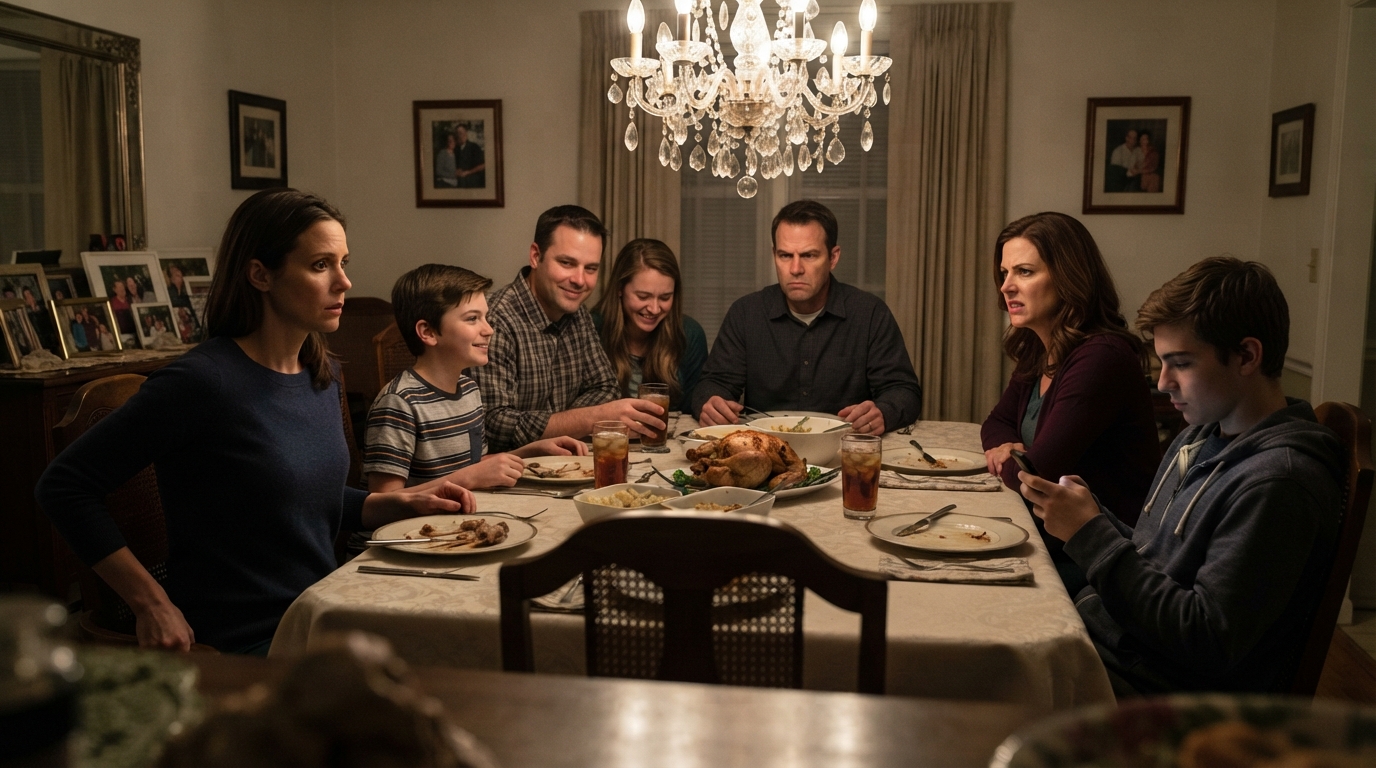
One evening, years after that first dinner, I stood in the kitchen beneath the same light where everything had begun.
The sugar jar sat on the counter.
The room was quiet.
Ella was laughing in the next room.
Jonah was arguing with Eric about music.
Dad was outside repairing the porch railing.
Mom was bringing tea from the kitchen.
I looked at the photograph of Evelyn.
For years, I had believed the worst thing my family had done was lie to me.
It wasn't.
The worst thing was teaching me that love required me to carry everyone else's burdens.
The truth taught me otherwise.
Love could exist beside boundaries.
Family could exist without control.
Forgiveness could exist without surrender.
And helping someone did not require disappearing inside their problems.
I touched the frame.
“I'm sorry it took so long,” I whispered.
The house gave no answer.
It didn't need to.
The records were safe.
The three names had been restored.
The stolen properties had been accounted for.
The people responsible had faced consequences.
And the family secret that had controlled our lives for decades had finally become something that belonged to the past.
I turned off the kitchen light.
For the first time, leaving the house did not feel like walking away from an obligation.
It felt like going home.
The End
Read more original stories on Feel Every Story.
One Cruel Joke at Dinner Exposed the Price My Family Had Been Quietly Expecting Me to Pay
Part 20 of 20