
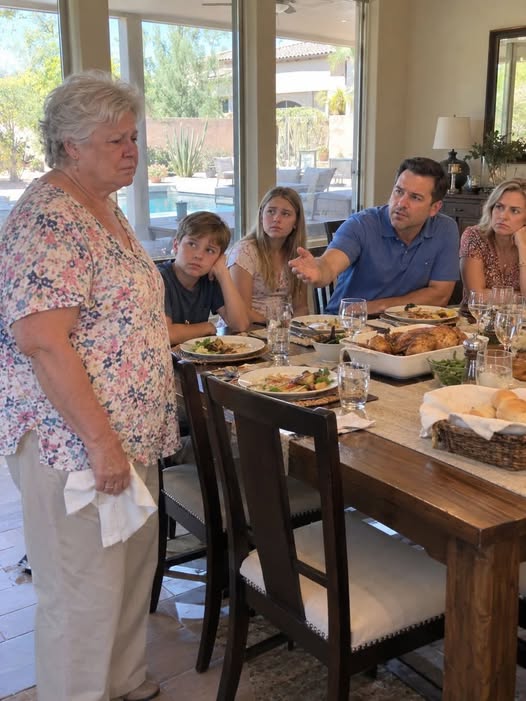
Daniel arrived at Willow Creek Lane on a Saturday afternoon.
I watched him walk up the path toward the porch.
For a moment, I saw the little boy Harold and I had raised.
Then he looked up.
And I saw a grown man who seemed unsure whether he was welcome.
That hurt more than I expected.
I had spent most of my life wanting Daniel to feel at home wherever I was.
But I was no longer willing to pretend everything was fine simply to make him comfortable.
I opened the door.
“Hello, Daniel.”
“Hi, Mom.”
He looked past me into the house.
I stepped aside.
“Come in.”
He entered slowly.
I knew what he was seeing.
The home he and Renee had wanted.
The rooms they had imagined filling with their belongings.
The place they had hoped to buy before another purchaser took it.
And now his mother lived there.
He stopped near the living room.
“It's beautiful.”
“Yes.”
He looked toward the windows.
“The trees are even better than I remembered.”
I smiled.
“They're one of my favorite things about it.”
He nodded.
For a moment, neither of us spoke.
Then I asked whether he wanted something to drink.
“Tea would be nice.”
I went into the kitchen.
He followed.
My blue mug was sitting on the counter.
Daniel recognized it immediately.
“You brought that with you?”
I picked it up.
“Of course.”
He smiled faintly.
“I remember that thing.”
“So do I.”
He looked around the kitchen.
I could see him taking in the space.
The cupboards.
The windows.
The quiet.
Then he asked something unexpected.
“Are you happy here?”
I considered the question.
“Yes.”
It was the first answer I had given him that afternoon without hesitation.
He looked relieved.
But there was sadness in his expression too.
“I wish things had happened differently.”
I filled the kettle.
“So do I.”
We sat together a few minutes later.
Daniel held his cup between both hands.
I sat across from him with my blue mug.
It reminded me of the conversations Harold and I used to have in Tucson.
Except Harold had always made me feel that I could say what I needed to say.
With Daniel, I wasn't certain.
He looked toward the window.
“Renee and I talked after your call.”
I waited.
“She was upset.”
“I imagine she was.”
“She thinks you kept the money secret because you wanted to make us look bad.”
I rested my mug on the table.
“Did she say that?”
“Yes.”
I nodded.
There was a time when I would have hurried to reassure her.
I would have explained that I never wanted anybody to feel embarrassed.
I would have apologized for making things uncomfortable.
But I hadn't done anything wrong by protecting my financial privacy.
And I wasn't going to apologize for it.
“I didn't tell anyone because I needed to protect myself while I made arrangements.”
Daniel looked at me.
“I know that's what you said.”
“It's also the truth.”
He nodded slowly.
Then he asked another question.
“Were you testing us?”
I thought about that.
I didn't want to lie.
“Not when I first won.”
He waited.
“At first, I was frightened. I didn't understand how to manage that kind of money. I needed professional advice.”
“And later?”
I looked down.
“Later, I began wondering whether you'd treat me differently if you knew.”
He sighed.
“Mom.”
“Daniel, you and Renee were already treating me like a burden.”
He lowered his eyes.
“I didn't realize you felt that way.”
“I know.”
This time, I didn't say it to hurt him.
I was simply acknowledging the truth.
He hadn't understood.
Or hadn't wanted to.
And that failure had consequences.
I continued.
“When your father died, I was lost. You asked me to come live with your family, and I believed I would be surrounded by people who cared about me.”
“We did care.”
“I believe you cared.”
He looked up.
“But caring isn't only something people say.”
Daniel didn't answer.
“I made the children's lunches. I picked them up from soccer. I cooked dinners. I did laundry. I stayed with them when you and Renee went away.”
He nodded.
“I know.”
“Then you must understand why it hurt when your wife said I contributed nothing.”
He closed his eyes.
For a few seconds, I thought he might argue.
Instead, he looked at me.
“You're right.”
I stayed still.
I hadn't expected those words.
He continued.
“I should have said something.”
I felt tears gathering.
But I wasn't ready to cry.
Not yet.
Daniel looked down at his cup.
“I got used to you taking care of things.”
“Yes.”
“I stopped noticing how much work it was.”
“Yes.”
“And when Renee started talking about expenses, I thought about the bills instead of everything else.”
I listened.
He wasn't offering a grand explanation.
He wasn't claiming he had meant well.
He was describing what had happened.
And for the first time, I believed he was beginning to understand it.
“I was wrong, Mom.”
I swallowed.
“I needed to hear that.”
He nodded.
Then he said the words I had wanted for months.
“I'm sorry.”
I looked at him.
My son.
Harold's son.
The little boy I had once held in my arms.
The man who had asked me to leave his home.
I loved him.
And I was still hurt.
Both things were true.
“Thank you, Daniel.”
He reached across the table.
I let him take my hand.
For a moment, we sat quietly.
I wished Harold could have been there.
He would have understood how much that small apology mattered.
But he also would have known that an apology couldn't erase everything.
Daniel had more to say.
He admitted that Renee had been struggling with the household expenses.
The mortgage.
The groceries.
The cost of raising two children.
He said the pressure had made them focus on money more than they should have.
I understood financial pressure.
Harold and I had experienced it.
There had been years when we watched every dollar.
Years when repairing something meant postponing another expense.
Years when we had to be careful.
But I remembered something important.
We hadn't treated family members as less worthy because they couldn't contribute money.
I told Daniel that.
He listened.
“Financial stress doesn't excuse making someone feel unwanted.”
“I know.”
“And if you needed me to contribute toward expenses, you could have asked.”
He looked startled.
“I never thought you'd be able to.”
There it was.
The assumption beneath so many of our problems.
They had decided what I could afford.
They had decided what I needed.
They had decided what my future should look like.
And they had done it without asking me.
“You never asked,” I said.
Daniel nodded.
“No. We didn't.”
The conversation became quiet again.
Then he looked around the house.
“I still can't believe you bought this place.”
I smiled slightly.
“Neither can I sometimes.”
He hesitated.
“Renee wondered whether you might consider selling it to us.”
I had expected that question eventually.
Still, hearing it made my chest tighten.
Only minutes earlier, he had apologized.
Now the house had entered the conversation again.
I watched his face.
He seemed embarrassed.
“I told her I didn't think we should ask.”
“Then why are you asking?”
He looked down.
“Because she wanted me to.”
I let the silence sit between us.
Then I answered.
“No, Daniel.”
He nodded quickly.
“Okay.”
“I'm not selling the house.”
“I understand.”
“And I'm not giving it to you.”
He looked up.
“I wasn't asking you to give it to us.”
“I know. But I want there to be no misunderstanding.”
He nodded again.
I continued.
“This is my home. I chose it because I like it. I intend to live here.”
He looked around the kitchen.
Then he smiled sadly.
“You sound like Dad.”
That caught me off guard.
I felt my throat tighten.
Harold had always been gentle.
But he could be firm when something mattered.
He didn't need to shout to make a decision clear.
I had forgotten that part of our marriage.
Or perhaps I had simply forgotten that I possessed the same strength.
“I'll take that as a compliment.”
“It was one.”
We sat quietly for a while.
Then Daniel asked whether I planned to leave the money to the family.
I looked at him carefully.
I could tell he regretted the question almost as soon as he asked it.
He rubbed his forehead.
“I'm sorry. That came out wrong.”
I took a breath.
“Daniel, I'm seventy-one. I hope I have many years left.”
“Of course.”
“I intend to enjoy them.”
He nodded.
“And I've arranged for professionals to help me make responsible decisions about the money.”
He listened.
“My estate plans are private. They'll remain that way.”
He didn't argue.
That was a relief.
I wasn't trying to punish him through an inheritance.
I wasn't making threats.
I was protecting the independence I had only recently regained.
What happened to the money after my lifetime would be handled through proper planning.
But my remaining years belonged to me.
I wanted Daniel to understand that.
After a while, we began talking about Chloe and Caleb.
That conversation came more easily.
Daniel told me about school.
About soccer.
About Caleb's questions.
About Chloe's growing independence.
I listened with the same interest I always had.
The children had never stopped mattering to me.
I asked whether they wanted to visit.
Daniel smiled.
“They've been asking about you.”
I felt tears in my eyes.
“I've missed them.”
He looked at me.
“Would you like them to come next weekend?”
“Yes.”
Then I added something I needed him to hear.
“But I want visits to be visits, Daniel.”
He frowned slightly.
“What do you mean?”
“I want to enjoy the children. I don't want you and Renee assuming I'll be available whenever you need childcare.”
He considered that.
Then he nodded.
“That's fair.”
I was glad he understood.
I didn't want to stop helping.
I simply wanted to choose.
There was a difference between being a grandmother and being treated as a permanent employee who happened to be related to the family.
I had learned that lesson the hard way.
Over the following weeks, our relationship began changing.
Not dramatically.
Not all at once.
Daniel called more often.
Sometimes he asked about the house.
Sometimes he asked whether I had been enjoying myself.
Sometimes he simply wanted to talk.
I noticed the difference.
There were fewer instructions.
Fewer assumptions.
More questions.
I appreciated that.
But I didn't pretend everything had returned to the way it once was.
It hadn't.
Trust was slower to rebuild than I had expected.
There were moments when Daniel said something ordinary and I remembered the dinner at 6:18.
There were moments when Renee spoke politely and I wondered whether she would have used the same tone before learning about the lottery.
Those thoughts didn't disappear simply because I wanted them to.
I had to accept that rebuilding a relationship required time.
And that some things might never feel exactly the same.
Renee eventually visited.
She was noticeably uncomfortable when she entered the house.
I understood why.
This was the home she had wanted.
She had imagined moving her family into it.
Now it belonged to me.
She looked around the living room.
Then she turned toward me.
“Margaret, I'm sorry for the way things ended.”
I studied her face.
I didn't know whether she fully understood what she was apologizing for.
So I asked.
“Which part, Renee?”
She looked surprised.
Then she lowered her eyes.
“The way we made you feel like you weren't contributing.”
I waited.
She continued.
“You did a lot for us.”
“Yes.”
“We got used to it.”
I nodded.
“That happens.”
She swallowed.
“But we should have appreciated it.”
I looked at her for a long moment.
“Thank you for saying that.”
We didn't become close friends that afternoon.
I didn't expect us to.
But the conversation was a beginning.
A few days later, Chloe and Caleb came to visit.
They ran toward me when I opened the door.
Caleb hugged me so tightly that I laughed.
Chloe held me a little longer than usual.
I looked at their faces and felt something in my chest finally loosen.
They were still my grandchildren.
Nothing about the money had changed that.
Nothing about the house had changed it either.
Caleb wanted to see the rooms.
Chloe was curious about the porch.
We walked through the house together.
I watched them look around.
They remembered the property from the visits they had made with their parents.
But this time, they weren't discussing which bedrooms would belong to them.
They were visiting Grandma.
That felt right.
Later, Caleb asked whether we could make sandwiches.
I smiled.
“Of course.”
We went into the kitchen.
I took down the bread.
The honey.
The plates.
Caleb watched me open the jar.
Then he looked up.
“Grandma, can I have lots?”
I laughed.
“You can have enough to enjoy it.”
He grinned.
I spread the honey carefully.
All the way toward the edges.
I remembered Renee complaining about how much it cost.
Four spoonfuls.
Six dollars for the container.
I had carried that small humiliation longer than I should have.
Now I was standing in my own kitchen, making a sandwich for my grandson because I wanted to.
Nobody was counting.
Nobody was criticizing.
Nobody was treating my kindness as an expense.
Caleb took a bite.
Then he asked another question about bees.
I smiled.
I remembered him asking whether they slept at night.
Such an ordinary question.
Such an ordinary morning.
And suddenly I understood what I had been missing.
Not luxury.
Not excitement.
Not eighty-nine million dollars.
The freedom to enjoy an ordinary moment without feeling that I had to earn my place in the room.
After the children left, I sat on the porch.
The afternoon was quiet.
The trees shaded part of the yard.
My blue mug rested beside me.
I thought about Tucson.
The yellow kitchen.
The roses.
Harold's tea.
I had spent so long believing that leaving our old home meant losing the life we had built.
Now I understood that some of what Harold taught me had come with me.
I knew how to make a home.
I knew how to care for people.
And I knew how to recognize when care wasn't being returned.
Those were things money hadn't given me.
They had been there all along.
I simply needed to remember them.
I didn't regret winning the lottery.
Of course I didn't.
The money had provided security beyond anything I had imagined.
It had allowed me to leave a situation that was making me unhappy.
It had given me the means to purchase a home I loved.
But I no longer thought of eighty-nine million dollars as the most important part of my story.
The most important part was what happened after I had the freedom to choose.
I chose not to remain where I felt unwanted.
I chose not to turn my fortune into a weapon against my son.
I chose to keep loving my grandchildren.
I chose to accept Daniel's apology without pretending the past had never happened.
And I chose to let Renee rebuild our relationship through her behavior rather than her words alone.
Those choices cost me something.
I lost the uncomplicated trust I once had in my son.
I lost the belief that family members automatically understood one another's sacrifices.
And I lost the comforting idea that being needed was enough.
But I gained something too.
I learned that love didn't require me to give up my dignity.
I learned that generosity could have boundaries.
And I learned that at seventy-one, I was still allowed to build a life that belonged to me.
Daniel and I continued speaking.
He remained my son.
I remained his mother.
We weren't exactly the family we had been before.
Perhaps we never would be.
But there was more honesty between us.
And for the first time in a long while, I wasn't afraid to say what I needed.
One morning, I woke before sunrise.
For a moment, I expected to hear Daniel's household stirring.
I almost began thinking about lunches.
School schedules.
Laundry.
Then I remembered where I was.
Willow Creek Lane.
My home.
I got out of bed and walked into the kitchen.
I made tea.
Poured it into my blue mug.
And carried it onto the porch.
The sky was beginning to brighten.
The trees stood quietly around the yard.
I sat down.
There was no schedule waiting for me.
No one telling me what needed to be done.
No one counting what I used.
For a long time, I watched the morning arrive.
Then I thought about Harold.
I wished he could have seen the house.
He would have loved the porch.
I was certain of that.
I smiled.
“It's a good place, Harold.”
The words sounded small in the quiet.
But they were enough.
I took another sip of tea.
It was still warm.
I had once believed I needed to be useful to deserve a home.
Now I knew better.
A home wasn't a reward for completing somebody else's chores.
And love wasn't something I had to purchase with my time, my labor, or my money.
I was Margaret Briggs.
Seventy-one years old.
A widow.
A mother.
A grandmother.
A woman who had won eighty-nine million dollars.
But none of those things explained the peace I felt sitting on that porch.
The peace came from knowing I could stay.
Not because somebody needed me.
Not because somebody had given me permission.
Because I had chosen this place for myself.
I looked down at my blue mug.
It was the same ordinary cup I had carried out of Scottsdale.
The same one that had sat beside me while I packed lunches and wondered whether I mattered.
I had brought it with me because it belonged to me.
Now it sat on the porch of a home that belonged to me too.
And for the first time since Harold died, I wasn't waiting for somebody else to tell me where I belonged.
I already knew.
The End
Read more original stories on Feel Every Story.
I Thought My Son Was Giving Me a Place to Heal, but I Slowly Became Someone His Family Took for Granted
Part 10 of 10

One Comment on “PART 10 – I Finally Told My Son What His Words Had Cost Us, and Learned That Eighty-Nine Million Dollars Couldn’t Buy Back the Family We Once Had”