I used to believe that being needed meant being loved.
At seventy-one, I should have known those were two different things.
But losing my husband had left me unsure of almost everything.
My name is Margaret Briggs.
For thirty-eight years, Harold and I lived in the same house in Tucson, Arizona.
It wasn't a remarkable house.
Not to anybody else.
But every room held something that belonged to us.
The kitchen was yellow.
I had spent years caring for the roses outside.
And every morning before work, Harold would sit on our porch with his tea.
I could picture him there even after he was gone.
That was the hardest part.
The house remained exactly where it had always been.
Harold didn't.
Two years after his death, I was still learning what it meant to live without him.
I knew how to take care of a home.
I knew how to manage ordinary problems.
What I didn't know was how to make a future that no longer included my husband.
Our son, Daniel, worried about me.
At least, that was what I believed.
He didn't like the idea of me staying alone in Tucson.
He thought I should come to Scottsdale and live with his family.
He told me it didn't have to be permanent.
“Come stay with us, Mom. You can figure out what you want to do later.”
I listened.
I wanted to believe that being surrounded by family would make the empty days easier.
Daniel was my son.
Renee was his wife.
And their children, Chloe and Caleb, were two of the best reasons I had to get out of bed each morning.
It seemed like a sensible decision.
I sold the home Harold and I had shared for nearly four decades.
That sentence still troubles me.
I sold our home.
The kitchen.
The roses.
The porch.
All those years of ordinary mornings.
I told myself that a house was only a building.
Harold wouldn't want me sitting alone in it forever.
And Daniel was offering me something I needed.
Family.
Company.
A place where I wouldn't spend every evening listening to an empty house.
So I moved.
Scottsdale was different from Tucson, but I wasn't concerned about the city.
I cared about the people waiting for me.
In the beginning, Daniel and Renee made me feel welcome.
I believed they were pleased to have me.
The children were happy to spend more time with their grandmother.
I was happy to be useful again.
That word matters.
Useful.
After Harold died, I had spent so much time wondering what I was supposed to do with myself.
Then I moved into a busy household.
There were meals to prepare.
Children with schedules.
Clothes that needed washing.
Things to remember.
Little problems that could be solved simply by paying attention.
I knew how to do all of that.
And I enjoyed helping.
When Chloe needed something, I wanted to be available.
When Caleb needed attention, I was glad to give it.
I didn't consider those things sacrifices.
They were my grandchildren.
I loved them.
And at first, the work seemed like a fair way to contribute to the household.
I wasn't paying the mortgage.
Daniel and Renee already had their routines.
I didn't want to disrupt anything.
I wanted to make their lives easier.
So I began helping with school lunches.
Then with collecting the children after soccer practice.
Then with dinner.
Three evenings a week, I prepared meals for everyone.
Laundry became another regular task.
There was always something waiting to be washed, dried, or folded.
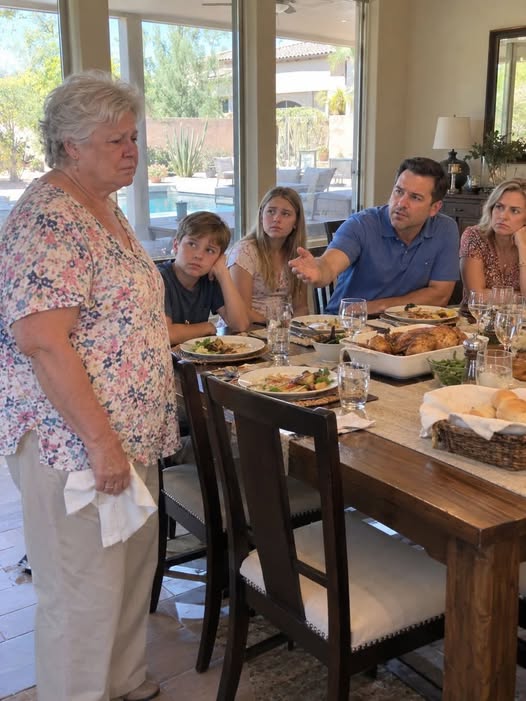
And when Daniel and Renee wanted to spend a weekend away, I stayed with the children.
Nobody sat me down and told me I had to do these things.
There was no family meeting.
No agreement.
No list of responsibilities.
I simply started doing them.
And once I started, everyone became accustomed to it.
That was how the change happened.
Quietly.
One ordinary day after another.
A favor became a habit.
A habit became an expectation.
Eventually, something I had once offered gladly was treated as something I owed.
I didn't recognize the difference quickly enough.
Looking back, I think part of me was afraid to recognize it.
Because if I admitted that my family was taking advantage of me, I would have to ask myself why I was allowing it.
And the answer wasn't pleasant.
I was lonely.
I missed my husband.
I wanted to belong somewhere.
I had already given up the house where I had belonged for thirty-eight years.
I couldn't bear the thought that I had moved into another home where my place wasn't secure.
So I kept helping.
I didn't complain.
I didn't ask anyone to count the hours.
I didn't remind Daniel how many times I had looked after his children.
I assumed he knew.
I assumed Renee knew.
People notice when someone makes their lives easier.
Don't they?
For a long time, that was what I told myself.
Then Renee began speaking to me differently.
At first, she would ask whether I had time to help.
Later, she would simply ask me to take care of something.
Eventually, she stopped making it sound like a request.
“This needs to be done, Margaret.”
I heard the difference.
Of course I did.
I wasn't confused.
I wasn't incapable of recognizing disrespect.
I just didn't want to make trouble.
That was the excuse I gave myself.
Keep the peace.
Don't make Daniel choose sides.
Don't upset the children.
Be grateful you have somewhere to live.
Those thoughts became familiar.
Too familiar.
I began measuring my days by what needed to be finished rather than what I wanted to do.
And the more I accomplished, the less anybody seemed to notice.
Dinner appeared.
Laundry was folded.
The children were collected.
Their lunches were ready.
Everything was handled.
That became my role in the house.
I wasn't asked how I wanted to spend my time very often.
I was expected to have time available.
There is a difference.
One means somebody values your company.
The other means they value your convenience.
I wish I could say I understood that immediately.
I didn't.
I kept thinking of Daniel as the boy I had raised.
I remembered how much Harold and I had loved being his parents.
I believed that love still worked the same way.
A mother gives.
A son understands.
Nobody needs to explain it.
But one afternoon, I learned just how little Daniel understood.
And I never heard his voice quite the same way afterward.
Click here to continue reading: PART 2: I Heard My Daughter-in-Law Complain About Supporting Me, and My Son’s Two-Word Answer Changed How I Saw Our Family
I Thought My Son Was Giving Me a Place to Heal, but I Slowly Became Someone His Family Took for Granted
Part 1 of 10