The house changed instantly.
Not emotionally.
Operationally.
Reed called federal protection.
Lena ordered officers to the property.
Frank moved toward me.
Stopped.
“Do you want me close?”
That question.
Even then.
“Yes.”
He came beside me.
No grabbing.
No dragging me toward a safer room.
Just presence.
The message remained on my phone.
IT WAS ABOUT MAKING HIM LIVE WITH THE SAME LOSS.
I read it again.
Jonathan did not want Frank dead.
He wanted Frank grieving.
The same punishment Thomas carried for Peter.
Except Thomas had not loved Peter cleanly either.
None of them loved cleanly.
Maybe no one does.
Lena instructed us not to leave.
Mom, Howard, Sarah, Diane, Ross, and Michael were moved to secure rooms under federal supervision.
Frank wanted them all out of the house.
Reed said moving everyone at once created more exposure.
Frank looked at me.
I said, “Listen to him.”
He did.
Another change.
The photograph of Frank sleeping had been taken from an adjacent building roof.
His apartment faced a commercial block.
Jonathan had been watching him.
For how long?
Unknown.
Joanna traced metadata from the image.
Sent through an encrypted relay.
No location.
No useful fingerprint.
Then Lena found Jonathan’s history.
He inherited the funeral home from his adoptive parents.
Peter Vale was his biological father.
Mother unknown publicly.
Thomas had secretly paid Jonathan’s tuition.
Then bought the funeral business building.
Jonathan knew Thomas.
Not as an uncle.
As a benefactor.
Thomas told him Peter died because Frank abandoned him.
That narrative shaped Jonathan’s life.
Forty years of transferred blame.
Mom shook her head.
“Thomas lied.”
Frank looked at her.
“What happened?”
Peter was not dying when Frank found him.
He was conscious.
He told Frank to go.
That stopped everyone.
“What?”
Mom said Peter could hear children screaming from the cabin.
Frank was seventeen.
Panicked.
He knelt beside Peter.
Peter pushed him away.
“Go get them.”
Frank stared.
“I don’t remember.”
“You hit your head later.”
Mom reminded him.
Part of the burning porch collapsed.
Frank suffered a concussion.
His memory of the night fragmented.
Peter had made the choice.
Not Frank.
Peter chose the children.
Frank obeyed.
Thomas later told Jonathan the opposite.
Because blaming Frank was easier than blaming himself for striking his brother.
The whole blood debt was built on a lie.
“We need Jonathan to hear that,” I said.
Reed shook his head.
“If we find him.”
“He’ll contact us.”
Frank looked at me.
“How do you know?”
“Because revenge without an audience is unsatisfying.”
Mom stared.
“When did you become frightening?”
“Recently.”
The phone rang.
Jonathan.
Of course.
I answered on speaker.
His voice sounded exactly as I remembered from the funeral home.
Professional.
Soft.
“Mrs. Mercer.”
“Jonathan.”
A pause.
“So you know.”
“Yes.”
“Does Frank?”
“I’m here,” Frank said.
Jonathan’s breathing changed.
“Good.”
Reed signaled everyone silent.
Frank asked, “Where are you?”
“Close enough.”
“Why Eileen?”
Jonathan laughed once.
“You know why.”
“No.”
“You left my father to die.”
“I was seventeen.”
“You left him.”
“I don’t remember enough to lie to you.”
That answer slowed Jonathan.
Frank continued.
“My memory is broken. Helen remembers.”
Jonathan said nothing.
Mom stepped toward the phone.
“Jonathan.”
His breath caught.
“You’re supposed to be dead.”
Mom almost laughed.
“Join the club.”
Even Reed smiled.
Then Mom’s voice changed.
“I was there.”
“So was Thomas.”
“Yes.”
“He told me what Frank did.”
“No. He told you what Thomas needed you to believe.”
Jonathan’s tone hardened.
“You expect me to trust you?”
“No.”
Good.
Mom had learned too.
“I expect you to listen.”
She described Peter.
The embankment.
The blood on his shirt.
Frank kneeling.
Peter pushing him toward the cabin.
Telling him to save the children.
Jonathan remained silent.
Mom continued.
“Your father died because Thomas hit him.”
“Stop.”
“Frank did not leave him helpless.”
“Stop.”
“Peter sent him away.”
Jonathan shouted.
“STOP.”
The line went quiet.
Then disconnected.
Frank exhaled.
“He doesn’t believe her.”
“Maybe he does,” I said.
“What makes you think that?”
“Because he hung up before she finished.”
Belief can be more threatening than disbelief.
Ten minutes passed.
Then a text.
PROVE IT.
Mom looked at me.
“Can we?”
Maybe.
Thomas’s final tape.
He had not mentioned Peter.
But the Origin File might.
Samuel’s records from Lake Crescent.
Howard began searching digitized pages with Joanna.
Nothing.
Eleanor’s archive?
Sarah called the hospital.
Eleanor was awake.
She remembered Peter.
More importantly, she remembered a photograph.
Taken after the fire.
Peter’s body before transport.
In his hand was something.
A strip of Frank’s jacket.
Frank frowned.
“My jacket?”
Peter had grabbed Frank before sending him away.
Maybe held on.
Maybe tore fabric.
Not proof.
Then Eleanor remembered a witness.
A ranger.
Name: Walter Kincaid.
Alive?
Possibly.
Reed searched.
Walter Kincaid, ninety-two.
Assisted living facility outside Tacoma.
Alive.
They called.
Walter’s hearing was poor.
Memory uneven.
But when Mom described the night, he remembered the injured man below the road.
Peter.
Walter found him before the ambulance.
Peter was conscious.
He said one thing repeatedly.
“The kid went back for the girls.”
Reed recorded the call with consent.
Jonathan needed proof.
We had a witness.
But first we needed Jonathan.
He texted again.
BRING FRANK TO THE FUNERAL HOME.
Lena said no.
Immediately.
Jonathan added:
EILEEN COMES TOO.
Frank said no.
Immediately.
I looked at him.
He stopped.
Then corrected.
“I don’t want you to.”
Better.
“What do you want to do?” I asked.
“Go alone.”
“No.”
“That’s what I want.”
Fair.
“What do I want?”
He waited.
“I want this ended with truth, not another person disappearing.”
Reed said controlled meeting might be possible.
The funeral home was a known location.
Surveillance.
Tactical access.
Negotiators.
Risk still real.
I agreed.
Frank hated it.
But he did not override me.
We went at dawn.
Appropriate.
Funeral homes look different before sunrise.
Less ceremonial.
More like businesses trying to imitate peace.
The front door was unlocked.
Frank entered first only because Reed’s team had already cleared the public rooms remotely as much as possible.
I followed wearing body armor beneath my coat.
Jonathan waited in the preparation room.
No corpse.
Thank God.
He stood beside a metal table.
Gun in hand.
Not pointed.
Yet.
Frank stopped ten feet away.
“I came.”
Jonathan looked at me.
“You brought her.”
“She chose to come.”
The sentence mattered.
Jonathan almost smiled.
“Still letting her make choices after what happened?”
Frank answered, “Especially after.”
Good.
Jonathan gestured toward two chairs.
We sat.
He remained standing.
“Tell me about my father.”
Frank said, “I can’t.”
Jonathan’s face hardened.
“I don’t remember him clearly.”
“Convenient.”
“Yes.”
Frank did not defend himself.
“But Helen remembers. Walter Kincaid remembers.”
Jonathan laughed.
“Ninety-two-year-old witness?”
“Better than Thomas.”
That landed.
Jonathan’s gun lifted slightly.
“Don’t.”
Frank stopped.
I spoke.
“Thomas left a tape.”
Jonathan looked at me.
“He addressed it to you.”
“Yes.”
“Did he mention Peter?”
“No.”
“Then it proves nothing.”
“It proves Thomas knew his own stories were lies.”
Jonathan’s eyes narrowed.
I told him Thomas admitted taking me as leverage.
Admitted using false deaths.
Admitted manipulating Diane’s death story.
Admitted Samuel’s role.
Admitted enjoying control.
“Why would Peter be the one story he told you honestly?”
Jonathan stared.
No answer.
Mom’s recorded testimony played from Reed’s device.
Peter telling Frank to go.
Jonathan listened without moving.
Then Walter Kincaid’s voice.
Old.
Cracked.
“The hurt man kept saying the boy went back for the girls.”
Jonathan’s gun lowered slightly.
Frank said, “I wish I remembered him.”
That surprised Jonathan.
Frank continued.
“I wish I could tell you his face.”
Silence.
“I remember smoke.”
Frank looked toward the floor.
“I remember somebody grabbing my jacket.”
Jonathan’s eyes changed.
“I remember a man saying go.”
There it was.
Fragment.
Real or prompted?
Frank did not claim certainty.
“Maybe it’s Peter. Maybe I’m building memory from what I’ve heard. I won’t lie to you and say I know.”
Jonathan’s mouth trembled.
Honesty where certainty would have been more persuasive.
That was what finally reached him.
Frank said, “But I know I did not choose your father’s death.”
Jonathan whispered, “You chose them.”
“The children?”
“Yes.”
Frank looked at me.
Then back.
“If Peter told me to, we chose them together.”
Jonathan’s face broke.
Forty years of vengeance depends on keeping blame simple.
Truth had complicated it beyond usefulness.
He sat.
The gun remained in his hand.
Reed’s team waited outside.
No one rushed.
Jonathan whispered, “Thomas paid for everything.”
“School?” I asked.
“Yes.”
“Funeral home?”
“Yes.”
“He told me it was Peter’s money.”
“Was it?”
“No.”
Crescent money.
Stolen.
Thomas turned guilt into patronage.
Jonathan spent his life believing he was being repaid for his father.
Instead he was being kept loyal.
“When did Thomas transfer the debt to you?” Frank asked.
Jonathan wiped his face.
“When I was twenty.”
He showed him the ledger note.
LIFE FOR LIFE.
Jonathan initially refused.
He did not want to kill anyone.
Thomas clarified.
Not Frank.
The person Frank loved most.
At the time, Frank had no wife.
No serious relationship.
So Thomas told Jonathan to wait.
Then Frank married me.
The debt acquired a face.
Jonathan watched from a distance.
Never acted.
“Why?”
He looked at me.
“Because you didn’t do anything.”
That simple.
For years, an intended victim survived because the avenger could not make inherited hate fit the actual person.
Thomas kept pressuring him.
Then Thomas grew sick.
Three days before death, he called Jonathan.
Told him the time had come.
Frank’s fake-death plan had created access.
Jonathan could substitute the body.
Control the funeral.
Reach me.
He agreed.
Not to kill me.
To decide.
That was why his hands trembled during the exhumation.
He had entered the plan intending possible revenge.
By then he had chosen against it.
“What did you do instead?” I asked.
Jonathan looked toward the preparation cabinets.
“I protected the cuff link.”
Thomas’s personal ledger.
Jonathan knew it existed.
Thomas told him.
Jonathan made sure the jacket remained with the body.
He ensured no one removed the cuff links during preparation.
He wanted the truth found eventually.
“You could have handed it to police.”
“I didn’t trust police.”
Another inherited fear.
Reed heard that from outside.
Probably sighed.
Jonathan said the message to my phone was not a promise.
It was a test.
He wanted to know whether Frank would still try to control me.
He photographed Frank’s apartment.
Sent the threat.
Watched what happened.
“That’s still stalking and threatening,” I said.
“Yes.”
“Illegal.”
“Yes.”
“Cruel.”
“Yes.”
No excuses.
Frank asked, “What were you going to do if I tried to hide her?”
Jonathan looked at him.
“I don’t know.”
That honesty frightened me.
Then he placed the gun on the table.
Pushed it away.
“I’m done.”
Reed entered.
Officers followed.
Jonathan raised his hands.
Before they cuffed him, Frank asked one question.
“What was Peter like?”
Jonathan looked at him.
He smiled faintly through tears.
“He hated bullies.”
Frank laughed once.
“That seems useful.”
“He played guitar badly.”
“Less useful.”
“He wanted to be a park ranger.”
Frank nodded.
A person emerged where a debt had been.
Jonathan was taken into custody.
No dramatic escape.
No shot.
No body.
Just a man walking out through the front door of his own funeral home in handcuffs.
I stood beside Frank.
He looked exhausted.
“Are you okay?”
“No.”
“Me neither.”
We walked outside.
Sunrise had begun.
The sky over the parking lot turned pale.
Frank stopped beside my car.
“I want to tell you something before I decide whether it matters.”
I looked at him.
Good phrasing.
“What?”
“When Jonathan threatened you, every part of me wanted to put you in a car and send you somewhere.”
“I assumed.”
“I almost called Lena behind your back.”
“But?”
“I didn’t.”
“Why?”
“Because you would have hated me for being right in the old way.”
That was exactly it.
Control can produce good outcomes and still damage the person controlled.
I touched his face.
“You chose differently.”
“Yes.”
“That matters.”
He closed his eyes against my hand.
Not forgiveness complete.
Not trust restored.
Evidence.
One choice.
Then another.
That was how anything changed.
My phone rang.
I groaned.
Frank laughed.
“Answer it.”
Lena.
Jonathan had given officers a key during booking.
A storage locker.
Not Thomas’s.
His own.
Inside was evidence he had collected for twenty years.
Photographs.
Letters.
Recordings.
One envelope carried my name and Frank’s.
We opened it later that morning.
Inside was no new conspiracy.
No new living dead relative.
A letter from Peter Vale.
Written hours before the Lake Crescent fire.
Addressed to Thomas.
Peter had planned to confront his brother.
He knew Thomas was hurting Margaret.
Knew Diane was in danger.
Knew Helen had the ledgers.
He intended to stop Thomas from reaching the cabin.
At the end, Peter wrote:
If anything happens tonight, it is because I finally stopped pretending family loyalty means protecting the worst thing someone does.
Frank read the line.
Then handed it to me.
Peter had died trying to break the same pattern.
Not perfectly.
Not successfully.
But deliberately.
The debt Thomas transferred had never belonged to Jonathan.
The guilt had belonged to Thomas.
The choice belonged to Peter.
The rescue belonged partly to Frank.
The survival belonged to all of us who came after.
I folded the letter.
Then asked Lena to copy it for Jonathan.
Not because he was innocent.
He had threatened me.
Stalked Frank.
Helped falsify a corpse.
He would face consequences.
But he deserved to know his father’s last intention.
Truth was not a reward.
That was the lesson everyone had missed.
You did not earn truth by behaving well.
You deserved it because it was yours.
That afternoon, Frank drove me home.
I invited him inside.
He hesitated.
“Are you sure?”
“Yes.”
He entered.
His old recliner waited.
He looked at it.
Then at me.
“Can I sit there?”
I laughed.
“Yes, Frank.”
He sat.
The depression in the cushion still fit him.
For a long time, neither of us spoke.
Then I sat on the sofa.
The walnut clock ticked.
The photograph of us after the fire rested on the mantel.
No hidden compartment opened.
No phone rang.
Nothing happened.
It was glorious.
Frank looked at me.
“Eileen?”
“Yes?”
“I want to come home someday.”
“I know.”
He caught himself.
We both smiled.
Then he tried again.
“I understand that you know.”
Better.
I looked around the living room.
My house.
Our history.
Not yet our shared home again.
“Keep choosing truth before fear.”
He nodded.
“That’s the plan.”
I raised an eyebrow.
“No secret plans.”
He laughed.
“Right.”
Then, for the first time since I buried the wrong man, I sat beside my husband in his chair’s shadow without wondering whether he would vanish before morning.
Click here to continue reading: PART 33: One Month After the Funeral That Wasn’t Frank’s, Restitution Began and the House Finally Faced What Survival Had Cost Everyone
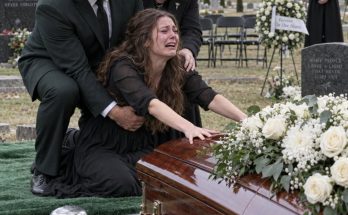
Before the Funeral Flowers Had Wilted, Frank’s Children Began Dividing My Home as Though I Had Already Disappeared
Part 32 of 35