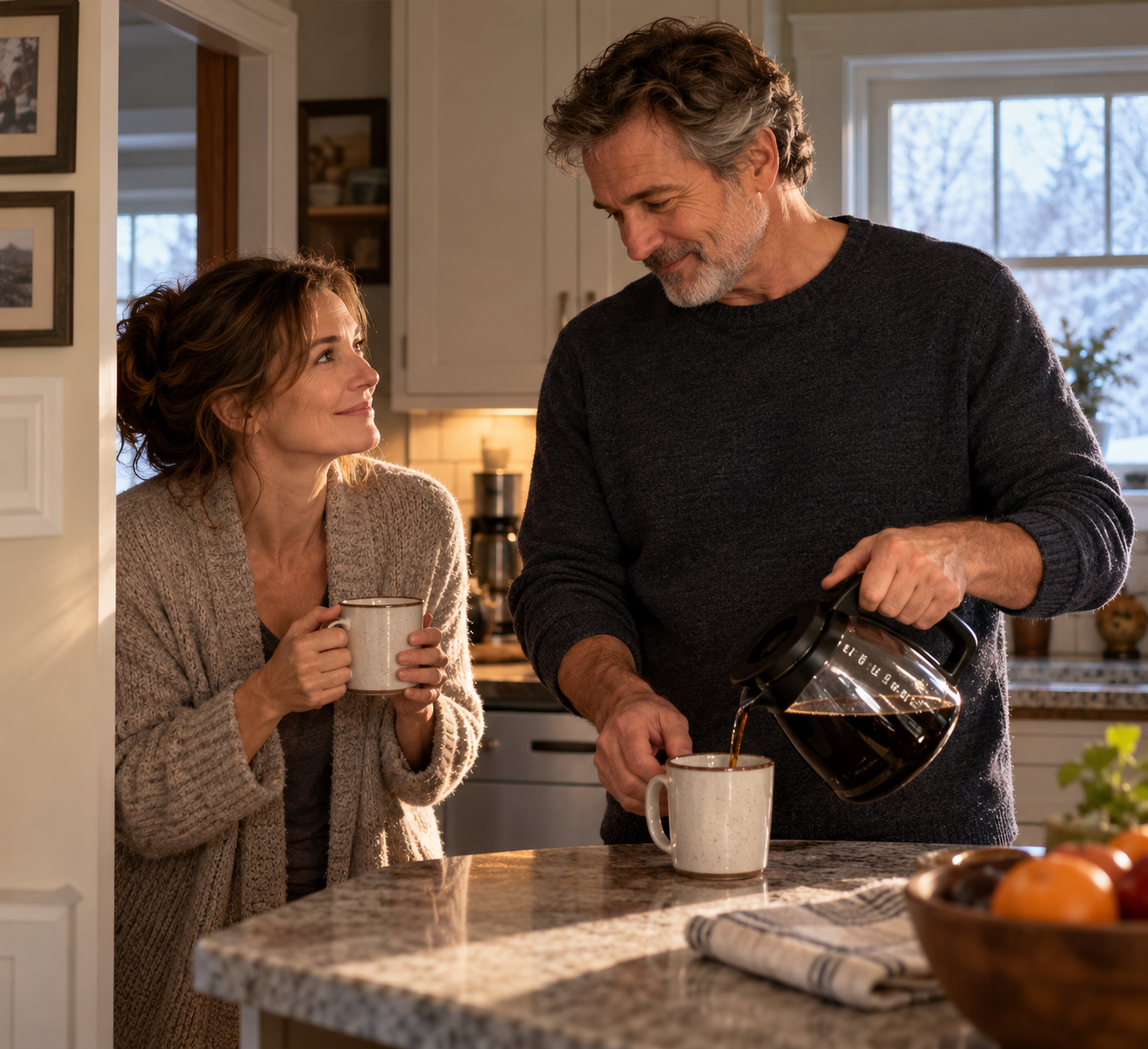
One month after Jonathan Vale surrendered, I woke to the sound of Frank making coffee in my kitchen.
That sentence would have been impossible a month earlier for several reasons.
First, I had believed Frank was dead.
Then I learned he was alive and wanted him out of my house.
Then I discovered half our family had practiced disappearance as a conflict-resolution strategy.
By the time October turned cold enough for frost on the grass, ordinary domestic noise had become more startling than gunfire.
Frank was not living with me again.
Not officially.
His apartment still existed.
His toothbrush was still there.
Most of his shirts were still there.
But he had stayed overnight after our counseling appointment because the roads iced, and neither of us pretended the weather was the only reason.
I stood in the kitchen doorway.
He looked up.
“Coffee?”
“Yes.”
He held the pot over my cup.
Then paused.
“Same amount?”
“Frank.”
“What?”
“We were married twenty years.”
“That does not make coffee preference legally immutable.”
I laughed.
He poured.
That was how our life had started rebuilding.
Not through declarations.
Through stupid questions answered honestly.
He still asked before making decisions that involved me.
At first, it felt almost mechanical.
Do you want me to call the insurance company?
Would you rather drive separately?
Can I tell Diane what the lawyer said?
Do you want company?
Sometimes I became irritated.
Then I remembered how often I had wished he would ask.
Habits look awkward while they are learning to become character.
The federal investigation had moved into what Lena called the boring stage.
The boring stage involved seven agencies, thirty-two subpoenas, fourteen reopened probate cases, hundreds of property claims, six grand juries, and so much paper that Joanna joked S.M. Legacy might finally be defeated by office supplies.
I told Diane that.
She stared at the pink sticky-note pad on my desk.
“Too soon.”
“Probably.”
We both laughed anyway.
The first Helen House restitution notices went out on October twenty-first.
Not payments.
Acknowledgments.
Letters telling families their claims had been located in the recovered records and would be reviewed.
Some people receiving those envelopes had spent thirty years being told nothing improper happened.
Some had died.
Their children opened the mail instead.
Lena showed me several responses after obtaining permission.
One woman wrote that her parents lost their orchard after a false lien in 1986.
Her father died insisting somebody had stolen it.
Everyone thought grief had made him paranoid.
Now, forty years later, a government letter said he had been right.
I sat at my kitchen table crying for a man I never met.
Frank sat across from me.
Neither of us tried to make the sadness inspiring.
Justice arriving late was still late.
Mom became involved with the restitution archive.
Not as director.
She refused every title offered.
Twice a week she helped identify handwriting, aliases, companies, and places in documents only she, Helena, Eleanor, or Howard understood.
She called it paying rent to history.
Howard volunteered too.
Lena kept them on separate schedules at first.
Not because they were dangerous.
Because whenever they worked together, they argued about what happened in 1983.
Nobody else understood the argument.
Apparently surviving criminal conspiracies did not eliminate ordinary marital irritation.
Sarah saw Dad more often than I did.
That was fine.
Their relationship had different damage.
Different repairs.
He and I still spoke every morning.
Nine o’clock.
Twenty minutes became thirty.
Sometimes we discussed old secrets.
Sometimes weather.
Once we spent fifteen minutes arguing over whether my hydrangeas needed pruning.
It was the best conversation we had all week.
Diane started visiting on Sundays.
Without claiming furniture.
Ross occasionally came too.
He had begun working with a financial counselor after discovering how much of his adult life had been built around believing inheritance would rescue him from his own choices.
“I have retirement savings,” he announced one afternoon.
I looked impressed.
“How much?”
“That feels invasive.”
“You announced it.”
“Fair.”
Diane returned Frank’s old side table permanently.
Not that she had ever physically taken it.
She placed a new lamp on it instead.
“I bought this.”
“For me?”
“For the table.”
I stared at her.
She smiled.
“The relationship remains complicated.”
That sounded healthier than pretending nothing happened.
Pastor Dave pleaded guilty to obstruction and falsification charges.
He resigned from ministry before the church could remove him.
The congregation fractured over whether he was a criminal, a whistleblower, a protector, or all three.
I visited him once in the county detention center.
Not because I had forgiven him.
Because I wanted to ask one question.
“Did you believe you were doing good?”
Dave sat behind scratched plexiglass.
“Yes.”
“Even when you helped Frank fake his death?”
His face tightened.
“Especially then.”
That answer mattered.
He had thought the operation would expose S.M. Legacy.
Thought controlled grief was justified by a greater outcome.
Thought the lie had a moral destination.
“So what do you believe now?”
He looked older without the collar.
“That outcomes do not retroactively purify methods.”
Good.
I left after that.
Claire agreed to testify against Gregory.
Joanna visited her twice more.
Their relationship remained damaged.
Maybe permanently.
When I asked Joanna whether she hoped to forgive her sister, she said, “I hope someday her name doesn’t change my breathing.”
That seemed more realistic.
Gregory refused a plea agreement.
He insisted the restitution structure was theft.
His lawyers argued he had inherited legitimate interests.
Lena said people who build fortunes from coerced deeds often become passionate about property rights when restitution begins.
Jonathan pleaded guilty to evidence tampering, stalking, and making threats.
Prosecutors agreed to consider his cooperation regarding Thomas’s records.
Before sentencing, he received the copy of Peter’s letter.
He wrote Frank back.
One line.
I spent forty years inheriting a debt my father never gave me.
Frank kept the letter.
Not hidden.
It sat inside an open folder on his apartment desk.
Rebecca Dane also entered plea negotiations.
Michael attended court but stopped paying her legal bills.
She asked why.
He told her, “Supporting you and rescuing you are not the same thing.”
I wrote that down too.
Our family was accumulating better sentences.
Eleanor recovered from the shooting.
Slowly.
The bullet had damaged muscle but missed bone.
She returned to Oregon after discharge.
Mom asked whether I wanted a relationship with her.
“I don’t know.”
Then I corrected myself.
“I want the option.”
That felt important.
Eleanor had lied.
Destroyed letters.
Helped hide my mother.
Also helped save Diane.
Helped build Helen House.
Helped expose Samuel.
No person fit comfortably inside one verdict.
Neither did I.
Frank attended his oncology appointments.
The cancer remained absent.
He called it remission cautiously.
I called it good news.
He continued counseling.
So did I.
Sometimes separately.
Sometimes together.
One Thursday, Dr. Chen asked whether I trusted him.
I answered too quickly.
“More.”
She waited.
I tried again.
“I trust what he tells me more than I trust what he decides alone.”
Frank nodded.
That hurt him.
He did not argue.
Dr. Chen asked what rebuilding trust would look like behaviorally.
Not emotionally.
I said, “He tells me the uncomfortable thing before he knows what I will do with it.”
Frank said, “I let her be angry without trying to manage the outcome.”
Then Dr. Chen looked at me.
“And you?”
I frowned.
“I’m the injured party.”
“That wasn’t my question.”
Annoying woman.
I thought.
“I tell him when I want him closer instead of testing whether he guesses.”
Frank looked at me.
That one landed.
I had begun using distance as a test.
If he respected it, I wondered whether he cared.
If he approached, I wondered whether he respected it.
Impossible.
I had inherited my own version of control.
Quieter.
Still control.
After counseling, we sat in Frank’s truck.
Rain tapped the windshield.
“I want you to come home tonight,” I said.
His hands tightened on the steering wheel.
“Okay.”
“Do not make that face.”
“What face?”
“The one where you turn a sentence into a constitutional amendment.”
He laughed.
“Sorry.”
“I said tonight.”
“Yes.”
“Not forever.”
“Understood.”
He slept beside me.
No drama.
No symbolic music.
At three in the morning I woke and watched him breathe.
That used to be ordinary.
Then impossible.
Now temporary and real.
I put my hand against his back.
Warm.
Alive.
He stirred.
“Everything okay?”
“Yes.”
Then I realized I wanted to say something harder.
“I’m still angry.”
He was quiet.
“I know.”
I pinched him lightly.
“Right. Sorry.”
He corrected.
“I understand.”
“Better.”
“I’m still angry and I still want you here.”
He turned toward me.
“Both can be true.”
“Yes.”
That was becoming the deepest lesson of all.
Love and anger.
Responsibility and compassion.
Harm and change.
Family and distance.
Truth did not always simplify.
Sometimes it taught you to hold contradictions without hiding one.
By November, Helen House had approved the first restitution settlement.
The orchard family.
Not full restoration.
The original land had been subdivided.
But the fund compensated the surviving children and transferred an adjacent parcel recovered from a Crescent shell.
Lena invited me to the signing.
I almost refused.
Then Mom said, “Go.”
“Why?”
“You spent your whole life being used as a symbol without consent. Go see what you consented to.”
So I went.
The daughter of the orchard owner was seventy-one.
Her name was Ruth.
She held the settlement papers with shaking hands.
“My father said they stole it.”
“I know.”
“They called him difficult.”
“I’m sorry.”
She looked at me.
“You didn’t do it.”
“No.”
“But your family helped fix it.”
That sentence made me uncomfortable.
“Many people did.”
She nodded.
“Then let me thank one.”
I let her.
Not because gratitude belonged to me.
Because refusing might turn discomfort into another form of control.
Afterward, I drove to Frank’s apartment.
He opened the door wearing an old sweater.
“What happened?”
“Nothing.”
“You’re crying.”
“Good crying.”
He looked suspicious.
“I have limited experience.”
“Same.”
I told him about Ruth.
He sat beside me.
Then said, “Samuel would hate this.”
I laughed.
“Probably.”
“Thomas too.”
“Definitely.”
Frank became quiet.
“Do you think any of them could have changed if they had lived longer?”
I thought of Samuel’s final note.
Thomas’s confession.
Peter’s letter.
Mom’s return.
Howard’s apology.
Helena surrendering.
“I think people can change.”
“That sounds hopeful.”
“It isn’t.”
He waited.
“Change does not mean escaping consequences.”
Frank nodded.
“That part I’m learning.”
“Good.”
He reached for my hand.
I let him.
Two weeks later, Helena was sentenced under a cooperation agreement.
Not lightly.
Not brutally.
Real prison time.
Reduced because her records dismantled major portions of the network.
Frank attended.
I went with him.
Before sentencing, Helena spoke.
She did not ask the judge for mercy.
She apologized for falsifying deaths, identities, and records.
She admitted she repeatedly convinced herself that fighting worse people made her methods acceptable.
Then she looked at Frank.
“I taught my son secrecy while telling myself I was teaching survival.”
Frank cried silently.
The judge sentenced her to six years.
At her age, six years could be most of what remained.
No one pretended otherwise.
Afterward, Helena asked to speak to me.
We sat in a courthouse interview room.
She looked smaller in custody clothing.
“I owe you an apology.”
“You owe many.”
“Yes.”
“Make this one specific.”
She almost smiled.
“I let Frank become like me.”
“That was his choice.”
“Yes.”
Good answer.
“But I made the choice familiar.”
Also true.
She said she had watched him respond to fear the way she did.
Gather information.
Limit disclosure.
Act alone.
Call control protection.
She had admired it once.
Then saw what it did to me.
“I’m sorry.”
I accepted the apology.
Not absolution.
Just the apology.
She asked whether Frank was home.
“Sometimes.”
Her eyebrows rose.
“That sounds promising.”
“It sounds accurate.”
She nodded.
Then said, “Accuracy is underrated.”
Before leaving, she gave me one final piece of advice.
I almost refused.
Then listened.
“Do not make him pay forever if you choose to stay.”
That angered me.
She saw.
“I don’t mean forgive cheaply.”
“Then what?”
“If every future mistake becomes evidence of the old crime, he can never become anyone else.”
I did not answer.
But I carried the sentence home.
That night Frank forgot to tell me Ross had asked him for money.
He remembered after dinner.
Old pattern.
Small version.
My stomach tightened immediately.
“How much?”
“Five thousand.”
“Why?”
“Dental work.”
“Did you give it?”
“No.”
“Why didn’t you tell me?”
“I forgot.”
I stared.
He looked terrified.
Not because I might leave.
Because he recognized the pattern.
“I should have told you.”
“Yes.”
“I wasn’t hiding it.”
“How do I know?”
He swallowed.
“You don’t.”
That answer prevented the argument from becoming something worse.
He did not demand trust.
He gave me reality.
Then he showed me the text thread.
Not performatively.
Because I asked.
Ross had requested money.
Frank said he would think.
Nothing more.
A normal omission.
Not a conspiracy.
My body took longer to believe that than my mind.
I went upstairs.
Frank did not follow.
Thirty minutes later, I came back.
“I believe you forgot.”
He exhaled.
“Okay.”
“But I hate that forgetting feels dangerous.”
“So do I.”
“That is part of what your lie cost.”
“I understand.”
Then Helena’s sentence returned.
Do not make him pay forever if you choose to stay.
I sat beside him.
“This time, I believe the smaller explanation.”
He nodded.
“Thank you.”
Trust rebuilt not by never triggering fear.
By surviving the trigger honestly.
December came.
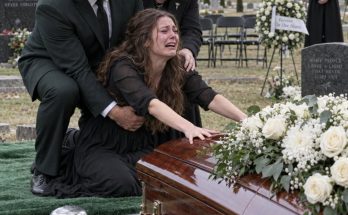
The funeral flowers had long since died.
I finally threw away the last arrangement.
White lilies turned brown at the edges.
Frank watched me carry them outside.
“Ready?”
“Yes.”
I put them in the compost.
Not the trash.
Something dead becoming something else.
Too symbolic.
I laughed at myself.
“What?” Frank asked.
“Nothing.”
Then the mail arrived.
One envelope.
No government seal.
No lawyer.
Handwritten.
For Eileen Mercer.
Return address:
Jonathan Vale Correctional Facility.
Inside was a photograph.
The funeral home preparation room.
Empty.
On the back Jonathan wrote:
I closed the business. The building is being sold. Before I left, I found this behind the old cabinet.
Another photograph was enclosed.
Thomas.
Peter.
Howard.
All young.
Standing beside Henry Vale.
Four men.
Brothers and father.
On the back, Peter had written:
Family is not who you protect from consequences. Family is who you tell the truth to before consequences arrive.
I handed it to Frank.
He read.
Then looked at me.
“That should go on the mantel.”
“Too crowded.”
“Hallway?”
“Maybe.”
We framed it anyway.
Not to honor Thomas.
To remember Peter.
The person whose death had become a weapon for forty years.
Now his actual words could replace the lie built around him.
That evening, Frank stood in the kitchen with his coat on.
He still returned to his apartment most nights.
I looked at him.
“Stay.”
He searched my face.
“Tonight?”
I took a breath.
“No.”
His expression changed.
“Come home.”
He did not move.
“Are you sure?”
“Yes.”
“Eileen—”
“I’m not saying everything is fixed.”
“I know.”
I raised an eyebrow.
He almost laughed.
“I understand.”
“Better.”
He stepped toward me.
I continued.
“You keep the apartment for a month.”
“Okay.”
“If this feels wrong, we say it.”
“Yes.”
“If either of us starts hiding to preserve the relationship, we stop.”
“Yes.”
“And no fake deaths.”
“I feel unfairly targeted by that rule.”
I laughed.
Then he kissed me.
Not like someone reclaiming his wife.
Like someone being invited.
That difference was everything.
Click here to continue reading: PART 34: When Frank Finally Came Home, One Last Court Decision Forced Diane and Ross to Decide What Their Father’s Love Was Worth Without Money
Before the Funeral Flowers Had Wilted, Frank’s Children Began Dividing My Home as Though I Had Already Disappeared
Part 33 of 35